

7 best GTM intelligence platforms for 2026 (based on user reviews)

Every GTM intelligence platform seems to be making the same promises – account scoring, buying signals, revenue alignment, and AI-powered insights sharp enough to replace half your team.
Swap out the logos, and you’d struggle to tell the feature pages apart. And if you scroll through GTM subreddits, you’ll see the sentiment building.
Reddit users are upvoting posts like this one for a reason:
Unpopular opinion: Most AI powered GTM platforms are just ChatGPT wrappers with worse delierablity
That growing skepticism is exactly why we wrote this guide. We analyzed hundreds of G2 reviews across seven GTM intelligence platforms to find out what holds up in practice and what doesn’t.
Whether you’re evaluating your first GTM intelligence platform or looking to replace one that isn’t pulling its weight, this guide will help. You’ll be able to compare your options based on the experiences of people who’ve already made the investment.
Key features and functionalities to look for in a GTM intelligence platform
Before we break down the seven platforms, here’s what to pay attention to when you’re comparing them:
- Account scoring and prioritization: Nobody has time to manually sort through thousands of accounts. The platform should score accounts based on fit, intent, and engagement so sales know exactly where to start.
- Account identification and de-anonymization: Your GTM intelligence platform should match anonymous website traffic to companies in real-time. The more specific it gets (down to location, business unit, or even department), the more useful it is for sales.
- Buying group mapping: B2B deals don’t close through one contact. A GTM intelligence platform should show you the full committee (from decision-makers to influencers and blockers), so you can build a multi-threaded deal from the start.
- Account-based advertising: You should be able to run account-targeted ads directly from the platform. If the only option is to export a list and upload it somewhere else, that’s a red flag. Native DSP or deep ad integrations make a big difference here.
- CRM and marketing automation integrations: Check how many native integrations the platform supports out of the box versus how much you’ll need to build through APIs or middleware.
- Intent data: The best platforms combine first-party engagement data with third-party signals like keyword research activity, content consumption on review sites, and competitor page visits.
- Multi-channel orchestration: The platform should let you coordinate ads, email, sales sequences, and web personalization from one place. More importantly, it should adjust what each channel does based on where an account currently is in the buying journey.
- Journey analytics & attribution: You need to see how accounts move through the funnel and which touchpoints push them forward. Bonus if it lets you compare attribution models (first-touch, multi-touch, linear) so you’re not locked into one view of what’s working.
Top GTM intelligence platform on the market right now
With those criteria in mind, let’s get into the platforms. You’ll find a detailed breakdown for each one, including features, pros, cons, and pricing based on user reports from G2.
| Platform | Best For | Key Differentiator | Pricing |
|---|---|---|---|
| Demandbase | Enterprise ABM and complex deal cycles | Full-stack GTM with native DSP, proprietary intent data, and buying group AI | Custom |
| HockeyStack | Marketing teams that need attribution and revenue analytics | Warehouse-native architecture with embedded AI analysts (Odin & Nova) | Custom |
| 6sense | Predictive pipeline and dark funnel visibility | Proprietary intent network (Signalverse) with buying stage prediction | Custom |
| HubSpot Breeze | Teams that are already running on HubSpot | Native enrichment and intent signals without third-party sync | Credit-based (free tier available) |
| ZoomInfo | High-volume outbound prospecting | Largest B2B contact database (260M+ profiles) with verified direct dials | Custom |
| Apollo.io | Budget-conscious outbound teams | Enterprise-level prospecting and sequencing at SMB pricing | Free / $49–$119/user/mo |
| RollWorks | Account-based advertising on a mid-market budget | Advertising-first platform with native DSP and stage-based automation | Custom |
1. Demandbase
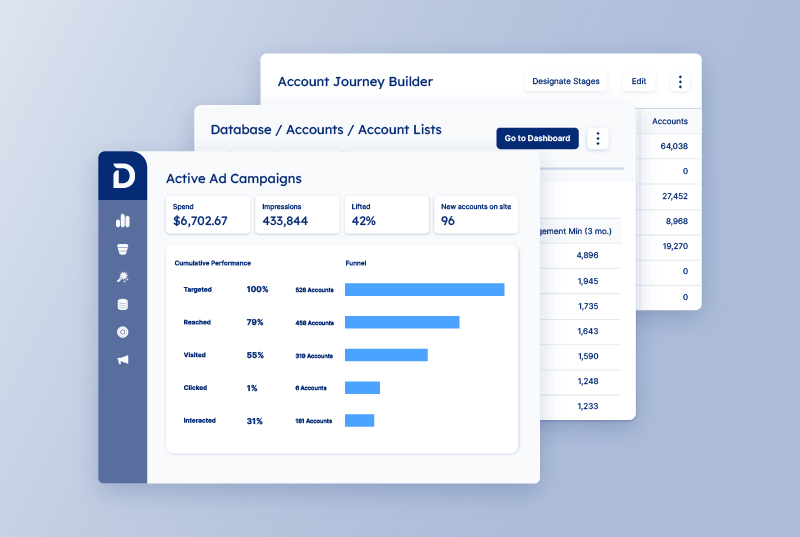
Demandbase is an AI-powered GTM intelligence platform that unifies account intelligence, B2B advertising, sales insights, and multi-channel orchestration into a single system that aligns marketing and sales teams around shared data and accounts.
Where most GTM platforms specialize in one or two areas and rely on integrations for the rest, Demandbase owns the full stack.
This includes a B2B-native DSP, unique semantic intent data, and buying group mapping. It also features a set of AI agents that automate intent analysis and campaign optimization.
Key features
- Account intelligence and ICP scoring: Demandbase combines firmographic, technographic, and intent data. This helps build granular account profiles and scores how well each one matches your ICP.
- B2B-native advertising (DSP): Demandbase is one of the only GTM platforms with a fully built-in demand-side platform built specifically for B2B. You can run display, video, native, retargeting, and connected TV campaigns from inside the platform.
- Proprietary intent data: While most platforms rely solely on Bombora or other third-party providers, Demandbase runs its own semantic intent engine that processes trillions of behavioral signals across the web.
- Agentbase (AI agents): The platform’s AI agent suite (Agentbase) includes specialized agents for intent analysis, account engagement research, campaign optimization, filtering, and more. These agents share the same data foundation, so their outputs are consistent across sales and marketing.
- Multi-channel orchestration and journey analytics: Demandbase lets you build automated workflows that coordinate ads, email, CRM data actions, and sales plays based on where each account currently is in the buying journey.
Advantages of using Demandbase
Demandbase targets enterprise ABM and complex deal cycles where account identification, intent, ads, and sales intelligence all need to work together.
G2 users praise the unified account view, with one describing how it pulls account data, Salesforce contacts, engagement levels, and interaction types into a single dashboard. This makes ABM decisions faster and more informed. [Read Full G2 Review]
That cross-team impact shows up in the numbers, too. Ingram Micro reported an 83% increase in pipeline velocity after implementing the platform. [Read Case Study]
It also gives you the most complete view of the buying committee of any platform on this list. Demandbase was the first to build buying groups as a core data object where you can define ideal groups by persona and role, track channel engagement, and target them directly in advertising.
As one G2 user puts it, Demandbase provides them with a clear view of both the account and the individuals behind the buying decision. Without that visibility, marketing dollars go to waste. [Read Full G2 Review]
2. HockeyStack
HockeyStack is a B2B GTM intelligence platform that brings marketing, sales, and product data together for multi-touch attribution, account scoring, and revenue analytics.
The core promise is complete buyer journey visibility, with every touchpoint mapped from first anonymous visit to closed deal.
HockeyStack’s major selling points are its warehouse-native architecture and two embedded AI agents (Odin for analytics, Nova for sales). They let teams query their go-to-market data and act on it without switching between tools.
Key features
- Multi-touch attribution: HockeyStack connects every touchpoint across ads, content, sales calls, and emails to pipeline and revenue. You can switch between attribution models (first-touch, linear, multi-touch) and break down performance by campaign or segment without building custom reports.
- AI agents (Odin & Nova): Odin is an embedded AI analyst that answers GTM questions in plain language and builds reports from text prompts. Nova is on the sales side, and it preps reps for meetings and recommends next steps based on patterns from closed-won data.
- Cookieless website tracking: The tool tracks visitor activity without relying on cookies, which sidesteps a lot of the privacy issues that other platforms run into. It also supports cross-domain and subdomain tracking out of the box.
Pros
- Easy to set up without engineering support: You can get HockeyStack running and start building reports without pulling in your data team. Users mention that after initial onboarding, they were able to configure dashboards and reports independently. [Read Full G2 Review]
- Native Salesforce embed: HockeyStack embeds directly into Salesforce via an iFrame on the account object, so reps see attribution insights without leaving their CRM. That removes a major adoption barrier. [Read Full G2 Review]
- Odin fills the analyst gap: Multiple users describe Odin as the analyst they don’t have the budget to hire. For smaller GTM teams especially, it frees up time to focus on market strategies instead of pulling reports. [Read Full G2 Review]
Cons
- Account intelligence is a separate purchase: HockeyStack doesn’t bundle account intelligence with the core platform. This can push the total price out of reach for smaller teams that need both attribution and account-level insights. [Read Full G2 Review]
- Needs ongoing maintenance from a technical owner: HockeyStack isn’t a set-it-and-forget-it tool. You’ll need someone who understands how your org defines goals like meetings booked, pipeline stages, and ACV to keep reporting aligned with your CRM. [Read Full G2 Review]
- Platform reliability is a sore spot: Some users report frequent login problems, crashing reports, and general platform instability. [Read Full G2 Review]
Pricing
HockeyStack doesn’t publish pricing on its website, so you’ll need to request a demo for a custom quote.
Based on publicly available data, plans start around $2,200/month, with the median annual contract sitting around $28,000. Discounts of 20-50% are common on multi-year deals, and startup pricing is available.
3. 6sense
6sense is an AI-powered revenue intelligence platform built around predictive intent data, account scoring, and multi-channel orchestration for sales and marketing teams.
The differentiator is its proprietary dataset network (Signalverse) and predictive models (6AI), which process billions of intent signals to forecast when accounts are most likely to convert.
Key features
- Predictive intent data and buyer journey tracking: 6sense pulls intent signals from across the web and maps each account to a buying stage (awareness, consideration, decision, purchase).
- AI-powered account scoring: The platform scores accounts using a mix of fit, intent, and engagement signals through its predictive models. The scoring is customizable and now includes more transparency into what’s driving each score.
- Sales intelligence and Chrome extension: Sellers get instant access to contact metrics, technographics, psychographics, and intent signals through its Sales Intelligence product and browser extension.
Pros
- Simple interface despite deep functionality: The platform keeps its UI clean and intuitive even though there’s a lot under the hood. Finding what you need doesn’t take five clicks and a tutorial. [Read Full G2 Review]
- Contact-level scoring inside Salesforce: 6sense pushes intent scores directly to individual contacts in Salesforce, which makes it easy for reps to prioritize outbound without leaving their CRM or interpreting dashboards. [Read Full G2 Review]
- Hands-on customer success team: Multiple users point to their CSM as a major part of the 6sense experience. Support is responsive on the ticket side too, and the team is good at helping them get more out of the platform over time. [Read Full G2 Review]
Cons
- Hard to see what’s behind the score: The intent scoring works well in practice, but the platform doesn’t make it easy to understand which signals are pushing a score up or down. That can make it tough to act with confidence or explain priorities to leadership. [Read Full G2 Review]
- Reporting feels limited compared to CRM tools: Users say that building custom reports and drilling into specific B2B data points isn’t as flexible as what they’re used to in Salesforce. [Read Full G2 Review]
- Engagement data lacks person-level clarity: While 6sense shows account-level activity well, it’s harder to pinpoint which individual or team is behind the engagement. [Read Full G2 Review]
Pricing
6sense offers a free tier, but with only 50 credits/month, it’s more of a sandbox than a working plan. It also doesn’t list paid plan pricing publicly. a
From what’s publicly available, mid-market deals typically fall in the $60,000–$100,000/year range, with enterprise contracts going higher.
Credits don’t carry over month to month, and most deals involve multi-year terms. You should ask about implementation fees upfront – they’re not always included.
Learn more → 15 Best 6sense Competitors & Alternatives Right Now
4. HubSpot Breeze Intelligence
Breeze Intelligence is HubSpot’s AI-powered intelligence module that brings data enrichment, buyer intent tracking, and AI agents for prospecting and research directly to the HubSpot CRM.
It stands apart from dedicated platforms like 6sense or Demandbase by trading depth for accessibility. It’s not as feature-rich on the ABM side, but it’s far easier to adopt if your team already runs on HubSpot.
Key features
- Data enrichment: Breeze Intelligence enriches contact and company records using a database of over 200 million company profiles. It fills in gaps like industry, revenue, employee count, and job titles.
- Buyer intent tracking: The platform uses reverse-IP lookup and HubSpot’s tracking code to find which companies are visiting your website and what pages they’re viewing. You define the intent criteria, and HubSpot flags accounts that match. However, it’s limited to first-party website data.
- Prospecting agent: The AI-powered prospecting agent researches target accounts, personalizes outreach, and engages prospects directly inside HubSpot. It pulls from past CRM interactions, company websites, news, and blog posts to build context.
Pros
- AI content agent shortens production time: Many users say that they use Breeze to turn one piece of content into multiple lead generation formats (social media posts, emails, ads, etc.) without losing their brand voice. [Read Full G2 Review]
- Centralized workspaces for each team: HubSpot’s AI-powered workspaces give sales, support, and customer success teams their own dashboards with relevant data and workflows in one view. [Read Full G2 Review]
- Easy to navigate, even for newcomers: G2 Users consistently praise HubSpot’s interface as one of the most intuitive in the category. The learning curve is noticeably shorter compared to some other popular alternatives. [Read Full G2 Review]
Cons
- Cost is a barrier for smaller teams: HubSpot gets expensive quickly, especially once you factor in premium tiers and credit-based AI features. For smaller businesses or startups, the total cost can be hard to justify before you’ve seen ROI. [Read Full G2 Review]
- Breeze Intelligence hasn’t proven its value for everyone: Some users say that while Breeze is easy to turn on, the impact has been underwhelming so far. Reporting is powerful in theory, but the volume of data and configuration options can make setup more effort than expected. [Read Full G2 Review]
- Frequent UI changes confuse teams: HubSpot’s habit of renaming and reorganizing features makes it harder to keep teams aligned. Senior staff and less tech-savvy users especially struggle when familiar navigation changes without warning. [Read Full G2 Review]
Pricing
Breeze Intelligence is tied to your HubSpot subscription, and basic data enrichment is free with paid seats.
Advanced features like buyer intent, the Prospecting Agent, and the Data Agent run on HubSpot Credits – included monthly credits range from 500 (Starter) to 5,000 (Enterprise), with extra packs available at $10 per 1,000.
Credits don’t roll over, and if you go over your limit, HubSpot auto-upgrades you to the next tier.
5. ZoomInfo
ZoomInfo is a B2B GTM intelligence platform that combines one of the largest contact and company databases on the market with buyer intent signals, sales outreach automation, and AI-powered prospecting tools.
Where it pulls ahead of more ABM-focused platforms is the depth and scale of its contact data, with direct dials, mobile numbers, org charts, and technographics.
Key features
- B2B contact and company database: ZoomInfo’s core is its database of 260M+ professional profiles and 100M+ companies, with verified emails, direct dials, mobile numbers, job titles, and reporting structures.
- Sales engagement (Engage): The built-in engagement module lets teams build and run multi-channel outreach sequences across email, phone, and LinkedIn directly from the platform.
- Website visitor identification: The platform uses reverse IP lookup to find companies visiting your website, even if no one fills out a form. You can see which pages they viewed, how long they spent, and tie that activity back to account-level intent and contact data in ZoomInfo.
Pros
- Low learning curve for most teams: Users note that while the platform could be more polished in spots, it’s easy to understand once you’re in. The B2B sales view in particular makes sense right away, and the filtering options help reps build targeted lists without hand-holding. [Read Full G2 Review]
- High-quality contact data across the US: The reliability of ZoomInfo’s contact data (names, emails, direct dials, and mobile numbers) is a major selling point, with some users reporting around 90% accuracy. For teams doing outbound at scale across regions, that hit rate saves a lot of wasted effort. [Read Full G2 Review]
- Deep company intelligence in one view: ZoomInfo puts budget data and tech stack details all on a single page. That level of detail in one place means reps can research a prospect’s financial health, technology infrastructure, and decision-making hierarchy without guesswork or jumping between tools. [Read Full G2 Review]
Cons
- No tolerance for imperfect data in bulk uploads: Bulk searches fail silently when company names don’t match ZoomInfo’s formatting exactly. For a premium platform, the lack of partial matching or suggestions is a major gap that eats up ops time. [Read Full G2 Review]
- Pricing is hard to pin down: Users say it takes multiple calls with sales just to figure out what’s included in your plan and what costs extra. For a platform at this price point, the lack of transparent, self-serve pricing frustrates teams trying to budget or compare options. [Read Full G2 Review]
- Industry segmentation falls short in messy verticals. ZoomInfo works well for clean org structures, but breaks down in industries where brands, franchise owners, and operators are separate entities. Finding the right account to contact in those setups takes a lot of manual work. [Read Full G2 Review]
Pricing
All plans are custom-quoted through sales. Pricing is credit-based and annual-only, with costs scaling by seats, features, and data volume.
Renewal prices tend to creep up 10–20%, but upfront discounts of up to 50% are common if you negotiate.
Learn more → 16 Best ZoomInfo Alternatives & Competitors Right Now
6. Apollo.io
Apollo.io is an all-in-one B2B prospecting platform that pairs a database of 275M+ contacts and 60M+ companies with built-in outreach tools, data enrichment, intent signals, and AI-driven workflows.
One of its strong suits is accessibility. Where most GTM intelligence platforms target enterprise buyers with five-figure contracts, Apollo gives startups and mid-market teams a usable free tier and per-user pricing that starts under $50/month.
Key features
- B2B contact and company database: Apollo’s core is a database of 275M+ professional profiles and 60M+ companies. It’s searchable through 65+ filters, including job title, seniority, company size, revenue, funding stage, technographics, and buying intent.
- Multi-channel sales sequences: The platform lets you build automated outreach sequences that combine email, phone calls, and LinkedIn tasks into a single workflow.
- AI Assistant and workflow automation: Apollo recently shipped an end-to-end GTM AI Assistant that handles multi-step workflows (from ICP identification to research and sequencing) through plain-language prompts.
Pros
- Chrome extension makes LinkedIn prospecting seamless: The browser extension lets reps collect contact data, add leads to sequences, and view account insights directly from LinkedIn profiles without switching tabs. [Read Full G2 Review]
- Clean interface with a short learning curve: The platform is well-organized and easy to navigate, even for people using a GTM intelligence tool for the first time. [Read Full G2 Review]
- Advanced filtering and tight CRM integrations keep workflows efficient: The 65+ search filters let teams build highly specific prospect lists (by seniority, funding stage, tech stack, intent, and more) without relying on manual research. [Read Full G2 Review]
Cons
- Data accuracy varies by region and role: Contact data is reliable for common markets and titles, but gets inconsistent for niche industries, smaller companies, and regions outside the US. [Read Full G2 Review]
- Apollo gates many key features behind higher-tier plans: The free and Basic plans look generous on the surface, but capabilities like the built-in dialer, call recording, advanced analytics, and certain filters are locked under premium tiers. [Read Full G2 Review]
- Support response times can be slow: While some users report positive experiences with Apollo’s support team, others — especially on lower-tier plans — describe long wait times for ticket resolution. [Read Full G2 Review]
Pricing
Apollo has a free tier and three paid plans, all billed annually:
- Free: $0 with 900 credits/year. Enough to explore the platform, but not enough for any real outreach campaigns.
- Basic ($49/user/month): 30,000 credits/year, granted upfront. Covers core prospecting and sequencing.
- Professional ($79/user/month): 48,000 credits/year, granted upfront. Also comes with the dialer, call recording, AI features, and advanced analytics.
- Organization ($119/user/month, min. 3 users): 72,000 credits/year, granted upfront. Adds international dialing, custom reports, and enterprise-grade security.
Credits cover actions like revealing emails (1 credit), phone numbers (8 credits), and data enrichment (1–8 per record). Once your allotment runs out, additional credits cost $0.20 each.
7. RollWorks
RollWorks (now operating under AdRoll ABM) is an account-based marketing solution that combines a built-in DSP and CDP with intent data from Bombora and proprietary sources, ICP fit scoring, and cross-channel campaign orchestration.
Where RollWorks separates from the rest of this list is its advertising-first approach. The team built the entire platform around account-based display, retargeting, and cross-channel ad delivery.
Key features
- Account-based advertising with native DSP: RollWorks runs display, LinkedIn, and Meta ads through its own demand-side platform, so you’re not exporting lists to a separate ad tool.
- ICP fit scoring and account prioritization: The platform grades every account on an A–D scale using firmographic and technographic data against your ideal customer profile.
- Journey stages and stage-based automation: It maps every account to a buying stage and logs progression and regression over time. You can trigger stage-specific campaigns automatically – for example, launching a nurture sequence when an account moves from “Unaware” to “Aware”.
Pros
- Website engagement data doubles as messaging intelligence: Tracking which pages different companies visit gives teams a better sense of what content resonates, which feeds directly into sharper outreach and marketing feedback loops. [Read Full G2 Review]
- CSMs stay involved long after onboarding: One user reports working with the same customer success manager for two-plus years, with ongoing help on GTM strategy, product updates, and fast turnaround on questions. [Read Full G2 Review]
- Account-level reporting makes sales handoffs cleaner: The platform shows which specific accounts are engaging with your campaigns, which gives sales teams more useful real-time data than what standard ad platforms provide. [Read Full G2 Review]
Cons
- Display ad sizes limit creative flexibility: Users find that the available ad formats feel small, which makes it hard to fit enough content into a single ad. [Read Full G2 Review]
- No visibility into who’s researching, only which company: The platform shows when an organization is active, but it doesn’t break that down to the individual or even the role. That makes it harder to personalize outreach. [Read Full G2 Review]
- Costs add up fast with multiple campaigns running: If you’re running several playbooks at once, ad spend can scale quickly. Users say budget pacing and monitoring need close attention to avoid overshoot. [Read Full G2 Review]
Pricing
AdRoll ABM splits its offering into four packages:
- Account-Based Advertising
- Account-Based Marketing + Advertising
- Account-Based Marketing
- Account-Based Retargeting
The first three are custom-quoted through sales. The Retargeting plan is the exception with no SaaS platform fee, and you only pay for ad spend.
Pricing isn’t available publicly. However, entry-level plans for small to mid-sized teams usually start just under $1,000 a month, based on available data.
How to choose the right GTM intelligence platform for your needs
By now, you’ve probably noticed that most of these platforms share a lot of the same language. The difference is in where each one goes deepest and what kind of GTM motion it’s built to support.
Here’s a quick way to narrow it down based on what your team needs most:
-
- Deep dark funnel visibility and enterprise ABM → 6sense or Demandbase
- Best for large sales teams running multi-stakeholder deals with long cycles.
- These two go deepest in predicting which accounts are in-market before anyone fills out a form. Both combine predictive scoring with orchestrated ad, email, and sales plays.
- Full-journey attribution and AI-driven analytics → HockeyStack
- Best for marketing teams that have the data but can’t tell which activities are producing pipeline.
- Multi-touch attribution and two embedded AI agents (Odin for analytics, Nova for sales) connect campaigns to revenue without a dedicated analyst pulling reports.
- High-volume outbound and contact data → ZoomInfo or Apollo.io
- Best for SDR-heavy teams where dialing and emailing at scale is the primary motion.
- ZoomInfo has a deeper, more reliable contact database, especially in the US. Apollo gives you comparable reach with built-in sequencing at a fraction of the price.
- Native market intelligence without leaving your CRM → HubSpot Breeze Intelligence
- Best for teams already running their full stack on HubSpot.
- It won’t match the depth of a standalone GTM platform, but enrichment and intent signals plug directly into your existing CRM fields without third-party sync.
- Budget-friendly entry into ABM → RollWorks (AdRoll ABM)
- Best for mid-market teams that want account-based advertising and intent data without a six-figure annual contract.
- It won’t go as deep on orchestration or predictive analytics, but it gets you running targeted campaigns fast at a lower price point.
- Deep dark funnel visibility and enterprise ABM → 6sense or Demandbase
Demandbase – the most complete GTM intelligence platform on the market
Demandbase covers more of the GTM stack than any other platform in this guide – account intelligence, proprietary intent data, a B2B-native DSP, buying group AI, and sales insights all sharing the same data foundation.
That means marketing and sales work from the same signals, the same accounts, and the same buying groups, without reconciling across tools. For enterprise teams that need both breadth and depth, that’s hard to match.
Here’s a quick recap of the features it brings to the table:
-
-
- A B2B-native DSP that lets you run display, video, native, retargeting, and CTV campaigns without leaving the platform
- Buying group mapping as a core data object that gives you full visibility into the decision-making committee
- A proprietary intent engine that tracks trillions of behavioral signals independently, so you’re not relying on the same recycled third-party data as everyone else in your market
- Agentbase – a growing suite of AI agents that automate intent analysis, campaign optimization, and account research across sales and marketing
- A shared data layer that keeps marketing and sales aligned on the same accounts, signals, and priorities
-
Whether you’re replacing a tool that isn’t delivering or building your ABM stack from scratch, Demandbase is worth putting on the shortlist.
Book a meeting and see how the platform works with your data, your team, and your pipeline goals.
FAQs
How long does it take to see ROI after implementation?
It depends on what you’re measuring. Quick wins like cleaner account lists, better ad targeting, and sharper sales prioritization can show up within weeks.
Pipeline-level results, such as more qualified opportunities, shorter sales cycles, and higher win rates, usually take 3 to 6 months. If your average deal cycle is 6+ months, give the platform at least two full cycles before you start judging ROI.
Is AI-driven intent data actually accurate, or just hype?
It’s somewhere in between. Intent data picks up real buying signals (keyword research, content consumption, competitor page visits, etc.), but no platform gets it right 100% of the time.
The accuracy depends heavily on the platform’s data sources, how they process signals, and how well your go-to-market team calibrates the tool to your ICP.
Platforms that combine multiple intent sources (first-party website data, third-party content consumption, review site activity) tend to produce more reliable results than those that rely on a single signal.
Can we use these platforms for Customer Success, or is it just for sales leaders?
They’re built for acquisition, but the same signals that help you win deals can help you keep them. Intent data can catch early warning signs, like a customer suddenly researching competitors or alternative solutions, before they show up in a QBR.
Engagement tracking can also point out upsell and cross-sell opportunities by flagging when existing accounts start exploring parts of your site or content they haven’t engaged with before.
Not every platform on this list handles post-sale equally well, but Demandbase and 6sense both offer retention and expansion use cases out of the box.
How do we handle data privacy (GDPR/CCPA) with these tools?
Most mature GTM intelligence platforms support GDPR and CCPA out of the box, with built-in consent management, data processing agreements, and opt-out handling.
Your responsibility is making sure your own data practices (cookie consent, privacy policies, and how you handle enriched contact data in your CRM) align with the platform’s compliance framework.
Before signing, ask specifically about where data is stored, how intent signals are collected, whether the platform relies on third-party cookies, and what happens when a contact submits a deletion request.
Experience the future of AI GTM
Related content


We have updated our Privacy Notice. Please click here for details.