

9 best B2B data enrichment tools for GTM teams

B2B deals close by committee. You’re selling to 11+ people across finance, IT, ops, and the line of business, and most of them form their opinions before a sales rep ever gets involved.
Per Gartner, vendor conversations account for only 17% of the B2B buying journey. The committee researches, debates, and narrows the field long before anyone fills out a demo form.
Enrichment is the counterweight. It fills in the missing 10 stakeholders, attaches firmographic and behavioral context to every record, and points to accounts in active buying mode.
Start with this side-by-side comparison of the leading platforms, and then read on for the full breakdown of each tool.
| Platform | Best for | Key differentiator | Pricing |
|---|---|---|---|
| Demandbase | AI GTM teams that treat enrichment as one piece of a bigger pipeline play | 40,000+ source inputs triangulated through MTV methodology, with 810K+ intent keywords in 133 languages on top | Custom quote |
| HubSpot Breeze Intelligence | HubSpot users who want native enrichment with zero integration overhead | Built directly into the CRM with no vendor contract or sync to manage | Included with paid seats; advanced features draw from HubSpot Credits |
| Clay | Revenue ops teams that want full control over enrichment workflows and provider routing | Waterfall logic chains 150+ data providers in a single programmable workspace | Free; paid from $167/month |
| 6sense | ABM teams that want predictive intent scoring as the foundation of pipeline strategy | Signalverse processes 1T+ daily signals into 6AI buying-stage predictions | Custom quote (~$60K–$100K+/year) |
| Apollo.io | Sales teams that need prospecting, verification, and outreach in one workspace | 275M+ contact database with built-in dialer at entry-level pricing | Free; paid from $49/user/month |
| Cognism | GTM teams that sell into European markets and need verified mobiles plus GDPR compliance | Diamond Data tier with human-verified mobiles connecting at 2-3x algorithmic rates | Custom quote (~$15K–$100K+/year) |
| ZoomInfo | Enterprise teams that want the largest contact database with deep CRM and MAP integrations | 320M+ contacts and GTM Studio orchestrating 60+ third-party vendors | Custom quote |
| Lusha | Individual SDRs and small teams that run daily LinkedIn prospecting | Chrome extension pulls verified emails and direct phones from LinkedIn in one click | Free; paid from ~$29/user/month |
| LeadGenius | GTM teams that need custom datasets or coverage in non-English markets | Human researchers verify every record and build datasets for unusual ICP criteria | Custom quote (~$18K–$80K+/year) |
1. Demandbase
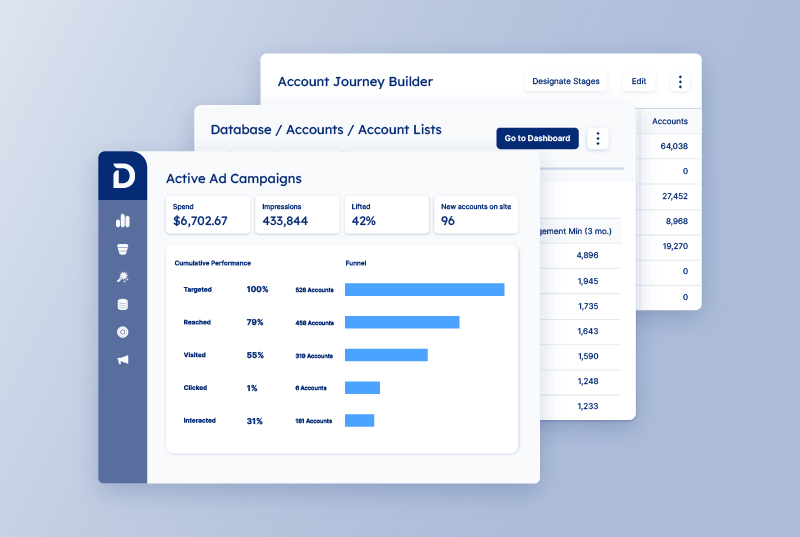
Demandbase is the pipeline engine for AI GTM teams, with one B2B platform doing the work of account identification, intent data, advertising, sales intelligence, and CRM enrichment.
Data Integrity is the enrichment module, and it updates Salesforce, HubSpot, and Marketo with firmographics, technographics, contact data, and intent signals on a fully automated schedule.
Depth plays a major role here. You get 100M+ companies, 176M+ B2B contacts, 47K+ technologies, and 810K+ intent keywords in 133 languages. And every record is validated against 40,000+ data sources before it reaches your CRM.
That’s why B2B teams choose Demandbase when enrichment is one piece of a bigger pipeline play, not a standalone purchase.
Key features
- Proprietary account identification: Demandbase’s account ID engine matches anonymous web visits back to specific companies with category-leading accuracy. The system pulls from 3.7B+ mapped IP addresses, hundreds of millions of active cookies, and AI models refined over a decade of training.
- Bidstream-fed B2B intent data: Intent data is the strongest piece of the platform for most enrichment buyers. Demandbase taps 1+ trillion monthly signals from its DSP and partner network, distilled by AI and NLP into 810K+ relevant keywords in 133 languages, with intent strength and keyword quality flagged on every account.
- Data Integrity for automated CRM enrichment: Data Integrity handles the CRM-side enrichment automatically. It refreshes Salesforce, HubSpot, and Marketo records on a one-time, scheduled, or near real-time basis, with field-level controls over what gets updated.
- MTV (Multi-sourced, Triangulated, Validated) data methodology: Demandbase doesn’t trust any one source. The MTV (Multi-sourced, Triangulated, Validated) methodology pulls data from 40,000+ inputs, including Refinitiv and Equifax, and triangulates every record to outline and remove conflicting information before it enters the database.
- Technographic intelligence on 47K+ technologies: SaaS teams use Demandbase’s technographic data to find accounts running competitive or complementary tools. The platform tracks 47K+ technologies, including 21K+ hidden behind firewalls, and adds IT spend and next-purchase signals to the same record.
Advantages of using Demandbase
What puts Demandbase ahead is the combination of clean data and tight platform consolidation. Every enriched record in your CRM stays accurate and connects to intent signals, account identification, and the AI GTM motion running on top.
Teams seem to love the unified workspace. One G2 user describes how Demandbase One brings account context, intent signals, and lead prioritization together in one view, which saves the time reps usually waste switching between separate tools and makes it easier to focus on accounts in active research mode. [Read Full G2 Review]
Navisite shows what Data Integrity can do at scale. The digital transformation firm had merged four companies into one bloated CRM, with six account records for every account and duplicate contact info scattered across the database.
After running Data Integrity, they ended up with 85% fewer account records, 66% fewer contacts, half the original lead count, and daily Demandbase usage from 80%+ of their reps. [Read Full Case Study]
Data accuracy is another thing that long-term users keep coming back to. One user mentions six straight months of validated, accurate records after years of frustration with stale data from other vendors, which is a rare run in a category where data decay is the default. [Read Full G2 Review]
Pricing
Pricing is custom-quoted based on your team size, target account list, and selected modules.
You can talk to the Demandbase sales team for a tailored quote that matches your GTM scale and the modules you need most.
2. HubSpot Breeze Intelligence
HubSpot Breeze Intelligence is HubSpot’s native data enrichment and intent signal feature, built directly into the CRM and powered by 200M+ profiles from the Clearbit data network HubSpot acquired in 2023.
Breeze Intelligence is the only enrichment option in this guide that comes built directly into the CRM, with no integration setup, separate vendor contract, or data sync to manage.
Key features
- 40+ attributes auto-populated inside HubSpot: Breeze auto-populates contact and company records in HubSpot with 40+ attributes, including industry, revenue, employee count, job title, and LinkedIn URL.
- Smart form pre-fill: The platform pre-fills known fields on lead forms using already-enriched data, hiding fields the visitor would otherwise have to complete.
- Bulk enrichment capabilities for existing records: Bulk operations enrich existing CRM databases at scale, filling gaps across thousands of records at once. This is especially useful for teams cleaning up legacy data after migrating to HubSpot or before launching a new outbound campaign.
Pros
- Automation across marketing, sales, and support: Breeze Agents work across knowledge management, prospecting, content creation, and customer service, with multi-account management and journey automation now available in Marketing Hub. [Read Full G2 Review]
- Day-one navigation that scales with the account: Many users find HubSpot easy to navigate from day one. The platform’s design holds up well as account complexity grows, which keeps onboarding light. [Read Full G2 Review]
- Faster content production with Breeze: Breeze takes care of the heavy lifting on landing pages, email copy, and content variations. Marketers running lean teams say this is one of the biggest day-to-day wins from the platform. [Read Full G2 Review]
Cons
- Total cost of ownership creeps up faster than expected: HubSpot can become expensive quickly, especially when scaling past Starter into Pro or Enterprise. Those running smaller businesses and startups mention this as the main barrier to broader adoption. [Read Full G2 Review]
- Inconsistent AI performance and complex platform: Breeze AI sometimes returns wrong answers or shaky outputs, particularly on complex queries. [Read Full G2 Review]
- Mixed support experience: Customer support quality fluctuates depending on issue complexity and which rep handles the ticket. Technical issues outside the front-line knowledge base often face long wait times, which can stall projects. [Read Full G2 Review]
Pricing
There’s no separate price tag for Breeze Intelligence.
Basic enrichment is included for free with paid seats, while advanced features (buyer intent, Prospecting Agent, Data Agent) draw from HubSpot Credits, with monthly allocations between 500 (Starter) and 5,000 (Enterprise).
Extra credits cost $10 per 1,000, unused credits don’t carry over, and overage usage auto-upgrades the account to the next tier.
Related read → How to Use Demandbase and HubSpot to Unify and Scale Your ABM Efforts
3. Clay
Clay is a programmable B2B data enrichment and workflow platform that connects 150+ third-party data providers into a single spreadsheet-style workspace.
The platform’s edge is the workflow engine underneath the enrichment. This means you build custom pipelines with conditional logic, AI agents, and any combination of providers you choose, all in one workspace.
Key features
- Waterfall enrichment across 150+ data providers: Clay runs each record through multiple providers in a defined sequence and keeps going until it finds a match. This approach pushes email coverage to roughly 78-80% on typical B2B lists, compared with 40-50% from single-source tools.
- Claygent AI research agent: Claygent navigates the web, scrapes gated pages, parses public databases, and pulls custom data points your providers don’t cover. You can connect it to MCP servers like Salesforce, Gong, and Google Docs for a deeper business context on every account.
- Custom logic and API access: The spreadsheet-style interface lets you chain enrichment steps, apply conditional rules, and route data based on any field you define. Higher-tier plans add webhook support and HTTP API integration, which makes Clay a full GTM orchestration hub.
Pros
- Waterfall enrichment that fills gaps automatically: Users mention Clay’s waterfall logic as the main reason they pick it over single-source tools. If one provider doesn’t return an email or phone number, Clay moves to the next source in the sequence and keeps going until it finds a match. [Read Full G2 Review]
- Claygent saves hours of manual research: Claygent handles the kind of company-by-company digging reps used to do by hand, from checking websites for product news to spotting hiring signals. Onboarding new reps gets faster because the AI agent does the legwork that used to take weeks to learn. [Read Full G2 Review]
- Strong automation for enrichment at scale: Teams talk about how much manual work Clay removes from list-building and contact enrichment. Once a workflow is set up, the platform can process thousands of records without anyone touching it. [Read Full G2 Review]
Cons
- Steep learning curve: Even with the familiar spreadsheet interface, new users say it takes time to get comfortable with multi-source automations and provider stacking. Teams without prior enrichment experience often need weeks before they’re running workflows confidently. [Read Full G2 Review]
- Integration setup takes work: Users mention that connecting tools like Salesforge and tailoring them to a specific GTM motion takes meaningful time upfront. They ask for more pre-built templates and onboarding guides to shorten that ramp. [Read Full G2 Review]
- Credits burn fast: Pricing is a risk, especially during the learning phase, when wasted runs can chew through credits quickly. The output preview helps you check actions before spending, but cost management still needs discipline. [Read Full G2 Review]
Pricing
Clay uses a credit-based model across four tiers, and two units determine what you pay. Data Credits cover the data you pull from Clay’s 150+ providers and cost from $0.05 each, while Actions cover the platform work behind your workflows and cost under a cent each.
- Free plan: $0. Good for testing the waterfall logic and Claygent on small lists, capped at 200 rows per table.
- Launch: Starts at $167/month. Right fit for small teams running their first prospecting workflows, with phone enrichment and basic intent signals included.
- Growth: Starts at $446/month. The recommended tier for teams syncing enrichment back to a CRM and automating around intent signals.
- Enterprise: Custom pricing. Built for larger GTM teams that need data warehouse syncs, SSO, role-based access, and a dedicated growth strategist.
Companies can save around 10% with annual billing.
4. 6sense
6sense is an AI-powered account-based intelligence and ABM platform that combines proprietary intent data, predictive models, and account enrichment in one system.
The defining feature is the Signalverse, 6sense’s proprietary intent network that tracks research activity across the open web. Combined with a decade of model training, it produces buying-stage predictions for accounts in your CRM.
Key features
- Signalverse and 6AI predictive intelligence: 6sense collects over a trillion buying signals daily through its proprietary Signalverse and feeds them into 6AI, the platform’s prediction engine, refined with more than a decade of B2B data.
- Web visitor identification: The ABM platform de-anonymizes traffic on your website and matches it back to accounts, even when website visitors never fill out a form. This pulls dark funnel research activity into your enriched account records and gives sales a view they wouldn’t get from form-fills alone.
- Multi-dimensional company and contact enrichment. 6sense enriches every account with firmographic, technographic, and psychographic data, plus verified contact details for the key personas inside it.
Pros
- Account intelligence depth and segmentation tools: The combination of granular account data and tools for slicing is important to users. Workflow execution and outcome reporting from inside those segments is what makes the platform feel useful day to day. [Read Full G2 Review]
- Duplicate detection and intent-driven personalization: G2 users mention how quickly 6sense spots duplicate accounts pulling from the same domain. The intent keywords also feed into outreach messaging, which gives reps angles tied to what each account is researching. [Read Full G2 Review]
- Smooth and responsive interface: Teams describe the UI as quick and intuitive once you’re past initial setup. Navigation across accounts, segments, and reports keeps pace with the work without slowing things down. [Read Full G2 Review]
Cons
- Weak contact data quality: A common complaint is that contact records often show outdated titles or people who have already left the company. Many teams keep LinkedIn Sales Navigator open alongside 6sense to verify or replace what they’re pulling. [Read Full G2 Review]
- Intent signal noise: The volume of intent signals can become overwhelming for reps when there’s no clear internal process to filter them. The firehose can slow teams down when no one defines what to act on first. [Read Full G2 Review]
- Limited regional and language coverage: Users in German-speaking markets and other non-English regions ask for deeper local data and intent signals in their own languages. Teams selling outside North America may need to supplement 6sense with regional providers. [Read Full G2 Review]
Pricing
Public estimates put Enterprise contracts somewhere between $60,000 and $100,000+ per year. Expect movement in either direction based on how many users you have, how much intent data you consume, and which modules you add.
Learn more → 15 Best 6sense Competitors & Alternatives Right Now
5. Apollo.io
Apollo.io is an all-in-one sales intelligence and engagement platform that combines a built-in B2B database of 275M+ contacts and 73M+ companies with lead enrichment, prospecting, and outreach tools in one workspace.
The biggest reason Apollo shows up in this guide is the combination of a 275M+ proprietary contact database with built-in enrichment and outreach tools, all at entry-level pricing well below most enterprise-grade platforms.
Key features
- Built-in B2B database with 275M+ contacts: Apollo gives direct access to more than 275 million contacts and 73 million companies, with 65+ filters covering title, seniority, industry, tech stack, and funding stage.
- Waterfall enrichment for higher coverage: When Apollo’s own data comes up short, the platform pulls from partner sources in sequence until it returns a verified email or direct dial. The same logic runs across new leads, CSV uploads, and CRM enrichment jobs without separate configuration.
- AI Research agents: Apollo’s AI agents handle custom research tasks like pulling specific data points from company websites or summarizing recent news per account. Reps get account-level context without manually digging through ten browser tabs.
Pros
- Database depth and granular filters: Apollo makes it easy to narrow by very specific criteria like job roles and company size. The 65+ filters and 275M+ contact pool give SDRs the precision they need without exporting data into a separate workspace. [Read Full G2 Review]
- All-in-one workflow that saves time: A common theme in G2 reviews is the time saved by having database search, email verification, and sequencing in one platform. Teams report cutting out two or three separate tools, which often saves a few hours per rep each week. [Read Full G2 Review]
- Chrome extension built for LinkedIn: Users mention being pleasantly surprised by how much the Chrome extension does. Pulling contact details and company info directly from a LinkedIn profile keeps research inside one tab. [Read Full G2 Review]
Cons
- Data accuracy gaps and email bounces: The most common complaint is bounce rates higher than users expect, with roughly 10-15% of contacts showing outdated information. Many users scrub lists through a separate verification tool before launching campaigns. [Read Full G2 Review]
- Sluggish performance on large lists: Some users report lag when working through long lead lists, especially when filtering or bulk-editing. It’s a minor frustration, but it slows things down on heavier prospecting days. [Read Full G2 Review]
- Limited per-step analytics: Users can see open and reply rates at the sequence level, but find it hard to drill into where exactly the drop-off happens. Step-by-step analytics often need manual exports, which only brings friction to sequence optimization. [Read Full G2 Review]
Pricing
Apollo has annual billing across four tiers:
- Free. Zero cost, 900 credits per year. Good for a trial only.
- Basic ($49/user/month). 30,000 annual credits for prospecting and email sequences.
- Professional ($79/user/month). 48,000 annual credits, plus the dialer, call recording, AI workflows, and deeper analytics.
- Organization ($119/user/month, 3-user min). 72,000 annual credits, plus international dialing, custom reports, and enterprise security.
Every action burns credits at a different rate. Email reveals cost 1 credit, phone numbers cost 8, and enrichment ranges from 1 to 8 per record. Top-up credits run $0.20 each after your annual pool empties.
6. Cognism
Cognism is a B2B SI and data enrichment platform built for compliant outreach in European markets, with a global database of 400M+ contacts and 70M phone-verified mobile numbers.
This platform’s reputation rests on Diamond Data, a tier of mobile phone numbers manually verified by human callers that consistently connect at 2-3x the rate of algorithmically validated numbers.
Key features
- Diamond Data verified mobile numbers: Cognism manually verifies mobile phone numbers through human callers before adding them to its Diamond tier. Users report 2-3x higher connect rates with Diamond Data compared to algorithmically validated phones from other providers.
- European market depth: The database covers 400M+ contacts globally, with the deepest coverage in the UK, DACH, and broader EMEA regions. Teams selling into Europe see much better hit rates compared to North American data providers.
- Real-time CRM enrichment via API: New records sync into Salesforce, HubSpot, and other CRMs through Cognism’s API the moment they’re created, filling in firmographics, contact data, and verified phones automatically.
Pros
- Phone number accuracy with Diamond Data: Human-verified mobile numbers earn Cognism most of its praise on review platforms. Users running daily call sessions through the Chrome extension see far less time lost to disconnected lines and wrong-number landlines. [Read Full G2 Review]
- Deep EU data coverage: Teams selling into European markets call Cognism’s EU contact coverage the best they’ve worked with. Hit rates on UK, DACH, and broader EMEA contacts hold up where other platforms thin out quickly. [Read Full G2 Review]
- Strategic firmographic context: Users appreciate having annual revenue, industry sector, and other strategic firmographic data included alongside contact information. The extra context helps reps tailor outreach and prioritize prospecting against ICP fit. [Read Full G2 Review]
Cons
- Direct dials aren’t always direct: Some users report that a portion of Cognism’s phone numbers route to switchboards or gatekeepers, not the prospect directly. This creates problems for outbound teams whose workflow depends on getting straight to the decision-maker. [Read Full G2 Review]
- Occasionally outdated employment data: Teams regularly find contacts whose employment information hasn’t been updated, with some records over a year stale. Reaching out to someone who left the company months ago wastes outreach effort and damages credibility with the actual buying committee. [Read Full G2 Review]
- Credits don’t roll over: Unused credits expire at the end of each cycle rather than carrying forward. Users who want to bank credits during slower months and use them during heavy prospecting periods find the current model frustrating. [Read Full G2 Review]
Pricing
Pricing for Cognism is quote-based and tied to team size, data volume, and contract terms.
Based on 2026 user reports, the Platinum plan starts near $15,000 per year plus per-user fees, and the Diamond plan with verified mobile numbers begins around $25,000. Enterprise contracts typically land between $30,000 and $100,000+ annually.
7. ZoomInfo
As one of the longest-running B2B data platforms, ZoomInfo handles contact intelligence, intent signals, AI-assisted outreach, and CRM enrichment in a single go-to-market system.
Scale puts ZoomInfo ahead of every other tool in this guide, with a database widely considered the largest in B2B sales intelligence and 60+ third-party vendor integrations feeding enrichment across CRM, marketing automation, and data warehouse environments.
Key features
- One of the largest B2B databases on the market: The platform holds 320M+ business contacts, 100M+ company profiles, and 135M verified phone numbers, with continuous AI-driven and human-checked refreshes.
- GTM Studio for multi-vendor enrichment: GTM Studio orchestrates enrichment across 60+ third-party data vendors using rules-based waterfall logic, all configured through a codeless interface.
- Webhook and API delivery into CRMs and MAPs: ZoomInfo enriches Salesforce, HubSpot, Marketo, and Microsoft Dynamics records in real time through APIs and webhooks.
Pros
- Deep integration ecosystem: Salesforce, HubSpot, and Marketo all sync tightly with ZoomInfo. Enrichment runs inside the CRM itself, so reps stay in one place and ops teams skip the export-import cycles entirely. [Read Full G2 Review]
- Automatic CRM enrichment keeps records current: The auto-enrichment feature often comes up as one of the platform’s most important advantages. Marketing teams in particular benefit from working off clean records, which sharpens targeting and improves downstream conversion rates. [Read Full G2 Review]
- Steady stream of platform updates: Frequent improvements and new releases keep ZoomInfo feeling modern compared to legacy data tools. Users say that the product evolves alongside the broader GTM tech stack. [Read Full G2 Review]
Cons
- Slow support response on integration issues. Technical glitches around integrations, especially with lead and account assignment, can take a while to resolve. Connecting with the right team isn’t always quick, which frustrates teams expecting enterprise-level support speed. [Read Full G2 Review]
- Patchy accuracy on smaller companies: The database covers a lot, but smaller and niche companies don’t always have the depth ZoomInfo claims overall. Records can be outdated or incomplete, which slows prospecting for teams selling into SMB segments. [Read Full G2 Review]
- High and opaque pricing: Quotes are custom and tied to seat counts, modules, and add-ons, which makes budget planning difficult upfront. Total contract values often climb higher than teams initially expect, particularly once credits, intent data, or enrichment volumes get added in. [Read Full G2 Review]
Pricing
Pricing for ZoomInfo runs entirely through sales, with no public rates.
Quotes flex around seats, credits, modules, and how much functionality you bundle in, and contracts come on annual or multi-year terms only.
Learn more → 16 Best ZoomInfo Alternatives & Competitors Right Now
8. Lusha
Lusha is a B2B sales intelligence platform with 285M+ enriched contacts, best known for a Chrome extension that pulls verified emails and direct phone numbers from LinkedIn profiles in a single click.
While most enrichment tools focus on database scale or workflow orchestration, Lusha leans into prospecting speed at the individual rep level. The Chrome extension keeps the data lookup inside LinkedIn itself, where SDRs already do their research.
Key features
- 285M+ contacts with strong NA and UK coverage: The database holds over 285 million enriched contacts and decision-makers, with continuous verification on emails and phones. Independent testing reports email accuracy of 80-90% and phone accuracy of 70-80%, strongest on North American and UK contacts.
- Native CRM integrations and one-click push: The extension pushes enriched contacts directly into Salesforce, HubSpot, and other major CRMs in one click. Lusha also connects with automation tools like Zapier, Make, n8n, and Workato for custom workflow setups.
- Compliance and security certifications: Lusha holds GDPR, CCPA, SOC 2 Type II, and ISO 27701 certifications, plus opt-out mechanisms for individuals in the database. This makes the platform a defensible option for teams selling into regulated industries or compliance-sensitive accounts.
Pros
- Saves time on contact research: The clearest payoff for users is time freed up from manual contact-finding. Reps move directly to outreach and coordination, which speeds up daily prospecting throughput. [Read Full G2 Review]
- Smooth LinkedIn and CRM workflow: The combination of the LinkedIn integration and one-click CRM push makes the lead-to-record flow nearly invisible. Prospecting and lead management feel like one motion, which keeps teams in flow longer. [Read Full G2 Review]
- Lean workspace focused on the prospecting motion: Lusha keeps the UI focused on the core prospecting motion, with none of the dashboard clutter that larger platforms carry. Junior reps and freelancers tend to find it intuitive on day one, which keeps onboarding fast and cheap. [Read Full G2 Review]
Cons
- No built-in dialer: Calling features stop at revealing the number. Anyone running cold-call campaigns has to plug in a separate dialer, which interrupts the otherwise smooth flow from prospect to outreach. [Read Full G2 Review]
- Coverage gaps on some contacts: Reviewers report finding numbers for only 70-80% of target contacts on average. The missing 20% sometimes includes the most relevant decision-makers, which forces reps back to LinkedIn or other tools to fill the gap. [Read Full G2 Review]
- Limited filtering and intent depth: Filters and intent signals are lighter than what enterprise sales teams typically expect from a full sales intelligence platform. Deeper segmentation, advanced ICP filtering, and AI-driven buying signals come up regularly in feature requests. [Read Full G2 Review]
Pricing
Lusha keeps detailed pricing behind an interactive configuration, but the four tiers break down roughly like this:
- Free: 40 credits per month, Chrome extension, basic CRM integrations.
- Pro: Around $29 per user monthly, with roughly 250 credits and list management.
- Premium: Around $70 per user monthly, with higher credit volumes and team management features.
- Scale: Custom pricing for teams of 6+, with per-user credit limits and sales-assisted onboarding.
Monthly plans let unused credits roll over up to 2x your limit, while annual plans grant credits upfront and reset what’s left at year-end.
9. LeadGenius
LeadGenius is a B2B contact intelligence platform that uses machine learning alongside a worldwide team of researchers to build custom datasets for sales and marketing teams.
The differentiator here is verified, human-touched data. Every contact and account passes through a researcher before delivery, which brings coverage in niche segments and global markets that fully automated databases typically miss.
Key features
- AI and human research hybrid: LeadGenius combines proprietary automation with a global team of human researchers who verify, source, and customize data for each account.
- Custom datasets on demand: Teams can request accurate data on specific roles, regions, technologies, or unusual ICP criteria not available in standard databases. LeadGenius builds the dataset to spec and verifies each record before delivery.
- Global coverage across EMEA, LATAM, and APAC: Researchers cover regions and languages that most US-built databases handle poorly. This makes the platform useful for teams selling into Latin America, Asia, or non-English European markets where data quality usually drops off.
Pros
- Strong account team and targeting support: Working directly with LeadGenius’s targeting specialists tends to be a big part of why customers stay, especially for demand gen and retention motions. [Read Full G2 Review]
- User-friendly platform with low learning curve: The platform comes across as intuitive enough that most teams don’t need much training to start using it. Daily workflow feels self-explanatory, which keeps support tickets and onboarding time low. [Read Full G2 Review]
- Live training and 24/7 support: Teams frequently mention how accessible LeadGenius’s training and support are around the clock. Real people walk teams through the platform when it counts, which beats relying on docs or AI chatbots for anything complex. [Read Full G2 Review]
Cons
- Heavy-handed sales motion: Some buyers report sales emails that feel pushy and presumptuous about their current tooling. The cadence can feel out of step with the prospect’s actual stage in the buying process. [Read Full G2 Review]
- Performance lags on cookie-heavy sites: Users mention the platform slowing down when browsing websites loaded with third-party cookies. It’s a minor issue, but noticeable enough to come up in feedback. [Read Full G2 Review]
- Missing native HubSpot connector: A common feature request is a direct HubSpot integration for ops teams that want to work inside their CRM. Workarounds exist, but a native connector would let HubSpot users skip manual data routing entirely. [Read Full G2 Review]
Pricing
LeadGenius has custom pricing only, with no public rates listed.
Reports from 2026 put entry deals near $18,000 per year, typical contracts around $22,000, and high-end enterprise engagements stretching past $80,000, depending on research scope and data volume.
How to choose the right B2B data enrichment tool for your needs
Enrichment is a use-case question, not a feature-list question. Below is a quick read on which platform fits which kind of GTM motion, so you can shortlist faster:
- For B2B teams running enrichment, intent, advertising, and sales intelligence under one roof, Demandbase has no real competition. Data Integrity keeps CRM records clean while feeding the same engine that powers Demandbase AI’s pipeline orchestration across marketing, sales, and ads.
- For ABM teams that want predictive intent scoring as the foundation of their pipeline strategy, 6sense is a solid alternative. The Signalverse processes over a trillion signals daily and feeds 6AI’s prediction engine, which assigns buying-stage scores to every account in your CRM.
- For revenue ops teams that want full control over enrichment workflows and provider routing, Clay is the answer. The waterfall logic chains 150+ data providers into one pipeline, and Claygent handles the kind of manual research that used to eat hours of SDR time.
- For sales teams needing prospecting, email verification, and outreach in one workspace, Apollo is the default pick. Apollo’s 275M+ contact database and built-in dialer cover the full SDR workflow.
- For GTM teams selling into European markets that need verified mobiles and full GDPR compliance, Cognism leads the category. Cognism’s Diamond Data tier offers human-verified phones connecting at 2-3x the rate of algorithmic numbers.
- For HubSpot users who want native enrichment with zero integration overhead, Breeze Intelligence is the best choice. It auto-fills 40+ firmographic and contact attributes inside HubSpot at no extra cost on existing seats, with credits that power advanced features like buyer intent and the Prospecting Agent.
- For enterprise teams that want the largest B2B contact database with deep CRM and MAP integrations, ZoomInfo is hard to beat. The 320M+ contacts and 135M verified phones run through GTM Studio for multi-vendor enrichment, with native syncs across Salesforce, HubSpot, Marketo, and Microsoft Dynamics.
- For individual SDRs and small teams doing daily LinkedIn prospecting, Lusha offers the cleanest workflow. The Chrome extension pulls verified emails and direct phones from any LinkedIn profile in one click, with native CRM push and a focused UI built for solo reps and freelancers.
- For GTM teams that need custom datasets or coverage in non-English markets that automated databases miss, LeadGenius is the right call. Human researchers verify every record and build datasets for unusual ICP criteria, with coverage that holds up in LATAM, APAC, and non-English European markets.
🚩Red flags to watch out for during evaluation → Some problems with enrichment tools only become clear once your team is using the platform day to day. Run your shortlist against the list below before signing.
- Vendors that quote credit allocations without telling you whether unused credits roll over or expire at the end of each cycle, which forces your team to either burn credits inefficiently or pay for ones that vanish.
- Match rate stats presented without an accompanying accuracy benchmark, since a record matched against an outdated profile costs more in wasted outreach than a missed record ever will.
- Single-source databases marketed as global, when the underlying coverage really only holds up in one region and thins out the moment your reps prospect anywhere else.
- Enrichment workflows built on scheduled file syncs into your CRM, which leaves new leads sitting raw for hours while reps work them with no firmographic or intent context attached.
- Vendors are light on regional compliance certifications (GDPR, CCPA, SOC 2 Type II) and vague on how they handle data subject requests, since the legal exposure on this lands on your team, not theirs.
- Phone databases that bundle human-verified mobiles with algorithmically validated switchboard numbers under the same “direct dial” label, which inflates the headline coverage number and tanks actual connect rates.
- Renewal language that allows automatic price escalations of 15-20% with short notice windows, which leaves you either eating the increase or scrambling to migrate mid-quarter.
Demandbase – #1 B2B data enrichment platform
The choice in this category usually comes down to a contact database or a full GTM platform.
Demandbase is the platform pick, with enrichment that flows straight into intent scoring, advertising, and sales intelligence across the same data set. For teams building toward AI GTM, that consolidation is the deciding factor.
Here’s a quick summary of exactly what you get with Demandbase:
- Proprietary account identification that matches anonymous traffic to real companies through 3.7B+ IP addresses and a decade of AI training
- The largest native B2B intent network in the category that brings 810K+ keywords in 133 languages
- Automated CRM cleanup and enrichment across Salesforce, HubSpot, and Marketo, scheduled or near real-time
- MTV (Multi-sourced, Triangulated, Validated) data methodology that pulls firmographic, technographic, and contact data from 40,000+ inputs
- Person-Based Intent that links keyword activity to specific contacts inside each account and ranks them by buying group relevance
- Technographic coverage on 47K+ technologies with IT spend and next-purchase signals attached
- Native MCP support so AI assistants pull Demandbase enrichment and intent data through natural language prompts
Demandbase covers the full enrichment workflow, from CRM cleanup to intent signals to buying group data.
Book a meeting to walk through how it fits your team.
FAQs
How do these platforms manage compliance when extracting data from social profiles?
Privacy handling and legal exposure vary significantly across the category. Platforms like Cognism and Lusha maintain explicit GDPR and CCPA certifications, whereas tools that strictly scrape unverified data from social media carry a higher regulatory risk for your RevOps team.
What is the realistic implementation timeline for these platforms?
Native CRM features like HubSpot Breeze require almost zero technical setup time and activate immediately. Conversely, orchestrating multi-source validation workflows in Clay or mapping out a full ZoomInfo API integration typically requires 30 to 90 days for testing and alignment with your high-quality account definitions.
Is B2B data enrichment legal under GDPR and CCPA?
Yes, B2B data enrichment is legal under both GDPR and CCPA, as long as the vendor and your team follow the rules.
That means processing only business contact data for legitimate interests, honoring opt-out and deletion requests, and working with providers that can prove their sourcing is compliant.
How often should I enrich my CRM data?
For new leads and accounts, enrichment should run in real time or close to it. For existing records, a refresh every 30 to 90 days keeps job titles, phone numbers, and company data current enough to trust.mm



We have updated our Privacy Notice. Please click here for details.