

10 best Clearbit alternatives & competitors in 2026

You cannot buy a new standalone Clearbit subscription anymore. HubSpot acquired Clearbit in December 2023, sunset the free platform in April 2025, and no longer offers new standalone Clearbit subscriptions.
Existing customers are still supported, but anyone comparing Clearbit alternatives or competitors in 2026 now has to choose a different product for new deployments.
Start with what you actually used Clearbit for.
Enrichment, Reveal, and Clearbit’s APIs solved different problems, and each has a different replacement. A tool that replaces one of those jobs well can be a poor fit for the others.
This guide groups the best Clearbit alternatives by the job they replace, so you can narrow the field before comparing vendors.
What happened to Clearbit?
HubSpot acquired Clearbit in December 2023 and has since folded its data capabilities into HubSpot’s product ecosystem. New standalone Clearbit subscriptions are no longer available, while existing Clearbit customers continue to be supported.
HubSpot initially packaged many of the acquired data capabilities under Breeze Intelligence. In 2026, HubSpot moved enrichment into Smart CRM under the name HubSpot Data Enrichment. HubSpot now describes Data Enrichment as drawing from its commercial dataset, third-party providers, and publicly available information.
Free users lost access first. On April 30, 2025, HubSpot sunset the free Clearbit platform along with the Weekly Visitor Report, the TAM Calculator, Clearbit Connect, the free Slack integration, and the free implementations of the Risk API and the Name to Domain API. On December 8, 2025, the free Logo API shut down.
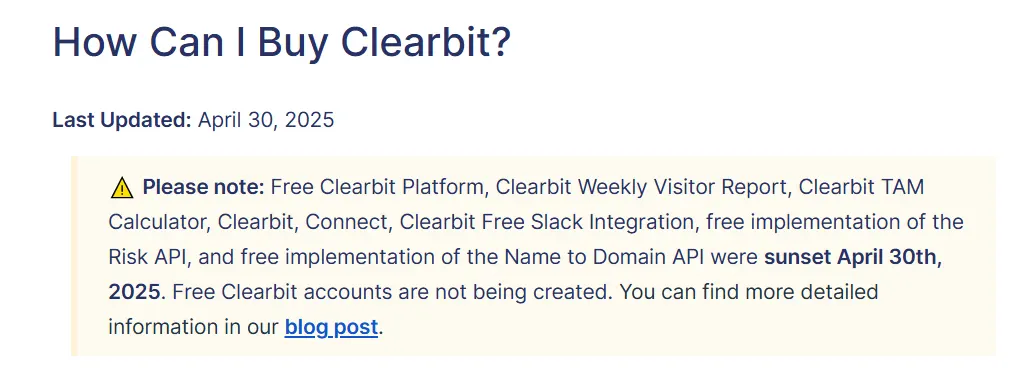 (Source: Clearbit Help Center)
The buying route closed too. Clearbit’s Help Center states that it is no longer offering new standalone subscriptions and is focused on supporting current customers. Its older support documentation directs prospective buyers toward Breeze Intelligence, while HubSpot’s current product pages now use Data Enrichment for the enrichment capability.
That leaves two different situations. Existing Clearbit customers can plan their migration around the products they already have access to. New buyers need to choose a current alternative rather than starting a new standalone Clearbit subscription.
| Date | What changed |
|---|---|
| November 1, 2023 | HubSpot announces an agreement to acquire Clearbit |
| December 4, 2023 | The acquisition completes and Clearbit becomes a wholly owned HubSpot subsidiary |
| April 30, 2025 | The free Clearbit platform, Weekly Visitor Report, TAM Calculator, Clearbit Connect, free Slack integration, and the free Risk API and Name to Domain API implementations are sunset. No new free accounts |
| December 8, 2025 | The free Clearbit Logo API shuts down |
| Today | No new standalone Clearbit subscriptions. Clearbit remains available to existing customers, while HubSpot directs new enrichment use cases toward HubSpot Data Enrichment and related HubSpot data products. |
What this means for you → Existing customers have room to plan this properly, since the product keeps working while they decide. Everyone else has to choose something now. Either way, the starting point is the same, which is working out what Clearbit was doing for you before comparing anything that claims to replace it.
What are the best Clearbit alternatives in 2026?
The best Clearbit alternatives in 2026 include Demandbase, HubSpot Data Enrichment, ZoomInfo, Cognism, Clay, Apollo, Leadfeeder, RB2B, 6sense, and People Data Labs.
The right choice depends on whether you need to replace Clearbit Enrichment, Clearbit Reveal, API access, or several of those workflows together.
Here is the quickest way to narrow the field.
| Tool | Clearbit job it replaces | Best for | Skip it if |
|---|---|---|---|
| Demandbase | Enrichment + Reveal | Teams that want data to drive scoring, buying groups and advertising | You want fields filled in and nothing more |
| HubSpot Data Enrichment | Enrichment | Teams running CRM and marketing workflows inside HubSpot | Another CRM is your primary system of record |
| ZoomInfo | Enrichment | Depth of contact and company records | Budget and contract terms are the constraint |
| Cognism | Enrichment | Phone coverage and EMEA compliance | You want a full GTM platform |
| Clay | Enrichment, API | Ops teams running several data sources | Nobody internally will own it |
| Apollo | Enrichment, API | Smaller teams buying data and outreach together | Your segment needs deep coverage |
| Leadfeeder (formerly Dealfront) | Reveal | Company-level visitor identification | You need to know which person visited |
| RB2B | Reveal | Person-level visitor identification | Your traffic is mostly outside the US |
| 6sense | Enrichment + Reveal | Teams already evaluating account-based platforms | You want a point tool at a point-tool price |
| People Data Labs | API | Developers replacing a direct API dependency | You need workflow around the data, not raw records |
How we evaluated the best Clearbit alternatives
Demandbase publishes this comparison and is one of the vendors included in it. To keep the comparison useful, we evaluated each product against the specific Clearbit job it can replace instead of treating every vendor as interchangeable.
We looked at replacement scope, enrichment capabilities, website visitor identification, API availability, CRM and marketing integrations, data coverage, pricing model, compliance considerations, and what teams can do with the data after it is collected.
That distinction matters because Clearbit covered several different use cases. A developer replacing the Company API should evaluate a different set of products than a marketing team replacing Reveal, while a revenue team that used several Clearbit products may be better served by a broader GTM platform.
Product features and pricing change frequently, so confirm final requirements and commercial terms directly with each vendor before purchasing.
First, work out which Clearbit you are replacing
One Clearbit subscription covered three products:
- Enrichment filled in company and contact fields on records you already had.
- Reveal identified the companies behind anonymous website traffic.
- The APIs and free tools gave developers direct endpoints to build against.
Teams could use several of those capabilities together, which is why “what replaces Clearbit?” has no single answer.
Most replacement advice assumes you were using Clearbit for enrichment. If that is true, the enrichment section below covers what you need. If you also used Reveal or the APIs, those are separate replacement decisions covered in their own sections.
Use the table below to find your row:
| The job | What Clearbit did | What you need now | How you know this was you |
|---|---|---|---|
| Enrichment | Filled in company and contact fields on records in your CRM | A data provider that matches your CRM and your market | Your records came in half empty and Clearbit completed them |
| Reveal | Identified the companies behind anonymous website visits | A visitor identification tool, which is a separate category | You had a dashboard or a Slack alert showing which companies hit your site |
| API and free tools | Direct endpoints developers called, plus the free logo and lookup tools | A developer-grade data API, or a rebuild on a platform | Someone on your team wrote code against clearbit.com, or your app pulled logos |
Keep in mind → Enrichment and visitor identification get confused often, partly because vendors describe them in similar language. But they work differently. Enrichment takes a record you already have and matches it against a database to fill in the missing fields. Visitor identification starts with an IP address or a device and works out which company or person it belongs to, before any record exists.
The best Clearbit alternatives for data enrichment
Enrichment was the most common reason teams paid for Clearbit, and it is the easiest of the three jobs to replace. The market is crowded, coverage is comparable across the main vendors, and the decision usually comes down to your CRM, your market, and what you plan to do with the data.
Each tool below gets the same treatment, which is what it does well, who it fits, and where it falls short. We have kept the feature comparison out of it. That already exists in our 9 best B2B data enrichment tools roundup.
Demandbase
Demandbase is a complete GTM platform across marketing, sales, advertising and data. Specifically, Demandbase Data replaces Clearbit, enriches CRM and marketing automation records, and keeps them accurate as companies and buyers change.
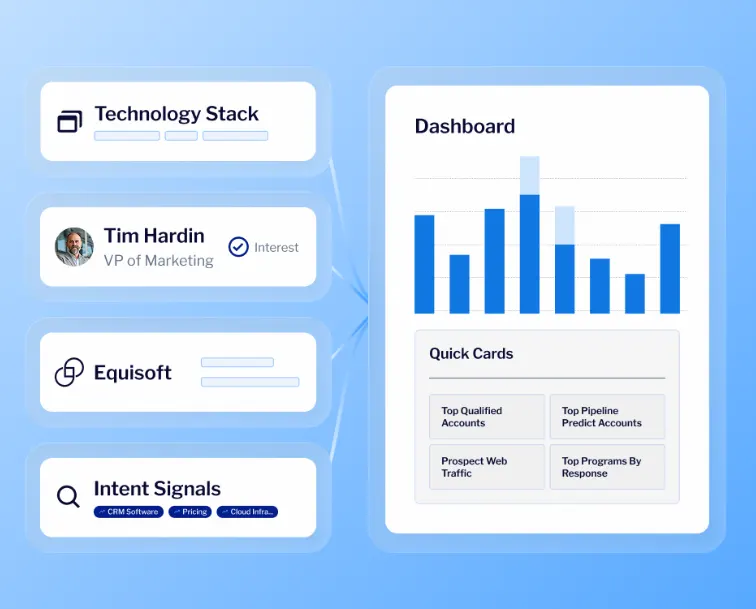
How it compares to Clearbit: Clearbit appended company and contact attributes to records you already held. Demandbase does the same job at the account level, then puts the result to work. The enriched data feeds account scoring, buying group identification and advertising inside one system, and reaches your CRM and warehouse through B2B APIs and warehouse-native delivery.
Who it fits: Marketing, sales and RevOps teams running account-based motions. If your pipeline is built on named accounts and buying groups, the data model matches the way you sell.
The limitation: Demandbase is a full platform, so it is more than a team needs if the only requirement is filling in CRM fields. Teams looking for a simple enrichment tool will find better value elsewhere.
HubSpot Data Enrichment (formerly Breeze Intelligence)
HubSpot Data Enrichment is the current HubSpot product for enriching contact and company records inside Smart CRM. HubSpot says it uses its commercial dataset alongside third-party providers and publicly available information to add and refresh business information on CRM records.
How it compares to Clearbit: HubSpot acquired Clearbit in 2023 and subsequently folded enrichment into its own CRM. For HubSpot-native teams, that makes Data Enrichment the lowest-friction path away from standalone Clearbit: enrichment can run automatically on new records, continuously on existing records, or manually, without adding a separate enrichment integration.
Who it fits: Teams already using HubSpot as their CRM and marketing platform. If the records already live in HubSpot, keeping enrichment in the same system removes a migration and integration project.
The limitation: HubSpot Data Enrichment is designed around HubSpot Smart CRM. If Salesforce, Dynamics, or another CRM is your primary system of record, it is not a like-for-like standalone Clearbit replacement.
ZoomInfo
ZoomInfo sells a B2B contact and company database with roughly 500 million contact records and 100 million company profiles, packaged as a go-to-market intelligence platform with intent data and AI tooling on top.
How it compares to Clearbit: Depth is the difference. Clearbit handled company firmographics well and worked as a light append. ZoomInfo carries far more contact-level detail, including direct dials, verified emails and org charts, and adds intent signals across the same records. Its GTM.AI connector (generally available since June 2026) also exposes the database to AI agents and developer workflows through an API and an MCP server.
Who it fits: Teams whose bottleneck is coverage. Outbound organisations that need phone numbers and complete buying committees at scale get the most from it.
The limitation: Contract structure. Annual terms with seat minimums make it a heavier commitment than a straight Clearbit swap, and ZoomInfo has been moving upmarket, so smaller teams find the fit narrowing. Our 16 best ZoomInfo alternatives roundup covers more options if that rules it out.
Cognism
Cognism is a B2B contact data provider built around verified phone numbers and a compliance-first approach to European data. It sells prospecting seats, a CRM Enrichment product you can buy on its own, and a Data-as-a-Service option that delivers records through an API or bulk transfer.
How it compares to Clearbit: Clearbit did company firmographics well and never did much with phone numbers. Cognism inverts that, with phone-verified mobiles, on-demand verification for priority prospects, and records built to hold up under GDPR scrutiny. Its CRM Enrichment product maps closely onto the Clearbit job.
Who it fits: Teams whose pipeline depends on connect rates in Europe. Cognism concentrates on verified mobiles and a compliance posture built for GDPR, which is what makes outbound into EMEA workable.
The limitation is: Cognism is primarily a sales intelligence and enrichment provider, so it does not replace the broader account identification, scoring, and activation capabilities of a full GTM platform.
Clay
Clay is an orchestration platform built over a marketplace of more than 150 data providers. You point it at a list and it runs lookups across several vendors in sequence until one returns a match. The company calls this waterfall enrichment.
How it compares to Clearbit: You are replacing one dataset with access to many. Coverage improves because a miss from one provider passes to the next, and data credits get spent only on results. Claygent handles research no database covers. The structural benefit is independence, since losing any one provider costs you a row in a waterfall and nothing more.
Who it fits: Ops teams running enrichment across several providers, and anyone whose CRM records need fields no single vendor covers well.
The limitation: Somebody has to own it. Clay hands you the parts and expects you to assemble the workflow, so a team with nobody in GTM ops to build and maintain the tables will get a fraction of what they paid for.
Apollo
Apollo is a sales intelligence and engagement platform that combines B2B contact and company data with enrichment, prospecting, sequencing, and API access. Its current plans support CRM, CSV, and API-based enrichment, alongside outbound sales workflows.
How it compares to Clearbit: Apollo can replace the core enrichment job by filling and updating contact and company records, while also giving teams access to the same data for prospecting and outreach. It also offers enrichment APIs, including person and bulk enrichment endpoints, making it useful for teams that previously relied on Clearbit both for CRM data and programmatic access.
Who it fits: Smaller teams and startups who want data and outreach on one bill. Entry pricing makes it the most accessible option on this list.
The limitation is: Apollo’s coverage and match quality can vary by market and segment, so teams should test it against their own target accounts and contacts before treating it as a direct Clearbit replacement.
The best Clearbit alternatives for website visitor identification
Demandbase, Leadfeeder, RB2B and 6sense all replace Clearbit Reveal. Reveal identified the companies behind anonymous website traffic, which is a different job from contact enrichment and usually a separate purchase.
The choice comes down to how far you need the identification to go:
- Company-level identification matches the visit to an organization, so you know a business in your target list looked at your pricing page.
- Person-level identification resolves the visit to a named individual, along with their email address and job title.
Many B2B teams choose company-level, since the privacy burden is lighter and several people from the same account will research you over a matter of weeks. Our guide to account identification explains how the matching works.
That account-level view changes when your team sees a deal forming. Leanne Chesco, Marketing Director at Demandbase, explains the difference:
“When they implemented account-level visitor identification, it fundamentally changed what they could see and when. Demandbase ultimately helps surface those signals by combining multiple data sources to identify that early buying activity at the account level, and I think the account-level part is the key part, because we’re now operating and selling into buying groups as well.”
If you want company-level, Demandbase, Leadfeeder and 6sense are your options. If you want person-level, RB2B is the one here that does it, and its coverage is limited to US traffic.
Demandbase
Note → Demandbase appears twice because it replaces two of Clearbit’s three jobs. The profile above covers enrichment, while this one covers Reveal.
Demandbase Account Identification resolves anonymous visits to accounts using behavioural signals, traffic patterns and proprietary IP and cookie data, classifying 3.7 billion IPs and 3.1 billion active cookies. It avoids IP registries and reverse DNS lookups, which is the method most lightweight visitor tools rely on, and that difference shows up in match rates on remote and mobile traffic.
How it compares to Clearbit: Clearbit Reveal gave you a company name. Demandbase gives you the account, what it has been researching elsewhere, which people in the buying group are engaged, and whether that engagement climbs or fades week to week.
Who it fits: Teams selling into buying groups, who need to know which accounts are in market and who inside them is involved. It also suits anyone covering enrichment and Reveal in a single purchase.
The limitation: You get the account rather than the person. That suits how most B2B buying works, since several people research you before anyone raises their hand, though reps who want a name to call the same afternoon will need something else alongside it.
Leadfeeder (formerly Dealfront)
Leadfeeder matches anonymous website traffic to company records through reverse IP lookup, then pushes those accounts into your CRM or Slack. The Dealfront brand rebranded back to Leadfeeder in March 2026, so both names still circulate in comparison content.
How it compares to Clearbit: Leadfeeder is one of the closest like-for-like replacements for Clearbit Reveal if company-level website identification is the main requirement. Its free Lite plan shows the last 100 identified companies per month, while paid visitor-identification plans currently start at €79 per month when billed annually and scale with usage.
Who it fits: Teams who want the Reveal function back and nothing more, particularly where the budget will not stretch to a platform.
The limitation: Reverse IP has a structural weakness that has grown since Reveal launched. Remote workers on home connections identify poorly, mobile traffic worse, and cookie consent rules cut into trackable sessions across Europe. Match rates depend heavily on how much of your audience browses from an office network.
RB2B
RB2B identifies individual visitors by name, job title and LinkedIn profile, then pushes them into Slack in real time. It works off a permissioned publisher network, so a visitor gets identified only when that network already holds their profile.
How it compares to Clearbit: Reveal never did this. Person-level identification goes a step further than Clearbit ever went, and it carries a matching set of constraints. RB2B’s own documentation puts person-level identification at roughly 40 to 45% of qualified US traffic, with company-level covering another 30 to 35%.
Who it fits: US-focused teams with high-intent traffic and a sales motion built on same-day follow-up.
The limitation: Person-level identification works for US visitors only. That is a deliberate choice, since identifying European individuals would bring RB2B under GDPR. International traffic identifies at company level through a Demandbase partnership, and that setup needs a consent management tool. The less US traffic you have, the less this tool does for you.
6sense
6sense identifies the companies behind anonymous website visits and connects that activity to account-level data and buying signals. Its Company Identification API can take an IP address and return company firmographics, segments, and 6sense scores associated with the visitor.
How it compares to Clearbit: Like Demandbase, 6sense treats a website visit as one input into a wider account picture. Reveal told you a company visited. 6sense weighs that visit against research the account has been doing elsewhere and returns a buying stage prediction, which is where its strength concentrates.
Who it fits: Enterprise teams already evaluating account-based platforms, particularly where predictive intent ranks as a primary requirement.
The limitation: A team replacing Reveal is buying an enterprise ABM platform to get visitor identification, which is a large purchase for one job. It makes sense when account-based marketing is already on your roadmap and much less when it is not. Our 15 best 6sense competitors roundup covers the alternatives.
The best Clearbit alternatives for the Clearbit API
People Data Labs, the Apollo API and Clay are the three worth checking if you were calling Clearbit’s endpoints directly. All three give you an enrichment endpoint and a JSON response, which is what a GTM platform is not built to do.
Start with where you stand. If you hold a paid Clearbit contract, the Person and Company APIs still return data, so this is a planning decision and not an emergency. If you have no contract, you cannot start one, which is what makes this section necessary.
The free Logo API is a separate case. It shut down on December 8, 2025, and HubSpot pointed developers at logo.dev as the replacement.
| Option | Best for | API approach | Main tradeoff |
|---|---|---|---|
| People Data Labs | A direct Clearbit API replacement | Person, Company and IP endpoints, REST design, free tier of 100 lookups a month | Records refresh monthly, so job changes lag |
| Apollo API | Teams already using Apollo for outreach | Person and company enrichment, including bulk endpoints | API access is available across Apollo plans, but endpoint access, rate limits, and credit usage vary by plan |
| Clay | Coverage across several providers at once | One integration fronting more than 150 data sources | Clay’s own API comes with the Enterprise tier |
People Data Labs is the closest replacement for the Clearbit developer experience, and the free tier makes it easy to test before you commit. Apollo suits teams already using the platform for outreach. Clay makes sense when your problem is coverage across several sources.
Demandbase has B2B APIs and warehouse-native delivery, so the data can reach your CRM, your warehouse and your own applications. That works when enrichment feeds a wider platform. When the requirement is a single endpoint and a JSON response, go with one of the three above.
Should you move to HubSpot Data Enrichment?
If HubSpot is already your CRM, Data Enrichment is the first Clearbit replacement to evaluate. It is built directly into Smart CRM, enriches company and contact records inside the system where your team already works, and removes the need to integrate a separate data provider for basic enrichment.
Do not treat it as Clearbit with a different name, though. HubSpot acquired Clearbit and initially packaged its data capabilities under Breeze Intelligence, but the current product is HubSpot Data Enrichment. HubSpot says the enrichment service uses its commercial dataset, third-party providers, and publicly available information.
There is also less incremental cost than there used to be. HubSpot currently says Data Enrichment is included with paid Smart CRM plans at no additional cost, although other data and intelligence features can have their own subscription or credit requirements.
There are three situations where another Clearbit alternative may fit better:
- HubSpot is not your primary CRM. Data Enrichment is designed to work inside HubSpot Smart CRM, so Salesforce-, Dynamics-, and other CRM-centric teams should evaluate a provider built for their existing stack.
- You need a broader account-based GTM platform. Enriching records is different from combining account fit, intent, engagement, buying groups, sales prioritization, and advertising in one operating model.
- Your enrichment has to activate natively across several external systems. If the data needs to feed a warehouse, account-scoring system, advertising platform, and other GTM tools, evaluate the full integration path rather than assuming CRM enrichment alone covers the workflow.
For a HubSpot-native team that mainly used Clearbit for enrichment, HubSpot Data Enrichment may cover the requirement without adding another vendor.
If Clearbit also powered website identification, account intelligence, APIs, or activation elsewhere in your stack, compare those jobs separately before assuming HubSpot replaces the entire Clearbit footprint.
Enrichment is the floor, not the ceiling
A like-for-like swap is the fastest route out of this. Pick a vendor, connect the CRM, carry on. The catch is that you inherit the old situation along with the fix, and for many teams that situation was clean data producing very little.
Complete records are a prerequisite. The value arrives when somebody uses them to decide who to call, which accounts to prioritise, and where the ad budget goes. As Umberto Milletti, CPO at Demandbase, puts it:
“Data without context doesn’t mean a whole lot.”
The problem usually appears in the sales team. Records fill in correctly, account alerts arrive in Slack, and reps carry on working the way they always did. Luke Thornton, Head of Strategy and Partnerships at Informa TechTarget, explains why:
“SDRs and reps just don’t know what to do with signals. But understanding the context of the account, the person that they’re calling into, is really key. And what that enables you to do is orchestrate the engagement and the context that the buyer’s receiving about you and your company, to guide that buyer’s journey.”
Enrichment is step one of three. The records fill in, a score ranks them, and the ranking directs where reps and budget go. Most teams complete the first step and stop, which is why clean data so often produces nothing.
Score the accounts, don’t just fill in the fields
Scoring is what converts a filled-in record into a decision. Every account gets a number, and the numbers give your team an order of priority.
Three inputs feed that number:
- Fit (firmographics and technographics from your enrichment vendor, measured against the profile of customers you already win).
- Intent (research the account does across the web, which shows whether they are actively looking).
- Engagement (direct activity with you, from site visits and content downloads to email replies).
The trend carries more information than the score. A static score says an account looks like a good fit, but a score that climbed twelve points this week says something happened, and that is what determines when to reach out. Indranil Chakraborty, Technical Account Manager at Demandbase, talks about how this works in practice:
“Inside Demandbase, engagement points appear as an account-level score that continuously updates as new activity comes in across your connected systems.
You can actually track whether engagement is increasing or leveling off or starting to decline over time. And honestly, that trend is usually just as important as the score itself.”
Worth keeping in mind while you compare options → Clearbit alternatives for account scoring do more than fill in fields, since they read that data alongside intent and engagement and keep the ranking current as accounts move through their buying cycle. Our guides to account scoring and intent data explain the mechanisms behind both.
Point the data at your advertising
The same enriched data that feeds a score also defines an audience. Once you know which accounts fit your profile and which people inside them are involved in a purchase, you can put ads in front of those companies before anyone fills in a form.
Standard B2B targeting cannot do this. Job title and industry filters on a self-serve ad platform give you a rough approximation of your market. Targeting built from your own account and buying group data reaches the companies you have already qualified.
Paige Marsin, ABM & Digital Marketing Manager at Palo Alto Networks, ran exactly this test:
“I was able to first pilot an initial rollout for our marketing teams by pulling in the targeting of our buying groups, and that buying group object, within our display ad campaigns in Demandbase.
By using that targeting, we were able to see an increase of a 65% click-through rate compared to campaigns that were not leveraging the buying group targeting.”
The effect carried through to deals. In the same programme at Palo Alto Networks, opportunities with a buying group present showed 2.3 times higher average deal sizes and a 17% better closed-won rate.
The best Clearbit alternatives for ad targeting handle this natively. Enriched records that only exist in your CRM need export work and manual list building before they reach an ad platform, and most teams never get round to it. Our guide to buying groups covers how they work, and you can see the targeting itself on Demandbase Advertising.
How to choose a Clearbit alternative
Start by settling how many of Clearbit’s three jobs you need to replace. Teams replacing two of them will usually find a platform cheaper to run than two separate contracts. Once that is clear, five more questions narrow the field:
- What is the match rate on my list? Published coverage numbers describe the database, not your target market. A vendor with 200 million records may cover your industry poorly. Run a few hundred of your own accounts through a trial and count the fields that come back complete.
- Does it work with my CRM? Some tools only operate inside one CRM, and others integrate with several but write cleanly to one. Confirm which category your shortlist falls into, along with whether enrichment runs automatically on new records or needs a manual trigger.
- How often does the data refresh? People change jobs and companies restructure constantly, so a record that was accurate in January may not be by June. Ask what triggers a re-verification, how frequently it happens, and whether refreshed records cost you additional credits.
- What does it replace? Work out the total cost across a year, including the licence, implementation, and the person who owns it internally. A platform that consolidates four subscriptions can cost less overall than a cheap enrichment tool sitting alongside the three you keep.
- Where does it stand on GDPR and CCPA? Compliance posture varies widely, and some tools achieve it by restricting what they cover. Ask whether European data is processed at all, where the records come from, and what the vendor requires from you, since some need a consent management tool on your site.
When Demandbase makes sense as a Clearbit alternative
There is no single right replacement for Clearbit. HubSpot’s built-in enrichment is the simplest path for HubSpot-native teams, dedicated API providers suit developers who only need an endpoint, and a specialist visitor identification tool is enough if Reveal was all you used.
Demandbase fits the case those options leave open, where two of the three jobs need covering and the enrichment has to feed scoring, buying groups and advertising.
Five parts matter to a team leaving Clearbit:
- Demandbase Data: Fills in company and contact records across your CRM and marketing automation, then refreshes them as companies restructure and people change roles. B2B APIs and warehouse-native delivery push the same records into your warehouse and the rest of your stack.
- Account identification: Resolves anonymous website traffic to accounts, which is the job Reveal did. It works from behavioural signals and proprietary IP and cookie data instead of reverse DNS lookups, so match rates hold up better on remote and mobile traffic.
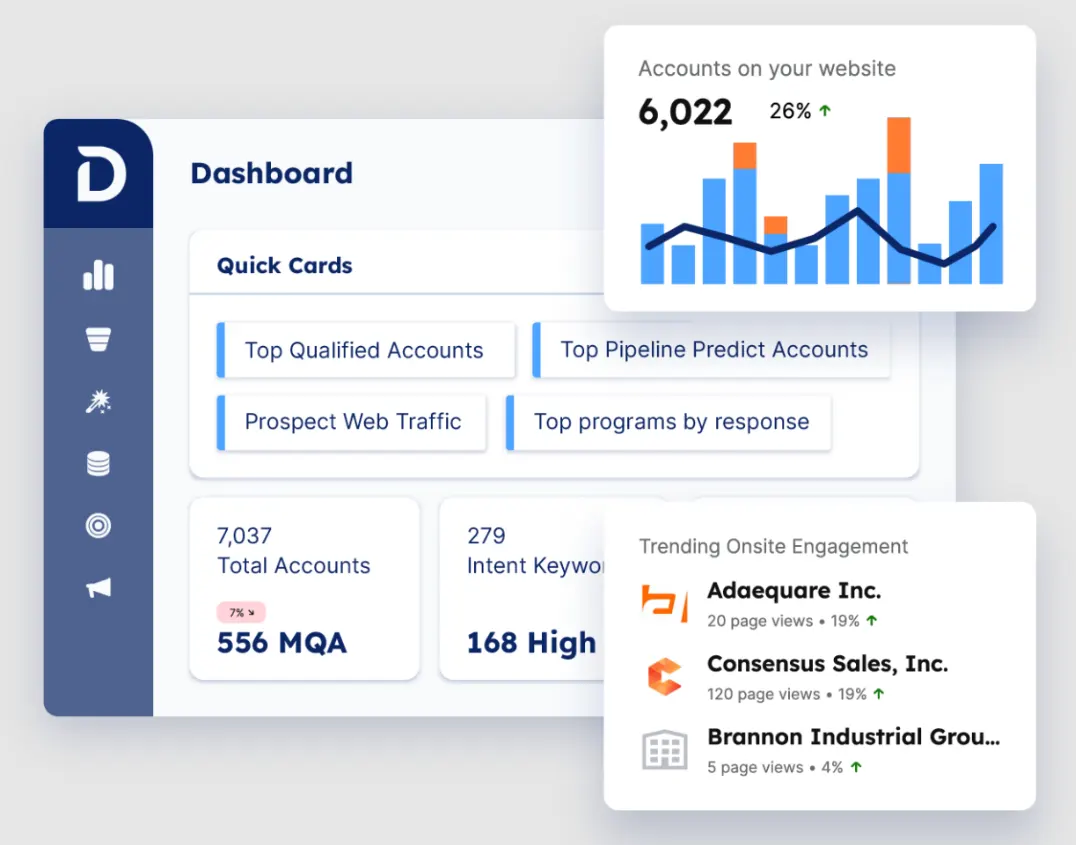
- Account scoring: Reads your enriched fields continuously alongside intent and engagement signals, then ranks accounts by how close they look to a purchase. The ranking moves as behaviour changes, so reps see which accounts warmed up recently.
- Buying groups: Identifies which people at an account are involved in a purchase, which matters when several stakeholders research you before anyone fills in a form. Palo Alto Networks saw 2.3 times higher average deal sizes on opportunities where a buying group was present.
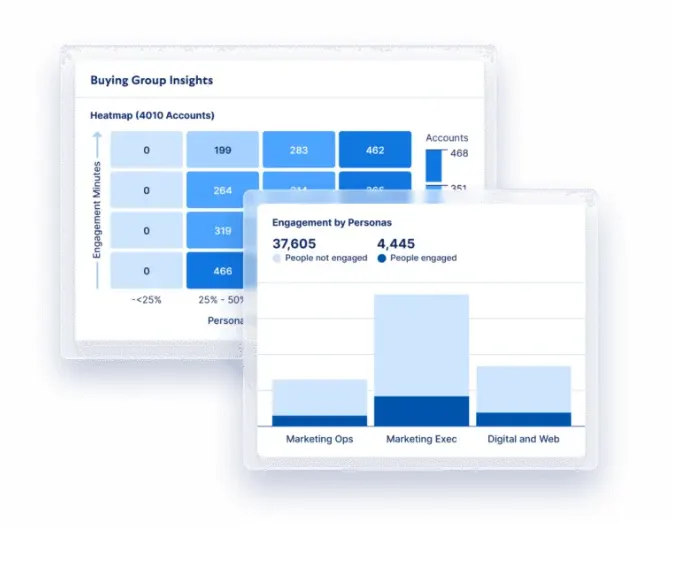
- Demandbase Advertising: Points display and social budget at the accounts your data identified. The audience comes from the same records your reps work, so marketing and sales target the same list.
If Clearbit was doing two jobs for you, this covers both in one place. Book a demo and see how enrichment, account identification, scoring and advertising work off the same account record.
FAQs
Is there a free alternative to Clearbit?
Yes, several. Leadfeeder’s free tier identifies up to 100 companies a month, People Data Labs gives you 100 API lookups a month permanently, and 6sense offers 50 monthly credits on its free Sales Intelligence tier.
Demandbase also has a free website traffic tool for checking which companies visit your site. None of them cover everything Clearbit’s free platform did, but each handles one job well enough to start.
Can I still use the Clearbit API?
If you already pay for Clearbit, yes. The Person and Company APIs still return data for existing customers.
If you have no contract, you cannot get one, because HubSpot closed new standalone subscriptions. The free Logo API is gone for everyone, since it shut down on December 8, 2025.
Is Breeze Intelligence the same as Clearbit?
No. Breeze Intelligence was the name HubSpot used for a set of data capabilities after acquiring Clearbit, but HubSpot has since moved enrichment into Smart CRM under the name HubSpot Data Enrichment.
Clearbit is the acquired standalone product and data business; HubSpot Data Enrichment is the current HubSpot-native enrichment capability. HubSpot says its current enrichment uses HubSpot’s commercial dataset, third-party providers, and publicly available information, so it should not be described as simply the same Clearbit dataset under a new name.
Can I still buy Clearbit in 2026?
No. HubSpot says it is no longer offering new standalone Clearbit subscriptions. Existing Clearbit customers continue to be supported, but new buyers need to use HubSpot’s current data products or choose another Clearbit alternative.
What replaced Clearbit?
No single product replaced every part of Clearbit. HubSpot Data Enrichment is the closest continuation for HubSpot-native enrichment, while products such as Demandbase, Leadfeeder, and 6sense address company-level website identification. People Data Labs, Apollo, and Clay are options for teams replacing direct API workflows.
Start with the Clearbit capability you actually used, then compare products within that category.
Book a meeting to see how Demandbase can replace more than Clearbit enrichment



We have updated our Privacy Notice. Please click here for details.