

A practical guide to generative AI for B2B marketing

What is generative AI?
Generative AI (or GenAI for short…) is a type of artificial intelligence that creates new content (text, images, code, audio, even videos) based on what you ask it to do.
For example:
- You give it a prompt (a question, command, or task) like: “Write a LinkedIn post about ecommerce marketing trends in 2025.”
The GenAI tool will analyze everything it has learned from millions of marketing posts, blogs, and data sources. It will then generate a fresh post, complete with structure, tone, and insights.
The key tech powering this is called a large language model (LLM)—like GPT (which powers ChatGPT).
These models are trained on massive amounts of data from the internet, books, and internal documents to understand language, logic, tone, and structure.
These models are trained on massive amounts of data from the internet, books, and structured datasets—giving them a broad understanding of patterns and context.
Why should B2B marketers care?
Because B2B marketing today is faster, noisier, and more competitive than ever. To make it worse, budgets are tight— with 73% of marketers expected to do more with less and 64% not even having the budget to execute their strategy.
Ewan McIntyre, VP analyst and Chief of Research at Gartner calls this the “new normal” due to lack of funding in the market.
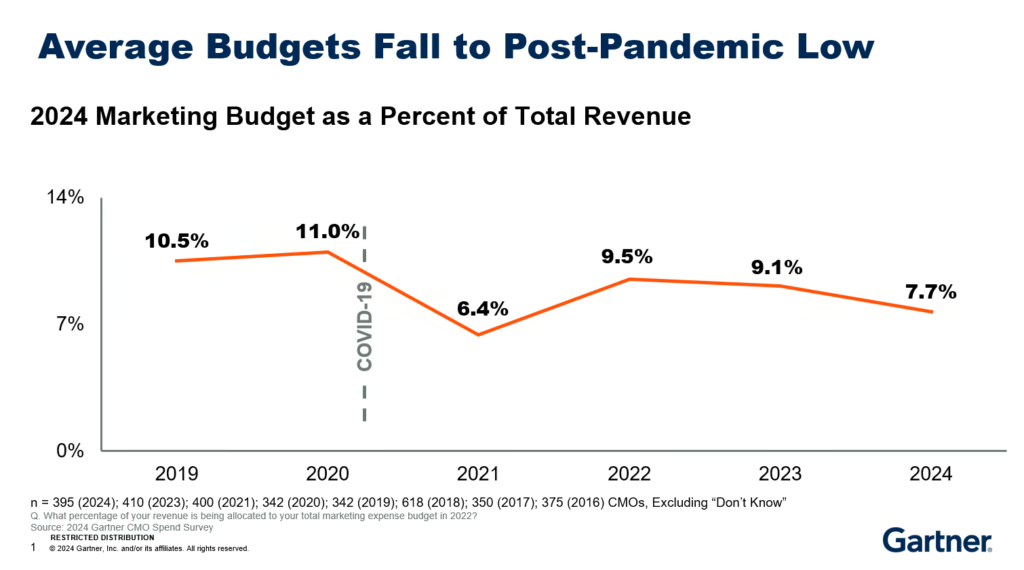
In all of this, the expectation to produce high-performing content, campaigns, and results hasn’t slowed down.
On the flip side, GenAI presents an opportunity for these types of marketers, shifting how they create, operate, and compete.
Listen → Future of Artificial Intelligence and Machine Learning | Demandbase
Increased productivity
One of the biggest day-to-day struggles in marketing is time. Time to write that new campaign, time to personalize messaging for different personas, time to brainstorm new angles.
According to CMI, 58% of content marketers cite lack of internal resources as a major challenge. And about 50% of them have problems creating the right content for the right audience.
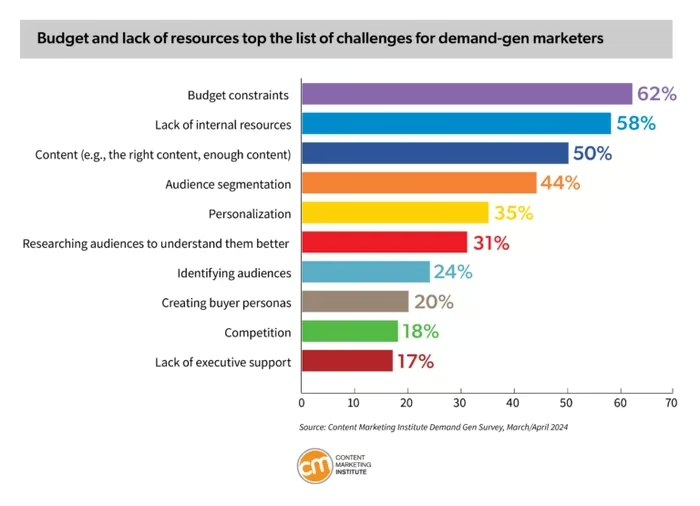
Generative AI addresses this directly by eliminating the blank page problem.
Whether you’re crafting an email sequence, outlining a blog, or generating ad variations, GenAI can spin up a draft in seconds.
This gives you something to kickstart, making it easier to iterate as you go. 83% of marketers further support this, according to survey respondents in a recent report from CoSchedule.
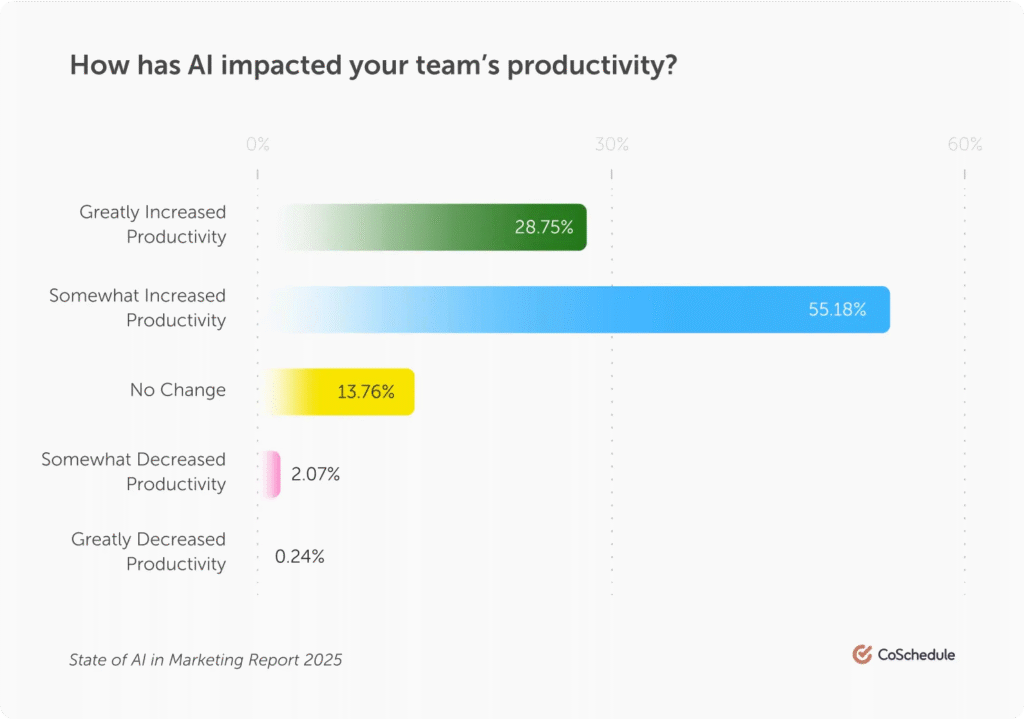
Over time, this has a compounding effect. One marketer can now ideate, draft, and finalize content at a pace that would’ve required an entire team.
That means faster turnarounds, improved customer experiences, fewer bottlenecks, and more time spent on the parts of the job that actually move the needle, like strategy, analysis, and experimentation.
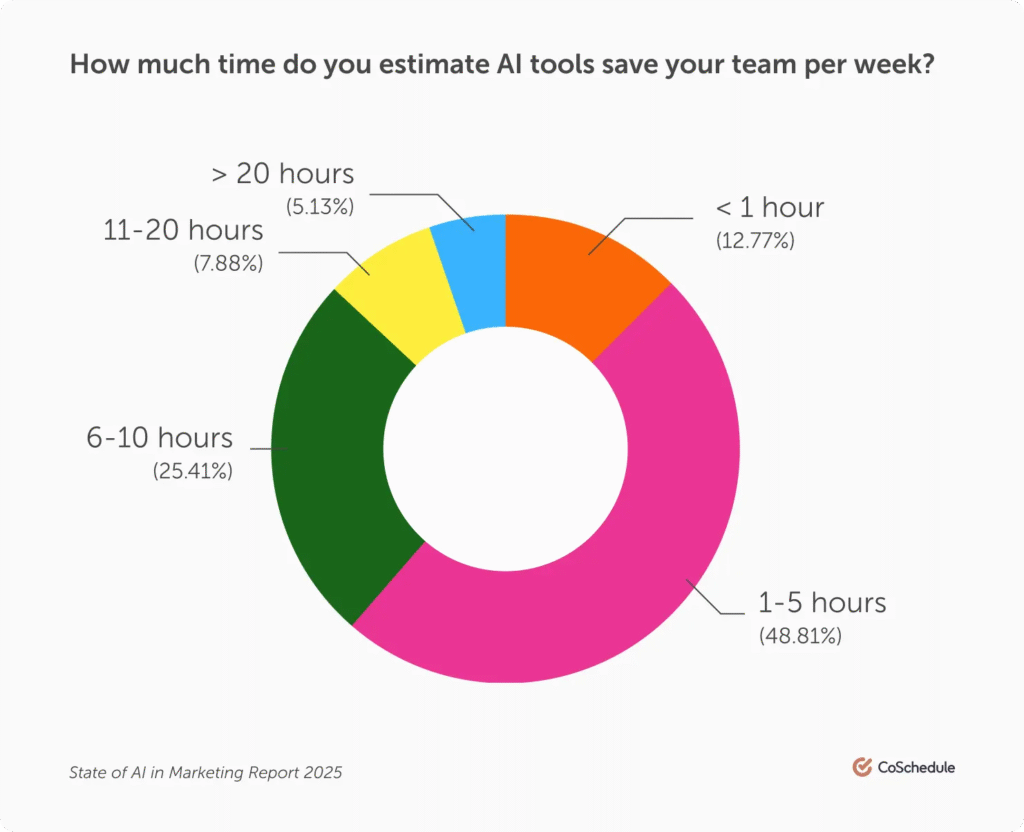
Recent reports show marketers saving an average of 5+ hours weekly using AI tools.
Related → Can AI really make go-to-market more productive?
Enhanced efficiency across the funnel
Beyond prompting your favorite GPT and getting a response, GenAI also reduces friction across the entire marketing workflow.
For example, it can;
- summarize competitor intel for the sales team,
- turn a webinar into five different content formats,
- create briefing docs, meeting recaps, and even FAQs for product launches.
And all of this with a single prompt.
Faster buyer journeys
The buyer’s journey today is completely different from a decade ago. They don’t need to be nurtured and hand-held through every stage.
In fact, most high-value prospects are are already 50–70% through their decision-making process before they even talk to sales. This is why momentum matters.
However, most B2B deals are still stuck in this cycle of slow follow-ups, generic touchpoints, delayed content delivery, giving prospects room to cool off and look elsewhere.
Generative AI helps solve this by keeping the conversation going.
Let’s say a prospect downloads your product’s pricing guide. GenAI can create a follow-up email (or sequence) based on their job role, company size, and behavior. The prospect stays engaged, feels seen, and moves more quickly through the funnel.
Now multiply that across hundreds of accounts, and you’ll feel the impact on your bottom line.
Hyper-personalization
You already know that personalization works. But at scale, it’s been nearly impossible to do without serious automation or a huge writing team.
GenAI offers a (near perfect) solution. It allows you to create multiple versions of the same message—each tuned to a specific persona, industry, use case, or buyer stage—without manually rewriting everything.
For example, let’s say Tim, a demand gen marketer at a cybersecurity startup, needs to launch a new marketing campaign targeting CISOs. Here’s how GenAI helps him:
- Campaign naming: He types, “Give me 10 campaign name ideas about zero trust security for CISOs.”
- Email sequence: Then he says, “Write a 3-part cold email sequence introducing our zero trust platform.”
- Social copy: Next, “Turn this blog into 5 LinkedIn posts with strong hooks.”
- Landing page: “Summarize the value of zero trust in a headline + 3 bullet points for a landing page.”
He can even go a step closer by creating landing pages that speak to different job titles, or ads that address region-specific compliance issues.
Stats to munch on:
- 84% of marketers believe personalization is more attainable with AI.
- 88% of marketers plan to use AI in their personalization efforts.
- Marketers are expanding their use of AI into analytics and 90% believe acting on buyer insights will be faster and easier with AI.
Webinar → AI-powered B2B advertising: the future of targeting and personalization
Your buyer is a machine (a.k.a. algorithms)
Before you get to an actual human buyer, you need to get past their machines first. AI-powered inbox filters, feed algorithms, and summarization tools are the new gatekeepers.
And increasingly, your content is being processed, summarized, and filtered before a human ever reads it.
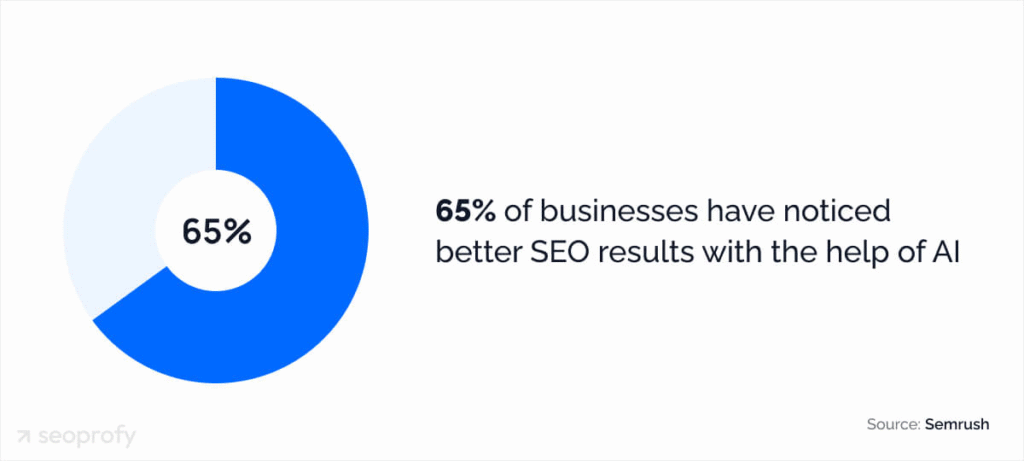
That changes how you write. Generative AI helps you optimize content for these gatekeepers, using smart prompts to suggest the best meta descriptions, keyword placement, and even video scripts based on ranking signals. The companies who understand this dynamic will get their ideas heard.
Competitive edge in fast-moving markets
The speed of execution has become one of the most powerful competitive advantages in B2B marketing.
If your competitors are using GenAI to publish faster, test more ideas, and personalize messaging more effectively, they’ll learn faster than you.
They see what’s working sooner. They shift direction with less friction. They ship new messaging before your team has finished drafting its first version. That’s what makes this so important.
Related → AI: Promise or Hype?
Key applications of GenAI in B2B marketing
Content creation for every funnel stage
Every B2B content marketing team needs content—from awareness-building blogs to mid-funnel guides and bottom-funnel case studies.
GenAI streamlines this entire process by giving marketers the ability to quickly draft high-quality content that matches buyer intent and funnel position.
You can input a topic, desired tone, and target persona, and have a full draft ready within minutes.
But the real magic happens in volume. Instead of just one ebook, you now have five landing pages, ten ad copy versions, a nurture email sequence, and four social media posts—all derived from the same core message.
Example: Let’s say your marketing team just hosted a 45-minute webinar on “Risk Mitigation in Cloud Security.” You want to make the most of it.
With GenAI, you feed in the transcript and prompt:
“Summarize this webinar into:
- A long-form blog post
- 3 LinkedIn posts
- 1 nurture email
- A bullet list for a sales enablement one-pager.”
Personalized email campaigns and nurture flows
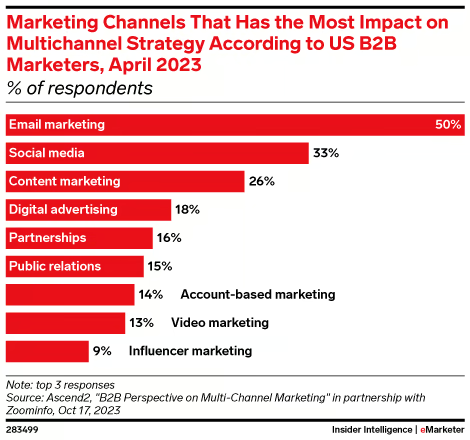
Email remains one of the most effective channels in B2B.
However, writing email sequences that feel personal, timely, and relevant to each segment is tough.
GenAI makes this scalable.
Rather than sending the same generic message to every lead, you can generate multiple variations of your copy tailored to industry, role, stage in the funnel, or past engagement behavior.
This makes your email nurturing smarter and more dynamic.
Example: Suppose you’re launching a new integration with Salesforce.
You need an email sequence that educates users about the integration, invites them to a demo, and nudges those who show interest.
You prompt GenAI:
“Create a 3-email sequence for mid-funnel leads announcing our Salesforce integration. The tone should be confident but friendly, targeting RevOps leaders in mid-sized SaaS companies.”
GenAI delivers:
- An announcement email with a clear CTA
- A follow-up with use case examples
- A final nudge with social proof and limited-time demo offer
With the result, you can later fine-tune the copy to your taste and hit send.
Sales enablement materials
B2B sales teams are always asking for help: case studies, one-pagers, objection-handling scripts, or quick competitor comparisons. And in account-based marketing (ABM), this work must scale across dozens or hundreds of accounts.
GenAI bridges the gap between marketing and sales by
- Auto-generating 1:1 battlecards for specific industries or competitors
- Customizing cold email copy based on firmographics or behavior
- Generating responses to common sales objections
- Helping SDRs quickly create personalized outreach sequences
Example: Your SDR is preparing for outreach to a healthcare tech company in your ABM list. Instead of writing everything from scratch, they type:
“Generate a cold outreach email for [Company X], a healthcare data platform. Focus on how our product helps reduce compliance risks and speed up audits. Keep it under 120 words and be friendly-professional.”
The result is a concise, tailored message aligned to the account’s pain points—with room for personalization if needed.
Now imagine scaling that to 50 accounts a week.
Webinar → ABM and AI 2025 marketing use cases | Demandbase
Conversational marketing
Buyers want instant answers, 24/7 availability, and real-time engagement. All of which has made AI-powered chatbots and virtual assistants the go-to for most businesses.
However, basic bots are not enough. B2B buyers now expect intelligent, human-like responses— and GenAI makes that possible.
It’s like putting your best customer rep on your website to answer complex product questions, guide users to the right content, qualify leads, and even schedule demos.
In addition, GenAI understands nuance, remembers context across messages, and adapts responses based on how technical or casual the user is.
This creates a smoother, more intuitive buying experience, driving higher levels of customer engagement throughout the journey.
Example: Suppose you run a B2B analytics company, and add an AI-powered chatbot to your pricing page.
When a CMO visits the site and types, “Do you offer volume discounts for multi-region teams?.
Instead of a dead-end FAQ or ticket submission form, your chatbot replies conversationally:
“Yes, we offer custom pricing tiers for multi-region deployments.
Would you like to see a breakdown or schedule a 15-minute call with one of our solution consultants?”
That same bot then gathers email, company size, and tech stack details—and automatically routes the lead to the right rep.
Related → AI agents for marketing: top solutions & use cases for 2025
Impacts of generative AI on B2B marketing
Better use of first-party data
As third-party cookies phase out and data privacy tightens, B2B marketers are under pressure to make better use of their own first-party data.
GenAI becomes a natural partner in that customer journey. It can ingest CRM data, customer interviews, and sales call transcripts to help generate content that reflects real buyer language, behavior, and intent.
You can also train prompts based on past successful deals, lead scoring models, common questions, or recurring objections, and use those insights to tailor campaigns or improve messaging.
Related → AI agents & GTM strategy: 5 critical pitfalls to avoid | Demandbase
Faster go-to-market (GTM) execution
Traditionally, launching a new product, campaign, or repositioning takes a while (weeks…sometimes months).
Multiple teams need to align, content has to be created from scratch, and messaging must be tested and validated before you go live.
GenAI compresses this entire timeline. It gives you the ability to generate messaging drafts, create campaign copy, spin up landing pages, and brainstorm creative directions all within a single sprint.
For example, Lumen Technologies recently reduced their time-to-launch campaigns from 25 days to 9 days using Adobe Gen Studio.
Related → AI strategies that will define GTM success in 2025
Increased creative capacity with smaller teams
B2B marketing is often constrained by limited headcount and bandwidth. Even if you’ve got brilliant minds on your team, there are only so many hours in a week to produce content, analyze data, launch campaigns, and support sales processes.
Generative AI acts like a creative multiplier. It can assist you with writing,ideation, content repurposing, tone adaptation, and even creative brainstorming.
One content marketer can now do the work of three, and a lean growth team can ideate, launch, and refine campaigns without needing a full agency retainer or extra hires.
This allows smaller teams to produce polished, personalized, and high-volume marketing material without compromising quality.
Creates a culture of experimentation
In most B2B teams, testing is something you want to do, but rarely have time for. Crafting multiple variations of a subject line or a landing page requires time, resources, and approval layers.
But with GenAI, experimentation becomes a default. You can now generate 10 CTA variations, rephrase headlines for different segments, or test multiple intros to the same piece of content. Teams can ship, test, learn, and repeat at a much faster way.
Shortened sales cycles and smarter enablement
The ripple effect of faster content creation, better personalization, and smarter buyer engagement is simple: the sales cycle shrinks.
GenAI gives marketers the ability to equip sales with customized decks, tailored leave-behinds, real-time competitor comparisons, and more—right when they need it.
With this, sales reps now get buyer-specific assets that align perfectly with messaging, pain points, and industry context. This accelerates trust, reduces objections, and keeps deals moving.
Related → AI Agents Will Eat Your Pipeline Or Save It
How to implement generative AI in your B2B marketing strategy
Identify the Bottlenecks in Your Marketing Workflow
Choose the Right Tools Based on Task Type & Control
Assign Human + AI Collaboration Roles
Create an Internal Prompt Library
Set Guardrails for Brand Voice, Compliance, and Approval
Measure and Document the Impact
Expand to Cross-Functional Teams
Identify the bottlenecks in your marketing workflow
Before you try out prompts or pick a tool, evaluate the purpose of integrating GenAI into your B2B marketing strategy.
This means auditing your current workflows across the full marketing lifecycle (ideation → campaign launch → reporting).
The goal here is to identify repeatable, time-consuming, or manual tasks that GenAI could assist with.
What to look for:
- Do you spend too long writing first drafts?
- Is content repurposing inconsistent?
- Are sales enablement materials always delayed?
- Does your team struggle with segmentation or personalization?
Highlight any stage that is resource-heavy, repetitive, or bottlenecked, these are your best GenAI pilot zones.
Example: You realize your team spends:
- ~6 hours writing first drafts of blog posts
- Another ~2–3 hours rewriting the same post into email campaigns and LinkedIn posts
That’s nearly a full workday per post. So, you decide to start with AI-powered content repurposing as your first workflow target.
Choose the right tools based on task type & control
Now that you know the use case, choose tools that map to your goals. You don’t need a massive AI stack to start, just the right one or two tools that solve your immediate bottleneck.
Types of GenAI tools to consider:
- Text Generation (e.g. Jasper, Copy.ai, ChatGPT) for blog posts, emails, campaign copy.
- Design/Visual Generation (e.g. Midjourney, Canva AI, Adobe Firefly) for creative assets.
- Meeting and Content Repurposing (e.g. Grain, Descript, Scribe, Claude) for transcripts and summaries.
- Custom Workflows (e.g. Zapier + OpenAI, Notion AI, Airtable AI) for internal automations and scalable prompts.
What matters isn’t really the tool, but how easily it fits into your team’s existing workflows.
Example: For your blog repurposing task, you could use:
- ChatGPT to generate first drafts and post variations
- Notion AI to organize assets and standardize formatting
- SurferSEO to structure outlines with keyword targets before AI writes
Assign human + AI collaboration roles
To avoid confusion or sloppy output, define what the AI should do, and what only a human should touch.
Here’s how to do it:
- Let’s say you want to optimize your content process, by breaking it into phases (e.g., ideation → outline → draft → edit → format → publish)
- For each phase, we’d be dictating what goes to AI and what should be reviewed by a human.
- You’d also document this in your workflow SOP or internal playbook for future reference.
- Also add guidelines like:
- “Humans always review final CTAs”
- “AI only drafts; editor must refine tone”
- “AI cannot make compliance claims without manual approval”
Example: For a marketing team, here’s how your blog workflow roles could be assigned:
| Phase | Responsible Party | Notes |
|---|---|---|
| Ideation | Human + AI | AI helps suggest 10 topic angles |
| SEO Brief | Human + SurferSEO | Human tweaks based on content strategy and SEO goals |
| First Draft | ChatGPT | Using custom prompt template |
| Editing | Content Editor | Reviews tone, adds product links |
| Repurposing | AI (email + LinkedIn) | AI generates snippets from blog draft |
| Approval | Marketing Lead | Final check and scheduling |
Create an internal prompt library
GenAI is only as good as the prompt you give it. To avoid starting from scratch every time, build a prompt library for your team with structured templates, proven frameworks, and role-specific examples.
Here’s how to do it:
- Write your prompts with a structure that covers all areas of your product’s use case. It should answer:
- Who is the target audience?
- What do we want them to know?
- What tone do we want to strike?
- What format/structure should the output take?
- Save effective prompts in an internal “Prompt Library”
Depending on the results, you should also tweak new prompts based on output coherence, brand voice consistency, and speed of usability.
Example: Here’s a reusable prompt template for repurposing:
“You are a B2B SaaS content marketer. Use the blog post below to create a LinkedIn post.
- Audience: mid-level marketing managers.
- Tone: Smart, conversational, no jargon.
- Goal: Share a surprising insight and invite engagement.
- Output: Hook (2 lines) + Body (4–6 lines) + Question CTA.”
You test this across 5 blog posts and refine based on what performs best.
Set guardrails for brand voice, compliance, and approval
The problem with AI tools is they’re prone to mistakes. So if you don’t control the output, it can mislead your audience.
Guardrails ensure every AI-assisted asset still feels like you and aligns with compliance and internal policies.
Here’s how to do it:
Write a short “Voice & Style for AI” document:
- Tone traits (e.g., bold, clear, practical)
- Language to avoid (e.g., buzzwords, filler)
- Formatting preferences (e.g., short paragraphs, active voice)
Next, add disclaimers where needed:
- “No compliance promises unless manually verified”
- “Never mention client names without approval”
Example: You can implement this in your marketing team documents:
- “Always write in second person”
- “Avoid superlatives unless backed by data”
- “CTAs must be focused on discovery and not hard selling”
These rules are now added to every GenAI prompt template.
Measure and document the impact
Once your pilots are running, start measuring their impact. Set up simple but effective ways to track key metrics such as:
- Time saved per task or per project
- Output increase (e.g., number of assets created, faster turnarounds)
- Engagement lift (e.g., CTR, open rates, conversion rates)
- Quality control (Was editing time reduced? Did AI content pass brand voice checks?)
Also gather qualitative feedback from team members to understand if AI tools are making their job easier, and whether it should be scaled up or phased out.
Example: After 6 weeks of AI-enhanced nurture campaigns, you compare engagement data and find open rates improved by 17% and copywriting time dropped by 40%.
That’s enough to justify expanding to ABM campaigns next.
Expand to coss-functional teams
Once marketing sees success, bring in your broader go-to-market (GTM) ecosystem:
- Sales: Cold outreach, demo follow-up emails, objection handling scripts
- Customer Success: Onboarding playbooks, help docs, quarterly business review decks
- Product: Feature summaries, internal enablement, release notes
Create shared AI libraries that serve everyone, making marketing the hub of enablement.
Example: Say sales wants more tailored email templates for outreach.
Marketing can use GenAI to generate a library of persona-specific value props + CTAs. CS adapts that same messaging into onboarding emails. Everyone wins.
5 common gen AI risks in B2B marketing (and how to solve them)
Inaccurate or fabricated information (AI hallucinations)
GenAI has a tendency to “hallucinate”—meaning it confidently outputs information that sounds true but is completely false.
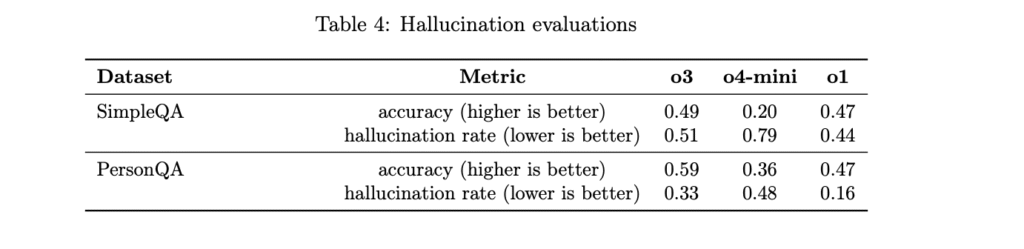
In fact, when OpenAI conducted research on its latest and powerful models (o3 and o4-mini), it discovered that it hallucinated 33-48% of the time.
This is especially risky for B2B companies where buyers expect accurate, verified claims. AI might invent fake statistics, cite non-existent reports, or confuse product features between vendors.
Imagine your product page says your platform is SOC 2 certified when it isn’t. Or your blog claims a competitor raised Series D funding when they’re still in Series A.
Solution: Implement a Human-in-the-Loop Workflow
Every GenAI-generated asset (especially anything customer-facing) should go through human review by a subject matter expert (SME).
This should be standard policy for blog posts, comparison pages, technical explainers, and product content.
You can also use prompts that instruct the AI to avoid fabrication. For example:
“Only include statistics that are widely cited and verifiable from real publications. If unsure, leave it out.”
This helps reduce hallucination at the source.
Off-brand or inconsistent messaging
AI technologies are trained on public data, not your company’s internal brand guidelines or positioning strategy. Out of the box, they have no idea what your tone of voice is, what makes your product different, or how you communicate to your target personas.
Without guardrails, they might generate language that sounds generic, mismatched, overly casual, or even contradictory to your messaging.
This is dangerous in B2B because buyers are often skeptical, risk-averse, and highly attuned to how vendors communicate.
A small slip—like describing a cybersecurity solution as “fun and quirky”—can instantly kill credibility to key stakeholders.
Solution: Create a Detailed Brand Voice Guide AI:
Break down your voice by tone (e.g., authoritative, witty, empathetic), sentence structure, vocabulary, and style. Then translate that into a “Brand Prompt Template” like:
“Write this blog post in a confident, punchy tone using short, declarative sentences. Avoid jargon. Use analogies where appropriate. We sound like a helpful advisor, not a sales rep.”
You can also go a step further by feeding the AI a paragraph or two of your best existing content as a tone reference:
“Use the writing style below as your reference. This is how we explain complex topics to B2B marketing teams…”
Data privacy and IP exposure
Feeding proprietary data (like unpublished product roadmaps, customer data, or internal notes) into GenAI tools (e.g., public ones like ChatGPT) can pose serious data security and privacy risks.
You risk unknowingly exposing private information to third-party systems, risking privacy violations or breaches of NDA.
A recent incident can be traced back to 2023, when a ‘system malfunction’ allowed some ChatGPT users’ to see others’ conversation titles.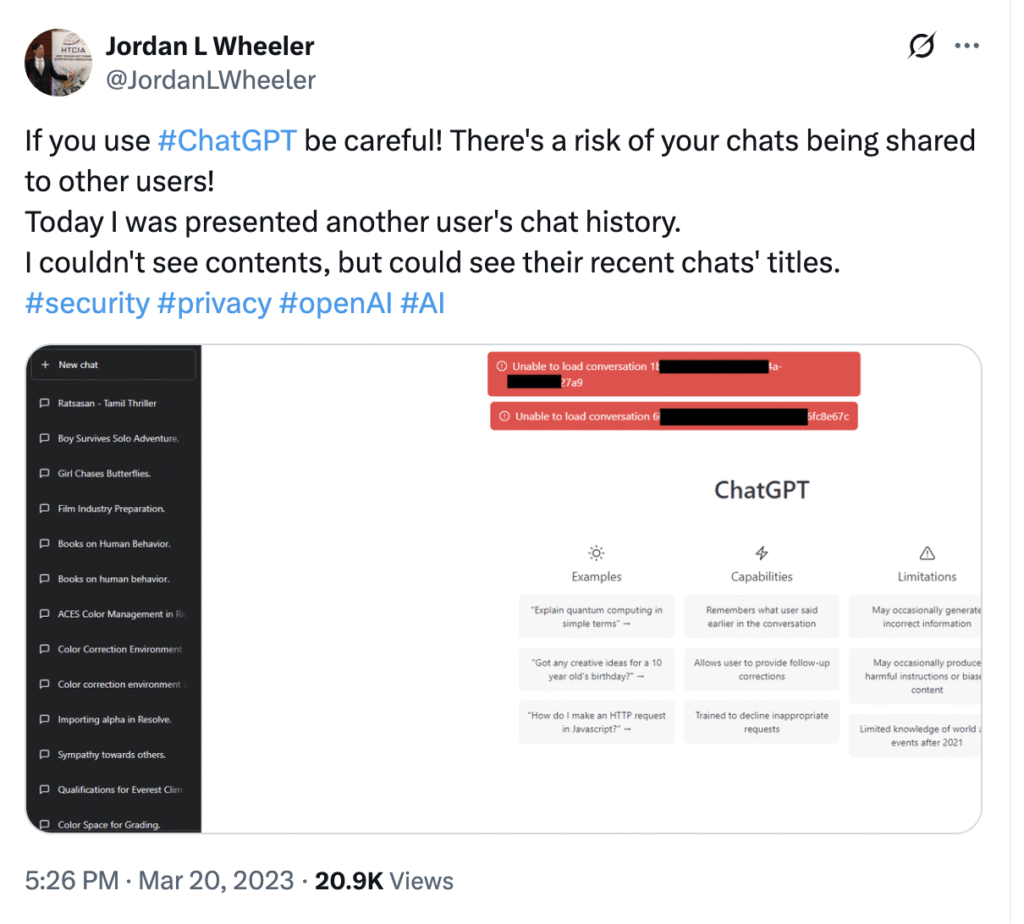
Solution: Establish Clear Guidelines on What Not to Input
Build a documented policy that outlines banned input types, such as:
- Customer names/emails
- Proprietary code
- Contractual or financial information
- Anything governed by NDAs
Next, educate your team not to dump sensitive PDFs or meeting transcripts into chatbots. Instead, anonymize inputs or summarize key points manually before using AI.
“Summarize this customer interview transcript. The client is a Fortune 100 insurance company.”
Do not mention a name.
Overdependence on AI for creativity and strategy
When teams start seeing how fast and easy GenAI can be, there’s a tendency to rely on it too much. Instead of using it to assist creative thinking, they let it do the thinking for them.
Over time, this creates lazy marketing—bland, and indistinguishable from competitors who are doing the same thing.
You end up with a safe, generic copy that’s well-written but says nothing new. You stop speaking to your customer’s true pain points or differentiating your brand.
A recent study was conducted on students’ cognitive capabilities. Researchers found that ‘68.9% of students exhibiting increased laziness and 27.7% experiencing a degradation in decision-making abilities’ can be linked to the over-reliance on AI systems.
Solution: Set Up A Framework for Using AI
Structure your workflow like this:
- You define the strategy: audience, angle, purpose, differentiation.
- AI generates a draft: with structure, tone, and formatting.
- You inject insight: refine with your own perspective, add original stories, real customer examples, or fresh market positioning.
Also encourage your team to brainstorm campaign ideas or positioning statements without AI prompts, and only bring in GenAI later to help articulate or expand on what you’ve already decided.
Legal, ethical, and copyright concerns
Because GenAI is trained on vast datasets from the internet, it can unintentionally replicate content structures, phrases, or data from copyrighted sources.
If your team uses AI-generated copy without checking, you might accidentally publish plagiarized work—or worse, content that mirrors a competitor.
Ethical issues also come into play when AI-generated content blurs the line between real human insight and machine-written filler—particularly in thought leadership, or opinion pieces.
Solution: Avoid Publishing AI Output Without Edits
Always run AI-generated content through a plagiarism checker like Grammarly, Copyscape, or Originality.ai before publishing. It won’t catch everything, but it’s a strong line of defense.
And also note that AI-generated images and icons may resemble copyrighted work. Have designers vet every output for likeness, especially if publishing externally.
Recommended → Navigating AI in 2025: key takeaways from Tom Gruber (Co-Founder of Siri)
What the future looks like for AI-first B2B teams
Campaigns will be built in real time around buyer signals
Right now, most B2B campaigns are planned in quarterly cycles. But in the AI-first future, that’s too slow.
With GenAI and predictive analytics tools working hand-in-hand, campaigns will be dynamically built around real-time buyer intent signals.
Picture this: An account surges in activity, visiting your pricing page three times.
In response, your AI engine instantly generates a personalized email, a case study tailored to their vertical, and a one-pager comparing your solution to their current stack. That content gets sent or activated within hours while the lead is still warm.
Content operations will run as scalable systems
In AI-first teams, content will be systematized and repurposed by design. A customer webinar instantly becomes a blog series, three social carousels, five SEO-optimized FAQs, and a battlecard for sales.
In addition, teams will build content supply chains, powered by GenAI, that take every major asset and repurpose it across channels, personas, and funnel stages with minimal manual effort.
This level of scale and systemization means AI-first teams will dominate organic visibility, thought leadership, and social engagement.
Marketers will co-create with AI
It’s tempting to see GenAI as just a marketing automation tool. But the future shows a far more collaborative system.AI-first marketers would use these tools to speed up repetitive work, co-create ideas, campaign angles, narrative frameworks, and customer stories.
Prompting will become a creative skill in itself. That means knowing how to shape language, and refine outputs through intelligent iteration.
Note: This won’t replace creativity or humans. It’ll only free marketers from mundane work, enabling them to reallocate time to more strategic marketing efforts like audience research and campaign optimization.
Sales and marketing will finally speak the same language
AI will act as a bridge between teams that have historically been misaligned. With shared insights, automated enablement content, and intelligent workflows, sales and marketing will collaborate more naturally.
For example;
- When a sales rep identifies a new objection, they can input it into a shared AI system that instantly generates a revised battlecard or FAQ response.
- When marketing launches a campaign, the AI can proactively prep sales with personalized scripts, visuals, and competitive talking points.
This fluid, AI-driven feedback loop ensures messaging stays aligned, and teams move together as one unified revenue engine.
You + GenAI + Demandbase = B2B power move
…Or to say it in the words of Jared Levy, Growth Marketing Manager, League —
“With Demandbase, we effectively transformed advertising spend into qualified opportunities. Through precision targeting and actionable insights, we’ve strengthened cross-functional alignment, accelerated pipeline growth, and delivered measurable impact in the areas that matter most.”
Read Case Study → How League increased meeting bookings by 41% using Demandbase
Which begs your next question: Why choose Demandbase?
Because you get three things:
- Smart segmentation. We understand B2B buyers and know they don’t act alone. There are researchers, blockers, champions, etc., and they all move differently.
- Demandbase helps you understand who inside those accounts is taking action, what roles are heating up, and how to engage each one.
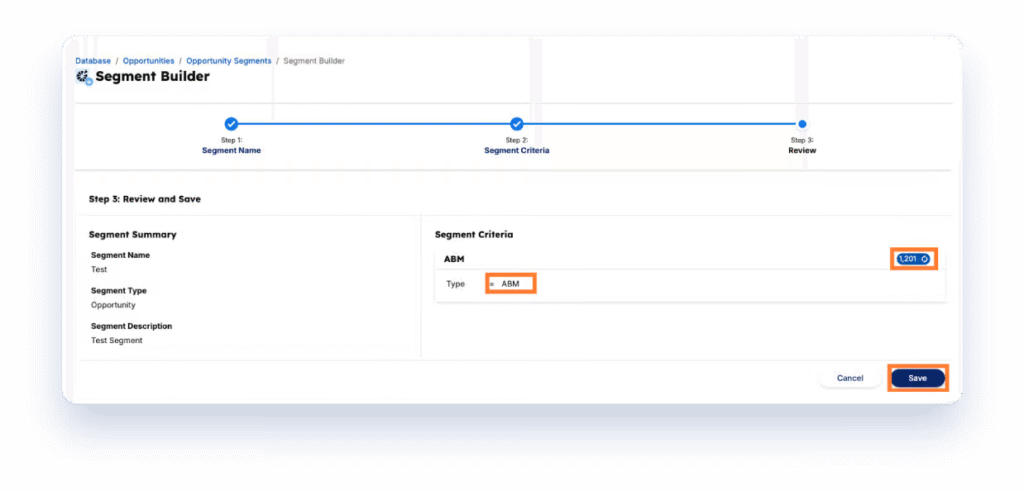
- Demandbase helps you understand who inside those accounts is taking action, what roles are heating up, and how to engage each one.
- AI-augmented account intelligence. Most “personalized” B2B campaigns are just templated emails with {{company_name}} dropped in.
- Demandbase changes that. It layers AI on top of rich account data (including firmographics, technographics, historical engagement, and buying team structure) so you can create genuinely intelligent messaging for each segment.
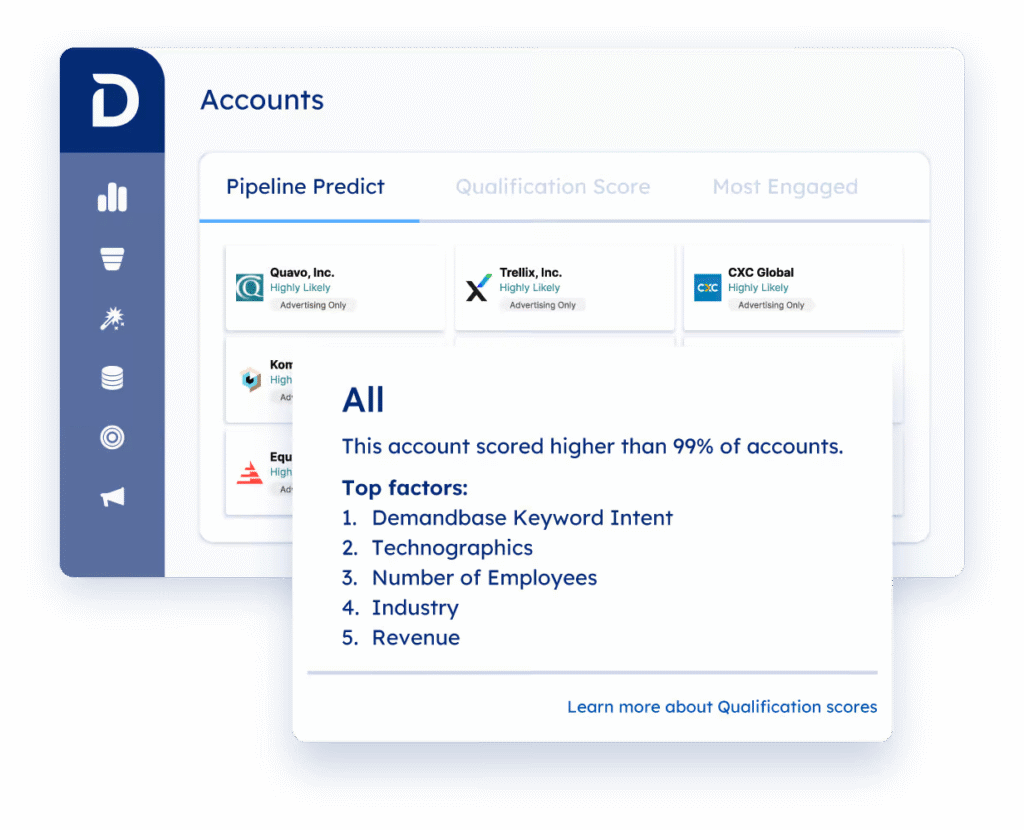
- Demandbase changes that. It layers AI on top of rich account data (including firmographics, technographics, historical engagement, and buying team structure) so you can create genuinely intelligent messaging for each segment.
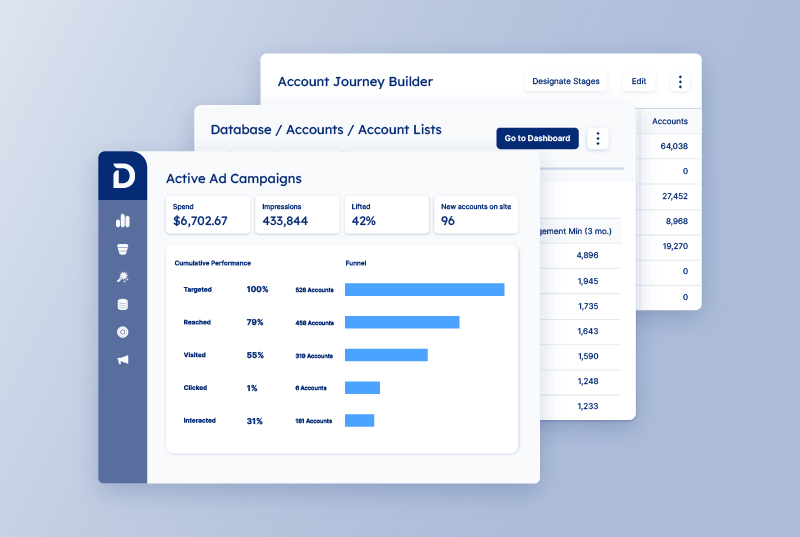
- Seamless activation across channels. One of the biggest challenges in B2B is fragmented execution. You write a LinkedIn ad here, an email there, and hope it all aligns. It rarely does.
- Demandbase gives you a unified platform to activate your GenAI-powered content across the right channels—from programmatic ads to outbound email to personalized web experiences—without breaking flow or message consistency.
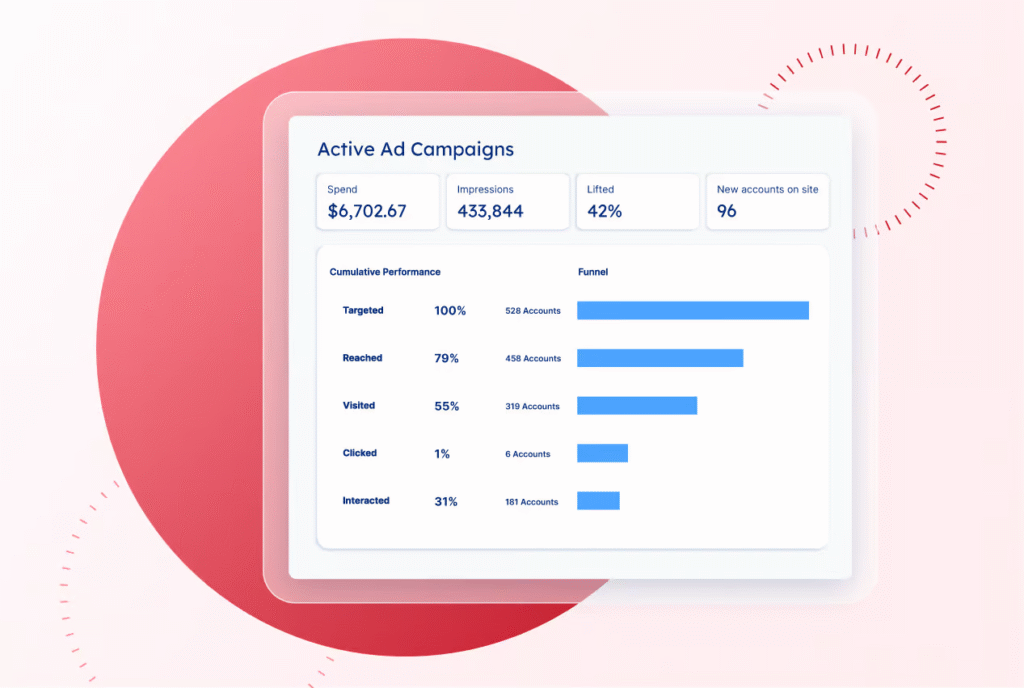
- Demandbase gives you a unified platform to activate your GenAI-powered content across the right channels—from programmatic ads to outbound email to personalized web experiences—without breaking flow or message consistency.
But don’t take it from us. Here’s what Thera Martens, Vice President Marketing, Embedded Analytics and Partnerships at Visier, had to say —
“We’ve gotten to the right accounts much faster using the magic of Demandbase and LinkedIn together.”
Read case study → Visier sees a 234% higher click-through rate with an ABM approach using Demandbase + LinkedIn
Let’s build your AI-first B2B motion together.


We have updated our Privacy Notice. Please click here for details.