

AI in account-based marketing: the complete guide for 2026

Only about 5% of your target accounts are in-market at any given time. The rest aren’t looking, aren’t ready, or don’t even know they have a problem yet.
That’s always been one of the core challenges of ABM. You need to find the right accounts, reach them at the right moment, and make your message feel relevant.
Doing that manually across hundreds or thousands of accounts doesn’t scale. And that’s a big reason why AI adoption in ABM has taken off so fast.
Demandbase and ForgeX research found that 91% of B2B marketers now use AI in their ABM programs. The problem is that only 19% have a formal plan for how they’re using it. Most teams added the tools without rethinking the process around them.
This guide is here to fill that gap. From finding high-value accounts and reading intent signals to personalizing outreach and measuring pipeline impact, you’ll get a clear picture of what good AI-powered ABM looks like and how to get there.
The intersection of AI and account-based marketing
Most B2B teams have been running ABM the same way for years. And that process has a ceiling. It holds together when you’re working a short list of target accounts, but the more you try to scale, the more it breaks down. Here’s how one marketer on Reddit explained it:
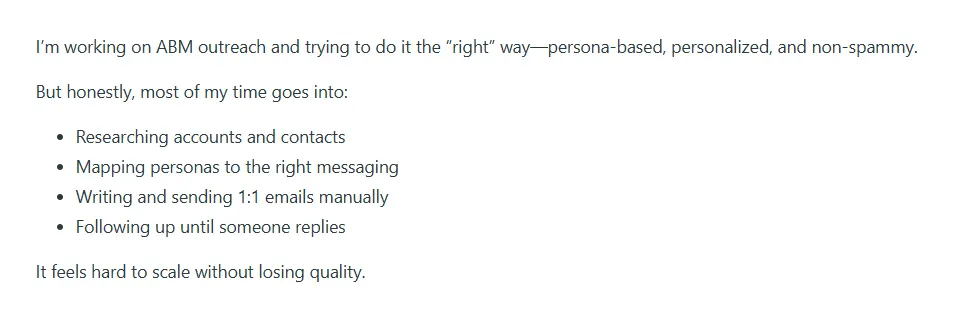
That tension between doing ABM the right way and doing it at scale is something most teams run into eventually. Research takes longer, personalization gets thinner, and teams can’t move fast enough to act on buying signals before the moment passes. AI now removes most of those bottlenecks.
Here’s a side-by-side look at what that means across each stage:
| ABM stage | Without AI | With AI |
|---|---|---|
| Account selection | Teams build lists based on firmographics and past playbook experience. Time-consuming and often incomplete. | AI analyzes thousands of data points to score and rank accounts by fit, intent, and engagement. |
| Buying signals | Reps manually track activity across channels. Easy to miss signals or act on them too late. | AI monitors intent data in real time and finds accounts showing active research behavior. |
| Personalization | You get tailored at the segment level. Maybe a different version per industry, at best. | AI creates account-specific messaging based on industry, pain points, buying stage, and engagement history. |
| Orchestration | Campaigns run on static schedules. Same sequence, same timing for everyone. | AI adjusts timing, channels, and content dynamically based on how accounts are responding. |
| Measurement | Attribution is patchy. Hard to connect ABM activity to revenue with confidence. | AI connects touchpoints across the full journey and ties engagement to pipeline and closed deals. |
The strategy still comes down to targeting the right accounts and engaging them with relevant outreach. AI just lets you do that at a scale that wasn’t realistic with a manual process.
But “AI” gets used as a catch-all in ABM, and not all of it works the same way. Different types of AI handle different parts of your program.
- Predictive models look at your historical deal data and current account signals to score which accounts are most likely to convert. This is what powers account scoring, ICP development, and pipeline forecasting.
- Natural language processing (NLP) reads and interprets unstructured data like web content, search queries, and social posts. It’s the foundation of intent monitoring. When a platform tells you an account is researching “enterprise data security,” NLP is doing that work.
- Generative AI creates content, whether that’s ad copy, email drafts, or landing page variations. It’s the layer that helps teams personalize outreach at scale without writing every asset from scratch.
- Machine learning orchestration decides what to do and when. It looks at how accounts are engaging and adjusts campaign timing, channel mix, and content dynamically based on those patterns.
Most ABM platforms combine several of these under the hood. Knowing which type does what helps you evaluate where a tool adds real value versus where a vendor is just putting “AI-powered” on a feature that runs basic automation.
How AI fundamentally upgrades traditional ABM
ABM as a strategy hasn’t changed much over the years. You still pick your best-fit accounts, personalize your outreach, and try to engage the full buying group.
What has changed is how much of that process AI technology can handle, and how well it can do it compared to a manual approach.
The 2025 State of ABM report from Demand Gen Report and Demandbase breaks down how B2B teams are leveraging AI in their programs right now:
- Predictive scoring that ranks accounts by how likely they are to buy: AI algorithms look at hundreds of signals at once, from technographic data and hiring activity to content engagement and past deal outcomes. They learn from your closed-won and closed-lost accounts to find who’s worth going after next.
- Real-time intent monitoring across the open web: AI watches what your target accounts are researching across third-party sites, review platforms, and publisher networks. When activity spikes around topics tied to your solution, the system points to that account so your team can act early.
- Buying group identification across the entire committee: B2B purchases continue to become more complex. Our Demand Gen report found that 26% of buyers now involve more people in their decisions than they did a year ago. AI helps map out who those stakeholders are and engage them individually rather than betting everything on one contact.
- Personalization driven by account-level insights: The report found that 50% of marketers use AI to understand better what their accounts need. That data feeds into personalized content, messaging, and ads tailored to where each account currently is in their buying process.
- Orchestration that responds to account behavior in real time: A static email sequence doesn’t know if your account just visited your pricing page or went quiet for two weeks. AI does. It adjusts the timing, channel, and content of your outreach based on what each account is doing right now.
- Account research that happens automatically at scale: Pulling together a full picture of a target account used to be a manual, time-consuming process. But AI does it in seconds. The report found that 40% of marketers already use AI to automate tasks like this, and 48% use it to engage accounts more effectively.
- Attribution that ties your marketing strategies back to pipeline: AI maps every touchpoint across the buying journey and weighs how much each one influenced the outcome. The ABM Benchmark Survey found that 39% of leading ABM teams fully leverage account intelligence, compared to 25% of lower-performing teams.
Worth noting: These are all proven benefits, but results depend heavily on what you feed the system. Predictive models need enough deal history to learn what “good” looks like for your business. Intent monitoring only helps if your team has a process to act on what it finds.
Learn more → The Account-Based Revolution: From Origins to AI-Driven Futures
How to leverage AI for ABM: core use cases
AI sounds broad in the context of ABM, but in practice, it comes down to a specific set of use cases that map to the stages of your program.
Here’s how teams are applying it across the ABM process today:
| Where it fits | Use case | How AI handles it |
|---|---|---|
| ICP development | Build a dynamic ICP from historical data | Analyzes closed-won deals to find patterns in industry, company size, tech stack, and buying behavior. Updates as new data comes in. |
| Account targeting | Replace static lists with signal-based targeting | Finds accounts that match your ICP and show active buying intent right now. Your list stays fresh without manual rebuilds. |
| Account scoring | Score and rank accounts by likelihood to convert | Weighs fit, intent, engagement, and behavioral signals to prioritize accounts. Your team focuses on where the odds are highest. |
| Outreach timing | Trigger outreach when intent spikes | Detects when a target account starts researching relevant topics and alerts reps or triggers automated sequences. |
| Content personalization | Personalize content to individual accounts | Pulls from account data to tailor emails, ads, and landing pages by industry, buying stage, and specific pain points. |
| Buying group engagement | Map and reach the full buying group | Identifies stakeholders involved in the deal and brings personalized messaging to each of them, not just the primary contact. |
| Campaign orchestration | Adjust ABM campaigns based on real-world behavior | Changes channels, timing, and content dynamically based on how each account is engaging at the moment. |
| Funnel tracking | Track account progression through the funnel | Maps every touchpoint and shows how target accounts move from first engagement to pipeline. |
| ICP refinement | Refine your ICP over time | Feeds performance data back into your targeting model so account selection and messaging improve with every cycle. |
You don’t need to adopt all of these at once. Most teams start with scoring and ABM intent monitoring, then bring in personalization and orchestration as they get more comfortable with the data.
A practical way to think about it:
- If you’re still building lists manually → Start with ICP development, account scoring, and intent monitoring. Let AI handle the heavy lifting of figuring out which accounts deserve your team’s attention.
- If you know your accounts but outreach feels generic → Personalization, buying group engagement, and outreach timing are your next move. You’ve got the right accounts, but now you have to make every touchpoint feel relevant.
- If you’re looking to scale what works → Orchestration, funnel tracking, and ICP refinement close the loop. AI adjusts your campaigns based on how accounts respond and feeds what it learns back into your targeting.
Each tier builds on the one before it. Trying to orchestrate campaigns before you have reliable scoring and intent data is how teams end up automating the wrong things.
Learn more → ABM and AI for marketers: Priority use cases for 2025
How to develop an effective AI-powered ABM strategy
AI won’t fix a broken ABM program. It will amplify whatever is already there, for better or worse. So before you start adding AI capabilities, it helps to make sure your program is in good shape to take advantage of them.
The first phase is building your foundation:
- Get your data in order first: AI pulls from your CRM, engagement data, and deal history to make data-driven decisions. That data needs to be accurate and connected. Remove duplicates, fill in gaps, and make sure signals from every channel flow into one place so AI has a full picture to work with.
- Build your ICP from closed-won deals: Look at your closed-won deals from the past 12 to 24 months. Note the industries, company sizes, tech stacks, and buying behaviors that showed up most. Use that as your starting ICP and let AI refine it as more deal data comes in.
- Align sales and marketing teams on target accounts and goals: Agree on your target list, account tiers, and what counts as a qualified account. Define shared success metrics. If your teams work from different lists or different definitions, AI will find strong accounts that never get followed up on.
Once the foundation is in place, you move into execution:
- Pick one or two use cases and start there: Predictive scoring and intent monitoring are the most common starting points, and for good reason. They sharpen your targeting fast and give your team something concrete to work with.
- Use both first-party and third-party intent data: Your own engagement data tells you what accounts do on your site. Third-party data shows what they research everywhere else. AI needs both sides of that picture to accurately score and prioritize accounts.
- Build campaigns that reach the entire B2B buying group: The Demand Gen report found that 26% of buyers now involve more people in their decisions than they did a year ago. That means your marketing campaigns need to reach multiple stakeholders at each account with messaging that fits each of their roles and priorities.
The last phase is ongoing optimization:
- Measure account progression, not just lead volume: Track how target accounts move through each stage of your funnel. Compare ABM accounts against a control group to see the impact on conversion rates and pipeline velocity.
- Use the data to refine your ICP and messaging over time: Every closed deal and every lost deal teaches AI something about your program. Maybe your ICP skews too broad, and a specific industry converts twice as fast. Pull those insights regularly and feed them back into your ICP, your content plan, and your outreach.
- Build a regular feedback loop between sales and marketing: Even a 30-minute weekly meeting makes a difference. Review which accounts are active, where deals are stuck, and what each team is seeing that the other isn’t.
How to measure the success of AI in ABM
AI gives you better data to work with, but that also means you need to rethink how you measure your ABM efforts. Most of the metrics teams track today were built for lead-based marketing efforts. They measure individual actions like email opens, form fills, and page views.
AI-powered ABM operates at the account level, so your measurement framework needs to match. The goal is to track how accounts move through your funnel, how effectively you’re reaching buying groups, and whether AI is making your targeting and timing better over time.
Here are some concrete metrics worth paying attention to:
| Metric | What it measures | Why it matters |
|---|---|---|
| Account engagement score | The combined engagement of the full buying committee across intent data, website visits, content, and events | Gives you a real-time read on account readiness instead of relying on individual lead activity |
| Buying group coverage | The percentage of identified stakeholders within a target account that your campaigns have reached | Shows whether you’re engaging the full committee or just one person |
| Pipeline velocity | How fast ABM accounts move from first engagement to qualified opportunity compared to your non-ABM baseline | Shows whether AI is helping shorten sales cycles and find bottlenecks in the funnel |
| Predictive score accuracy | How often your AI-scored top accounts convert compared to manually selected ones | Tells you whether the AI is improving your targeting or if you need to retrain the model |
| Signal-to-action speed | How quickly your team acts after AI flags an intent spike or engagement signal | The value of real-time monitoring drops fast if nobody follows up for days |
| Account penetration rate | The percentage of your target account list where you have successfully engaged or opened active opportunities | Measures how effectively your team is breaking into the accounts that matter most |
| Lift vs. control group | The difference in conversion and pipeline velocity between ABM accounts and a matched group that didn’t receive ABM treatment | Isolates what AI and ABM are contributing versus what would have happened anyway |
Essential AI-powered platforms for B2B ABM
If you’re evaluating ABM platforms right now, the market can feel overwhelming. Dozens of vendors all claim to “use AI” without making it clear what that means in practice.
It’s also worth keeping perspective on where platforms fit in your program. As one marketer put it on Reddit:
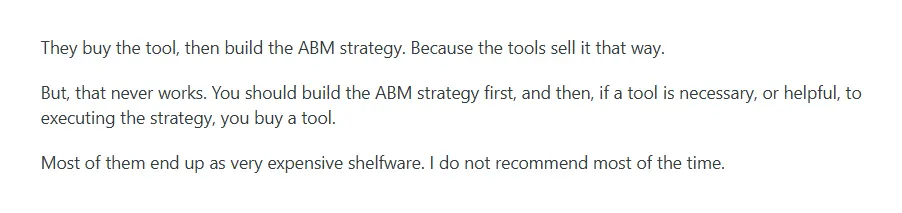
The tool should serve the strategy, not replace it. With that in mind, the simplest way to make sense of the market is to break the stack into functional categories and understand what role each one plays in your program:
| Platform type | What it does | Examples |
|---|---|---|
| Account intelligence and intent platforms | Pull together first-party CRM data with third-party intent signals to score accounts, find in-market buyers, and trigger campaigns at the right moment | Demandbase, 6sense, ZoomInfo |
| Predictive revenue operations software | Plug into your CRM to analyze pipeline health, map buying committees, find at-risk deals, and forecast revenue based on engagement patterns | Clari, Gong, Aviso |
| Programmatic ABM advertising networks | Run account-targeted display, video, and CTV campaigns that serve ads to specific buying committees at your key accounts | Demandbase, RollWorks, Terminus |
| Dynamic website personalization tools | Swap out headlines, hero sections, CTAs, and page layouts in real time based on who’s visiting and where they are in the buying process | Mutiny, Intellimize, Optimizely |
| Conversational marketing and AI chatbots | Use AI to start conversations with in-market visitors, answer their questions, and hand off qualified buyers to sales reps with full context | Warmly, Drift (Salesloft), Intercom |
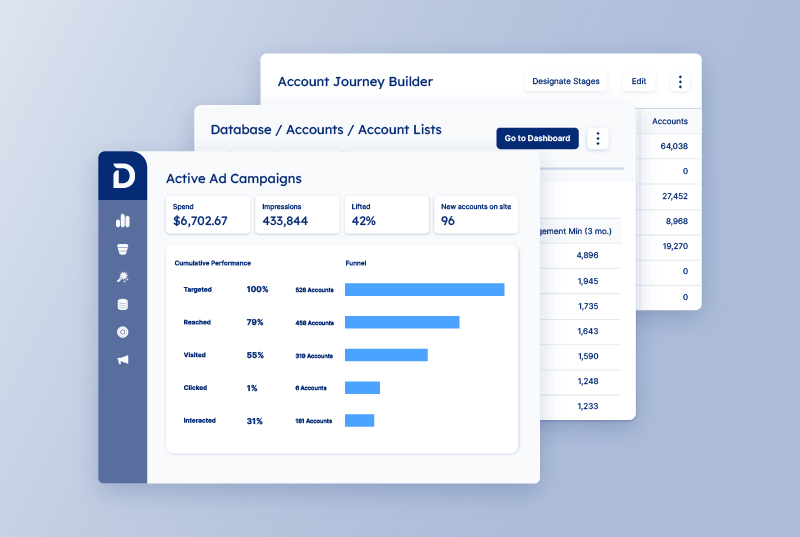
Demandbase shows up in two of those categories, but the platform covers far more than that. It’s built as a full pipeline AI platform that spans account intelligence, intent monitoring, advertising, orchestration, buying group mapping, and data enrichment in one place.
That means your scoring, campaigns, and outreach all draw from the same dataset. Signals don’t get lost moving between tools, campaigns respond faster, and attribution is simpler because every touchpoint is already tracked in one place.
The future of AI in ABM
Most of the AI use cases covered in this guide are still early. Our ABM report found that marketers rate their generative AI maturity at just 2.3 out of 5. Nearly 40% are implementing AI on a limited scale, and another 33% are still exploring potential use cases. The capabilities are there, but most teams haven’t operationalized them yet.
That gap is where the next 12 to 24 months get interesting. AI in ABM is moving past one-off use cases and toward something more integrated, where intent data, campaign execution, and attribution all feed the same engine.
For example, Demandbase is already moving in this direction with AI agents that manage workflows like campaign optimization and audience segmentation from start to finish.
Gartner predicts that 40% of enterprise applications will include task-specific AI agents by 2026. For ABM, that means the delay between detecting a buying signal and acting on it gets dramatically shorter.
The other shift is happening on the buyer’s side. Demandbase CEO Gabe Rogol notes that buying groups now use AI tools to research vendors, compare options, and score solutions before any committee member contacts your sales team.
If your content isn’t structured for machines to parse and evaluate, you may not make the shortlist, even if your product is the best fit.
Everything covered in this guide (scoring, intent, personalization, orchestration, measurement) works better when it’s connected.
The next phase of artificial intelligence in ABM is about collapsing the gaps between those stages so your program moves at the speed of your buyer, not the speed of your team’s ability to sync tools and spreadsheets.
Key takeaways from this section:
- Most teams rate their AI maturity at 2.3 out of 5 – the gap between what’s possible and what’s in practice is still wide
- AI agents are starting to handle full workflows like campaign optimization and audience segmentation
- Buyers are using AI to research and compare vendors before your team even knows they’re looking
- Content that isn’t structured for machines to read may not make the shortlist
- The biggest advantage comes from connecting scoring, intent, personalization, and orchestration into one system instead of running them separately
Build your AI-powered ABM program with Demandbase
The use cases covered in this guide only deliver full value when they’re connected. A scoring model that doesn’t inform your ad targeting, or intent data that doesn’t feed your orchestration, leaves gaps your competitors will fill.
Demandbase is built around that exact idea. It’s a GTM AI platform that combines account intelligence, intent monitoring, advertising, orchestration, data enrichment, and attribution into a single connected system for B2B go-to-market teams.
Here’s what that looks like in practice:
- Account intelligence powered by AI: The platform combines your CRM data with proprietary intent signals to build a complete picture of every target account. AI then ranks them by fit and readiness to buy, so your team knows where to focus.
- Real-time intent monitoring: Demandbase tracks what your target accounts research across millions of B2B sites. When activity spikes around topics tied to your solution, your team sees it right away and can move before a competitor does.
- Data integrity and enrichment: The platform automatically identifies duplicates, fills in gaps, and enriches records across your CRM and marketing automation systems. Every AI capability in the platform depends on clean data. Demandbase handles that upkeep so your team doesn’t have to.
- Built-in B2B advertising DSP: Demandbase runs its own demand-side platform for programmatic display, video, and Connected TV ads. You target specific accounts and buying committees directly, so your budget reaches key decision-makers instead of broad audiences.
- Agentbase: A collection of AI agents that take over the operational work that slows teams down. They optimize ad campaigns, summarize account engagement for sellers, and build audience segments through conversation instead of manual filtering.
- Predictive analytics and account scoring: Machine learning models analyze hundreds of signals, including technographic data, hiring activity, content engagement, and past deal outcomes. They predict which accounts are ready to buy and when they’re most likely to engage.
If you’re building or scaling an AI-powered ABM program, book a meeting with Demandbase to see how the platform can work for your team.
FAQs
How does AI help with multi-channel ABM campaigns?
AI tracks how your target accounts engage across channels like email, LinkedIn, social media, display ads, and webinars. Then it adjusts where and when you show up based on what’s working.
So instead of running the same sequence everywhere, your program moves budget and attention toward the channels each account responds to most. That’s a big upgrade over traditional marketing playbooks, where you’d set your channels once and hope for the best.
Can small teams and startups run AI-powered ABM?
Yes. AI helps streamline the parts of ABM that usually need a big team. A startup with two or three marketers can use AI to build their persona, score accounts, and prioritize outreach without spending hours on manual research.
You won’t run the same program as an enterprise team, but you can cover the fundamentals and scale up as your data and budget grow.
Do I need a specific CRM to run AI-driven ABM?
Most AI-powered ABM platforms integrate with major CRMs like Salesforce and HubSpot.
The platform pulls from your CRM data for account scoring, data analysis, and pipeline tracking. The cleaner your CRM is, the better everything works.
Related content


We have updated our Privacy Notice. Please click here for details.