

18 best demand generation tools for B2B teams in 2026

Demand generation tools help B2B teams decide which accounts to pursue, reach the people researching a purchase, and move that interest toward a sales conversation. The category covers a lot of ground, from data providers and intent platforms to advertising, conversion, automation, and analytics tools.
Much of that range comes from how B2B purchases are made. Forrester’s State of Business Buying 2026 report found that a typical purchase involves 13 internal stakeholders and nine external influencers. Each of those people researches through different channels at a different pace.
This guide organizes 18 B2B demand generation tools into six areas, in the order the work happens. For each tool, you’ll see what it does, who it’s best for, and the main limitation, plus advice on which areas to prioritize based on your team’s size.
What are demand generation tools?
Demand generation tools are the software B2B teams use to create and capture demand for their product across the full buying journey. They help marketing find the accounts most likely to buy, stay in front of those accounts during research, and show how that activity leads to pipeline.
Demand generation and lead generation tools are often grouped together, and they overlap at the bottom of the funnel. The main difference is scope.
- Lead generation tools collect contact details through forms, gated content, and prospecting databases. They typically focus more heavily on the number and quality of leads captured.
- Demand generation tools cover the full buying journey. They build awareness with target accounts long before a sales conversation, respond when those accounts start researching, and measure success in pipeline and revenue.
Most demand generation tools fit into one of six layers of the B2B stack. The work starts with account data and intent signals, continues through advertising, conversion, and automation, and ends with analytics and attribution.
The 18 best demand generation tools at a glance
The top B2B demand generation tools in 2026 range from platforms like Demandbase, which covers account data, intent, and advertising, to specialists like ZoomInfo for contact data, Chili Piper for meeting booking, Marketo Engage for automation, and Dreamdata for attribution.
The right mix depends on which parts of the stack your team needs to cover, and those layers build on one another in a logical order.
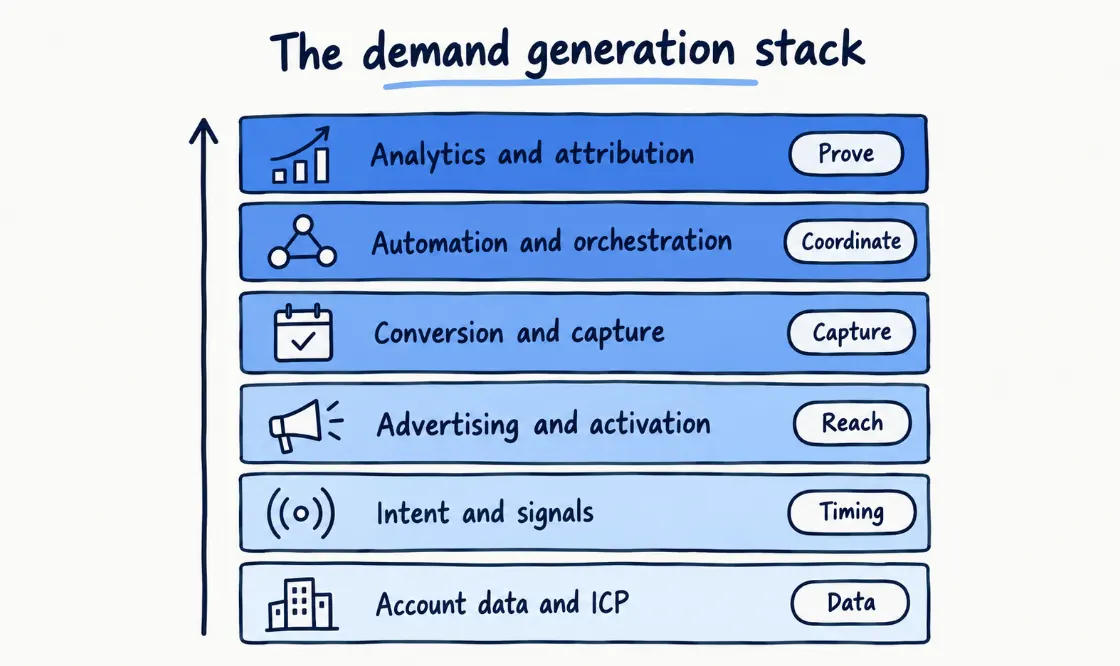 Six-layer demand generation stack diagram, from account data and ICP at the base to intent,
advertising, conversion, automation, and analytics and attribution at the top.
Each layer supports the ones above it, so weaknesses early in the stack can affect everything that follows:
- Account data and ICP tools define which companies to target
- Intent and signal tools show when those companies are in market
- Advertising puts the message in front of their buying groups
- Conversion tools collect the interest that follows
- Automation keeps plays consistent across every channel
- Analytics connects activity to pipeline and revenue outcomes
The table below lists all 18 tools by layer, with three options for each job and what each one does best:
| Tool | Stack layer | Best for | Standout capability |
|---|---|---|---|
| Demandbase Data | Account data and ICP | Teams that want one account record shared across the stack | Account hierarchies, visitor identification, and CRM enrichment |
| ZoomInfo | Account data and ICP | Teams that need broad company and contact coverage | Large B2B contact database with automated CRM enrichment |
| Clay | Account data and ICP | Lean RevOps teams building custom enrichment workflows | Waterfall enrichment across 150+ data providers |
| Demandbase Intent | Intent and signals | Combining several intent sources with journey stages | Proprietary keyword intent plus Bombora, G2, and TrustRadius signals in one view |
| Bombora | Intent and signals | Adding third-party topic intent to existing tools | Consent-based publisher co-op and Company Surge scores |
| G2 Buyer Intent | Intent and signals | Software companies tracking review site research | Signals from G2, Capterra, Software Advice, and GetApp |
| Demandbase Ads | Advertising and activation | Buying group targeting tied to pipeline measurement | B2B DSP with account-level frequency control |
| LinkedIn Campaign Manager | Advertising and activation | Reaching specific roles and decision-makers | Professional targeting and Buyer Groups |
| StackAdapt | Advertising and activation | Multi-channel programmatic reach using your own account data | Display, video, CTV, audio, and DOOH in one platform |
| Chili Piper | Conversion and capture | Inbound-heavy teams booking meetings from the website | Instant routing and scheduling from forms and chat |
| Unbounce | Conversion and capture | Building and testing campaign landing pages | A/B testing and AI-based Smart Traffic |
| Goldcast | Conversion and capture | Event-led programs capturing demand through webinars | Detailed attendee engagement data and AI video repurposing |
| Marketo Engage | Automation and orchestration | Complex nurture, scoring, and lifecycle programs at scale | Smart Campaigns and engagement programs |
| HubSpot Marketing Hub | Automation and orchestration | Growing teams that want automation and CRM together | Workflows built on HubSpot’s Smart CRM |
| Zapier | Automation and orchestration | Connecting tools that lack native integrations | 9,000+ app integrations |
| Dreamdata | Analytics and attribution | Connecting ad spend and campaigns to pipeline by account | Account-based multi-touch attribution |
| HockeyStack | Analytics and attribution | Campaign and channel analytics with an AI analyst | Odin AI analyst and nine attribution models |
| Google Analytics 4 | Analytics and attribution | Free website traffic and conversion reporting | Event-based web and app analytics |
Disclaimer → Demandbase appears in three layers because the platform includes dedicated products for account data, intent, and advertising. Each one is listed and reviewed in its own layer so it can be compared directly with the other tools that do the same job.
Layer 1: account data and ICP tools
Targeting, scoring, routing, and attribution all rely on account records, so the quality of this data carries into every other part of the stack. An account list with missing firmographics or outdated contacts leads to wasted ad spend, misrouted leads, and pipeline reports that credit the wrong campaigns.
Account data tools help a team define its total addressable market, narrow it to an ideal customer profile, and keep each account record complete enough for the rest of the stack to use. That usually means firmographic data like industry, size, and revenue, technographic data on the software a company already uses, and contacts across the buying group.
When you evaluate account data tools, compare them on these points:
- Accurate account records, with parent companies and subsidiaries linked together
- The share of your existing CRM accounts the tool can match and enrich
- Update frequency for company and contact data, since job titles, headcounts, and tech stacks change often
- Direct sync with your CRM and marketing automation platform, so records update without CSV uploads
Weak data at this stage compounds quickly. Poor account matching can send advertising budget toward companies that were never a fit, distort intent and scoring models, and make downstream reporting less trustworthy. Improving campaign execution later in the stack cannot fully compensate for starting with the wrong accounts.
Demandbase Data
Best for: B2B teams that want account data, buying group contacts, and CRM enrichment on the same platform they use for intent, advertising, and orchestration.
Demandbase Data gives marketing, sales, and RevOps teams one account record that combines firmographic, technographic, buyer, and intent data, with account hierarchies that connect parent companies to their subsidiaries.
That record is the foundation for the rest of the Demandbase platform, so the same accounts carry directly into intent scoring, advertising audiences, and orchestration in later parts of the stack.
Key features:
- Identification of the companies behind anonymous website traffic
- Firmographic and technographic enrichment for ICP segmentation
- Buying group and contact data linked to each account record
- Ongoing CRM enrichment, plus syncs to warehouses and marketing tools
- Shared account data that feeds Demandbase intent, advertising, and orchestration
Limitation: Demandbase Data delivers the most value when account intelligence is being used across a broader B2B go-to-market motion, so teams looking only for a standalone contact database may not need the wider platform.
ZoomInfo
Best for: Go-to-market teams that need broad company and contact data, along with enrichment and intent data, in one platform.
ZoomInfo is a B2B data and go-to-market platform that marketing, sales, and RevOps teams use to find target accounts, identify contacts across a buying group, and enrich records in their existing systems. According to ZoomInfo, its data covers more than 100 million companies and 500 million contacts.
Key features:
- Emails and direct dials for contacts across target accounts
- Firmographic, technographic, and intent filters for ICP segmentation
- Automated CRM enrichment in Salesforce, HubSpot, and other systems
- Waterfall enrichment from 25+ third-party sources in GTM Studio
- B2B advertising audiences built on the same company and contact data
Limitation: Data coverage can vary by market and company size, and records for international and smaller companies are commonly reported as less complete. Credit-based usage can also make high-volume enrichment or exports more expensive for some teams.
Related read → 16 Best ZoomInfo Alternatives & Competitors in 2026
Clay
Best for: Lean RevOps and growth teams that want to build their own enrichment workflows across multiple data providers.
Clay is a GTM data enrichment and workflow platform that lets teams combine third-party data providers, AI research, and their own business logic to build and maintain account records. Teams work in a spreadsheet-style workspace and can send enriched records to their CRM, ad platforms, or outreach tools.
Key features:
- Waterfall enrichment across 150+ data providers for higher match rates
- AI web research for niche firmographic and account attributes
- Signals for job changes, company news, and web intent
- Two-way CRM sync with Salesforce and HubSpot
- Conditional logic for scoring, routing, and custom workflows
Limitation: Clay’s flexibility comes with more setup and workflow design than a single-source data provider, so it suits teams with RevOps or GTM engineering time. Because its data comes from third-party providers, match rates and accuracy can vary depending on which providers a workflow uses.
Related read → 9 Clay alternatives worth considering for GTM teams
Layer 2: intent and signal tools
Intent and signal tools track research activity at the account level. They show which target accounts are reading about your category, comparing vendors, or engaging with your content, so a team can decide which accounts to prioritize first.
At any given time, only a small part of a target list is ready to buy. Tom Furr, CMO at DISCO, puts it this way: “On any given day in a B2B buying cycle, 95% of your audience is not in market looking to buy. We’ve over-rotated on demand generation. We’ve built the most sophisticated ways of capturing that 5%, but it is only 5%.”
Intent data helps a team find that smaller group early, and the rest of the audience still needs reach and education until its timing changes. Most tools work with three kinds of signals.
- First-party signals come from activity on your own properties, such as website visits, content downloads, and product usage.
- Third-party signals show research happening elsewhere, including topic consumption across publisher networks and review sites.
- Engagement signals track how an account interacts with your team, from ad clicks and event attendance to email replies and sales meetings.
Each type shows a different stage of research, and combining them builds the account intelligence a team needs to decide which accounts to engage, when, and through which channel. Tools in this category differ mainly in which signals they collect and how quickly they pass them to other systems.
When you compare intent and signal tools, check the following:
- How often signals and scores update
- Whether signals tie back to named accounts and contacts
- Direct syncs to your CRM, ad platforms, and sales tools
- Control over the topics and keywords being tracked
Without intent signals, a team has to treat all target accounts as equally ready to buy. Campaigns and sales outreach follow the same schedule for every account, whether it’s researching a purchase now or not planning one for another two years.
For teams choosing between intent providers, the 15 best intent data and intent-based marketing tools compares the main options in more detail.
Demandbase Intent
Best for: Teams that want first-party, third-party, and review site intent combined to show which accounts are in market now and which journey stage each one has reached.
Demandbase combines its own keyword intent with first-party activity and third-party signals to show which accounts are researching a purchase and how far along each one is. Demandbase AI uses those signals to identify in-market buying groups earlier and help sales and marketing decide where to focus.
Key features:
- Proprietary keyword intent tracked across the B2B web
- Bombora, G2, and TrustRadius signals brought into the same view
- Journey stages that update automatically as account activity changes
- Predictive scores that rank accounts by buying stage
- AI Chat for questions like which accounts show rising intent
Limitation: Journey stages, scoring, and keyword sets need initial setup, so teams should plan for onboarding time before the signals are fully tuned.
Bombora
Best for: Organizations that need a broad, consent-based source of third-party intent to feed into existing systems.
Bombora is a B2B intent data provider that tracks content consumption across its Data Co-op of publishers and B2B websites, showing which companies are researching specific topics. Teams use its data inside other systems, such as a CRM or ABM platform, to prioritize accounts and target campaigns.
Key features
- Research tracked across 25,000+ intent topics and thousands of B2B sites
- Surge scores that compare recent research with each account’s historical baseline
- Persona insights showing which functions and seniority levels are researching
- Consent-based data collection through a publisher co-op
- 100+ integrations and partnerships for activation across GTM tools
Limitation: Bombora covers the signal side of demand generation, and teams still need separate tools for campaigns, orchestration, and reporting. Topic selection and score thresholds also take some tuning before the signals reliably point to in-market accounts.
Related read → How to set up Engagement Points for Bombora intent in Demandbase
G2 Buyer Intent
Best for: Software companies that want account-level signals from buyers actively comparing vendors on G2 and its sister review sites.
G2 Buyer Intent identifies companies researching software across G2 and related marketplaces, including Capterra, Software Advice, and GetApp. Signals come from actions such as viewing product profiles, pricing pages, comparisons, and competitor content.
Key features:
- Profile and pricing views that show direct research on your product
- Comparison and alternatives signals for accounts weighing you against competitors
- Category activity from buyers researching solutions in your market
- Buying stage and activity scores for each account
- Integrations with Salesforce, HubSpot, and ABM platforms, including Demandbase
Limitation: Signals come only from G2 and its sister review sites, so coverage depends on how many buyers in your category research software there. The data also reflects the shortlist stage of research more than early awareness, which makes it a narrower source than broad topic intent.
Layer 3: advertising and activation tools
Advertising and activation tools reach the accounts selected in Layer 1 and prioritized in Layer 2 with paid campaigns. Because a large part of demand generation budget is often spent here, finance teams usually want clear proof of what these campaigns produce.
B2B advertising platforms can reach target accounts through channels such as display, video, connected TV, and paid social. Programmatic ad space is usually bought through a demand-side platform, and most teams combine several channels to reach buyers where they already spend time, which is the core of B2B multi-channel marketing.
Persona targeting reaches people based on attributes like job title or function, wherever they work. Buying group targeting begins with the target account and reaches the people inside it who are most likely to influence the purchase.
Paige Marsin, ABM and Digital Marketing Manager at Palo Alto Networks, saw how that approach changed her team’s results: “By using buying group targeting in Demandbase display ad campaigns, we saw a 65% increase in click-through rate compared to campaigns that were not leveraging buying group targeting… We saw a 6X increase in our booking influence and a 5X increase in our opportunities.”
Before choosing an advertising tool, compare these points:
- Targeting by named account list, or only by broad attributes like job title and industry
- Reach across multiple people in each buying group
- Reporting that connects impressions and clicks to pipeline and revenue
- Identity methods that work without third-party cookies
- Channel coverage across display, video, CTV, and paid social
Without an advertising tool designed for accounts, the target list from Layers 1 and 2 has no paid channel to support it. Demand generation then usually depends mostly on outbound email volume. Many of these tools also serve as ABM platforms, and the 40 best ABM solutions compares that category in more depth.
Demandbase Ads
Best for: Account-based marketers who want to reach the right people at each target account, control how often each account sees ads, and measure results in pipeline.
Demandbase Ads is built on a DSP designed specifically for B2B buying, so campaigns are planned around accounts and the people in their buying groups. Teams can target using the account intelligence, intent, and journey stages already in Demandbase, and AI adjusts audiences and spend as buyer activity changes.
Key features:
- Buying group targeting to prioritize key decision-makers in each purchase
- Account-level reach
- Ads across display, video, CTV, and social channels
- Ad and website experiences matched to each account’s journey stage
- Measurement of ad influence on meetings, opportunities, and revenue
Limitation: Demandbase Ads focuses on display, native, video, CTV, and social, so paid search campaigns are managed and reported on outside the platform.
LinkedIn Campaign Manager
Best for: B2B advertisers who want to reach specific professional roles and decision-makers using LinkedIn’s member and company data.
LinkedIn Campaign Manager is LinkedIn’s self-serve ad platform, where B2B teams target ads using the professional data members share on their profiles, such as job title, function, seniority, and company. You can also upload account lists to focus campaigns on named companies and apply role filters within those accounts.
Key features:
- Targeting by job title, function, seniority, skills, and industry
- Company list uploads for account-based campaigns
- AI-powered Buyer Groups targeting for multi-role buying committees
- Account-level reporting on paid and organic engagement in the Companies tab
- CRM-based revenue attribution for pipeline and closed deals
Limitation: Campaigns reach people only on LinkedIn and its Audience Network, and coverage of a target account’s buying group depends on how many of those people keep current profiles. Company list audiences also need a minimum number of matched members before they can serve, which can make very small account lists harder to target.
StackAdapt
Best for: Teams that already have account lists and intent data and want a flexible platform to activate them across many ad channels.
StackAdapt is a programmatic advertising platform that supports B2B campaigns across native, display, video, connected TV, audio, in-game, and digital out-of-home.
For account-based campaigns, teams can combine target account lists with firmographic, persona, first-party, and intent data to build more specific audiences.
Key features:
- Account-based targeting with engagement reporting against target lists
- Bombora, Leadspace, and Lead Forensics integrations for intent and firmographic data
- First-party audience activation through HubSpot, Salesforce, LiveRamp, and Snowflake
- Contextual targeting based on keywords and content environments
- Ivy, an AI assistant for campaign planning and optimization
Limitation: StackAdapt is a general-purpose programmatic platform, so the quality of account-level targeting depends on the audience and data sources a team brings into it. Teams that want intent, account intelligence, and orchestration closely connected to their advertising may need additional tools alongside it.
Layer 4: conversion and capture tools
Conversion and capture tools come into play once an account is ready to engage. They include landing pages, forms, meeting schedulers, and event platforms, and they help a buyer move from research to a sales conversation with as few steps as possible.
These tools usually cost far less than paid media, yet they directly affect how much of that spend turns into pipeline. If landing pages convert poorly, forms ask for too much, or qualified buyers cannot book a meeting quickly, even well-targeted campaigns can underperform.
Gating content is also a bigger decision than it used to be. Buyers now complete much of their research on their own, and a form in front of every asset can slow that research down. A more flexible approach is to match the conversion point to where each account is in its buying journey, so early-stage visitors can read freely, and later-stage accounts see a clear path to sales.
Real-world example → SAP Concur reduced gated content for early-stage buyers and used Demandbase journey stages, combined with its own first-party behavioral data, to decide what each visitor should see. Awareness-stage visitors were directed to ungated videos and blogs, and accounts further along saw gated buyer’s guides and high-value forms. Conversion rates for that later-stage group were 52% higher.
Look at these points when comparing conversion and capture tools:
- Time from form submission to a booked meeting
- Routing accuracy, so each lead reaches the right rep or team
- Recognition of target accounts, so high-priority visitors get a faster path to sales
- Personalized pages or offers by account, industry, or journey stage
- Data sync with your CRM and marketing automation platform
Small changes here can have an outsized effect on the rest of the stack. A shorter form, an instant booking option for target accounts, or a better match between ad message and landing page can raise pipeline from the same ad budget.
Chili Piper
Best for: Inbound-heavy sales teams that want website visitors and form leads routed to the right rep and booked into meetings without manual follow-up.
Chili Piper focuses on the handoff between inbound interest and a sales conversation. When a prospect submits a form, it can qualify them, route them using CRM and firmographic data, and show the right rep’s availability so they can book without waiting for follow-up.
Key features:
- Routing by territory, account owner, company size, or other CRM fields
- Form shortening that fills fields from enrichment data
- Instant phone or video calls from forms through Concierge Live
- Re-engagement flows for no-shows, cancellations, and abandoned forms
- Salesforce and HubSpot integrations that sync routing and meeting data
Limitation: Chili Piper is strongest at routing, scheduling, and conversion rather than creating landing pages or running broader demand generation campaigns. Pricing for its Routing & Scheduling package currently starts at $15,000 per year, so smaller teams should weigh the conversion volume and routing complexity against the cost.
Unbounce
Best for: Marketing teams that want to build and optimize campaign landing pages without relying heavily on developers.
Unbounce is a landing page and conversion optimization platform for building campaign pages, forms, popups, and sticky bars with a drag-and-drop editor. Its higher plans add A/B testing and Smart Traffic, an AI feature that sends each visitor to the page variant most likely to convert for them.
Key features:
- 100+ templates for lead generation and campaign pages
- Multi-step forms that split longer qualification across several screens
- Dynamic text replacement that matches page copy to ad keywords
- 1,000+ integrations with CRMs, marketing automation, and ad platforms
- An MCP server for building and managing pages from AI assistants
Limitation: Unbounce personalizes pages using URL parameters and ad keywords, and it doesn’t natively identify which company a visitor works for, so account-based personalization needs a different tool. Smart Traffic also needs several page variants and a learning period before it starts optimizing, which limits its value on low-traffic pages.
Goldcast
Best for: Event-led marketing programs that use webinars to capture demand and want attendee engagement to feed sales and marketing follow-up.
Goldcast is a B2B events and video platform for webinars, virtual and hybrid events, field events, and event series. It captures registrations and detailed engagement data from attendees, then passes that activity to the CRM and marketing automation platform for follow-up and measurement.
The platform is now part of Cvent, so teams that already manage in-person events in Cvent can bring webinars and video under the same vendor.
Key features:
- Branded registration pages and attendee management
- Engagement tracking across 21 data points per attendee
- Native integrations with Salesforce, HubSpot, and Marketo for scoring and workflows
- Content Lab, which repurposes recordings as clips, blogs, and social posts
- On-demand video hubs that keep sessions available after the event
Limitation: Goldcast is designed around events and video, so teams that convert mostly through landing pages or direct meeting booking will rely on other tools for those paths. Some formats, integrations, and API features are also limited to higher-tier plans or sold as add-ons.
Layer 5: automation and orchestration tools
Automation and orchestration tools coordinate the work across the stack. When an account shows new intent, engages with an ad, or books a meeting, these tools trigger what should happen next and carry it out across the connected systems.
Marketing automation and orchestration are often grouped together, but they work at different levels:
- Automation follows a set path for individual contacts, such as a series of emails after a download.
- Orchestration looks at the full account and picks the next play based on its current signals and stage. Most teams need both.
This is also where many AI tools for B2B demand generation now focus. Common uses for AI agents at this stage include drafting and launching campaign plays, prioritizing which accounts to focus on, and moving budget toward the programs and accounts that perform best. Demandbase AI, for example, includes Mojo, a B2B marketing agent that helps teams plan and launch campaigns.
These agents still depend on the data underneath them. As Tina Katic-Michalos, Sr. Director of Demand Generation at TaskUs, explains: “The biggest misconception is that AI is the silver bullet that’s going to come in and fix everything… The truth is that AI needs a lot of data, and it needs clean data. If the CRM is super messy, all the AI is going to do is amplify that dysfunction.” That’s a large part of why account data comes first in the stack.
Automation and orchestration tools vary most in these areas:
- Native integrations with your CRM and marketing automation platform, with no middleware in between
- Plays and workflows that can start from account-level signals
- How much marketers can build and change without engineering help
- Reporting that shows which plays each account received
- Clear controls over what AI agents can launch or change
The manual alternative is a weekly routine of exporting lists, uploading audiences, and updating the CRM. Each new campaign adds to that work, which is why many demand generation programs slow down as they scale.
Orchestration and AI marketing are large categories of their own. The 20 best GTM orchestration tools with AI compares orchestration platforms in more detail, and the 16 best AI tools for B2B marketing covers the wider AI marketing category.
Marketo Engage
Best for: Larger marketing operations teams that need sophisticated nurture, scoring, and lifecycle automation across complex buying journeys.
Adobe Marketo Engage is a marketing automation platform for managing campaigns, lead and account scoring, segmentation, and lifecycle programs at scale.
Its Smart Campaigns trigger actions from behavior, score changes, CRM updates, and other conditions, and it syncs with CRMs such as Salesforce and Microsoft Dynamics.
Key features:
- Dynamic smart lists that segment people and accounts
- Engagement programs for multi-step nurture streams
- Lifecycle programs that manage status changes and CRM handoffs
- Dynamic Chat for website conversations, included in every edition
- Marketo AI agent skills and an MCP server for assistants like Claude
Limitation: Marketo Engage has a reputation for a steep learning curve, and getting full value from its programs and scoring usually takes dedicated marketing operations time.
HubSpot Marketing Hub
Best for: Companies that already use HubSpot’s CRM and want their marketing programs connected to the same contact and deal data.
HubSpot Marketing Hub is the marketing automation product in HubSpot’s customer platform. It handles email, segmentation, lead scoring, and workflows on the same Smart CRM that HubSpot’s sales and service tools use, so campaign activity and deal data are kept in one system.
Key features:
- Workflows built from scratch, from templates, or with AI-assisted setup
- Segments that update as contacts and companies meet set conditions
- Ad audiences synced from CRM segments to connected ad accounts
- AI agents in Agent Hub, including Campaign Agent and Content Agent (beta)
- Multi-touch revenue attribution on the Enterprise plan
Limitation: HubSpot is easier to consolidate around when teams already use its CRM and broader platform, and its more advanced automation features are concentrated in the Professional and Enterprise tiers. Complex workflows can also take more setup and governance than smaller teams expect, and costs increase as organizations move to higher plans and larger contact volumes.
Related read → How to Use Demandbase and HubSpot to Unify and Scale Your ABM Efforts
Zapier
Best for: Lean marketing and RevOps teams that need to connect demand generation tools when native integrations are missing or too limited.
Zapier is a no-code automation platform that connects more than 9,000 apps through workflows called Zaps, where a trigger in one app starts actions in others.
In a demand generation stack, teams often use it to pass form fills, event registrations, and enrichment data between tools that don’t integrate directly.
Key features:
- Multi-step Zaps that automate handoffs across several systems
- Filters and Paths for conditional and branching logic
- Webhooks for tools outside Zapier’s app directory
- AI steps and Zapier Agents that can research, summarize, and update records
- Zapier MCP, which lets AI assistants take actions across connected apps
Limitation: Zapier connects apps and passes data between them, but it doesn’t track intent, journey stage, or buying group activity at the account level, so most teams use it next to an orchestration platform. Pricing is based on tasks, and high-volume or AI-heavy workflows can use a monthly allowance quickly, leading to pay-per-task charges or a plan upgrade.
Layer 6: demand generation analytics and attribution tools
Demand generation analytics tools show what’s working across the rest of the stack. Most teams use a mix of attribution, pipeline analytics, and web analytics to connect marketing activity to pipeline and revenue.
- Attribution connects campaigns and touchpoints to the opportunities and revenue they influenced.
- Pipeline analytics tracks how accounts move through journey stages before and after they become opportunities.
- Web analytics reports on traffic, sources, and behavior across your site and landing pages.
Analytics also affects how leadership judges a demand generation program. Many teams still report on lead volume, which says little about whether target accounts are moving toward a deal, since B2B purchases involve several people at each account. As a result, more teams are moving from MQLs to account and buying group measurement.
G2 made that change in 2025. As Michael Pannone, Head of Global Demand Generation at G2, shares: “We left MQLs in 2025. We rebuilt our inbound process around a new account-based funnel… What we now track in marketing is marketing qualified accounts. Out with the MQL and in with the MQA.”
Compare analytics and attribution tools on these points:
- Reporting at the account and buying group level, alongside lead-level data
- Visibility into pre-pipeline engagement and account progression
- Attribution models that match the complexity of your buying journey
- Integration with CRM, advertising, and marketing automation data
- Reporting that finance and revenue teams can understand and defend
Teams without strong analytics can usually report on activity, like clicks, form fills, and event attendance, but have a harder time showing which programs created pipeline. That makes it difficult to defend the budget during planning.
Dreamdata
Best for: Revenue marketing teams that need account-based, multi-touch attribution to show which channels and campaigns contribute to pipeline.
Dreamdata is a B2B attribution and revenue analytics platform that combines website, CRM, marketing, advertising, and sales data into account-level customer journeys.
Teams can use those journeys to compare attribution models, analyze which channels and campaigns contribute to pipeline, and connect marketing spend with revenue outcomes.
Key features:
- First-touch, last-touch, linear, U-shaped, W-shaped, and AI-based models
- Attribution analysis across different pipeline stages
- Ad spend reporting that connects campaign costs to pipeline and revenue
- Journey views that combine known, anonymous, and cookieless activity
- An Analytics Agent for plain-English questions, plus an MCP server
Limitation: Dreamdata works best when teams can connect clean CRM, web, advertising, and marketing data, since attribution is only as accurate as the journeys it can rebuild. Advanced attribution, custom reporting, and activation are on custom-priced plans, which makes the full platform a better fit for teams with complex reporting needs than for those that only need basic web analytics.
HockeyStack
Best for: Marketing and RevOps teams that want attribution and pipeline reporting they can query in plain English through an AI analyst.
HockeyStack started as a B2B attribution platform and now positions itself as a GTM AI platform for marketing and sales teams. It connects CRM, marketing automation, ad, website, and product data into buyer journeys, and its AI analyst, Odin, answers reporting questions and recommends next steps.
Key features:
- Nine attribution models, from first-touch to multi-touch
- Buyer journey views that run from anonymous impression to closed-won
- No-code funnel, cohort, and campaign reports
- Prescriptive recommendations from Odin for pipeline and campaign performance
- Nova, an AI sales assistant for account research, stakeholder mapping, and outreach
Limitation: HockeyStack has no ad buying or website personalization of its own, so teams pair it with other platforms for those parts of the stack. Teams that only need website traffic reporting may find a basic web analytics tool covers what they use.
Related read → Top 11 HockeyStack alternatives for GTM teams that need more than attribution
Google Analytics 4
Best for: Teams of any size that need free reporting on website traffic, sources, and conversions.
Google Analytics 4 is Google’s free web and app analytics platform, built on an event-based data model that tracks page views, clicks, form submissions, and other interactions.
Teams use it to see where traffic comes from, how visitors move through the site, and which channels lead to key events such as demo requests.
Key features:
- Data-driven and last-click attribution models for key events
- Funnel and path explorations for analyzing visitor journeys
- An AI Assistant channel for traffic from ChatGPT, Gemini, and Claude
- A Gemini-powered Advisor that answers questions about property data in plain language
- BigQuery export for warehouse analysis and custom reporting
Limitation: GA4 measures users, sessions, and events, without identifying the companies behind them. Teams that want to see account-level engagement or buying group activity usually pair it with an account-based analytics or attribution platform.
How to choose demand generation software for your team
Choosing the best demand generation software for your team starts with deciding how many parts of the stack you should own outright at your current size. Most teams don’t need a tool in all six areas on day one, and the right mix changes as the team grows.
The ideal starting mix of demand generation solutions usually depends on team size, how account-based the go-to-market motion is, and how closely finance reviews marketing’s results.
The table below gives a recommended starting point for three common stages:
| Team stage | Buy first | Can wait | Why |
|---|---|---|---|
| Early stage, fewer than 10 people in marketing, mostly inbound demand | Conversion and capture, marketing automation, web analytics | Account-based advertising, dedicated intent data | Inbound volume is the main source of pipeline, so converting it and following up quickly can pay back fastest. Account-based programs work best once there’s a defined target list. |
| Scaling, with a named account list and sales working target accounts | Account data, intent signals, account-based advertising | Custom attribution modeling | With the target list set, the priority is knowing which accounts are in market and reaching their buying groups. Standard multi-touch reporting usually covers most needs at this stage. |
| Mature, with multiple segments, regions, or product lines | All six, consolidated onto fewer vendors | Point tools that repeat what a platform already covers | Coordination across teams becomes the main cost, so a shared account record and one reporting view could save the most time. |
At the scaling stage, teams also need to decide how to buy these capabilities. Point tools and a consolidated demand generation platform can cover the same six jobs, with different trade-offs in cost, setup, and reporting.
| Consideration | Point tools | Consolidated platform |
|---|---|---|
| Time to first value | Fast, since each tool handles one job and can launch quickly | Slower at the start, with one larger implementation |
| Data consistency | Depends on the integrations your team builds and maintains | One shared account record across data, intent, ads, and reporting |
| Cost structure | Lower entry cost, with spend growing as each new tool is added | Higher entry cost, with flatter growth as more capabilities are used |
| Reporting | Pulled together by hand from several tools | One account-level view of engagement and pipeline |
| Admin and maintenance | A contract, login, and integration for each tool | Fewer vendors to manage and renew |
| Best fit | Teams that need one specific job done well | Teams whose tools no longer work together cleanly |
Many teams end up with a mix of both. A demand generation platform covers account data, intent, advertising, and orchestration, and point tools handle jobs the platform doesn’t, such as landing pages, webinars, or meeting scheduling.
When comparing B2B demand generation ROI optimization tools, look at the total cost of that mix, including integration and admin time, along with license fees.
Useful tip → Smaller teams should not try to buy all six at once. A five-person marketing team with mostly inbound demand will usually get more from a solid conversion, automation, and analytics setup than from an account-based platform it doesn’t yet have the account list or headcount to use. The rest of the stack makes sense once there’s a defined target list and a sales team working it.
Demand generation tools for SaaS teams
The top demand generation tools for SaaS teams include Demandbase and G2 Buyer Intent for account-level intent, Dreamdata and HockeyStack for attribution, and Chili Piper for converting demo requests.
They suit most SaaS programs because software is bought and renewed in ways that put extra weight on intent and analytics:
- Software buyers do much of their research on review sites and vendor content before they contact sales.
- Purchases usually involve end users, team leads, IT, and finance, each researching at a different time.
- Subscriptions renew and expand, so marketing needs to show its effect on retention and expansion as well as new pipeline.
Each of the five tools covers at least one of these needs. Here’s how each one fits a typical SaaS motion.
- G2 Buyer Intent shows which accounts are comparing software in your category on G2 and its sister review sites, a signal that comes directly from software buying.
- Demandbase combines keyword intent, review site signals, and journey stages, so SaaS teams can prioritize accounts by how far along they are, including existing customers showing interest in expansion.
- HockeyStack brings product data into the same buyer journeys as marketing and sales activity, which helps teams see how trials and product usage connect to pipeline.
- Dreamdata gives account-based attribution across the long, multi-touch buying cycles common in B2B software.
- Chili Piper routes demo requests and can schedule meetings from inside a product, which fits teams that move trial users into sales conversations.
The exact mix depends on the go-to-market model, however. Enterprise SaaS companies with high contract values and long sales cycles usually put more into account data, intent, and attribution, and lower-touch SaaS businesses often start with conversion, automation, and product analytics.
That last group includes product-led companies, where more of the buying signal comes from the product itself. Teams with a free trial or self-serve signup should watch for users inviting colleagues, reaching plan limits, or exploring paid features, and make sure their conversion and analytics tools can see that activity alongside marketing and sales touches.
What a working demand generation stack produces
The strongest evidence that a stack is working comes from account-level results, such as faster movement through journey stages, more pipeline from target accounts, and higher conversion from priority companies.
Four Demandbase customers show how that worked in practice, each at a different point in the stack:
- Adobe wanted its website chat team to focus on the visitors most likely to buy. After adding Demandbase’s real-time company identification to its chat tool, agents could see each visitor’s company, size, and industry and start conversations with qualified enterprise visitors first, which led to a 3X increase in chat-to-qualified-lead conversions.
- WorkForce Software moved from a gated, lead-based approach to an account-based one, using Demandbase intent data to see where each account was in its buying journey. Over six months, in-market accounts visiting its site or engaging with the team increased 121%, and pipeline momentum for those accounts increased 24%.
- Thales moved its EMEA marketing from lead generation to ABM and used Demandbase to select target accounts and launch account-based ads. Within six weeks, its campaigns reached four times the industry average click-through rate, about half of its target account list re-engaged, and the share of accounts in the MQA stage doubled.
- SAP Concur reduced gated content for early-stage buyers, then used Demandbase journey stages to decide which content and conversion points each account should see. Its demand gen segment moved to the next stage 4X faster, and the number of those accounts progressing increased 250%.
Each result comes from a different part of the stack. Account data identifies who is visiting, intent shows when to act, advertising extends reach inside target accounts, and conversion and orchestration determine what happens once that interest appears.
Consolidate your demand generation stack with Demandbase
Building a demand generation stack doesn’t necessarily mean buying a different platform for every part of it. As teams mature, the harder task is often keeping account data, buying signals, audiences, campaigns, and sales activity in sync across all those systems.
Demandbase addresses that problem by covering several core parts of the stack within one AI-powered GTM platform. Our data, intent, buying group, advertising, orchestration, and AI products all share the same account context, so marketing and sales can work from one view of each account.
Here are the Demandbase capabilities most relevant to a demand generation stack:
- Demandbase Data combines firmographic, technographic, buyer, and intent data into one record for each account, with parent and subsidiary relationships mapped. It enriches CRM records, identifies the companies behind anonymous website traffic, and syncs to CRMs, data warehouses, and ad platforms, so every other product works from the same accounts.
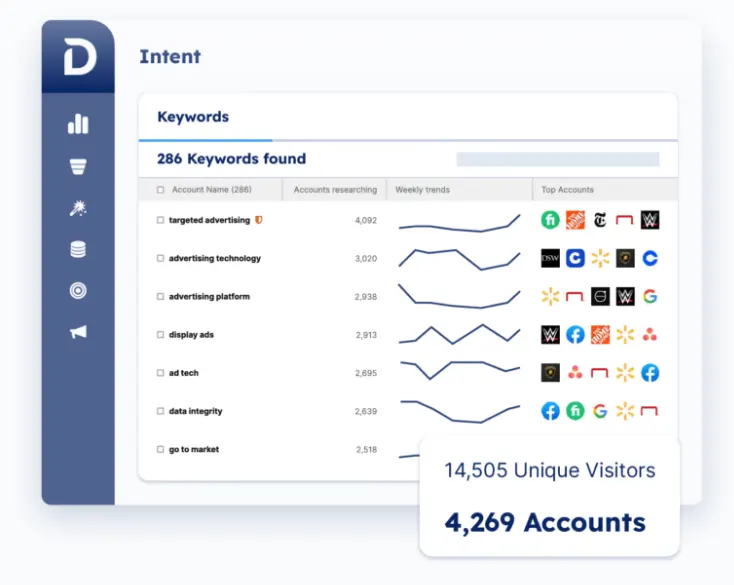
- Demandbase intent and account intelligence pairs proprietary keyword intent with first-party engagement and third-party signals to show which accounts are researching your category, products, or competitors. Teams build keyword sets around their own topics and journey stages, and predictive scoring ranks accounts by how far along they are.
- Buying Groups maps known contacts to their roles, shows which roles are missing, and outlines who is actively engaging at each account. An AI agent can build buying groups from a database of more than 150 million contacts, and teams can sync contacts, launch campaigns, or update CRM fields directly from that view.
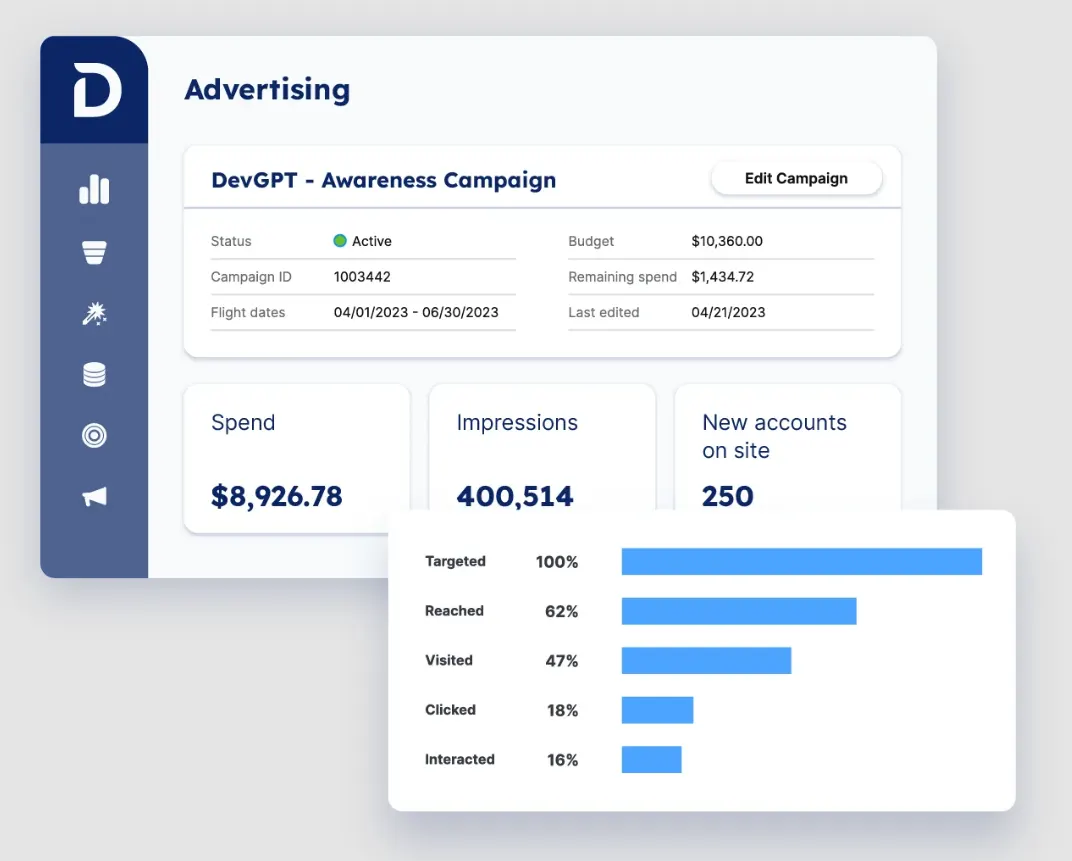
- Demandbase Ads runs on a DSP designed specifically for B2B, so campaigns are planned around target accounts and the people in their buying groups. Teams can advertise across display, video, CTV, and social, manage reach and frequency by account, and measure how ads contribute to meetings, opportunities, and revenue.
- Demandbase Orchestration triggers coordinated plays when intent spikes, deals show risk, or competitive activity appears. Plays can be one-time or always-on, and they coordinate actions across the CRM, marketing automation, advertising, and sales engagement tools like Salesforce and Outreach.
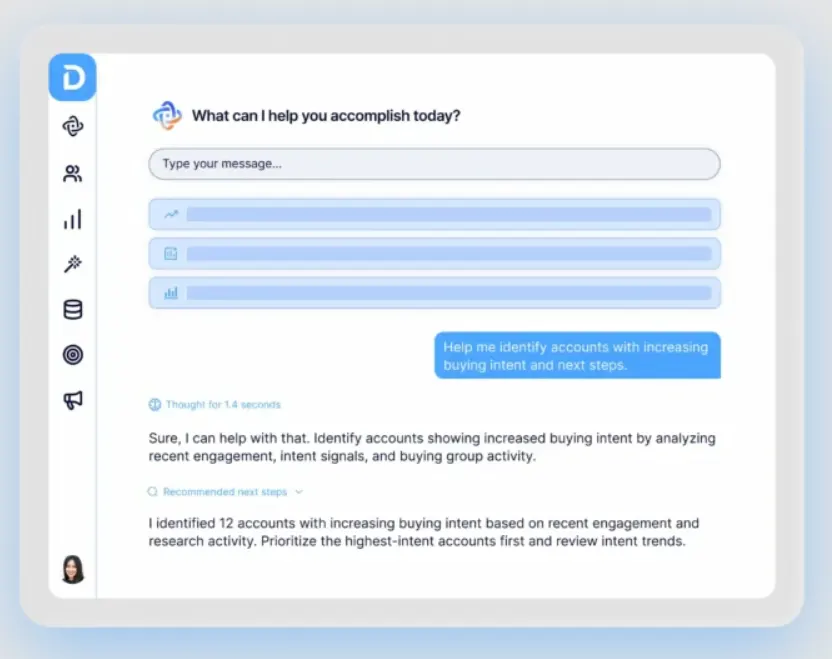
- Demandbase AI starts from a pipeline goal, then identifies where to focus, launches coordinated plays, and adjusts based on results. It includes Mojo, a B2B marketing agent, and teams can access Demandbase data inside AI tools like ChatGPT and Claude through MCP.
Demandbase does not replace every tool in this guide, nor should it. It’s not a landing-page builder like Unbounce, a webinar platform like Goldcast, or a general-purpose web analytics product like GA4. Teams may still use specialist tools where they need deeper functionality in those areas.
Its advantage is the amount of the account-based portion of the demand generation stack that can operate from shared context. For teams that have reached the point where separate data, intent, advertising, and orchestration tools are creating more integration work than value, consolidation can make the stack easier to operate and give marketing and sales a more consistent view of the accounts they are trying to move.
Book a meeting with Demandbase to see how the platform could fit into your existing demand generation stack. If you’d rather explore first, see how Demandbase AI prioritizes accounts and coordinates programs, or browse the full Demandbase product suite.
Last updated: October 2026. This guide is reviewed and refreshed quarterly as tools and pricing change.
———



We have updated our Privacy Notice. Please click here for details.