

9 Clay alternatives worth considering for GTM teams

Few tools have shaped modern GTM workflows the way Clay has. It combines enrichment, scraping, and automation in one place and hands teams the freedom to build outbound their way.
But that flexibility comes at a price. Credit costs are hard to predict once your lists grow, since each enrichment step burns a share of the balance. The scraper also fails on bot-protected sites, mobile match rates run only around a third of a list, and new hires need weeks to learn how to build automated workflows.
None of that makes Clay a poor choice, though it does send plenty of teams looking for a better fit. If you are weighing your options, this guide breaks down nine of the best Clay alternatives on the market, with a look at user reviews, key features, and pricing for each.
Why should you look for alternatives to Clay
Clay is built for teams who want to construct their own enrichment and automation workflows, and that flexibility carries a time cost. The issues that come up most often relate to credit forecasting, scraper reliability, phone coverage, and the hands-on time the tool asks for.
Here is a closer look at each:
- Credit costs are hard to forecast: Clay runs on a credit model, and a large list with several enrichment steps can drain a balance fast. Many teams say they plan each task carefully and keep an eye on what runs so they don’t burn through credits before the work finishes. [Read Full G2 Review]
- Custom integrations take setup time: Connecting tools like Salesforge and tuning them for a specific workflow can eat into the first days of use. Users ask for more ready-made templates and onboarding guides so new teams can wire up CRM integrations without the early trial and error. [Read Full G2 Review]
- Power comes at the cost of a steep ramp: The spreadsheet looks simple, then conditional logic and formula chains turn it into something close to coding. Users say the main time sink is learning how to structure workflows and write prompts that get good output from the AI. [Read Full G2 Review]
- The scraper fails on protected pages: It pulls from many sources well, though pages with heavy bot protection or complex logins still cause failures. The error messaging makes the problem worse, since a vague “could not extract data” never says whether the page blocked the request, a selector changed, or the site timed out. [Read Full G2 Review]
- Mobile match rates are a problem: Mobile coverage hovers near 30 to 35 percent for many users, so phone-led teams hit dead ends on a third or more of their list. Many teams end up adding a specialized phone data vendor alongside Clay. [Read Full G2 Review]
- Signal updates run on a daily cycle: Each signal updates once per day, which caps how quickly teams can act on fresh intent. With a CRM block list, the daily sync means a lead can pass through before Clay refreshes the list on the next cycle. [Read Full G2 Review]
Key features to look for in a Clay alternative
Clay is a build-it-yourself engine, so the question with any alternative is how much it does for you out of the box. These capabilities mark where a platform carries the intent, activation, and reporting that Clay leaves to your team and your other tools:
- Built-in intent data: Clay enriches lists but doesn’t tell you which accounts are in-market. Intent data shows which companies are researching your category right now, so you can prioritize accounts that are close to buying instead of working a flat list.
- Real-time signal updates: Clay pulls each signal once every 24 hours. Faster refresh means a job change, funding round, or website visit reaches your workflow the same day it happens, while a daily cycle can leave that signal stale for a full day.
- Low technical barrier: Clay’s power comes from conditional logic and chained formulas, which work like a lightweight programming language and tend to concentrate every workflow with one or two trained users. A template library and a guided, point-and-click builder let an SDR or marketer assemble a working play in an afternoon with no syntax to learn.
- Revenue analytics: Most enrichment tools report on activity, like records pulled or contacts found, which says little about what the data earned you. Revenue analytics ties each account back through the funnel, from the first signal to pipeline to closed-won, so you can see which sources and segments produce deals.
- Agentic AI for research and outreach: Clay uses AI inside a workflow you build step by step, with the conditional logic and prompts defined by you. Agentic AI runs the research on its own, pulling a lead’s recent initiatives, scanning an earnings call, and drafting outreach based on what it finds without a manual if/then chain behind it.
- Native multi-channel orchestration: Orchestration runs the same account list across email, LinkedIn, and advertising from one place, with the channels coordinated rather than fired off in separate tools. Clay enriches the list and stops, so the outreach moves to a stack of sequencers and ad platforms you connect and manage yourself.
- Compliance and data sourcing: B2B contact data falls under privacy laws like GDPR in Europe and CCPA in California, which govern how a record can be collected, used, and deleted on request. A vendor that documents its sourcing and consent handling gives you a defensible answer when a prospect asks where you got their number or files a deletion request.
9 best Clay alternatives on the market right now
The nine alternatives split across contact data, intent and timing, and full account-based orchestration. Here is how each one compares at a glance, so you can match a platform to your gap fast:
| Platform | Best for | Key differentiator | Pricing |
|---|---|---|---|
| Demandbase | Enterprise GTM teams that want a single platform to own the program end to end, from first signal through closed-won | A single account graph that carries proprietary intent, the only B2B advertising DSP, personalization, and orchestration | Custom |
| 6sense | Enterprise ABM programs with long buying cycles and large deal values | Predictive scoring that places each account in a buying stage before any form fill | Custom |
| ZoomInfo | High-volume prospecting teams that prioritize coverage and accuracy | A large owned database, refreshed continuously, that ships with intent signals and Copilot AI | Custom |
| Apollo.io | Startups and SMBs that want the complete outbound motion at an accessible price, mainly for US markets | An owned 265M-contact database paired with cadences and a dialer in one budget tool | From $49/seat/mo (free plan available) |
| HubSpot Breeze Intelligence | Current HubSpot users who want enrichment and intent native to their CRM | Enrichment and buyer intent native to HubSpot, drawn from its 200M-plus profile dataset | Credit-based, requires a paid HubSpot plan |
| Cognism | EMEA-focused teams that need compliant, phone-verified contact data | Human-verified Diamond mobile numbers plus GDPR and CCPA-first sourcing and deep European coverage | Custom |
| Lead411 | Mid-market and smaller sales teams that want dependable US data and intent at modest prices | Owned US contact data bundled with Bombora intent and real-time growth triggers | From $49/mo |
| Lusha | Smaller sales and recruiting teams that want quick, accurate contact reveals | A browser extension that reveals verified contacts straight from LinkedIn with almost no setup | From $37.45/mo (free plan available) |
| UserGems | Relationship-led revenue teams that want warm outreach off champion job changes | Job-change and champion tracking that turns each move into a warm CRM lead, run by the Gem-E AI SDR | Custom |
1. Demandbase
Best for: B2B revenue teams that want to replace a stitched-together stack with a single all-in-one platform for intent, advertising, web personalization, and sales orchestration.
Demandbase is the leading pipeline AI platform for B2B enterprises that brings account intelligence, proprietary intent, a native advertising DSP, and AI agents into one system so GTM teams can automate account-based growth at scale.
Think of it as one tool versus the toolkit. Clay handles a slice of the GTM motion, and Demandbase covers the full span, from account data to advertising to orchestration.
Key features
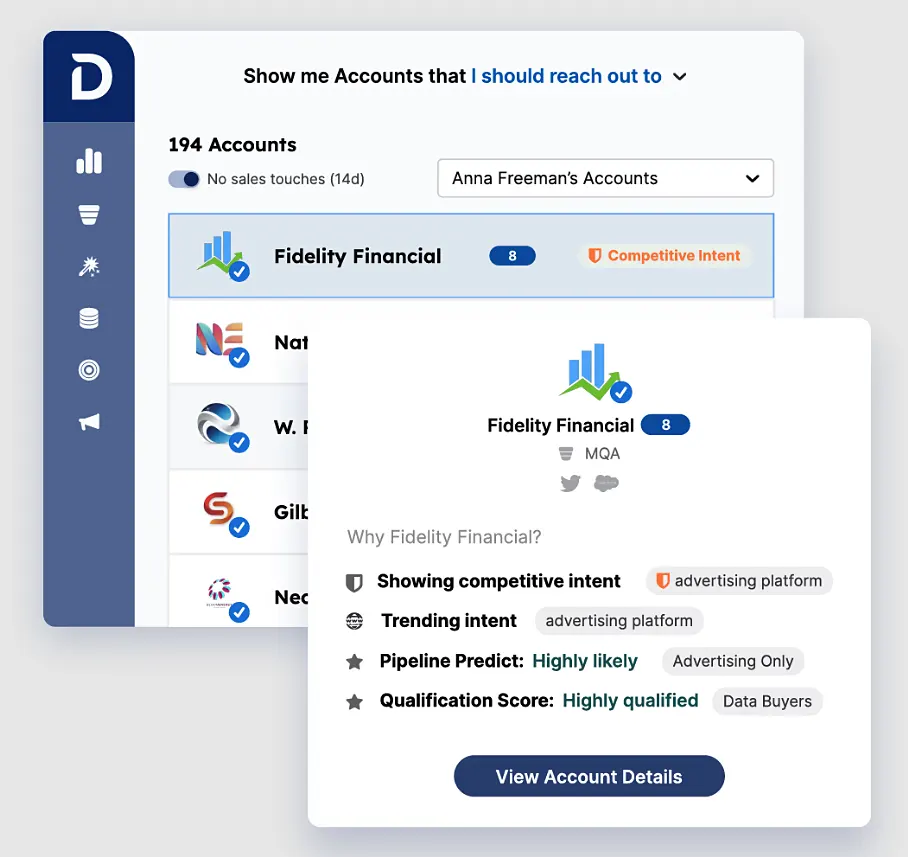
- Account intelligence and scoring: The platform connects first-, second-, and third-party data into one account view and scores each account on fit and engagement. That single picture tells a team which accounts belong in the program and which are heating up right now.
- Agentbase AI agents: The Agentbase agents work off one shared data foundation to optimize campaigns, track account engagement, and read intent, then suggest the next move. Teams get AI-driven recommendations and automation tools built into the workflow.
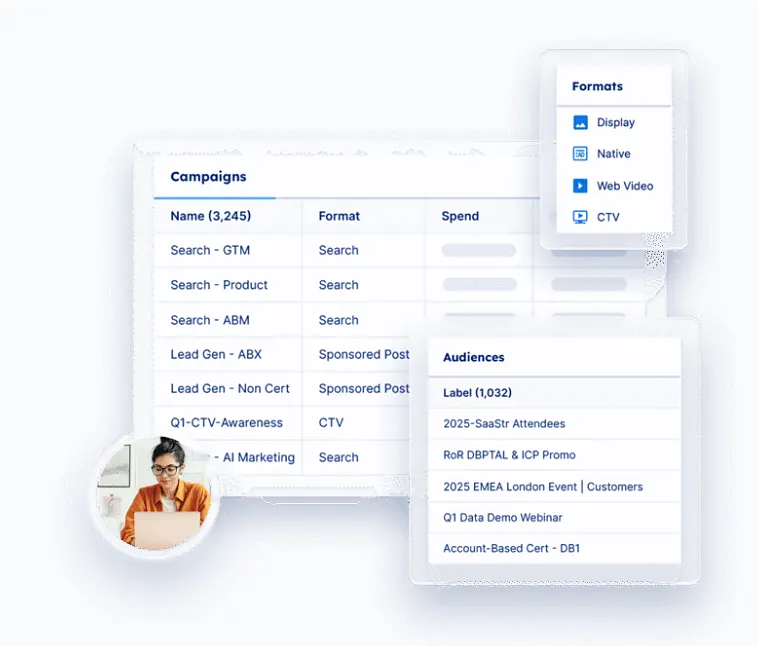
- Native B2B advertising DSP: Demandbase owns the only demand-side platform built for B2B, which runs account-targeted display, LinkedIn, and connected TV advertising inside the same system as the intent and account data. A team reaches target accounts across channels and ties ad exposure to pipeline without bolting on third-party ad tech.
- Website personalization: The platform tailors site content to a visiting account by industry, size, buying stage, and intent, so a known account sees messaging matched to its profile. That relevance lifts conversion on the traffic a team works hardest to attract.
- Proprietary intent and Journey Stages: Demandbase pairs its own intent data with Journey Stages that show where each account stands in the buying process. Teams act the moment an account advances toward a decision, which puts outreach ahead of the competition.
Advantages of using Demandbase
Many GTM stacks spread intent, ads, personalization, and sales workflows across four or five tools. Demandbase brings them together in one platform on a shared account graph. Users call that the biggest win, with one G2 user noting how having ABM, intent data, and account insights in a single place improves targeting and coordination between marketing and sales. [Read Full G2 Review]
Palo Alto Networks is a clear example. High-intent leads went unqualified under a passive scoring model, and manual handoffs stalled their buying groups. Demandbase’s intent-based MQL automations and orchestration fixed the routing, and where a buying group was present, closed-won rates rose 17%, deal sizes grew 2.3x, and opportunities reached forecasted pipeline 17x more often. [Read Full Case Study] The platform helps sales move faster too. One G2 user mentions AI Summaries, the playbook, and the Email Agent for keeping key information on hand. Reps go straight to the deal work, and the platform holds the details they used to chase across tools. [Read Full G2 Review]
Pricing
Pricing is custom and built for flexibility. A platform fee covers the essential software and services, and a flat per-user fee lets you scale as the team grows.
Demandbase keeps Demandbase as a single platform for sales and marketing, with Advertising available as an entry point and standalone Data solutions for teams that want the B2B data and insights inside their own stack.
2. 6sense
Best for: Enterprise B2B teams with long, multi-stakeholder sales cycles and six-figure deal sizes that run dedicated account-based programs.
6sense is a revenue AI platform that unifies account, contact, intent, and engagement data, then applies predictive and agentic AI to help B2B teams find in-market accounts and act on them across sales and marketing.
Clay is a data and automation engine you operate, while 6sense is a revenue AI platform that finds in-market accounts on its own and orchestrates the outreach, so the two cover different parts of the GTM motion.
Key features
- Predictive account scoring and buying-stage prediction: 6sense scores each account by fit and classifies it into a buying stage from target through decision and purchase, based on patterns its AI learned from millions of B2B purchases.
- AI agents and workflow automation: With its RevvyAI release, 6sense now includes AI agents that handle tasks like account qualification and research, then trigger the next go-to-market action.
- Multi-channel orchestration: The platform runs account-based advertising, email sequences, and chat from one place, and pushes target segments to channels like LinkedIn and display.
Advantages
- Finds accounts before they fill out a form: 6sense tracks the research a buying committee does anonymously across third-party sites and search, ties that activity to a company, and flags the topic they keep returning to. [Read Full G2 Review]
- AI agents that reply and book meetings: The AI email agents draft personalized outreach, read incoming replies, and respond in context, and they can push a thread far enough to secure a booked meeting. Routine follow-up, then scales without a rep touching every message. [Read Full G2 Review]
- One source of truth for sales and marketing: The platform pulls engagement across the buyer journey into one record, which makes account-based programs far less fragmented. Both teams align on shared signals, so prioritization stops being a debate between departments. [Read Full G2 Review]
Limitations
- Intent signals aren’t always right: The intent and identification models sometimes tag accounts that aren’t truly buying, or attach a signal to the wrong company. Teams report adding a manual validation step before they act, since chasing a false positive burns a rep’s time on a dead account. [Read Full G2 Review]
- Sparse data outside core regions: Coverage drops off beyond North America, and users in regions like LATAM hit thin prospect lists and missing contacts. Teams selling into those regions can’t lean on it for daily prospecting and end up backfilling with other sources. [Read Full G2 Review]
- Priced for enterprise budgets: The cost is built for enterprise budgets, so smaller teams often find it out of reach. The platform pays off at a certain deal size, and below that, the math is hard to justify. [Read Full G2 Review]
Pricing
6sense doesn’t publish pricing, and every contract is custom-quoted based on your addressable market size, the number of users, the modules you activate, and contract length.
There is a free Sales Intelligence tier with limited credits to start, but the broader platform is sales-led, and market estimates put paid plans in the range of $60,000 or more per year.
Related reading → 15 Best 6sense Competitors & Alternatives Right Now
3. ZoomInfo
Best for: Revenue teams that prospect at high volume and value data accuracy and coverage over the flexibility of assembling their own sources.
ZoomInfo is a go-to-market intelligence platform that pairs a massive verified B2B database, covering more than 100 million companies and 500 million contacts, with intent signals and AI workflows.
Where Clay is a flexible engine you wire up with outside data providers, ZoomInfo is an owned data platform with intent and AI built in, which trades some flexibility for depth and reliability out of the box.
Key features
- Deep, verified data foundation: ZoomInfo owns and continuously refreshes a vast B2B dataset, from contact details to org structure and tech stack data. The breadth lets teams segment by granular firmographic and technographic criteria without piecing sources together.
- Intent data and buying signals: The platform tracks intent topics and combines them with other buying signals like company scoops, funding, and hiring activity. Teams use these to spot accounts moving into a buying cycle and time their outreach to activity.
- ZoomInfo Copilot and GTM.AI: ZoomInfo Copilot reads the data and intent for each account, drafts a summary, and suggests who to contact and how. Through GTM.AI and an MCP connection, that same verified data powers AI agents in tools like Microsoft Copilot, so the intelligence travels with the rep.
Advantages
- Speed on broad queries: The platform returns results quickly even on broad queries, and it holds up with several tabs open at once. Teams running high-volume prospecting get the speed they can count on without lag slowing the work. [Read Full G2 Review]
- Reliable contact and company data: Users say the contact and company data is reliable and up to date, which makes prospecting and lead gen far more efficient. Paired with deep search and filtering, it finds the right decision-makers fast. [Read Full G2 Review]
- Precise role and title targeting: Teams can isolate exact roles and titles across many campaigns at once, from HR Managers to IT Directors. Users report building a 500-contact list in minutes, which makes the tool a workhorse for targeted outreach. [Read Full G2 Review]
Limitations
- Accuracy gaps in some regions: Some contacts have moved on from the company listed, or carry details that no longer hold. Users point to certain regions, Canada among them, where outdated records show up often enough to need a verification pass before cold outreach. [Read Full G2 Review]
- Configuration takes time: New teams need time to configure the platform and wire it into existing CRM workflows. The setup pays off, though the early ramp can slow a team before the tool runs smoothly. [Read Full G2 Review]
- Aggressive search filtering hides valid contacts: Records that haven’t been searched in the past ninety days can drop out of broad results, so a company may look like it has only ten employees when it has many more. A direct name search pulls the person up, but the default filtering can make a lead list feel complete when it isn’t. [Read Full G2 Review]
Pricing
ZoomInfo keeps pricing behind a sales call. Every quote is custom and negotiable, built around seat count, credit allowance, and add-ons like intent data and Copilot.
Related reading → 16 Best ZoomInfo Alternatives & Competitors in 2026
4. Apollo.io
Best for: SMBs, startups, and mid-market sales teams that want full-funnel outbound in one affordable platform, especially for US-focused prospecting.
Apollo.io is a unified GTM platform where an owned contact database and AI agents power the full motion, from prospecting and enrichment through outreach and deal management.
Clay gives you granular control over data sources and logic, and Apollo gives you a ready-made database plus engagement tools. Simply put, Apollo suits teams that value an out-of-the-box workflow over custom builds.
Key features
- Built-in contact database: Apollo includes its own database of more than 265 million contacts and 30 million companies, with no separate data subscription needed. Teams search and filter by detailed firmographic and persona criteria, then save lists straight into the workflow.
- Email, call, and task cadences: The platform handles multi-step, multi-channel cadences that mix email, calls, and tasks under one set of timing and deliverability controls.
- AI Assistant for outbound: Launched in March 2026, the AI Assistant executes outbound workflows from natural-language prompts, so a rep can describe a task and have the platform run it. It also helps with account research, lead scoring, and message drafting across the funnel.
Advantages
- One tool for the whole funnel: Teams find leads, enrich contact data, run email sequences, and track pipeline without bouncing between separate tools. That consolidation keeps the prospecting motion in one place. [Read Full G2 Review]
- Granular prospect targeting: The depth of the search filters lets teams isolate narrow segments by role, company size, and other detailed criteria. Users say that the precision keeps lead generation focused. [Read Full G2 Review]
- Time-saving email automation: The automated sequences, with built-in buffers between steps, save valuable time on follow-up. Reps set the cadence once and let it run, which frees them from manual outreach on every contact. [Read Full G2 Review]
Limitations
- Weaker international coverage: Coverage holds up well for US prospecting but thins out elsewhere, with APAC and the Middle East common trouble spots. Contacts in those regions often miss mobile numbers or carry job titles that have gone stale. [Read Full G2 Review]
- A lot to learn upfront: The sheer number of features can feel overwhelming early on, and new reps take time to see how sequences, filters, and reporting fit together. Users say the workflow becomes second nature once that initial ramp passes. [Read Full G2 Review]
- Slows on heavy loads: The platform can lag during very large exports or complex queries, which interrupts momentum mid-session. For teams running high-volume prospecting, that slowdown shows up at the worst moments. [Read Full G2 Review]
Pricing
Apollo prices on four annual tiers, each with per-seat credits:
- Free plan at $0 (900 credits/year)
- Basic at $49/seat/month (30,000 credits)
- Professional at $79/seat/month (48,000 credits)
- Organization at $119/seat/month (72,000 credits, three-seat minimum)
Credits cover emails, phone numbers, contact enrichment, and dialing, and paid add-ons like the Advanced Dialer run $119 per team per month.
5. HubSpot Breeze Intelligence
Best for: Existing HubSpot customers that want native data enrichment, buyer intent, and form optimization without adding a separate third-party tool.
HubSpot Breeze Intelligence is the platform’s native data enrichment and buyer intent product, born from the Clearbit acquisition, that auto-fills company and contact records from a dataset of 200 million-plus profiles.
Clay enriches data across any stack from many connected sources, and Breeze works only inside HubSpot from HubSpot’s own dataset. Because of this, Breeze trades Clay’s flexibility for a seamless native fit.
Key features
- Automatic record enrichment: Breeze fills missing company and contact information fields from a domain alone, pulling from 40-plus firmographic, demographic, and technographic attributes across a continually refreshed dataset of 200 million-plus profiles.
- Native HubSpot workflows: Because Breeze runs inside HubSpot, enriched data and intent signals feed straight into lists, lead scoring, routing, and workflow automation. Teams build segmentation and follow-up on Breeze data with no export or sync step.
- Smart form optimization: Breeze auto-populates fields it already knows, so a visitor sees a shorter form and only enters what Breeze can’t supply. Fewer fields lift completion rates, since long forms are a common reason prospects abandon a signup.
Advantages
- Reliable firmographic data: Users find the enriched profiles dependable, since details like industry, headcount, and location stay accurate against a continually refreshed dataset. That reliability means a team can segment and prioritize on Breeze data without a manual verification pass first. [Read Full G2 Review]
- A simple switch from other tools: Setup is about as light as it gets, because the tool already runs where the data does. A user who migrated from Leadfeeder found the transition smooth, since there was no separate platform to wire up or maintain. [Read Full G2 Review]
- Instant intent notifications: Breeze flags identified site traffic with an instant Slack ping, so no warm visit slips by unnoticed. The team reacts to interest as it comes up rather than spotting it a day later in a report. [Read Full G2 Review]
Limitations
- Recent interface updates weren’t helpful: Some of the recent interface changes have made the tool harder to use. Users single out the new visitor report, which they find clunkier and harder to read than the old one. [Read Full G2 Review]
- Misses personal domains: The enrichment runs off a company domain, so personal email contacts come back mostly empty. That’s a problem for anyone prospecting markets where people use a Gmail address over a work one. [Read Full G2 Review]
- Thinner data abroad: Coverage is deepest in the US, so international records are less complete. A team focused on EMEA or APAC will likely need a second source to fill the gaps. [Read Full G2 Review]
A quick note → These reviews are pulled from the G2 listing for Clearbit, now rebranded as Breeze Intelligence after HubSpot’s acquisition. What users describe still holds for the current product.
Pricing
There’s no separate Breeze Intelligence subscription. Access depends on a paid HubSpot plan plus HubSpot Credits, where firmographic enrichment costs nothing, but intent and the AI tools consume credits.
Related read → How to Use Demandbase and HubSpot to Unify and Scale Your ABM Efforts
6. Cognism
Best for: Teams selling into EMEA that want accurate, compliant contact data over the broad US coverage of North American providers.
Cognism is a B2B data and sales intelligence platform built around verified contact data and strong privacy compliance. It brings emails, phone-verified mobiles, intent, and trigger signals across EMEA, North America, and APAC.
Clay aggregates data from many third-party sources you connect per credit, while Cognism owns and human-verifies its own dataset, so Cognism trades flexibility for accuracy and compliance you can stand behind.
Key features
- Diamond Data verified mobiles: A research team manually calls and confirms mobile numbers before they enter the premium dataset, which pushes accuracy near 87% against the 20 to 30 percent typical of scraped sources.
- Compliance-first sourcing: Cognism builds for GDPR and CCPA and scrubs numbers against national Do Not Call registries across more than a dozen countries. Teams prospect into regulated markets with documented, permissioned data.
- Major international coverage: The database spans EMEA, North America, and APAC, with European and UK depth that North American providers rarely match. Teams selling into those regions get fuller, more current records than a US-first source delivers.
Advantages
- Seamless CRM and list enrichment: The integrations enrich a CRM and tradeshow lists directly inside the workflow, which removes hours of manual research and verification. Teams pull clean, current data into the systems they already use without the copy-paste cleanup. [Read Full G2 Review]
- Accurate, human-verified mobiles: The human-verified mobile numbers are the functionality users praise most, since they reach a live person far more often than scraped data does. [Read Full G2 Review]
- An easy learning curve: The interface reads as intuitive right away, and users report a smooth, bug-free start. A new rep ramps quickly, since the workflow feels learned before they have really learned it. [Read Full G2 Review]
Limitations
- Lag on large list exports: Exporting large lists can take a while to process, which adds a wait to high-volume work. For teams pulling big lists often, that lag interrupts the flow. [Read Full G2 Review]
- Pricey Diamond credits run out fast: The cost and the Diamond Data credit system are the main complaints, since the verified numbers carry a premium and high-volume outreach burns through credits quickly. Teams say they ration Diamond pulls carefully to make the allowance last. [Read Full G2 Review]
- Unreliable Sales Nav integration: The LinkedIn Sales Navigator sync can undercount a list, displaying far fewer contacts than it holds. A few screen refreshes usually fix the number, though the glitch slows the workflow. [Read Full G2 Review]
Pricing
Pricing is custom and unpublished, structured as a platform fee plus usage and grouped into Standard, Pro, and a flexible credits option.
7. Lead411
Best for: SMB and mid-market sales teams that want accurate US data and buyer intent without enterprise pricing.
Lead411 is a US-focused B2B sales intelligence platform that bundles verified contacts, Bombora intent, and growth triggers into transparent, low-cost plans.
Clay charges credits to pull data from providers you connect. Lead411 owns its database and bundles Bombora intent, which keeps costs more predictable.
Key features
- Continuously verified records: The platform re-verifies its contact data on an ongoing basis, which keeps emails and direct dials current. Cleaner records mean fewer bounces and more calls that reach a real person.
- Bombora-powered intent data: Higher tiers bundle Bombora-powered intent that flags companies researching topics tied to your product, with clear scores and filters. Teams use it to prioritize accounts showing active interest before they reach out.
- Sales Triggers: The platform tracks real-time growth signals like recent funding, hiring spikes, expansions, and tech-stack changes. These alerts point sales reps at companies in growth mode and are more likely to take a meeting.
Advantages
- Well-timed outreach from signals: Real-time alerts flag when an account shows buying activity, so reps reach out while interest is fresh. Users credit that timing with stronger response rates than cold, untimed outreach. [Read Full G2 Review]
- Quick verified-lead exports: Searching and pulling verified leads feels quick and clear, with filters and intent data doing the heavy lifting. Reps spend their energy on the outreach tools, not on learning the interface. [Read Full G2 Review]
- Post-event list enrichment: Lead411 enriches raw event lists, so the names you collect at a booth turn into accurate records. That saves the slow manual cleanup that usually follows a conference. [Read Full G2 Review]
Limitations
- Volume limits on cheaper plans: Export volume is gated on lower tiers, which frustrates high-volume teams that hit the limit mid-campaign. The unlimited exports only arrive higher up the plan ladder. [Read Full G2 Review]
- Stale records can be a problem: Users flag accuracy gaps where job data is out of date, sometimes by more than a year. The misses mean wasted touches and extra checking before a list goes live. [Read Full G2 Review]
- Filters need more depth: Some searches still push users to the open web for data the filters don’t capture. A wider set of criteria would keep that research inside Lead411. [Read Full G2 Review]
Pricing
Lead411 keeps pricing public and credit-based, with unlimited viewing and one credit per export.
The Spark plan is $49 a month for 1,000 exports and verified emails, while Ignite at $150 a month adds direct dials, API access, and intent data on annual billing. A 7-day trial gives 50 exports to start.
8. Lusha
Best for: SMB sales and recruiting teams that want fast, accurate contact reveals at an accessible price point.
Lusha is another sales intelligence platform that started as a LinkedIn contact-reveal extension and now spans verified data, intent signals, AI prospecting, and lightweight outreach.
Teams adopt Lusha for accessible pricing and an easy setup, which makes quick, accurate prospecting available to solo reps and small teams without an enterprise contract.
Key features
- Chrome extension for contact reveals: Lusha’s browser extension overlays verified emails, direct dials, and mobile numbers directly on LinkedIn, Sales Navigator, company websites, and the CRM.
- AI Recommendations and Flex Search: The platform suggests lookalike contacts that match your ideal customer profile and supports AI-powered prospecting through Flex Search.
- Conversation intelligence: Through Lusha Conversations, the platform records and analyzes virtual sales calls. Teams review what happened on a call and pull coaching insights, which extends Lusha past data into the engagement side.
Advantages
- Most users don’t need any training: Users get going right away, since the tool needs no onboarding to figure out. Even during a hectic stretch, a rep can search a contact or build a short list in moments. [Read Full G2 Review]
- Fits into LinkedIn and CRM workflows: Lusha slots into a rep’s existing tools, so contact data appears alongside LinkedIn and the CRM with no jumping between sources. Users say it runs smoothly for daily use, with data reliable enough to start outreach in most cases. [Read Full G2 Review]
- Easier than Apollo or ZoomInfo: Compared with Apollo and ZoomInfo, users find Lusha far simpler to navigate. The clean design means even a junior team member gets productive quickly, without the steeper ramp those platforms carry. [Read Full G2 Review]
Limitations
- Calls need a separate tool: There’s no way to dial a number directly inside Lusha, so calls happen in a separate app. The split workflow adds steps and breaks the rhythm of a heavy calling day. [Read Full G2 Review]
- Credits drain on big campaigns: Credit consumption can run high during large-scale prospecting, so heavy users feel the cost mount. Teams pacing a big push have to watch the balance to avoid burning through it early. [Read Full G2 Review]
- Filtering and intent need more depth: The filtering and intent features could go further, since current options limit how precisely a team can target. More depth here would raise Lusha’s ceiling for larger sales orgs. [Read Full G2 Review]
Pricing
Lusha runs a credit-based slider model across Free, Starter, Pro, Premium, and Scale, with annual billing 25% cheaper than monthly.
Entry pricing is friendly, with Starter at $37.45/month and Pro at $52.45/month, though credits and seats scale the cost quickly, and Premium jumps to $299.95/month for 40,800 credits. The Scale tier is custom-quoted for large organizations.
9. UserGems
Best for: B2B revenue teams that run relationship-driven, account-based selling and want warm outreach triggered by signals like champion job changes.
UserGems is a signal-based GTM platform built around job-change and champion tracking, now expanded into account scoring, intent, and AI-driven outbound and ABM orchestration.
Many teams run both. Clay handles the heavy data enrichment, and UserGems handles the timing, alerting reps when a tracked contact or account does something worth a call.
Key features
- Automated outreach with Gem-E: Gem-E acts as an AI SDR, assembling lists and writing personalized emails, call scripts, and LinkedIn notes for each signal it sees. A human stays in the loop to approve.
- AI scoring and buying-stage mapping: UserGems weighs 600+ criteria to score accounts and contacts, maps each account to a buying stage, and decays old signals so the priority list stays current.
- Multi-signal capture: UserGems pulls dozens of native signals into one view, from contact-level intent and site visits to funding rounds and M&A activity. Its Research Agent can hunt down custom signals on top, so a rep sees every reason an account is heating up in one place.
Advantages
- Reliable job-change alerts: When a past customer or champion moves to a new company, UserGems flags it, and the rep reaches out warm. Teams trust the alerts because the job-change data has held up in practice. [Read Full G2 Review]
- Faster outbound with Gem-E: Teams point to the signal tracking, Gem-E email writing, and orchestration straight into Outreach as major wins. Sales especially likes the pre-written Gem-E emails, with some reps saving 15-plus minutes per email. [Read Full G2 Review]
- Steady stream of new features: Users appreciate that UserGems keeps shipping, and that its roadmap tends to match what their teams and executives ask for. That momentum gives buyers confidence that the platform will keep pace with their needs. [Read Full G2 Review]
Limitations
- Clunky audience and persona builder: The UI can feel complicated, especially in the audience and persona sections. Filtering only supports “and” logic, so teams sometimes build several audiences and run several campaigns to reach one outcome that a single “or” filter would handle. [Read Full G2 Review]
- No way to prioritize competing signals: When an account or contact fires multiple signals at once, there’s no option to rank them or switch focus between them. Users want a way to set which signal leads so the strongest one drives the play. [Read Full G2 Review]
- Hard to integrate with niche CRMs: Integrations run smoothly with major CRMs like Salesforce and HubSpot, and less so with niche or homegrown platforms. Companies on a custom-built CRM should expect onboarding to take meaningful technical effort. [Read Full G2 Review]
Pricing
UserGems offers Core at $33k/year, Advanced at $69k/year, and Elite at $120k/year, with Enterprise pricing on request. All plans carry a closed-won ROI money-back guarantee.
Episode to listen → Revenue Alignment at UserGems
How to choose the right option for your team
Picking the right alternative starts with the gap you most need to close. The tools on this list split into a few camps, contact data, intent and timing, and full account-based orchestration, and the best fit depends on which matters most to you.
These matches narrow the field:
- If you want the full account-based motion in one platform, Demandbase is the best fit. It brings intent, advertising, web personalization, and sales orchestration onto one account graph, so a team runs and measures the entire program in a single place. For any org ready to replace a fragmented stack, it covers the ground that a list-building tool like Clay leaves to others.
- If you run a mature, enterprise ABM program built on predictive intent, look at 6sense. Its AI scores accounts by buying stage and finds in-market activity before a form fill, which suits long, multi-stakeholder deals. The trade-off is enterprise pricing and the ops capacity to run it well.
- If you prospect at high volume and need deep, reliable data, ZoomInfo and Apollo.io lead the field. ZoomInfo offers the broadest verified database with intent and AI built in, which fits mid-market and enterprise teams that value coverage and accuracy. Apollo.io packs data, sequences, and a dialer into one affordable platform, which makes it the better pick for SMBs, startups, and US-focused outbound on a budget.
- If accurate phone data or regional coverage drives your outbound, Cognism, Lead411, and Lusha each fit a lane. Cognism is the choice for compliant, phone-verified data in EMEA, and Lead411 delivers accurate US data and intent without enterprise pricing. Lusha works for SMB sales and recruiting teams that want fast, accurate contact reveals straight from LinkedIn.
- If you already run HubSpot, Breeze Intelligence is the path of least resistance. It adds native enrichment, buyer intent, and form optimization inside the CRM you already use, with no third-party tool to integrate. Coverage skews to US firmographics, so weigh that against your target market.
- If your best opportunities come from people who already know you, UserGems is the right tool. It tracks job changes across your customers and champions, and then puts each move as a warm lead inside the CRM. That makes it a strong fit for teams that sell on relationships and referrals.
Demandbase — the ideal alternative to Clay
Every gap that pushes teams away from Clay, unpredictable scope, no native intent, no way to act on the data, points back to the same need for one connected platform.
Demandbase meets that need with proprietary intent, account intelligence, advertising, personalization, and orchestration in one system. For most teams, that makes it less an alternative to Clay and more a step up.
The platform covers the full motion across these areas:
- Account intelligence and scoring that unifies firmographic, technographic, intent, and behavioral data into one profile, so teams know which accounts to work and why.
- Agentbase AI agents that automate analysis and recommend the next move across the whole motion.
- The only B2B demand-side platform on the market, so teams run account-targeted ads across display, LinkedIn, and CTV and tie spend straight to pipeline.
- Built-in intent data and real-time Journey Stages that tell teams which accounts are active and how close each is to a decision.
- Account-based web personalization that adapts what a known account sees on your site, so hard-won traffic converts at a higher rate.
- Two-way integrations with Salesforce, HubSpot, and Microsoft Dynamics that keep account data, intent, and engagement current across your stack.
Stop stitching tools together and run the whole motion on one platform. Book a meeting to see how Demandbase works for your team and your pipeline goals.
FAQs
What use cases do these Clay alternatives cover?
Most of these platforms cover the same core use cases around contact data, intent, and outreach. Where they differ is in depth.
A SaaS sales team that wants a clean prospecting dashboard and tight ICP filters will lean toward Apollo or ZoomInfo.
A RevOps lead who needs intent and orchestration on one account graph will get more from Demandbase or 6sense.
How do these tools handle data quality and email verification?
Data quality comes down to how a vendor sources and maintains its records. Tools that own and verify their own database, like ZoomInfo and Cognism, return high-quality contacts with fewer dead ends than scraped sources.
Most run email verification before a record ships, so your bounce rate remains low. For ongoing CRM enrichment, look for a native two-way sync that refreshes fields automatically, plus a fast lookup when a rep needs one contact on the spot.
Which tool is the easiest to start with for cold email?
For cold email, Apollo and Lusha win on ease of use. A rep can build a list and launch a sequence the same day with little training. Apollo bundles cadences and a dialer into one platform, which keeps the whole outbound motion in one place.
On cost, the published plans suit smaller teams, while enterprise platforms like Demandbase and 6sense run on custom pricing quoted to your market size and module mix. Weigh how fast your team needs to ramp against how much of the motion you want one tool to own.




We have updated our Privacy Notice. Please click here for details.