

How to navigate longer B2B sales cycles in Europe

Across Europe, B2B buying has changed.
Sales cycles are longer. Buying committees are larger. Budgets are under more scrutiny. And in many markets, especially across the UK and EU, buyers are doing more research before they ever speak to sales.
But one of the biggest shifts is this: Buyers are not requesting demos like they used to.
Instead, they are researching independently. They are comparing vendors before they raise their hand. They are using peer communities, review sites, analyst content and increasingly, LLMs, to scope out new tools.
In many cases, buyers are already asking AI:
- Which platforms solve this problem?
- How do these vendors compare?
- What should I ask in an evaluation?
- What are the risks?
- Which solution is best for a company like mine?
Everyone is living inside AI to understand their options before they engage.
That creates a new challenge for sales teams.
By the time a buyer appears in your funnel, they may already have a shortlist, a point of view and internal stakeholders involved. The opportunity is not to simply “get in earlier”. It is to understand the signals that show where the buying journey is already happening.
The European buying journey is more complex
Selling in Europe requires a different level of nuance.
There are multiple markets, languages, cultures and buying behaviours. A sales motion that works in the UK may not land the same way in Germany, France, the Nordics or Southern Europe.
European buyers often expect:
- Greater relevance before engagement
- Clear business value early in the conversation
- Respect for privacy and consent
- Local market understanding
Prospecting also has to operate within privacy laws. GDPR and local privacy expectations mean sales and marketing teams cannot rely on broad, untargeted outreach. They need to be intentional, relevant and able to explain why an account or contact is being approached.
That does not mean prospecting stops.
It means prospecting has to get smarter.
The best-performing GTM teams are moving away from volume-based outreach and towards signal-led engagement. They are using intent, account engagement and journey insights to understand where there is genuine commercial relevance.
From alerts to actionable guidance
Most sales teams are overwhelmed with notifications.
- Intent spikes
- Website visits
- Engagement scores
- Content downloads
But none of that helps unless reps know:
- Who to contact
- Why now
- What message is likely to resonate
- Which stakeholders matter
- What action will move the account forward
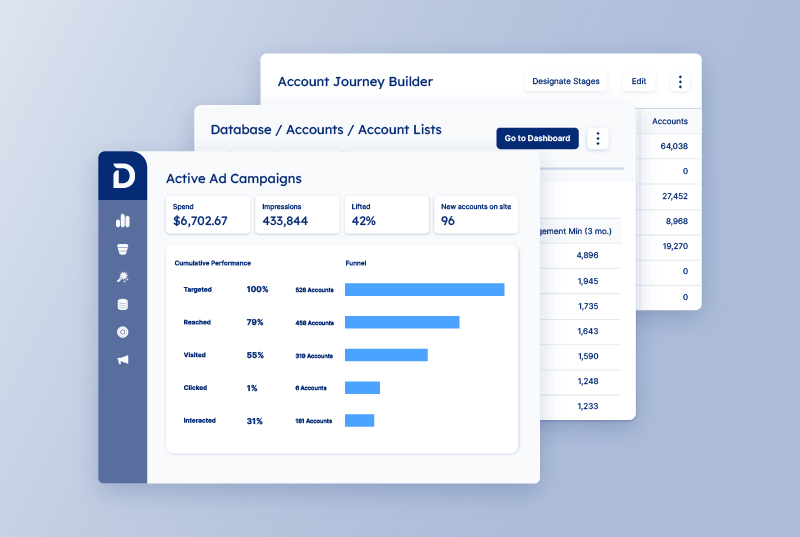
This is where Demandbase AI helps sales teams move from alerts to actionable guidance.
Instead of relying on static account lists, AI can dynamically surface:
- The most engaged accounts
- Emerging opportunities
- Accounts showing buying intent
- Recommended plays
- Missing personas in the buying group
- Signals that indicate deal readiness or expansion potential
The real value is reducing decision friction, because one of the biggest GTM challenges today is not lack of information. It is a lack of clarity on what to do next.
How new Sales teams are using Demandbase
For sales teams focused on net new business, the challenge is no longer simply finding accounts. It is identifying which accounts are actually in-market, which ones are showing meaningful engagement and which ones are worth a rep’s time now.
A UK enterprise sales team, for example, may be targeting a defined list of strategic accounts across financial services, manufacturing or technology.
Rather than asking reps to manually sift through hundreds of accounts, Demandbase can help prioritise accounts showing signals such as:
- Increased research activity around relevant topics
- Engagement from multiple people at the same account
- Visits to high-intent web pages
- Interaction with campaign content
- Movement across buying journey stages
This gives sellers a clearer reason to engage.
Instead of sending generic outbound messages, reps can tailor their outreach around what the account appears to care about now.
That matters in Europe, where trust, timing and relevance are critical. A message that feels informed and useful is far more likely to land than a cold pitch based on a job title alone.
How Customer expansion teams are using Demandbase
The same shift is happening in customer expansion.
Many customer opportunities do not begin with a hand raise. A customer may start researching a new use case, exploring an adjacent product category or involving stakeholders from a different business unit long before they speak to their account manager.
Demandbase helps customer-facing teams spot those signals earlier.
For example, an account management team may see that an existing customer is:
- Researching a new solution area
- Engaging with content tied to a different product line
- Showing increased activity from senior stakeholders
- Expanding engagement into another region or department
- Revisiting high-value pages before renewal
These signals can indicate upsell readiness, cross-sell potential or a broader transformation project taking shape.
Instead of waiting for the renewal conversation, teams can engage earlier with a more relevant point of view.
Moving from activity volume to deal progression
For years, many sales teams have optimised around activity volume.
- More calls
- More emails
- More meetings
- More sequences
Activity does not always mean progress, what becomes really powerful is combining journey visibility with AI interpretation.
Demandbase AI can help teams understand:
- Which activities actually correlate with progression
- Which personas are missing from the buying group
- Where deals are stalling
- Which accounts are gaining momentum
- What tends to move similar accounts forward
That is a major shift.
Instead of optimising around activity, AI allows teams to optimise around progression.
For European GTM teams, this is especially important. Longer buying cycles are often driven by consensus, risk review, procurement, compliance and local stakeholder alignment. Sales teams need to know not just whether an account is active, but whether the right people are engaged and whether the opportunity is actually moving.
Join our upcoming webinar
If you’re looking for practical strategies to navigate longer sales cycles, engage complex buying groups and accelerate pipeline performance, join us on 25th June at 11am BST for our webinar on “Cracking the Code on Longer Sales Cycles”.
If your team is selling into European markets, managing longer sales cycles or trying to turn buyer signals into meaningful action, this session is for you.
Related content


We have updated our Privacy Notice. Please click here for details.