

13 best B2B intent data providers for GTM intelligence

A B2B rep posted on Reddit asking if anyone gets ROI from intent data, or if the whole category is just overpriced lists. He’d reach out to flagged accounts and find they either had no idea what he was talking about or were 90% through a deal with a competitor. “Chasing ghosts,” he called it.
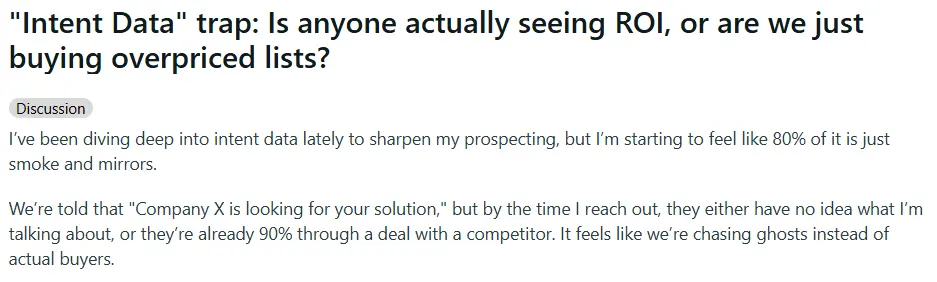
The complaint is reasonable, but it usually points to the provider, not the data type. Signal quality varies across vendors in 2026, and the right fit depends on how a team plans to use the data.
We ranked 13 leading B2B intent data providers below by working through current G2 reviews, Reddit threads, and peer discussions. You’ll see how each platform performs in practice, the trade-offs users mention most, and the kind of GTM team it fits.
| Platform | Best for | Key differentiator | Pricing |
| Demandbase | B2B teams that want a closed loop between intent and activation | Direct bidstream intent paired with the only B2B-native DSP, ABM orchestration, and Person-Based Intent on one dataset | Custom |
| 6sense | ABM teams that need to catch accounts at the right moment | 6AI engine turns billions of daily signals into account-level buying-stage predictions | Custom (free Sales Intelligence tier) |
| Cognism | Compliant, EMEA-heavy outbound that needs verified mobile numbers | Consent-based data with phone-verified Diamond mobile numbers and deep EMEA coverage | Custom |
| Bombora | Teams that want a clean topic-intent feed to plug into their own stack | Company Surge scores topic research against each account’s own 12-week baseline | Custom (about $25k to $75k/yr typical) |
| ZoomInfo | Outbound teams that want intent bundled with a large US contact database | Streaming intent paired with a 320M-plus verified contact database | Custom |
| Lead Onion | SMBs that want many intent sources under one affordable subscription | Aggregates 24 third-party intent sources, with person-level signals via Delivr.ai | Custom; free trial |
| HubSpot Breeze Intelligence | HubSpot users who want intent and enrichment without another tool | Enrichment and buyer intent native to HubSpot from the Clearbit dataset | Credit-based, $10 per 1,000 credits, on top of a HubSpot plan |
| DemandScience | Teams that want intent-driven campaigns run as a managed service | Managed-service model that delivers qualified pipeline as the contracted output | Custom |
| Lusha | Budget-conscious SMB and mid-market reps who want contact data with intent filters | Affordable, credit-based contact data with a Chrome extension and Bombora intent | Free, Pro, and Premium paid; Scale custom |
| UserGems | Teams that prioritize contact-level signals like job changes and champion moves | Gem-E AI agent scores contacts and auto-generates the outreach | Core $2,750/mo, Advanced $5,750/mo, Elite $10,000/mo, Enterprise custom |
| Madison Logic | ABM teams that want intent tied directly to multi-channel media | Intent identification and multi-channel media activation in one system | Custom |
| G2 | Vendors that want bottom-funnel, review-site buying signals | First-party signals like pricing checks and competitor comparisons from its marketplace | Buyer Intent add-on, quoted by sales (Starter $299/mo excludes it) |
| TrustRadius for Vendors | Enterprise vendors that want high-fidelity review-site intent without a lead auction | Enterprise-skewed downstream intent with a flat-rate, no-auction leads program | From $30k/product/yr; intent add-ons extra |
1. Demandbase
Demandbase is an AI-powered B2B GTM platform that spans account-based marketing, intent data, B2B advertising, and sales intelligence in a single system, with account intelligence, buying groups, sales playbooks, and revenue analytics built across the stack.
Plenty of tools sell intent data, but most resell signals they license elsewhere. Demandbase identifies unknown accounts through its own patented ID tech and reads signals directly from the bidstream via its B2B DSP, with visibility across 1M+ publishers and roughly 1 trillion monthly B2B interactions.
It also closes the loop most intent providers leave open. The only B2B-native ad platform in the category feeds each signal into account-targeted ads inside the same system, while Person-Based Intent names the specific buyers behind the research and ranks them by confidence.
Key features
- Proprietary bidstream intent: The intent data comes from direct bidstream access through Demandbase’s B2B DSP, with visibility across 1M+ publishers and 1 trillion monthly B2B interactions. Keyword sets are unlimited, and each one resolves into four views (historical baseline, current intensity, trending direction, signal quality).
- Person-Based Intent: Patented ID technology matches keyword intent to the known contacts inside an account, then ranks them by how important they are to the buying group.
- Buying group identification: An AI agent builds the complete buying group for each account in seconds, then fills any missing roles from a 150M+ contact database. You see every persona and role, plus a current read on which members are active right now.
- Third-party intent imports: You can connect a provider you already use, and Demandbase folds Bombora, G2, and TrustRadius intent into the same view as its own signals. Bombora Surge refreshes automatically on every update.
- Native B2B advertising: Because the DSP is part of the same system, an account you flag from intent is already an audience you can advertise to. Ads reach the buying committee on display, video, native, and connected TV, with no handoff to a separate ad tool.
Advantages of Demandbase
Most tools in this category are built to work the deals already in motion. Demandbase starts a step earlier, with in-market accounts that haven’t raised a hand yet, the full buying committee mapped out, and sales and B2B marketing work off one central dataset. And for revenue teams whose problem is pipeline quality more than pipeline volume, that head start changes the conversation in forecast calls.
Intent-based prioritization is one major strength that users name throughout G2 reviews. One user values the intent data because it flags which accounts have real interest, so sales can focus on the prospects most likely to convert. The shared account view also keeps sales and marketing teams aligned on the same list. [Read Full G2 Review]
Achievers shows the early-intent payoff in practice. The employee-recognition company kept losing ground because prospects were already deep in evaluations with competitors before sales could engage. After it made Demandbase its hub for intent and ABM, the team caught high-intent signals early and reached buyers before competitors entered the conversation, which one manager called the “timely truth” they had been missing. [Read Case Study]
Embed video
Another G2 user reports higher connect rates after moving outbound onto Demandbase’s real-time visit signals. Slack alerts fire as soon as a target account picks up engagement, with details on which pages they viewed, so reps can reference specific content in the outreach. [Read Full G2 Review]
Pricing
No public pricing. Demandbase tailors each quote to team size, target account list, and the modules selected, so the package matches the GTM motion you’re building.
2. 6sense
6sense is an AI-driven revenue intelligence platform that pulls together first-party, second-party, and third-party intent data and runs it through predictive account scoring to map out which accounts are researching, who’s on the buying team, and how to reach them.
The 6AI engine and Signalverse network do the heavy work, pulling trillions of buyer signals from across the open web and converting them into account-level predictions of where each buyer is in the research journey.
Key features
- Unlimited custom keyword tracking: The platform tracks an unlimited number of custom keywords across over 40 languages, with AI-generated keyword recommendations that expand tracking based on what the platform learns about your category.
- Multi-source intent aggregation: 6sense collects intent signals from its proprietary network of B2B websites along with major partners like Bombora, G2, TrustRadius, and PeerSpot.
- Anonymous visitor identification: Matches anonymous web traffic and intent signals to specific accounts across devices and locations, with coverage for both IPv4 and IPv6 addresses.
Pros
- Top-notch dark funnel visibility: One of 6sense’s biggest advantages is the account-level visibility into the anonymous research phase. Through keyword-level intent signals, the platform shows which target accounts are researching the category well before they fill out a form. [Read Full G2 Review]
- Useful starting point for prospecting: Sales Intelligence works well as a contact-discovery tool when reps don’t know who to approach inside a target account. Engagement data also adds context on how warm or cold each contact is. [Read Full G2 Review]
- Fast onboarding for sales teams: Users note that the initial setup was easy on the sales side. A short training session is often enough to get reps working in the platform without a long ramp-up. [Read Full G2 Review]
Cons
- Intent signal accuracy is a problem: Intent signals aren’t always accurate, and the platform sometimes points to accounts as in-market that have no real buying activity behind them. [Read Full G2 Review]
- Poor LATAM coverage: Sales Intelligence has thin coverage of Latin American markets, both in prospect counts and contact-level depth, which forces teams to use a secondary source. [Read Full G2 Review]
- Limited list controls: There’s not enough flexibility to suppress or remove accounts from working lists, especially when 6sense keeps finding accounts that are already customers, poor fits, or previously disqualified. [Read Full G2 Review]
Pricing
6sense doesn’t publicly list prices for its full intent data platform.
Sales Intelligence has a free tier and three paid tiers built around data credit volume and Predictive AI access.
Pricing for the full platform is custom-quoted by demo, with third-party reports placing enterprise contracts in the $60,000 to $120,000+ per year range.
Related reading → 15 Best 6sense Competitors & Alternatives Right Now
3. Cognism
Cognism is a globally compliant B2B prospecting platform that combines verified contact data, Bombora intent signals, and trigger events with Cortex AI for persona generation, search, and pre-call research.
Where Cognism stands out is in compliance-first data collection, phone-verified Diamond mobile numbers, and deeper EMEA coverage than most US-built competitors.
Key features
- Bombora-powered intent data: Intent data in Cognism comes from a Bombora integration that tracks topic-level research activity at the account level.
- CRM and engagement tool integrations: Records, intent flags, and trigger events go directly to Salesforce, HubSpot, Outreach, and Salesloft. You can also export contact data from a Chrome extension that works on LinkedIn profiles and company websites.
- GDPR and CCPA compliance: Cognism is built on a consent-based data model made for compliant prospecting in regulated industries and across European borders.
Pros
- Diamond Data mobile accuracy: Users single out the human-verified mobile numbers as the best feature of the platform, especially when calling US prospects. [Read Full G2 Review]
- Reliable integrations: The Salesforce and Outreach integrations sync contact and intent data into existing sales workflows without major issues. Reps can act on Cognism’s signals from inside the tools they already use. [Read Full G2 Review]
- Flexible search filters: Reps can search by person, company name, revenue band, or industry sector, with relevant firmographic context attached to each result. [Read Full G2 Review]
Cons
- Extension and data hygiene: The Chrome extension can be slow to load on LinkedIn, and the platform sometimes fails to update company records when an account merges or rebrands. [Read Full G2 Review]
- Patchy Middle East coverage: Cognism’s data for the Middle East is fragmented and inconsistent, and many government entities have no contact information at all. [Read Full G2 Review]
- 25-contact selection cap: The platform limits contact selection to 25 records per page, which slows down bulk list-building and exports. [Read Full G2 Review]
Pricing
Cognism doesn’t publish specific prices.
Sales Prospecting comes in Standard and Pro tiers, with intent data via Bombora available only on Pro and capped at 12 topics from a library of 11,000+.
4. Bombora
Bombora is a B2B intent data provider built on the industry’s largest consent-based data cooperative, with Company Surge as its main product that picks up when accounts research specific topics above their normal baseline.
That cooperative model makes Bombora the underlying intent data source for much of the B2B ecosystem, and platforms like 6sense, Cognism, and ZoomInfo all license Company Surge data to power parts of their own intent offerings.
Key features
- Company Surge methodology: Company Surge scores each account on each topic from 0 to 100 based on the past three weeks of research activity compared to that account’s 12-week baseline.
- Data co-op model: Bombora’s intent data comes from a cooperative of 5,000+ B2B publishers that contribute anonymized content consumption data in exchange for aggregated insights.
- Consent-based data model: Publishers in the co-op share data under explicit consent, so the signals carry GDPR and CCPA compliance out of the box, with less legal exposure than bidstream or scraped intent sources.
Pros
- Foundational position in the B2B intent data market: Bombora is widely credited as the platform that established account-level intent tracking as a category, and much of the modern ABM playbook borrows from the framework Company Surge introduced. [Read Full G2 Review]
- Quick to learn and use: Users describe Bombora as straightforward enough to pick up without prior experience, with most reaching productive use within their first session. [Read Full G2 Review]
- Publisher-sourced accuracy: Most of the intent comes from Bombora’s network of B2B publisher sites, which raises the accuracy floor compared to scraped or bidstream-based intent. [Read Full G2 Review]
Cons
- Filtering options could improve: The filtering and drill-down options are broader than power users would like. They say that they can’t narrow results as tightly as they need for vertical-specific or persona-driven analysis [Read Full G2 Review]
- Manual LinkedIn ad workflow: The Bombora-to-LinkedIn Campaign Manager handoff isn’t fully automated, which means teams have to download the list, filter it, and re-upload to LinkedIn for each campaign. [Read Full G2 Review]
- Hard-to-navigate history: Historical surge data is harder to retrieve than the current-week view, and the interface for tracking how an account’s intent has changed over multiple weeks is one of the platform’s weaker spots. [Read Full G2 Review]
Pricing
Bombora doesn’t list pricing publicly and only sells annual contracts.
Public estimates put most deals in the $25,000 to $75,000 range, scaling with data volume, topic coverage, and the number of integrations a buyer needs. Enterprise contracts can run well into six figures.
Related read → How to set up Engagement Points for Bombora intent in Demandbase
5. ZoomInfo
ZoomInfo is an all-in-one B2B revenue platform that connects verified contact data, intent signals, conversation intelligence, and AI agents into a single stack used mostly by North American sales and marketing teams.
The main edge over standalone intent providers is the integration with ZoomInfo’s 320M+ contact database. The same platform that finds an in-market account also gives teams the verified emails, mobile numbers, and decision-maker contacts to reach inside it.
Key features
- Streaming Intent: Streaming brings intent alerts in real-time as accounts spike on a tracked topic. This is a step up from the weekly refresh used by most co-op-based intent providers, and the alerts go directly into CRM and sales engagement workflows.
- Guided Intent: Guided Intent uses AI to recommend intent topics correlated with the buyer’s historical closed-won deals.
- G2 Buyer Intent integration. ZoomInfo has a native integration with G2 Buyer Intent, which also brings product-review-site signals on top of ZoomInfo’s own intent data.
Pros
- Fast, targeted prospect search: Reps say that they can filter ZoomInfo by job title, function, or seniority and build lists of 500+ contacts in just a few minutes. [Read Full G2 Review]
- Strong email campaign results: Users report high response rates on outbound campaigns powered by ZoomInfo contact data, and several attribute closed deals directly to the quality of the contact records. [Read Full G2 Review]
- Real-time outreach triggers: Some teams describe Scoops as one of the platform’s most powerful features, with real-time insights into what news is happening at a target account and which specific contacts are reading articles or guides. [Read Full G2 Review]
Cons
- Search misses inactive contacts: If a contact hasn’t been searched or used in the past 90 days, the platform sometimes leaves them out of search results unless their name is typed in directly. [Read Full G2 Review]
- The login system is often broken: Some users mention the login as the most frustrating part of the platform, where both username/password and SSO break at unpredictable points. [Read Full G2 Review]
- Poor alert customization: The home page alerts are hard to navigate, and the platform doesn’t offer a way to tie alerts directly to specific accounts in the connected CRM. [Read Full G2 Review]
Pricing
Pricing is custom-quoted by demo. Intent data is limited to the Sales Advanced or Elite tiers, and Streaming Intent is typically sold as an add-on on those packages.
Related reading → 16 Best ZoomInfo Alternatives & Competitors in 2026
6. Lead Onion
Lead Onion is a multi-source intent platform that brings together 24+ third-party intent feeds, contact data, website visitor reveal, and an AI agent (Aimee) for in-market account validation and outreach.
What works in Lead Onion’s favor is pricing and breadth. The platform packages many of the providers featured elsewhere in this guide into a single subscription.
Key features
- Multi-source intent aggregation: Teams that would otherwise need separate contracts and integrations across 4 or 5 providers get one centralized feed with overlapping signals validated against each other.
- Person-level intent: Through a partnership with Delivr.ai, Lead Onion provides person-level intent on top of the standard account-level signals. The integration analyzes 35 billion daily signals to find specific individuals in active research.
- Research Quadrant classification: The Research Quadrant maps each in-market account to one of four buyer journey phases (Initial, Interested, Active, or In-Depth) based on the volume and depth of research signals captured across sources.
Pros
- Clean HubSpot integration: The HubSpot connection works reliably out of the box, and intent signals and contact data move into the CRM workflow without any manual intervention. [Read Full G2 Review]
- Surge data for prospect evaluation: The Surge Data feature is often mentioned as one of the biggest advantages of the platform. The signal mix shows teams which prospects deserve attention first. [Read Full G2 Review]
- Devoted customer support: The Lead Onion team stays in close touch with customers, with regular check-ins and follow-ups during the onboarding and renewal cycles. [Read Full G2 Review]
Cons
- Complex filtering UX: Some teams mention that the filtering interface is hard to use, with too many options arranged in ways that aren’t at all intuitive. [Read Full G2 Review]
- Confusing platform organization: Lead Onion uses non-standard names for some features (the contact module is called ‘CDP’), and certain settings end up in menus that don’t match where users expect them. [Read Full G2 Review]
- No automated unsubscribes: The platform doesn’t auto-process unsubscribes, so users often have to handle the cleanup themselves to keep contact lists compliant. [Read Full G2 Review]
Pricing
Lead Onion doesn’t have a public pricing model. Quotes are scoped to each team’s volume of intent triggers, contact reveal credits, and user seats, with a free trial offered as a low-risk way to evaluate the product.
7. HubSpot Breeze Intelligence
HubSpot Breeze Intelligence is a native data enrichment and buyer intent product built into HubSpot’s Smart CRM. The platform is powered by a dataset of 200M+ company and buyer profiles from HubSpot’s late-2023 Clearbit acquisition.
The benefit is that you don’t need a separate intent vendor for this, since enrichment, intent signals, and form shortening come bundled into HubSpot as one credit-based product on a single bill.
Key features
- One-click data enrichment: A single click adds 40+ firmographic, demographic, and technographic attributes (industry, revenue, employee count, tech stack, contact role) to any company or contact record.
- Form shortening: Once a visitor enters their email, Breeze checks the enrichment database and hides any fields it can already fill on the backend (Company Name, Job Title, Industry, and similar). Visitors only complete what’s missing.
- 30-day signal backfill on activation: When a new company enters Buyer Intent tracking, HubSpot automatically populates 30 days of prior intent activity, which gives reps immediate high-quality context on what the account has already done.
Pros
- Useful company-visit feed: Breeze’s daily company-visit feed comes up often in G2 feedback as a major boost to outbound timing, since reps can act on a fresh list of accounts that hit the site each day. [Read Full G2 Review]
- Quick activation inside HubSpot: Enrichment and Buyer Intent can be active within minutes, since the data flows straight into existing HubSpot properties with no middleware or API setup. [Read Full G2 Review]
- Reliable executive-level data: Verified email coverage extends across most of the buying committee, including senior-level executives across target accounts, which holds up in G2 feedback. [Read Full G2 Review]
Disclaimer → Reviews below come from the G2 page for Clearbit, which HubSpot acquired and rebranded as Breeze Intelligence. The capabilities described still apply.
Cons
- UX updates made the experience worse: Users report that the product has gone through a string of interface updates since the HubSpot acquisition, and some, like visitor report, were made worse. [Read Full G2 Review]
- Few ICP criteria available: The ICP setup is currently constrained by a narrow set of available criteria, with limited depth for precise target-market definition. [Read Full G2 Review]
- High cost for SMBs: The total cost of the required HubSpot subscription plus per-credit charges for enrichment and Buyer Intent can run high for smaller teams. [Read Full G2 Review]
Pricing
There’s no standalone price for Breeze Intelligence.
Basic enrichment comes bundled free with paid HubSpot seats, and advanced features (buyer intent, Prospecting Agent, Data Agent) run on HubSpot Credits, allocated monthly from 500 on Starter up to 5,000 on Enterprise.
Extra credits cost $10 per 1,000, unused balance expires at month-end, and going over the limit pushes the account up to the next tier automatically.
Related read → How to Use Demandbase and HubSpot to Unify and Scale Your ABM Efforts
8. DemandScience
DemandScience is a fully managed B2B demand generation and ABX platform that brings together intent data, content syndication, ABM display advertising, email outreach, and a 247M+ contact database.
The value proposition is performance marketing as a service. DemandScience’s team plans, executes, and optimizes intent-driven campaigns on the customer’s behalf and contracts on qualified pipeline as the output.
This appeals to demand gen leaders who want guaranteed CPL delivery across syndication, ABM, and email without running the platform themselves.
Key features
- Multi-source buying intent signal coverage: The tool combines first-party data with third-party intent signals and secondary triggers like technology renewal dates, job changes, hiring data, funding rounds, and product launches.
- IONIC Identity Graph foundation: DemandScience’s IONIC Identity Graph holds 247M+ verified professional profiles in 100+ countries, with documented data provenance on each signal source and capture method.
- Full signal provenance and transparency: The platform provides documented provenance on every intent signal, with visible source, capture method, and verification logic for each account-level score.
Pros
- Hands-on account management: DemandScience puts weight behind every campaign through its account team. Users describe them as fast to respond, well-versed in the category, and easy to deal with day-to-day. [Read Full G2 Review]
- Solid coverage in international markets: Lead quality holds up well outside North America, with delivered leads that match ICP criteria at both the person and account level. [Read Full G2 Review]
- Deep audience filtering: Filters for country, account list, and job function go deeper than most competing demand gen tools, which makes ICP targeting more precise. [Read Full G2 Review]
Cons
- Hard to tell apart from competitors: Users explain that, on feature lists alone, DemandScience is similar to other content syndication and intent vendors. The managed-service model is practically the only thing that separates the platform from a crowded category. [Read Full G2 Review]
- Separate teams for each channel: To run cross-channel campaigns, you need to coordinate with two separate DemandScience teams, one for content syndication and one for display advertising. Many users have asked for a single campaign owner to cut down the back-and-forth. [Read Full G2 Review]
- Quarter-end delivery timing: Lead delivery sometimes runs longer than expected, and uploads can land on the final day of a quarter when teams would prefer a week of buffer for QA. [Read Full G2 Review]
Pricing
Like most platforms on this list, DemandScience doesn’t publish pricing. A sales conversation is the only way to get an accurate quote.
9. Lusha
Lusha is a B2B sales intelligence platform with verified contact data, Bombora-licensed intent signals, and a Chrome extension as the primary access point for sales professionals.
The platform’s main strength is direct-dial mobile data and email verification on North American contacts, with intent and trigger signals available as filters on prospect search.
Key features
- Flex Search feature: Flex Search interprets natural-language prompts and returns matching contacts from the 280M+ Lusha database, which speeds up list building for teams that don’t want to stack a dozen filters.
- AI Recommendations: AI Recommendations builds a lookalike list around existing CRM contacts and recent search behavior. It ranks each suggestion by ICP fit score so reps can scale outreach past their first list.
- Lusha Playlists: A feature that keeps lead lists current and adds contacts as soon as they match the saved ICP and intent criteria, with optional auto-enrollment into Engage email sequences.
Pros
- Deep CRM and engagement sync: The platform pushes contact data into Salesforce, HubSpot, Outreach, and Salesloft natively, which keeps prospect records flowing into rep workflows without manual exports or middleware. [Read Full G2 Review]
- Affordable compared to some competitors: Lusha’s credit-based model costs less than competitors’ license pricing for similar contact data access at SMB and mid-market scale. [Read Full G2 Review]
- Chrome extension keeps reps in-flow: The browser extension reveals contact data directly inside LinkedIn and any B2B website, with no need to switch to a separate app during daily prospecting. [Read Full G2 Review]
Cons
- Not a one-stop solution: Lusha covers contact data and intent well, but it doesn’t replace the full prospecting stack. Most teams still run it alongside a CRM, an outbound platform, and other go-to-market tools. [Read Full G2 Review]
- Company intelligence: Users have asked for deeper firmographic and account-level detail in enrichment. The current company data covers the basics but doesn’t go as deep as some teams expect. [Read Full G2 Review]
- Credits burn fast: Teams that run large outbound programs report the credit-based model as limiting, especially since unverified contact data still consumes credits. [Read Full G2 Review]
Pricing
Lusha runs on a credit-based model across four tiers, with detailed numbers behind an interactive configurator:
- Free: 40 credits/month, Chrome extension, basic CRM integrations.
- Pro: ~$29/user/month, around 250 credits, list management.
- Premium: ~$70/user/month, higher credit volumes, team management features.
- Scale: Custom pricing for teams of 6+, with per-user credit limits and sales-assisted onboarding.
Monthly subscribers can roll unused credits forward up to 2x the cap.
10. UserGems
UserGems is an AI GTM platform that tracks person-level signals (job changes, hiring, past champions) and account-level intent, and then creates outbound sequences through Gem-E.
UserGems pioneered job-change tracking for past champions and still leads on person-level signals. Each account signal pairs with the specific people to reach, and Gem-E ships ready-to-send sequences into the CRM.
Key features
- Gem-E AI agent: Gem-E monitors buying signals, evaluates them against 600+ ICP criteria, and creates enriched leads in the CRM with personalized outreach messages already pre-written for the sales rep.
- AI scoring engine: Every contact and account gets weekly score updates based on 600+ ICP signals. Sales teams can see which prospects are most likely to convert at any point in the week.
- AI-drafted outreach: When a signal fires, Gem-E auto-creates a personalized email based on the signal type, the contact’s history with the account, and the relationship context, with the rep able to send, edit, or skip.
Pros
- Purpose-built for B2B revops teams: The platform is built tightly around B2B pipeline generation, with feature scope limited to signals, scoring, and outbound. Some teams describe it as a relief compared to bloated GTM suites. [Read Full G2 Review]
- Easy Salesforce and HubSpot setup: Most teams have UserGems pushing signals into Salesforce or HubSpot within a week, well ahead of the multi-month rollouts typical of enterprise intent platforms. [Read Full G2 Review]
- Job change tracking on autopilot: The platform watches every past customer and champion across LinkedIn and CRM data, catches the job change the day it happens, and writes the new company and role straight into the existing record. [Read Full G2 Review]
Cons
- Lead volume runs ahead of capacity: UserGems generates enough volume that many teams staff a dedicated BDR to qualify inbound leads before they reach Account Executives. [Read Full G2 Review]
- Manual import process: Users report the data import workflow as more hands-on than expected, with certain imports that still need manual steps. [Read Full G2 Review]
- Routing needs initial setup work: Job change alerts don’t always route to the right SDR by default, and teams have flagged that some alerts hit reps whose personas or playbooks don’t match the moved contact. [Read Full G2 Review]
Pricing
The platform has 4 separate pricing tiers:
- Core: $2,750/month ($33k/year)
- Advanced: $5,750/month ($69k/year)
- Elite: $10,000/month ($120k/year)
- Enterprise: Custom pricing on request
A Starter package is also available for companies under 80 employees through sales. All paid plans include UserGems’ money-back ROI guarantee tied to closed-won revenue.
Episode to listen → Revenue Alignment at UserGems
11. Madison Logic
Madison Logic is an enterprise ABM platform that connects proprietary intent data (ML Insights) with a multi-channel activation engine across content syndication, display, LinkedIn, CTV, and audio.
The differentiator is owning both ends of the workflow. Intent identification and multi-channel activation share one system, which removes the usual handoff between intent vendors and ad platforms.
Key features
- Predictive Buying Stage: ML Insights groups each account’s buying committee into one of four stages (Awareness, Consideration, Decision, Customer) based on engagement depth and intent signal patterns.
- ML SmartReach with Gong integration: Generates personalized outreach content based on each account’s intent signals and engagement history, then routes the messages into sales workflows through Gong.
- Multi-channel ABM activation: Intent data feeds straight into campaigns on Madison Logic’s content syndication, display, LinkedIn, CTV, and audio inventory, with no separate ad platforms to integrate.
Pros
- Clear cross-channel reporting: Users describe the platform’s dashboards as practical and well-built, with content syndication and display campaigns both visible in one place and easy to filter through. [Read Full G2 Review]
- Topic visibility comes at the right time: The Trending Topics view shows what target accounts are researching at any moment, which teams say makes content and messaging easier to time around active buyer interest. [Read Full G2 Review]
- Better data models than most ABM peers: Users prefer Madison Logic’s intent and account-targeting models over what most competing ABM platforms offer. [Read Full G2 Review]
Cons
- Slow reporting cadence: Many users report that custom reporting and account insights can take more than a month to arrive. [Read Full G2 Review]
- Account insights aren’t auto-served: The platform has useful account-level intel, but users have to manually go through them each time. Because of this, the feature is hard to lean on a day-to-day basis for busy teams. [Read Full G2 Review]
- Hidden default reports: Default dashboards open to broad views and skip the high-level metrics most teams check daily, which adds clicks to the routine reporting flow that other ABM platforms keep on the home screen. [Read Full G2 Review]
Pricing
Every deal is sales-led. The contract combines an annual ML Platform subscription with campaign-based media packages, and the final number depends on target regions, account volume, and channel mix.
12. G2
G2 Buyer Intent is the intent data product attached to G2’s software review marketplace. It pulls first-party intent data signals from how accounts browse profiles, categories, pricing pages, and alternatives on G2.com and syncs them into the buyer’s CRM and sales stack.
G2 owns the data source. The signals come from G2’s own marketplace, where buyers research and compare software, which means the intent is bottom-of-funnel and tied to specific competitor and category behavior in a way third-party intent vendors can’t match.
Key features
- Competitor intent signals: Shows when accounts research competitors’ profiles, comparisons, and alternatives pages on G2, which flags both competitive-displacement opportunities and churn risk in the existing customer base.
- First-party intent signals: Captures real account activity on G2.com, profile views, pricing checks, and competitor comparisons, all far more specific than inferred third-party intent.
- ICP and firmographic filters: Intent signals can be filtered by company size, industry, region, and custom ICP criteria, so reps only see in-market accounts that match the target profile.
Pros
- Hands-on customer success: G2’s team works with customers to build specific use cases and set shared goals upfront, which several users describe as a genuinely collaborative onboarding. [Read Full G2 Review]
- Real-time sales triggers: Deep HubSpot, Salesforce, and LinkedIn connections fire automated workflows the second an account views a Compare or pricing page, so intent becomes an instant signal to act on. [Read Full G2 Review]
- Intent data you can’t get elsewhere: G2 shows who viewed your profile, compared you to a competitor, and researched your category, which is all behavior that’s hard to capture from any other source. The same data doubles as social proof in deals. [Read Full G2 Review]
Cons
- Incentivized reviews dilute quality: Users have asked for better filters to screen out incentivized reviews, which often skip the technical depth that buyers want. [Read Full G2 Review]
- Slow review moderation: The review approval process can take longer than expected, and users report that rejection feedback is often vague. This makes it hard to fix and resubmit a flagged review. [Read Full G2 Review]
- Lower volume in newer markets: In regions where G2 adoption is still early, like Australia, signal volume can be too low to build a reliable account list. [Read Full G2 Review]
Pricing
Buyer Intent is only sold as an add-on. It’s available on G2’s Professional and Enterprise Brand Packages, both quoted by sales, so the intent cost stacks on top of whichever package a customer already has.
Related read → Engagement points for G2 intent
13. TrustRadius for Vendors
TrustRadius for Vendors is the vendor-facing platform on top of TrustRadius’s software review marketplace. It converts on-site research behavior (reviews, comparisons, pricing-page visits, alternatives lists) into downstream intent data at the product, competitor, and category level.
Unlike review platforms that make vendors bid for leads, TrustRadius runs an Intent-Driven Leads program that brings ICP-filtered, opted-in prospects on a flat basis, so competitors can’t outbid you for the same account.
Key features
- Downstream intent data: Captures on-site buyer behavior like reviews read, products compared, pricing checked, and demos viewed, then reports it as intent signals at the product, competitor, and category level.
- Review content and TrustQuotes: The platform generates long-form customer reviews and packages them as licensed content, quotes, and awards for sales and marketing use.
- Salesforce Connector and ABM integrations: Sends downstream intent into Salesforce and ABM platforms like 6sense and Demandbase, so the data shows up where sales reps and marketers already work.
Pros
- Real-time account tracking in the CRM: The Salesforce Connector points out companies that research your product on TrustRadius in real-time [Read Full Capterra Review]
- High-fidelity, enterprise-skewed signals: Because TrustRadius reviews run long and skew toward enterprise buyers, vendors describe the downstream intent as cleaner and more decision-ready than broad topic data.
- Granular performance analytics: Vendors get detailed reporting on profile traffic, engagement, and product performance, so the team can understand its audience and act on hard numbers. [Read Full Capterra Review]
Cons
- Lower volume in niche verticals: In smaller or specialized verticals, the amount of buyer intent data on TrustRadius can run low, and that weakens its value for teams in narrow markets. [Read Full Capterra Review]
- ROI is hard to justify for SMB and low-ACV vendors: For teams that sell high-volume, low-ACV software, the cost per influenced deal climbs, which makes the math harder to defend than it is for enterprise sellers.
- Rough edges on UI and support: The interface takes time for beginners to learn, customer support can be slow, and TrustRadius runs better on desktop than mobile. [Read Full Capterra Review]
Pricing
TrustRadius starts with its Customer Voice Package at $30,000 per product per year, and a multi-year discount is available.
Category Intent Data and the Intent-Driven Leads program are add-ons on top of that base, priced separately by sales.
How to choose the right B2B intent data provider
Use the breakdown below to find your situation and the provider built for it:
- For enterprise GTM teams that need intent, contact identification, and ad activation working off the same data, Demandbase is the clearest fit on this list. Bidstream intent, Person-Based Intent, buying group resolution, and a native B2B DSP run on one dataset, so a hot account converts to coordinated ads and sales outreach without crossing platforms.
- For bottom-funnel signals from buyers comparing products, G2 and TrustRadius are the best sources. G2 captures pricing-page views and competitor comparisons on its marketplace, and TrustRadius adds enterprise-skewed, high-fidelity research.
- Teams that want intent on top of solid contact data should weigh ZoomInfo, Cognism, and Lusha. ZoomInfo suits large US outbound, Cognism handles compliant and EMEA-heavy programs, and Lusha works for budget-conscious SMBs.
- For predictive scoring that points out in-market accounts before they engage, 6sense is a good choice. Its AI turns billions of signals into account-level predictions, though if you want to see exactly why an account scored, Demandbase’s transparent model is the cleaner read.
- For raw topic intent you want to feed elsewhere, Bombora is the best fit. The data comes from a 5,000-plus publisher co-op and arrives GDPR-compliant out of the box, which is why much of the industry licenses it as a base feed.
- For intent without a heavy new platform, Lead Onion and HubSpot Breeze are the easiest entries. Lead Onion rolls two dozen third-party sources into one affordable feed with person-level signals, and Breeze bundles enrichment and buyer intent into HubSpot from its Clearbit-based dataset.
- For lead generation run as a managed service, DemandScience is suitable for most teams. Its team plans content syndication and ABM advertising on your behalf, backed by a 247M-profile identity graph, and delivers a qualified pipeline as the output.
- For automated, signal-triggered plays, UserGems and Madison Logic lead. UserGems uses its Gem-E agent to score contacts, catches job changes, and Madison Logic converts intent into coordinated campaigns on display, social, and syndication.
- Where does the intent data come from, and how much is first-party, bidstream, or licensed from partners?
- Does it report intent at the account level, or down to the people inside the buying group?
- How does the vendor cut false positives, and what drives each score?
- Which markets and languages does the data cover, so your regions are well represented?
- How fresh is the data, and does it arrive in real time or on a weekly cycle?
- Which tools does it connect to out of the box, like your CRM, marketing automation, and ad platforms, and can you act on a signal in the platform or only after an export?
- Can it bring in third-party intent like Bombora, G2, or TrustRadius if you already use them?
- How does pricing scale, and what becomes an add-on later, like seats, credits, ad spend, or data volume?
Demandbase — the ideal intent data provider for GTM intelligence
Most intent providers stop at the signal. They tell you an account is researching your category, then leave you to push that information into a separate ad platform, a separate ABM tool, and a separate sales workflow.
Demandbase does the whole loop from one dataset, which removes the lag between signal and outreach where most pipeline gets lost. The platform compresses what would otherwise be four or five separate vendors.
With Demandbase, you get:
- Bidstream intent read at the source, with unlimited keyword sets for products, competitors, and the exact problem language your buyers use.
- Person-Based Intent that names the contacts driving the research and ranks them by buying-group relevance.
- Orchestration that pushes each signal into coordinated ads, alerts, and outreach with no manual handoff between teams.
- Buying group identification that assembles the full committee in seconds and fills the gaps from a 150M+ contact database.
- A B2B-native ad platform that activates each signal as an account-targeted ad in the same workflow.
- Third-party intent imports that consolidate Bombora, G2, and TrustRadius signals in one view.
- Account identification that maps anonymous traffic to real companies through 3.7B+ IP addresses.
- A data foundation of firmographics, technographics on 47K technologies, and 176M verified B2B contacts.
Demandbase makes sense for teams that already have intent signals coming in and need a faster way to act on them.
The intent test drive is the easiest way to see what the platform finds in your category, no contract or sales call involved. Book a meeting when you’re ready to see how it would map to your accounts and team.
FAQs
How do buyer intent data providers differ in data sources and accuracy?
The main difference is where the data comes from.
Bidstream feeds capture broad ad-auction activity, so you get a wide reach with low accuracy. A publisher co-op like Bombora uses consent-based sites for cleaner topic data, and review sites like G2 and TrustRadius track behavior close to a purchase. Some vendors just resell one of these.
Cleaner sources read more accurately, and the best tools add AI to cut false positives and match each signal to the right account.
What is the difference between first-party and third-party intent data?
First-party intent is the activity people show on your own digital properties, like website visits, so it tells you who already engages with your brand. The signal is strong because the interest points straight at you, but it only covers people who have already found you.
Third-party intent is the activity that those accounts show everywhere else. It comes from outside sources like publisher co-ops, review sites, and the bidstream, and shows which companies research your category or competitors before they land on your site. The reach is wider and earlier, though the signal is less precise and not exclusive to you.
Can I use multiple intent data providers at once to improve my strategy?
Yes, and plenty of teams do. Each provider catches a different slice, so one might be strong on topic research, another on review-site behavior, and another on first-party site visits.
Stacking them widens your coverage and helps you cross-check a signal, since an account that shows up in two sources is more reliable than one that a single feed flags.
Related content



We have updated our Privacy Notice. Please click here for details.