

How to use ABM content syndication for staying top of mind with target accounts

What is ABM content syndication?
ABM content syndication is the process of distributing your marketing content (like whitepapers, eBooks, case studies, or webinars) across third-party platforms with the specific goal of reaching target accounts in your ABM strategy.
It’s an approach that focuses on accelerating the pipeline by getting the right content in front of the right people at the right time, and in the right place.
In this case, that’ll be influencing buying groups, engaging accounts that match your ICP (Ideal Customer Profile), and driving intent-based actions like demo requests, sales conversations, or deep product exploration.
How does ABM content syndication work?
- Define your target accounts. You start with a list of companies you want to reach (your ICP or ABM list). These are typically high-value B2B accounts that fit your product’s value proprositon—based on firmographic data (industry, size, revenue, tech stack, etc.).
- Choose a syndication partner or platform. You work with a B2B media network or content syndication platform (like Demandbase). These platforms already have access to huge databases of professionals and can distribute your content across niche sites or email newsletters where your audience hangs out.
- Content is matched to the target account. The syndication partner promotes your gated content (e.g., a whitepaper with a lead form) to specific job titles and roles inside your target accounts. Only qualified individuals from your ABM list are shown the content.
- Lead generation with intent signals. When someone from a target account downloads or interacts with the content, the platform captures their contact details (name, email, company, role). You now have an engaged lead from your dream account, plus data-driven insights on what content they care about.
- Lead validation and handoff to sales or nurture. These leads are often enriched with firmographic and technographic data, then routed to your sales team for outreach—or sent into a tailored nurture track.
Practical example: ABM content syndication
Let’s say you’re a cybersecurity SaaS company targeting enterprise CISOs in the finance and healthcare sectors. You’ve created a new industry report: “2025 Threat Landscape for Regulated Industries.”
Instead of uploading it to your blog and hoping the right buyers find it through SEO, you work with a B2B content syndication partner to:
- Target a curated list of high-value accounts from your ABM list; e.g., 500 companies, including JPMorgan, UnitedHealth Group, and others.
- Identify key decision-makers and influencers within those companies like CISOs, CIOs, and Heads of IT Security.
- Distribute the content across trusted publisher networks or niche industry platforms where they actively consume content.
- Gate the content with smart forms, so when a CISO from JPMorgan downloads it, you capture that engagement and route it into your CRM or MAP.
- Trigger a follow-up sequence—maybe your SDR reaches out with a personalized message:
- “Saw you downloaded our report on healthcare cyber threats. Happy to share insights from how we’re helping similar firms like XYZ stay compliant.”
And that’s all. You just moved a target account from cold to conversation-ready.
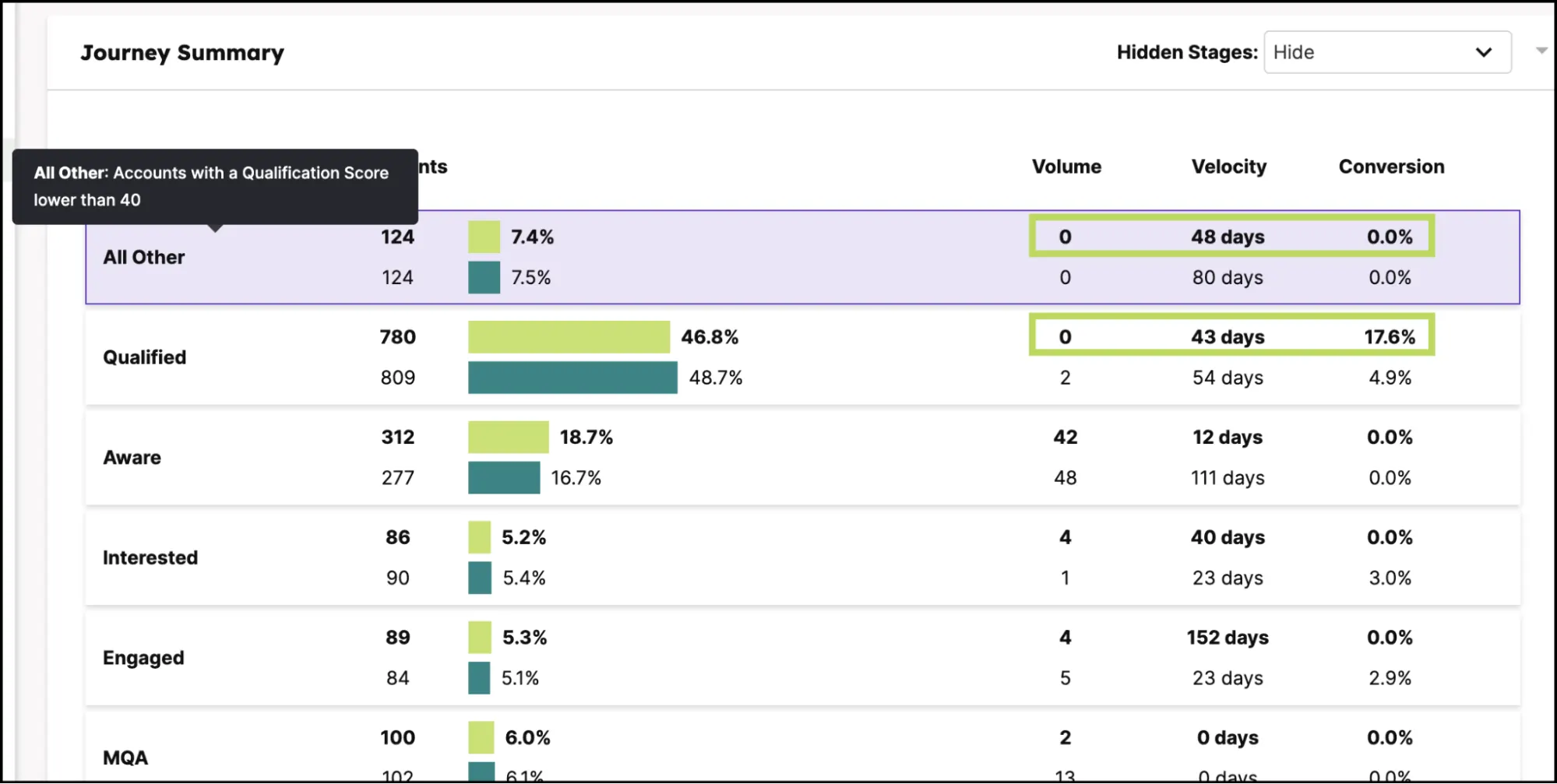
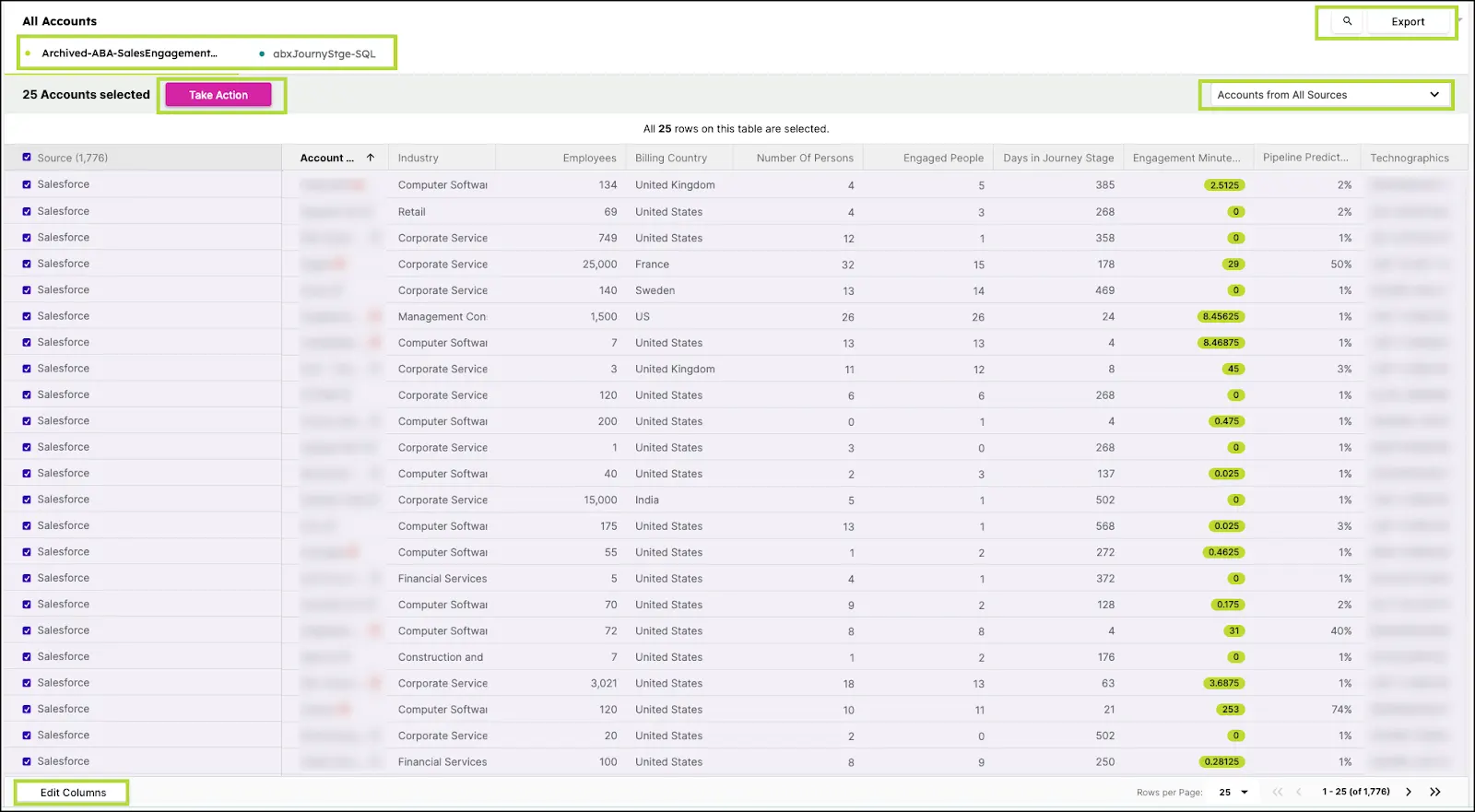
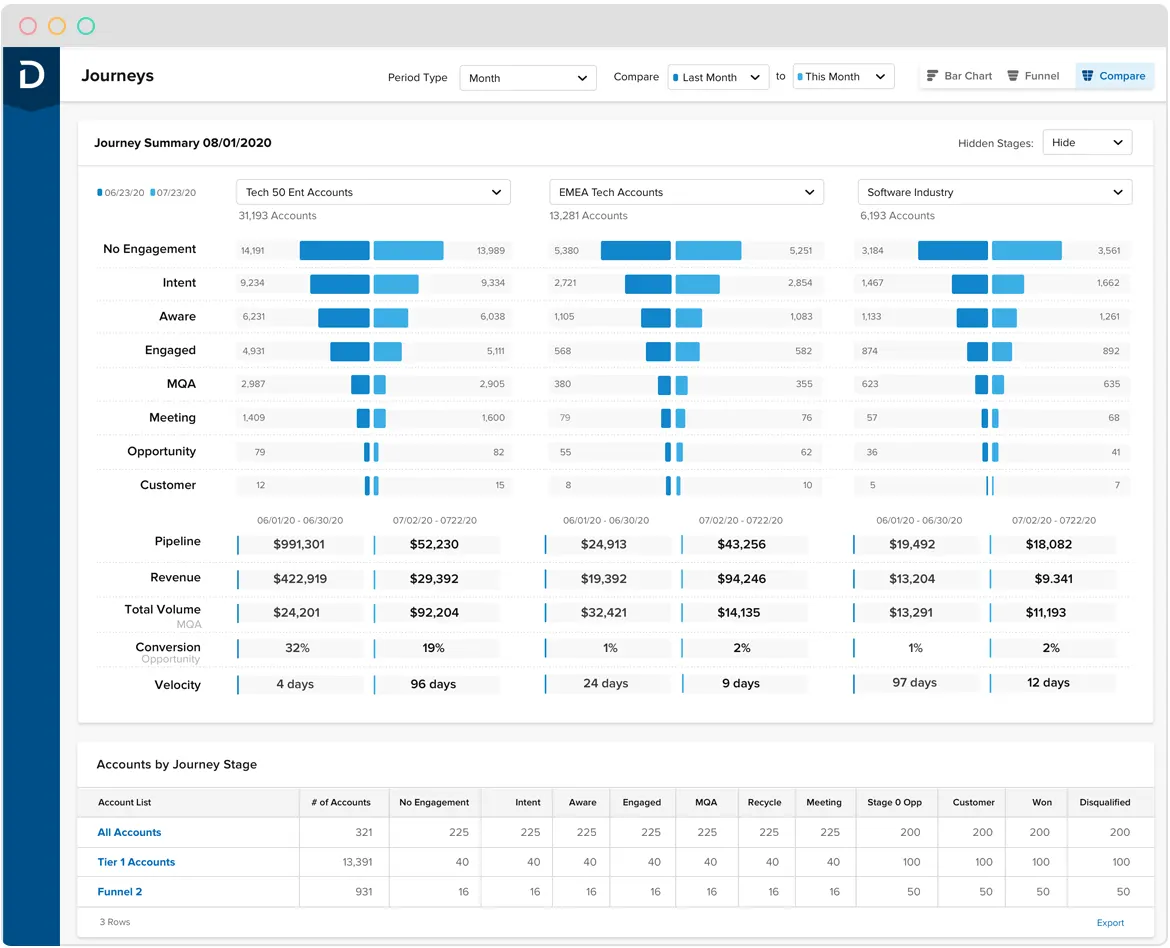
You can use the ‘Journey Stages’ feature on Demandbase to track key metrics such as pipeline, revenue, close rate, average deal size, volume, conversion, and velocity.
Related → How to identify accounts for ABM: A step-by-step guide for B2B Marketing teams
How is ABM content syndication different from traditional content syndication programs?
The key difference between Account Based Marketing (ABM) content syndication and traditional content syndication lies in who you’re targeting, why you’re targeting them, and what you expect to happen next.
Audience targeting: precision vs. volume
- Traditional content syndication aims for scale.i.e., casting a wide net, hoping one catches. You promote your content to a broad audience based on general filters like industry, job title, or region. Anyone who meets the criteria may see or download your content— even if they’re not in your ICP.
- ABM content syndication, on the other hand, is all about ‘precision targeting’. You push content only to a predefined list of high-value accounts, ensuring that every lead has strategic revenue potential.
For example, a traditional campaign might target all “IT Directors in North America,” while an ABM campaign targets “the Director of Cloud Infrastructure at Adobe, VMware, and Dropbox.”
Goal: lead generation vs. account engagement
- With traditional content syndication, the goal is to generate as many leads as possible, regardless of quality. These often end up in your CRM as cold contacts with little to no purchase intent.
- With ABM content syndication, the goal is to accelerate engagement within key accounts and move them deeper into the buying journey.
Success metrics: lead count vs. pipeline influence
- Traditional success = number of leads.
- ABM success = influence on pipeline and revenue from target accounts.
| Aspect | Traditional Content Syndication | ABM Content Syndication |
|---|---|---|
| Targeting | Broad filters | Target Account List (predefined) |
| Lead Fit | Mixed | High-fit, pre-qualified |
| Intent Signals | Low to medium | High, based on strategic content & role |
| Content Personalization | Generic | Customized for target accounts |
| Sales & Marketing Alignment | Low | High |
| KPIs | Lead volume, CPL | Pipeline contribution, revenue acceleration |
Related → How to measure ROI of your account based marketing strategy
How does ABM content syndication drive demand and lead generation in B2B?
How ABM content syndication drives demand
Warms up cold or stalled accounts
Half the time, target accounts are not net-new. In fact, they’re old MQLs, disqualified leads, or stalled deals that simply went dark.
ABM content syndication reactivates these cold or inactive accounts by re-engaging them with relevant content in new channels they already consume. This way, you can re-ignite interest without aggressive outbound.
Example: A dormant target from Q2 sees your latest “2025 B2B AI Forecast” guide in their Linkedin feed or inbox via a third-party publisher.
Because the content appears on neutral platforms or industry sites, it feels organic and trustworthy, not pushy. This will likely push them back into active consideration.
Aligns messaging with the buyer journey and triggers awareness
ABM content syndication lets you map content assets to specific needs of the buyer at each stage of their journey.
- If you’re targeting accounts in the awareness stage, you might syndicate industry research.
- Meanwhile for consideration-stage accounts, a comparison guide or case study.
By aligning content to what they’re feeling at each stage, you move them from passive browsing to active awareness. And in return, you manufacture demand as you nurture them forward.
Puts your brand in front of high-intent buyers early
ABM content syndication gets your content directly in front of decision-makers at your target accounts even before they’ve started a formal buying process.
This early exposure means your brand becomes part of their internal discussions and solution research from day one.
Unlike traditional inbound where you wait for discovery, here you’re proactively planting your solution into their awareness.
Builds a continuous stream of buyer intent data
Every engagement with your syndicated content gives off a signal, i.e., who viewed it, what they viewed, from which account, and how they engaged.
This data feeds your demand engine, helping you score accounts, prioritize sales outreach, and even inform ad retargeting strategies.
Related → Buyer intent explained: B2B sales signals that convert
How ABM content syndication drives lead generation
Enriches contact data with contextual signals for better sales outreach
Leads generated through ABM syndication are often accompanied by additional behavioral and firmographic data—such as job role, company size, content consumed, and intent signals.
This data empowers your sales team to personalize outreach with relevance from the first message.
Example: Instead of “Hey John, can we talk?”, you can say:
“Hey John, I saw you downloaded our guide on scaling cloud infrastructure. I noticed DealOps recently expanded its dev team—curious how you’re planning for system load balancing?”
Supports multi-touch account penetration
ABM syndication can be used to capture multiple leads across different departments within the same account, helping you map out buying centers and build influence across stakeholders.
This drives deeper account penetration and positions your brand more strategically within each organization.
Accelerates time-to-pipeline
Because ABM syndication brings in highly qualified leads who have already engaged with your thought leadership, they’re more likely to convert into meetings, product demos, or PQLs faster.
This time, you don’t have to educate them from scratch since they’ve already consumed value and often come with existing interests or questions. That shortens the path from form-fill to first call.
Captures leads with proven content
Instead of relying on your website or hoping that buyers stumble upon your lead forms, ABM content syndication pushes your gated content (e.g., eBooks, webinars) to high-intent buyers in the channels they already trust.
When they download, their contact info, job role, company, and engagement data is captured, and validated.
Benefits of using ABM content syndication in B2B marketing
Measurable influence on pipeline and revenue
Since ABM content syndication is highly targeted and integrated into your ABM platform (e.g., Demandbase), it becomes easier to track its influence on opportunity creation and closed-won deals. You can map content interactions to specific accounts and measure content influence across the buying journey.
For example, you can measure if a prospect engages with a thought leadership article before becoming an opportunity. Or if multiple stakeholders download related assets before the demo.
This attribution clarity helps justify budget and proves impact to leadership.
Related → How to measure account-based marketing (+ABM metrics)
Enhanced collaboration between marketing and sales
ABM content syndication provides account-level insights that sales teams can act on almost immediately.
For instance, when an SDR sees that a VP of Engineering from a Tier 1 account has downloaded a technical guide, they can follow up, referencing the content and continuing the conversation naturally.
This bridges the gap between both teams: marketing delivers MQLs with intent-rich account data that sales can convert into revenue.
Efficient use of high-quality content assets
ABM content syndication gives new life to your most valuable content. Rather than settle for one-off blog posts or gated reports collecting dust, you can systematically push them to top-tier accounts via syndication partners, publisher networks, or direct email to decision-makers.
With multi-touch orchestration, the same asset can be repackaged for awareness (e.g., thought leadership), mid-funnel (e.g., case study), and decision (e.g., product comparison guide) phases across different stakeholders.
What you’re doing is simply extending the lifecycle and reach of content you’ve already invested in, ensuring maximum return without additional production costs.
Better intent signal capture and lead scoring
Modern ABM content syndication platforms often integrate with intent data providers. That gives you better visibility into buying signals, which helps you allocate sales effort more strategically.
For example, you know which content was consumed, by whom, and at what stage of the funnel.
This rich engagement data allows you to score leads more accurately, prioritize outreach based on content interactions, and even trigger nurture sequences or SDR follow-ups based on content syndication behavior.
Related → How to effectively prioritize accounts in sales
Scalable awareness without limiting relevance
Traditional awareness campaigns often rely on broad-scale impressions which add little to no value to the bottom line.
Meanwhile, ABM content syndication enables scalable awareness within your target account list, reaching hundreds or thousands of relevant buyers without diluting message quality.
For example, through intent-powered syndication networks, you can push your content to only tech decision-makers at mid-market fintech firms actively researching cloud migration.
The key benefit here is: You grow brand visibility inside the right organizations, ensuring multiple stakeholders are exposed to your message while maintaining message control and relevance.
Key steps involved in setting up an ABM content syndication campaign
Step 1: Clarify your campaign objectives
The very first step in launching an ABM content syndication campaign is defining exactly what you want to achieve.
Vague goals like “get more leads” won’t work. You need to be precise, targeted, and tied to specific business outcomes.
Are you aiming to:
- Drive net-new pipeline from Tier 1 accounts?
- Accelerate in-progress deals by nurturing decision-makers?
- Generate awareness in a new market segment?
This objective will shape everything else, from the content format you choose to the targeting filters you apply. It also determines how you’ll measure success.
For example, if you’re trying to support mid-funnel acceleration, your KPI might not be downloads but rather increase in opportunity creation or deal velocity from those who engaged with the syndicated content.
Step 2: Build or refine your ideal customer profile (ICP)
Next, you must clearly articulate who you’re targeting, and that’s where your ideal customer profile comes in. This profile should be grounded in firmographic, technographic, and behavioral data points to help identify companies most likely to buy and benefit from your solution.
Here’s how to define your ICP attributes:
- Industry/vertical (e.g., healthcare, SaaS, fintech)
- Company size & revenue range
- Tech stack (e.g., uses Demandbase + Bombora + Salesforce)
- Pain points and goals
- Buyer persona titles (e.g., VP of Marketing, CIO, Procurement Manager)
Step 3: Build a tiered target account list
Once the ICP is set, generate a Target Account List (TAL), and segment it by priority tiers:
- Tier 1: High-value, named accounts with the greatest revenue potential (1:1 or 1:few campaigns)
- Tier 2: Mid-tier accounts that fit ICP well but may not be strategic targets (1:many campaigns)
- Tier 3: Broader segment of accounts with looser fit but potential for nurturing (awareness or testing grounds).
Related → The undeniable impact of account tiering for a modern ABM strategy
Step 4: Choose or create the right content assets
Now that you know who you’re targeting, you need to decide what you’ll show them. The content you choose or create must align with your campaign goals and the buying stage of your target audience.
Here are examples of of assets to syndicate:
- Thought leadership → for early-stage awareness
- Product comparison guides → for mid-funnel consideration
- Customer success stories → for building trust and social proof
- Analyst reports → for late-stage decision-making
Another thing to note is: format matters. Whitepapers and eBooks tend to generate more leads, but interactive assets (like assessments) can generate better engagement and qualification data.
Step 5: Choose a content syndication partner or platform
With your content ready, it’s time to distribute it—and here, you have options.
You can work with a third-party syndication vendor or use an ABM platform with built-in syndication capabilities.
- Third-party vendors have large databases of professionals and can promote your content across their media networks. You give them your targeting criteria, and they deliver leads who match your ICP and have downloaded your asset.
- Alternatively, if you use a platform like Demandbase, you can directly syndicate content to accounts within your platform’s ecosystem and tie it into your broader account based marketing strategy, such as display ads or triggered email sequences.
Whichever route you choose, vet them thoroughly. Ask how they qualify leads, whether they verify intent, what data fields they deliver, and how frequently they update their contact databases.
Step 6: Set campaign filters and lead qualification criteria
Before the campaign goes live, you need to define your qualification criteria, i.e., telling your vendor or platform which leads you want and which you don’t.
Common filters include:
- Job titles/seniority (e.g., Director+, C-level)
- Company size and industry
- Geographic location
- Technology used
- Buying intent signals or engagement metrics
For example, you might specify that you only want decision-makers from U.S.-based SaaS companies with over $50M in revenue. Or that you only want VP+ titles in IT at fintech firms.
You’ll also need to decide;
- how the content will be delivered (gated vs ungated),
- how leads are scored, and
- how they will be delivered to you (API, CRM integration, or CSV).
DB Nuggets → If your criteria are too loose, you’ll get volume without value. If they’re too strict, you might get excellent leads, but too few to move the needle. Find a balance that prioritizes quality but still allows for reach.
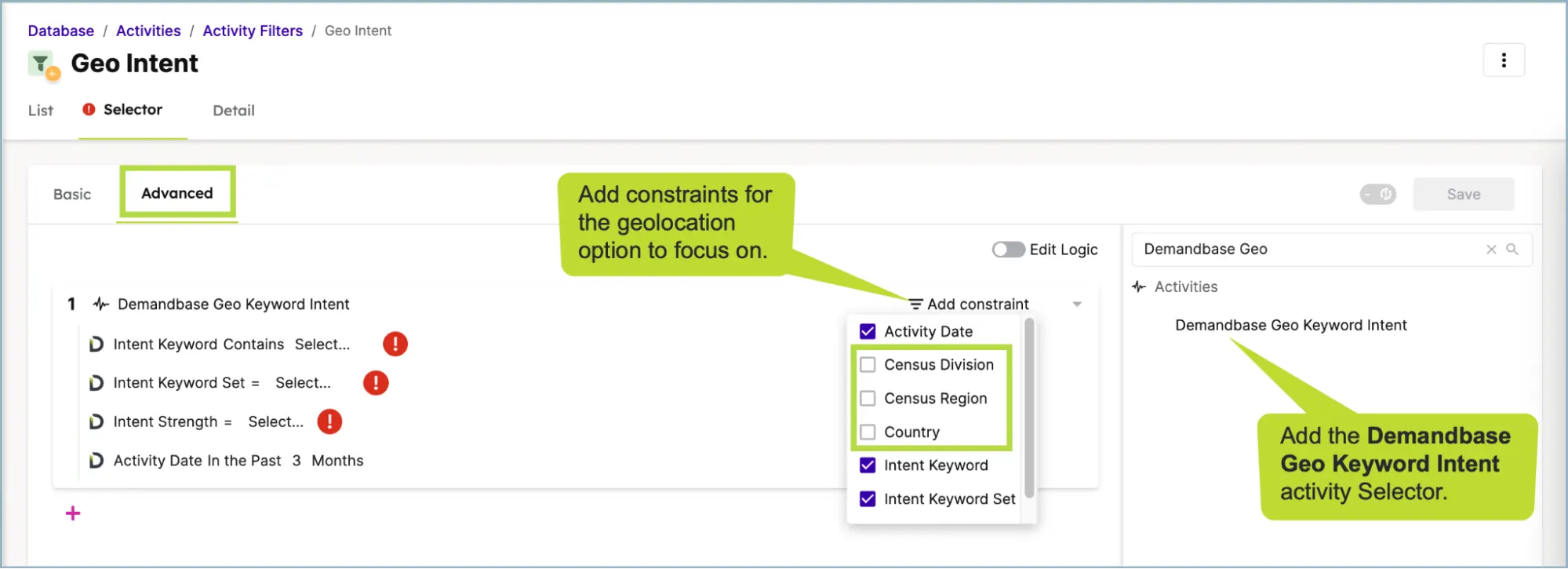
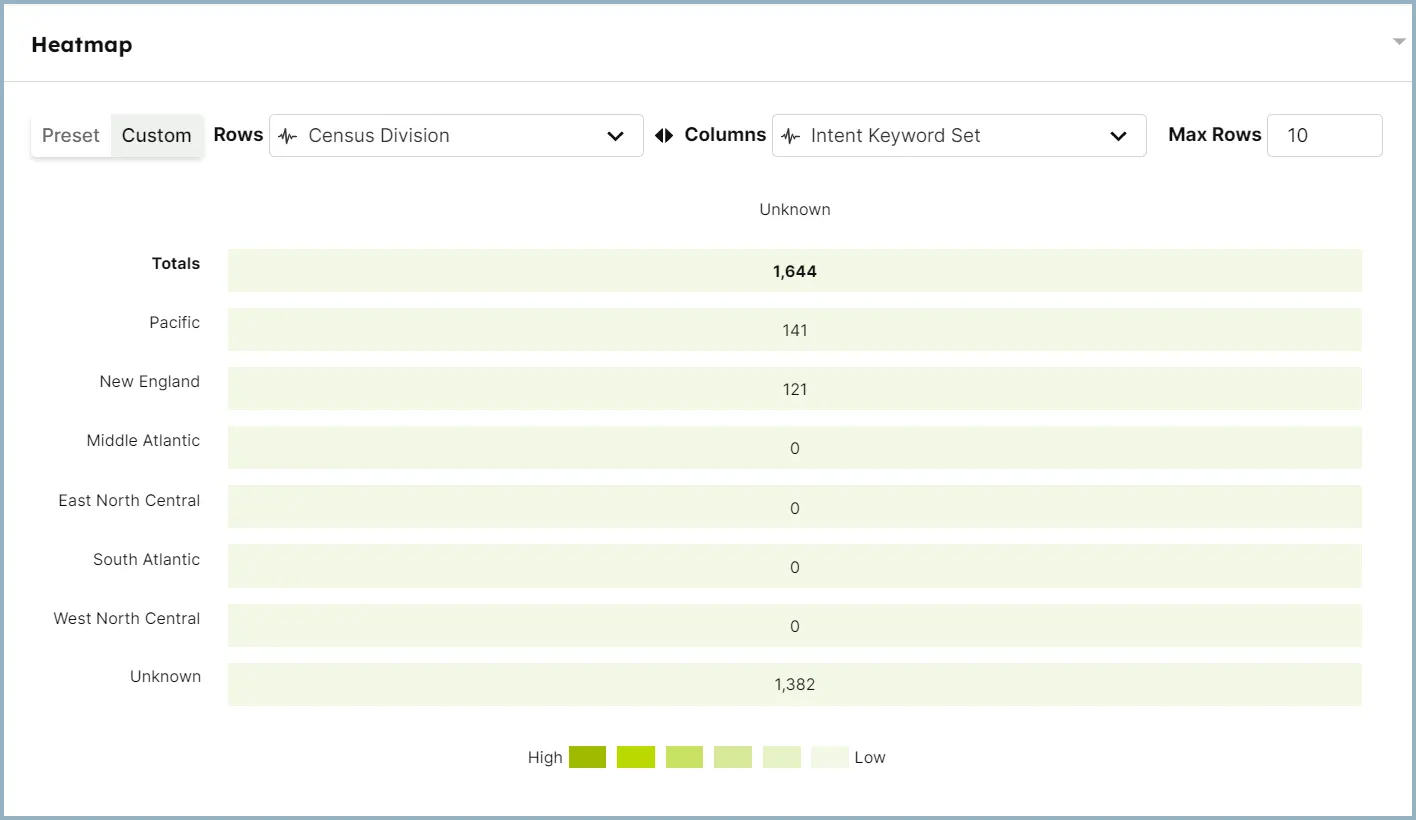
You can create a Geo keyword intent activity filter to view the engagement for an identified account based on census region, census division, or country.
Step 7: Launch and monitor your campaign in real time
With everything in place, the campaign goes live. The vendor distributes the content, captures leads, and sends them to you (often via API or CSV).
If you’re using a platform like Demandbase, you’ll also see account-level engagement — like which accounts are surging, which personas are reading your assets, and where they are in their journey.
Here’s what to monitor during the run:
- Lead volume and delivery pace
- Account match rates
- Content engagement (opens, dwell time, downloads)
- Account-level behavior (multiple touches, new visits to your site).
Step 8: Route, activate, and follow up with leads
As leads start coming in, you need to integrate them into your sales and marketing systems.
Whether they flow into your CRM, MAP, or sales engagement platform, what matters is that they are seen, acted upon, and engaged with quickly.
In this case, alert SDRs when a high-value lead downloads content. This should also trigger a relevant and timely follow-up (ideally within 24 hours) referencing the asset the lead interacted with and offering value in return.
For example: “Hi Caroline, I noticed you downloaded our CIO Cloud Migration Playbook. I’m happy to share a few additional insights tailored to your team if you’re exploring new infrastructure tools..”
Step 9: Measure campaign performance and attribute revenue
After the campaign has run for a defined period, you must analyze its impact in terms of business outcomes.
For example:
- What’s MQL → SQL conversion rate?
- How many opportunities were created from the target accounts?
- What is the average deal size and win rate of those who engaged with the content?
Also break this down by:
- Content type
- Persona/title
- Tier 1 vs Tier 2 vs Tier 3 account groups
The result of this analysis will determine if your investment is justified or there’s a need to adjust your strategy.
Step 10: Retarget, refine, and recycle for future campaigns
Finally, a good content syndication campaign is never a one-and-done marketing effort.
The data, content, and engagement you’ve gathered should feed into a broader ABM orchestration strategy.
Here are few example tweaks:
- Accounts that engaged but didn’t convert can be retargeted with additional assets.
- Personas that downloaded one type of content can be nurtured with another.
You can also use learnings to refine targeting parameters, adjust filters, and experiment with different formats.
- If whitepapers performed better than webinars, that’s your clue for the next round.
- If certain vendors underdelivered on lead quality, you now know where to focus your next campaign.
Related → Understanding ABM orchestration for B2B marketing
ABM content syndication best practices
- Start with a clean, prioritized target account list
- Use intent data to time and prioritize campaigns
- Work with trusted syndication partners or platforms
- Enable sales with context-rich lead handoffs
- Gate content with intent to generate high-quality leads
- Continuously test and optimize assets, formats, and timing
Start with a clean, prioritized target account list
The power of ABM syndication lies in the accuracy of the data you feed it. So, your first step is to build and refine a target account list that aligns with your revenue goals.
Instead of dumping every lead or company into your campaign, do this:
- Segment by firmographics (industry, revenue, location).
- Layer in intent signals, engagement data, or product fit scores.
- Break the list into tiers (Tier 1: high-touch, Tier 2: mid-tier, etc.)
Use intent data to time and prioritize campaigns
Not all target accounts are ready at the same time. Use real-time intent signals to determine which accounts are actively researching topics related to your solution.
With this, you can:
- Prioritize syndication campaigns to these accounts first.
- Adjust content messaging based on the topics they’re surging on.
Related → What is B2B intent data? How to get it, use it, and more
Work with trusted syndication partners or platforms
Vet your content distribution partner based on:
- Audience quality (can they reach your ABM list?)
- Lead qualification criteria (job title, engagement behavior)
- Transparency of performance reporting
If you’re using a platform like Demandbase, leverage its built-in syndication network and targeting tools to maintain control over delivery and outcomes.
Enable sales with context-rich lead handoffs
When leads come in from content syndication, you need to make sure your sales team has the entire context of that lead.
This includes:
- The exact content consumed
- The company and contact-level fit
- The engagement timestamp and any related intent signals
- A recommended follow-up message or talking point
Gate content with intent to generate high-quality leads
ABM syndication often requires gating (forms) to capture leads, but it’s essential not to overdo it.
Consider:
- Short forms with minimal fields (email + company domain can be enough)
- Progressive profiling (gather more info over time)
- Using engagement-based scoring instead of relying only on forms
You can also pair gated content with intent-based routing, so you’re not asking for more than necessary and can still qualify leads accurately.
Continuously test and optimize assets, formats, and timing
No ABM program should be static. Regularly test:
- Which types of content perform best for each persona or industry
- The effect of gated vs ungated content
- Time of day, day of week, and channel performance
- Subject lines, preview texts, and landing page copy
Over time, this will help you build a high-efficiency syndication engine that performs better with every iteration.
What if your content knew exactly who was reading it?
For years, the playbook has looked like this: write → publish → maybe distribute → cross fingers and hope leads roll in.
Sure, a few downloads trickle in. Maybe some views. But who actually engaged? Were they from a target account? Were they even in-market? You don’t know.
So that ‘beautifully’ crafted content quietly disappears—archived, ignored, and forgotten like all the others.
But let’s consider a world of ‘what-ifs.’
- What if it knew exactly who was reading, including their name, account, role, buying signals, and whether they were already deep in the decision phase.
- What if your content could flag the moment a key stakeholder engaged… and your sales team could jump in with context and perfect timing?
That endless ‘what-ifs’ is what Demandbase delivers.
Read case study → How AVEVA Solutions Ltd. elevated account-based marketing with Demandbase
And here’s what that actually means for you:
- Get real-time signals that drive real action. The second someone from a target account engages with your content, Demandbase captures it and pushes that intel to your CRM or sales enablement tools.
You can set up Demandbase Intent to help you identify prospects who show interest in your products, services, or those of your competitors.
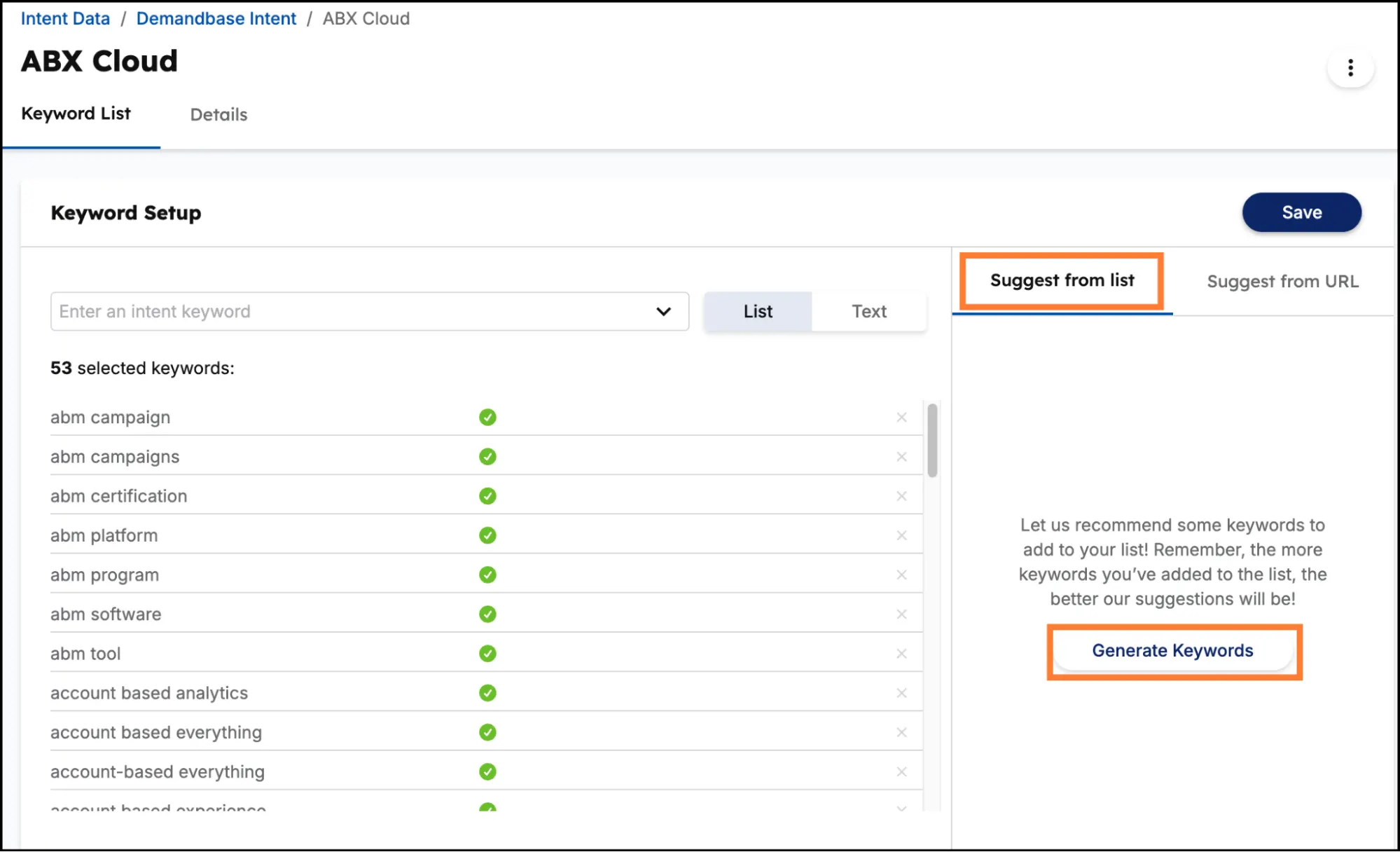

- Build influence across the entire Buying Committee. Demandbase tracks multi-stakeholder activity across accounts. You can see when multiple personas within the same company engage with your content, giving you a clear signal that the deal is heating up.
- Stop wasting content on the wrong people. Demandbase filters by company size, industry, tech stack, intent stage, and buyer role, ensuring your content reaches only the right accounts.
You don’t need more eyes. You need the right ones
FAQs
How does ABM content syndication fit into a broader multi-channel ABM strategy?
ABM content syndication helps you reach key accounts across trusted third-party channels, making sure your message gets in front of the right audience even outside your owned platforms.
It also complements your multi-channel strategy by extending targeted engagement beyond email, ads, and social media, ensuring consistent messaging at every touchpoint.
What types of content work best for ABM content syndication?
The best-performing content includes whitepapers, industry reports, case studies, and eBooks that speak to specific pain points.
This content should be educational, tailored to buyer roles, and offer real value, especially for mid to late-stage decision-makers.
How should I map content offers to different stages of the buyer’s journey for target accounts?
Use top-of-funnel content like thought leadership pieces for awareness, mid-funnel assets like product comparisons or case studies for consideration, and bottom-of-funnel content like product demos for decision-making. Align each offer with the account’s buying stage and role.
What are the most important KPIs to measure the success of ABM content syndication? (Beyond lead volume/CPL)
Key KPIs to measure ABM content syndication success include:
- Account engagement rate (how many target accounts interacted with content)
- Content influence on pipeline (how many opportunities were influenced by content engagement)
- Sales accepted leads (SALs) and lead-to-opportunity conversion rates
- Buying committee penetration (number of stakeholders engaged per account)
- Account progression through the funnel (engaged vs. non-engaged cohorts)
These metrics show whether your content is reaching the right people and contributing to revenue outcomes.
How can I effectively measure the ROI and pipeline influence of content syndication efforts?
To measure ROI and pipeline influence, integrate your content syndication data with your CRM and attribution platform. Track which accounts and contacts engaged with syndicated content, and monitor their progression into opportunities, pipeline, and closed-won deals.
In addition, use multi-touch attribution to connect content engagement to revenue, and compare performance against control groups or historical benchmarks.
Related content


We have updated our Privacy Notice. Please click here for details.