

Enterprise go-to-market (GTM) strategy: A blueprint for selling to large organizations

Enterprise sales operate on a completely different set of rules than SMB or mid-market.
You’re selling to buying committees that average 6 to 10 people. Cycles run for months, and the level of vendor scrutiny can stall even the strongest pipeline.
The payoff, though, is hard to ignore. Enterprise contracts typically range from $50K to $500K+ per year, and churn rates are considerably lower than what you’d see in SMB or mid-market.
But winning those contracts takes a GTM motion built specifically for how enterprise buyers operate. The targeting, the messaging, the sales process, the team structure – all of it needs to account for that complexity.
This guide walks through how to build one. From defining your ICP to running multi-threaded deals to scaling the systems that make it repeatable.
Why enterprise GTM is a whole different game
Enterprise deals carry a level of structural complexity that touches every part of your GTM motion. How you generate pipeline, run sales cycles, and close deals all need to work differently at this level.
Here’s a side-by-side look at how enterprise GTM differs from SMB and mid-market:
| SMB/Mid-Market | Enterprise | |
|---|---|---|
| Sales cycle | 2–6 weeks | 3–9 months |
| Decision-makers | 1–3 | 6–10+ |
| Deal size (annual) | $5K–$50K | $50K–$500K+ |
| Buying process | Informal, often champion-driven | Formal procurement with legal, security, and compliance review |
| Relationship model | Transactional or light-touch | Consultative, multi-threaded |
| Primary growth lever | Volume | Expansion and retention |
Talk to anyone who’s worked on enterprise deals, and you’ll hear the same things. Here’s a good example from a B2B sales community on Reddit:

This point keeps coming up because it’s true. Winning enterprise deals comes down to how well your GTM accounts for this complexity.
Understanding the enterprise buyer: navigating the “no”
Enterprise buyers default to “no.” And it makes sense when you think about what’s on the line. A bad vendor decision at this level can set a team back by quarters, damage someone’s credibility internally, and even put their role at risk.
That shapes how you need to sell. In SMB, you sell the upside. In enterprise, you remove the reasons to say no first. Risk comes before value in every conversation.
Enterprise buyers tend to evaluate vendors through three lenses:
- Stability and reliability → Will this product work at our scale? What’s the uptime track record? What happens when something breaks?
- Security and compliance → Does this meet our regulatory needs? Can it pass our security review? How is data handled?
- Integration and disruption risk → How does this fit into what we already have? What does migration look like? How much change management is involved?
On top of that, you’re not proving this to a single buyer. You’re proving it to a committee of members who each evaluate your solution through a different lens.
Here’s a quick breakdown of the key personas you’ll typically encounter, what they care about, and how to engage them:
| Persona | What they care about | How to engage them |
|---|---|---|
| Champion | Solving a day-to-day pain point they experience firsthand | Equip them to sell internally. Give them one-pagers, ROI data, and comparison docs they can present without you in the room |
| Economic buyer (CFO, VP) | Total cost of ownership, payback timeline, and budget impact | Make the financial case simple and concrete. Tie everything back to revenue impact or cost savings with clear numbers |
| Technical evaluators (IT, Security) | Integration, security posture, compliance, data handling | Provide technical documentation upfront. Give them sandbox access and be transparent about tradeoffs |
| End users | How it affects their daily workflow | Get them into the product as early as possible. If they push back during a pilot, executive buy-in won’t save the deal |
| C-suite | Strategic alignment, competitive edge, long-term value | Stay high-level. Connect your solution to the business outcomes they’re already reporting on |
Too many teams build their entire pitch around one persona – usually the champion or the economic buyer. That works until a security lead blocks the deal over a compliance gap or end users reject the product in a pilot.
The better approach is to map out the full buying committee early. Know what each person needs to hear and build touchpoints for all of them into your sales process.
The prerequisite: is your product enterprise-ready?
Before you invest in pipeline, make sure your product can survive an enterprise procurement process. Technical and security teams will put it under a microscope.
Here’s what enterprise buyers typically expect before a deal moves forward:

Make sure your product checks these boxes:
| Area | What enterprise buyers expect |
|---|---|
| Security | SSO, role-based access control (RBAC), audit logs, encryption at rest and in transit. If any of these are missing, most enterprise buyers won’t move past the evaluation. |
| Compliance | SOC 2, GDPR, HIPAA – depending on the industry. Buyers in regulated verticals will ask for proof early. If you can’t provide it, the conversation ends at the security review. |
| Integration | Your product needs to work with what they already run. Salesforce, Microsoft Azure, Okta, or whatever their stack looks like. Custom API access is often a baseline expectation. |
| Scalability | Enterprise buyers need confidence that your product holds up at their volume. Uptime guarantees, SLAs, and a track record of handling large deployments all matter here. |
| Support and roadmap | Enterprise accounts want dedicated support, quick responses to issues, and a clear view of your product roadmap. They want to know you’ll still be investing in the product a year from now. |
Procurement teams check these boxes before the deal goes anywhere near a decision-maker. And missing even one can disqualify you from the process entirely.
How to build a successful enterprise GTM strategy (data, ICP, and positioning)
Now that we’ve covered how enterprise buyers think and operate, let’s get into how to build a GTM motion around it:
Define your enterprise ICP
A generic ideal customer profile won’t work in enterprise. “We sell to mid-to-large B2B companies” is too broad to build a GTM strategy around. You need specifics.
A strong enterprise ICP combines three layers of data:
- Firmographics: Industry, company size, revenue, geography. These are your baseline filters. “A financial services company with $1B+ in annual revenue and a North American HQ” is a lot more useful than “large enterprises.”
- Technographics: Look at what’s already in their tech stack. If your product integrates with Salesforce, go after companies that run it. If you’re replacing legacy software, target the ones that haven’t switched yet.
- Intent data: Tells you which accounts are in-market right now. Content downloads, keyword searches, and competitor page engagement show that a company is looking for solutions like yours.
Put these three together. You go from “we sell to mid-to-large B2B companies” to “we’re targeting financial services firms with $1B+ revenue that run Salesforce and are actively researching cloud security.” That’s an ICP you can build a GTM motion around.
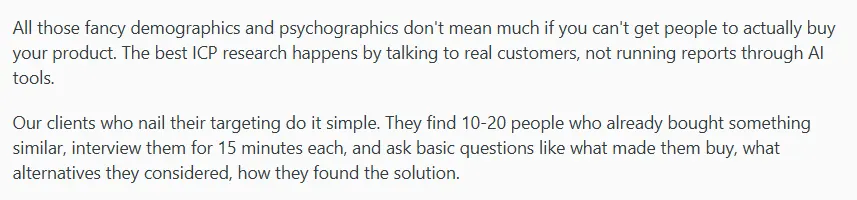
That said, data only gets you part of the way there. Your best ICP insights will come from talking to the people who already bought from you. This Reddit user explained it:
Your ICP also needs a segmentation filter. Pick the verticals where you have the strongest product fit, the best case studies, and the most momentum. Depth beats breadth in enterprise.
Build persona-specific positioning and messaging
A single pitch deck won’t carry an enterprise deal. The CIO has different concerns than the CFO, and neither of them thinks about your product the way an end user does.
For each persona, work through a few key questions before you write a single line of copy:
- What problem do they face that your product solves?
- What objections will they raise?
- What proof do they need to say yes?
- How do they measure success in their role?
- Who do they need to convince internally before they can support you?
- Where do they go to research solutions?
You also have to keep in mind that not every stakeholder shows up at the same time:
- Early conversations typically involve champions and end users. Keep the focus on the core problem and show them how the product works in their day-to-day.
- Mid-deal brings in the technical evaluators. They want to talk about architecture, security, compliance, and how your product fits into their existing stack.
- Late-stage is when the economic buyer shows up. Have your ROI numbers, total cost of ownership, and payback timelines ready.
And don’t treat this as a one-time exercise. Your messaging should evolve as you close more deals and learn what moves each persona.
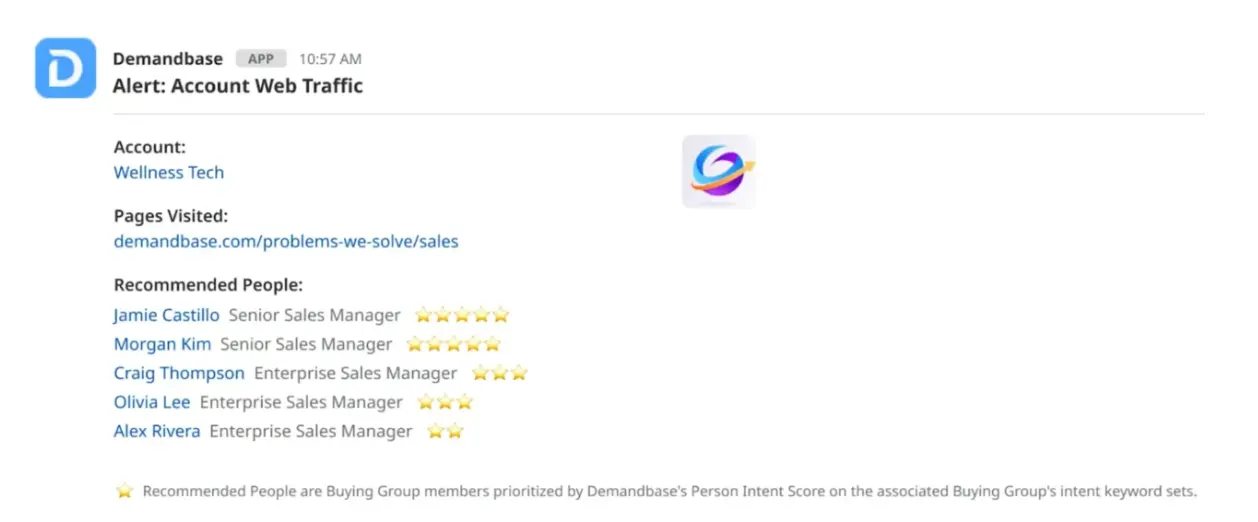
PRO TIP: Demandbase’s person-based intent finds contacts in an account who show buying signals. It also ranks them by their role in the buying group. Your team can see who’s actively researching and tailor outreach accordingly.
Get your pricing model right
Nobody clicks “buy now” on a six-figure contract. Enterprise deals go through procurement and legal review. They also need several rounds of negotiation before anyone signs.
And the pricing strategy itself needs to match the way enterprise buyers think about value. Here’s how this user put it on Reddit:

Your pricing model needs to hold up through that process. Three approaches tend to work well in enterprise:
| Pricing model | How it works | Why it works in enterprise | Watch out for |
|---|---|---|---|
| Value-based | Price tied to outcomes – revenue gained, costs saved, time reduced | Gives buyers a concrete ROI case to take to leadership | Harder to implement if your outcomes are difficult to measure |
| Tiered | Clear packages at different levels of service and capability | Gives procurement room to negotiate without breaking the deal structure | Can get complex if tiers aren’t well-defined |
| User-based | Price scales with headcount | Simple for buyers to understand and budget for | Can slow down expansion when teams are watching seat costs |
Most enterprise deals end up using some combination of these. The important thing is that your model gives buyers enough flexibility to work within their internal budget processes.
GTM strategy execution: orchestrating the enterprise deal
An enterprise GTM strategy on paper means nothing if the execution falls apart. This is where sales, marketing, and customer experience teams need to work in lockstep to move deals forward:o
Run the sales process like a project
Enterprise deals involve a lot of moving parts. There are discovery calls, technical evaluations, legal negotiations, and procurement sign-offs.
For example, deals over $100,000 regularly take 6 to 12+ months to close, according to Norwest’s 2024 B2B Benchmark Report. One missed step can set the whole thing back.
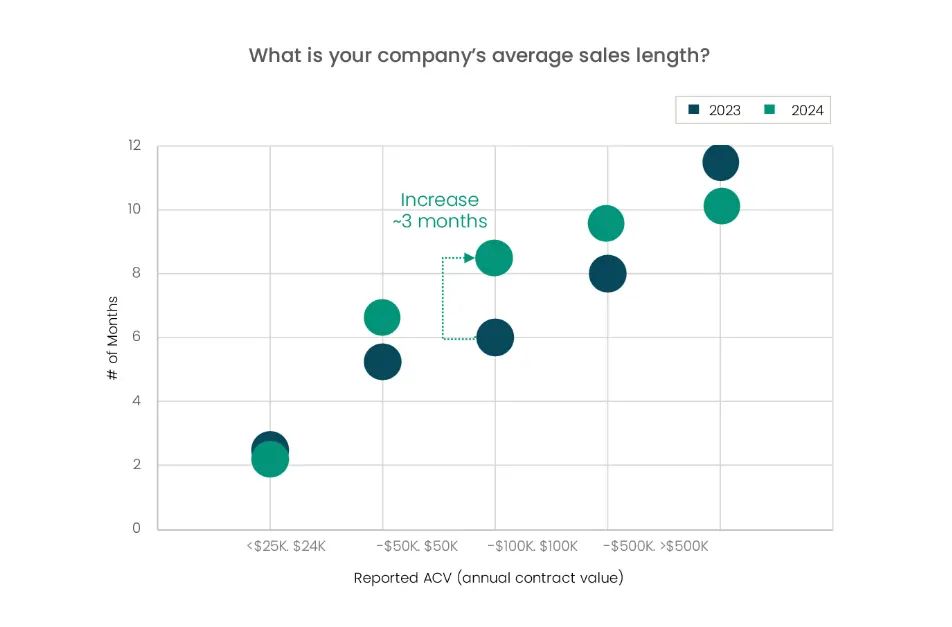 (Source: Norwest)
That’s why top-performing enterprise reps run their deals the same way a PM runs a project:
- Map the buying process early: Know every stage the deal has to pass through on the buyer’s side. Ask upfront what their internal approval process looks like and who needs to sign off.
- Build a mutual action plan: Set a shared timeline with the buyer. Cover every milestone from pilot to signed contract. This creates accountability on both sides.
- Track stakeholder engagement: Keep tabs on who you’ve spoken to and who you haven’t. If a key evaluator goes quiet, follow up.
- Maintain momentum between meetings: Don’t let gaps between meetings slow the deal down. Send follow-ups, share relevant content, and always lock in the next step before you hang up.
The takeaway is to never be surprised by what happens next in a deal. If your reps can see every stage, every stakeholder, and every open question at a glance, they’re in control of the process.
Use ABM to warm accounts before sales touches them
Cold outreach rarely works in enterprise. Research from TrustRadius found that 86% of enterprise buyers short-listed products they’d already heard of before starting their buying process. If your name isn’t familiar by the time a rep reaches out, you’re already behind.
That’s what enterprise ABM does. It targets specific accounts with relevant content and messaging before a rep ever picks up the phone. The goal is to create enough familiarity that when sales does reach out, it feels like a natural next step.
In practice, a solid enterprise ABM motion includes:
- Account-level targeting: Run ads and initiatives aimed at specific companies, not broad audiences. Your target account list should drive every campaign decision.
- Intent-based triggers: Monitor when target accounts start researching your category. When intent spikes, marketing increases touchpoints, and sales starts direct outreach.
- Personalized content: Build landing pages, case studies, and one-pagers around each account’s industry and pain points.
- Sales and marketing alignment: Both teams need to work from the same account list, share engagement data, and coordinate timing. ABM breaks down when marketing runs campaigns that sales doesn’t know about.
- Executive engagement: Find senior stakeholders at target accounts and build campaigns specifically for them. Webinar invitations, custom research, and industry roundtables work well here.
Yes, ABM takes time to build and even more time to show results. But enterprise deals also take months. The companies that invest in warming accounts early are the ones with healthier pipelines six months from now.
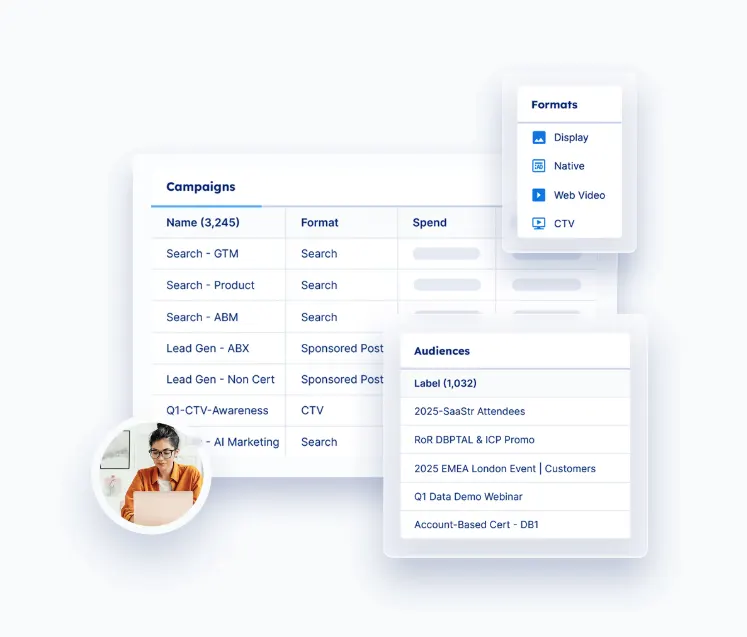
PRO TIP: Demandbase’s B2B-native DSP helps you target buying committee members. You can focus on intent signals, job function, and account fit. Plus, it all happens on the same platform your enterprise sales team uses.
Multi-thread every deal
Single-threaded deals are a major risk in enterprise sales. When your entire deal depends on one contact, you’re one job change or one missed internal meeting away from losing it.
Multi-threading means building relationships with multiple stakeholders across the buying committee. Not just your champion, but the economic buyer, technical evaluators, and anyone else who has a say in the decision.
A few ways to do this well:
- Ask your champion to make introductions: Ask them who else is involved in the decision, and have them introduce you. Don’t try to go around them. If they believe in your product, they’ll open doors.
- Map the org chart early: List every stakeholder who has influence over the deal. Know their role, what they care about, and how they feel about your solution. Update this as the deal progresses and customer needs change.
- Match the channel to the person: A CIO might engage on social media, while a technical lead might want sandbox access. Don’t use the same approach for every potential customer.
- Use events and content to open doors: Invite stakeholders to webinars, roundtables, or dinners. These create natural touchpoints that don’t feel like a hard sell.
- Watch for single-threading: If only one person is responding to your emails and showing up to calls, the deal is at risk. Healthy deals have activity across multiple contacts.
Think of multi-threading as deal insurance. The more contacts you have inside an account, the less any single change can sabotage the opportunity.
Operationalizing and scaling your GTM
Everything we’ve covered so far gets you through individual enterprise deals. But you can’t scale a sales motion that runs on heroic effort from a handful of senior reps.
To go from “we can win enterprise deals” to “we consistently win enterprise deals,” you need repeatable systems behind the motion.
Here’s what that looks like in practice:
Align your GTM teams around shared accounts and metrics
Get marketing, sales, and CS working from one account list with shared criteria for what qualifies an account at each stage. Without that, each team ends up running its own motion against its own targets.
That kind of misalignment is expensive. According to Demand Gen Report, poor alignment between sales and marketing can cost businesses 10% or more of annual revenue.
You need to build the operational rhythm that keeps everyone in sync:
- Run joint pipeline reviews so marketing and sales can assess the same accounts together and decide where to focus next.
- Give every team access to shared dashboards that track engagement, pipeline stage, and deal velocity in one place.
- Set clear handoff SLAs so everyone knows how fast sales follows up, when CS gets looped in, and what happens when an account goes quiet.
Deals lose momentum in the gaps between teams. A follow-up that slips, a campaign sales can’t speak to, a new customer CS has no context for. These small misses compound over long enterprise cycles.
Build a sales enablement engine that scales
Your early enterprise reps build their playbook through trial and error. They know what works because they’ve lived through enough deals to develop instincts.
But none of that transfers automatically to the next hire. Sales enablement bridges this gap. Package what your best reps have learned and give every new rep access from day one:
| Enablement area | What to build | Why it matters |
|---|---|---|
| Content library | Battle cards, objection docs, case studies, and ROI frameworks – organized by persona, vertical, and deal stage | Reps can pull the right asset at the right moment without digging through shared drives |
| Knowledge capture | A process for documenting what works in closed deals. Which talk tracks work, which objections keep coming up, and how top reps handle them | New reps learn from every deal the team has run, not just the ones they were on |
| Rep onboarding | Structured milestones, recorded call libraries, and documented playbooks for each deal stage | New enterprise reps ramp faster without relying on shadowing and tribal knowledge |
| Content maintenance | Assigned ownership over enablement assets with a quarterly review cadence at a minimum | Battle cards go stale, competitors ship new features, and messaging stops landing. Someone needs to keep it current |
The gap between your best rep and your newest rep tells you how well your enablement is working. Track ramp time and watch it closely.
PRO TIP: Demandbase for Sales gives your reps real-time account insights. They get intent signals, stakeholder engagement, buying group gaps, and relevant news. This helps new reps choose the right battle cards, case studies, and talk tracks for each conversation. They won’t need to depend on older teammates’ knowledge.
Choose a tech stack built for enterprise complexity
The volume of data, stakeholders, and handoffs in enterprise deals will expose every gap in your tech stack. Your reps need a clear picture of each account without having to pull it together manually from five different platforms.
Most teams are already paying for that fragmentation. A 2025 Revenue Velocity Lab study found that 73% of B2B sales teams have overlapping tools in their stack, wasting roughly $2,340 per rep per year.
At a minimum, your stack should cover:
| Capability | What it does | Why enterprise needs it |
|---|---|---|
| CRM | Manages pipeline, tracks deal stages, stores account and contact data | Enterprise deals have longer cycles and more stakeholders. Your CRM needs to handle those multi-threaded relationships |
| Account intelligence | Provides firmographic, technographic, and intent data on target accounts | Helps you see which accounts match your ICP and which ones are actively in-market |
| Buying group intelligence | Funds and tracks the full buying committee within each account – roles, engagement levels, and gaps in coverage | Enterprise deals are won or lost at the buying group level. You need insight into who’s engaged, who’s missing, and where to multi-thread next |
| Marketing automation | Runs campaigns, tracks engagement, and scores accounts | Enterprise ABM needs account-level targeting and engagement tracking, not just lead-level metrics |
| Sales engagement | Manages outreach sequences, tracks rep activity, and recommends next steps | Keeps multi-threaded outreach organized across buying committees |
And each of these tools is more valuable when it can pull from the others. This is why more enterprise teams are consolidating around platforms like Demandbase.
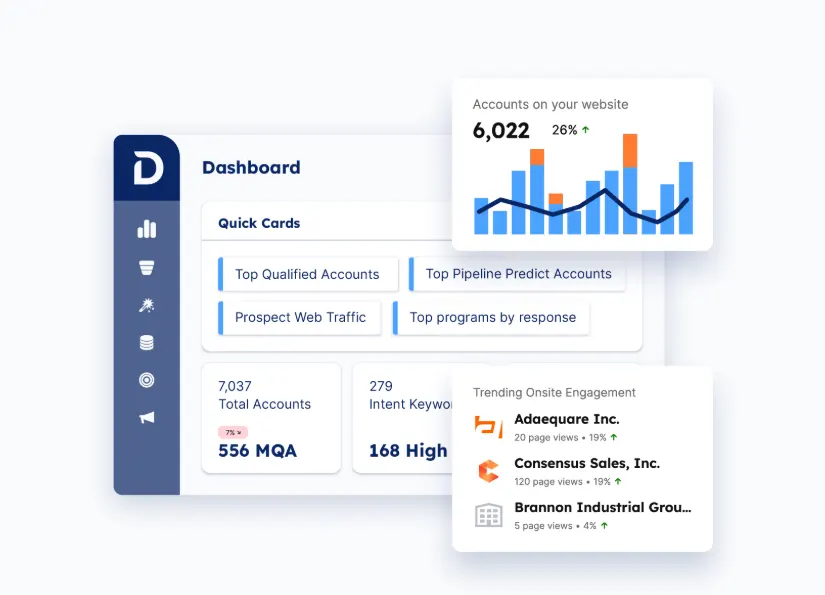
Demandbase combines account intelligence, intent data, buying group tracking, and ABM campaign orchestration in a single platform.
Instead of toggling between five tools to understand an account, your marketing, sales, and CS teams share one view. They see who’s in the buying group, what signals they’re showing, and where each deal stands.
Treat your GTM strategy as a living system
Your GTM strategy after 20 enterprise deals should look different from what it did after five. Every closed-won and closed-lost deal tells you something about what’s working and what’s not.
Here are a few systems worth putting in place from the start:
| Feedback loop | What to do | What it optimizes |
|---|---|---|
| Win/loss analysis | Interview buyers after every major deal. Find out what tipped the decision and where you lost ground to competitors | Messaging, positioning, enablement content |
| Pipeline metrics | Track stage conversion rates, deal cycle length, and pipeline velocity by customer segment. Investigate when numbers change | Process, forecasting, resource allocation |
| CS-to-GTM customer feedback | Have CS share what buyers expected vs. what they got. Route use case gaps and onboarding friction back to product marketing | Positioning, product roadmap, retention |
| ICP refinement | Revisit your ICP quarterly. Update targeting based on which accounts close faster, expand more, and churn less | Targeting, account selection, campaign efficiency |
You don’t have to overhaul your sales strategy every quarter. Small, data-informed adjustments compound over time. The difference between a good enterprise GTM and a great one is usually a year of consistent iteration.
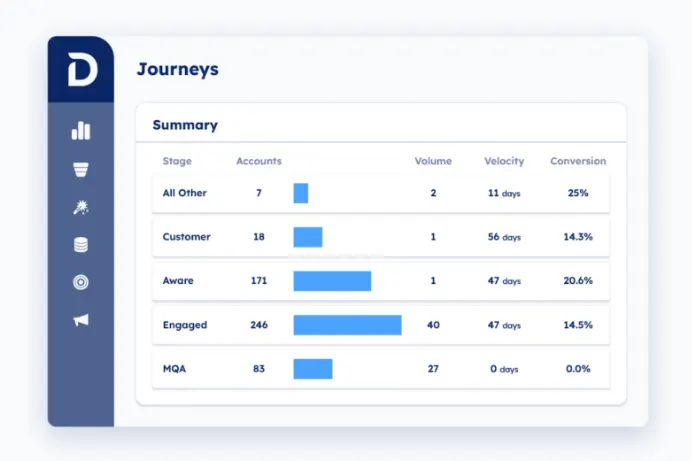
PRO TIP: Demandbase journey analytics show you how accounts progress through your funnel and which touchpoints drive that movement. You don’t have to pull data from five tools to run a quarterly review. Instead, your team can see engagement trends, pipeline velocity, and account-level performance in one place.
Alternative GTM models
This entire guide assumes a sales-led approach because that’s how most enterprise deals get done. But it’s not the only way in. Other models can work alongside it, especially as a way to open doors that a sales team can’t reach on its own.
Here’s how the three most common models compare in an enterprise context:
| GTM model | How it works | When it fits enterprise |
|---|---|---|
| Sales-led | Reps guide the entire buying process. High-touch, relationship-driven, built for long cycles and large buying committees | Complex products with high ACV where buyers need hands-on evaluation, custom implementation, and ongoing support. This is what the rest of this guide covers |
| Product-led (PLG) | The product drives adoption through free tiers, trials, or self-serve. Users experience value before sales gets involved | Pure PLG rarely closes six-figure deals on its own. The hybrid model works better – PLG captures end users, then sales converts the account to an enterprise license. Slack, Atlassian, and Datadog all scaled this way |
| Partnerships and channel | System integrators, consultants, or resellers sell or implement your product on your behalf | Useful for breaking into verticals or geographies where you don’t have presence or credibility yet. Partners already have the trust and relationships you’d spend months building |
These aren’t mutually exclusive. A sales-led motion with a PLG entry point and a partner channel for new markets is a common combination at the enterprise level. Start with whatever fits your product and buyer, and then expand from there.
Demandbase: the foundation of enterprise GTM
Enterprise GTM has a lot of moving parts. You’re coordinating across multiple teams, dozens of accounts, and buying committees that can shift mid-deal. And without the right platform underneath, things start breaking as you scale.
Demandbase is a GTM intelligence platform built for this level of complexity. It covers the full enterprise revenue cycle in one place.
Everything runs through one shared platform with one data layer. This includes finding high-fit accounts, mapping buying committees, running targeted campaigns, and tracking pipeline impact.
Some of the core capabilities that make this possible:
- Account intelligence across 100M+ companies: Demandbase combines firmographic, technographic, and intent data to help you find accounts that match your ICP and are actively in-market.
- Intent keywords with AI-powered context analysis: Tracks over 1 trillion intent signals per month to see which accounts are researching your category, your competitors, or your specific solution.
- Buying group tracking and contact recommendations: Maps the full buying committee within each account and recommends net-new contacts to help your reps multi-thread.
- The only demand-side platform built for B2B: The native DSP supports intent-based, people-based, and IP-based targeting. Your ads reach buying committee members on premium sites, not random placements.
- Orchestration and website personalization: Automates campaigns and plays based on journey stage, intent signals, and engagement data. The tool also personalizes your website experience by account or segment.
- Deep CRM and MAP integration with 110+ connectors: Demandbase plugs directly into Salesforce, HubSpot, Marketo, and a growing marketplace of GTM tools.
There’s a lot more under the hood than what’s listed here.
The best way to see how Demandbase fits into your GTM motion is to book a meeting and explore the platform first-hand.
FAQs
How does an enterprise GTM strategy differ from an SMB strategy?
The biggest differences are cycle length, deal complexity, and the number of people involved.
SMB deals can close in days or weeks with one decision-maker. Enterprise deals run for months across buying committees of 6-10+ stakeholders. And each one has different priorities and concerns.
Your GTM strategy needs to account for longer timelines, persona-specific messaging, and a much higher bar for security, compliance, and integration readiness.
What are the most important metrics to track in enterprise GTM?
The metrics that matter most in enterprise GTM are usually:
- Pipeline velocity — how fast deals move from one stage to the next. Slowdowns at specific stages point to process or messaging problems.
- Stage conversion rates — the percentage of deals that advance at each stage. Shows you exactly where your pipeline leaks.
- Deal cycle length — how long deals take to close, tracked by segment. Watch for trends — if cycles are getting longer, something changed.
- Win rate — especially against specific competitors. Tells you where your positioning holds up and where you’re losing ground.
- Buying committee coverage — how many stakeholders your reps are engaged with per deal. Low coverage is an early warning sign.
- Customer acquisition cost (CAC) — what it costs to acquire each enterprise customer. Make sure it makes sense relative to contract value and expected lifetime revenue.
- Net revenue retention (NRR) — whether your enterprise customers expand, stay flat, or churn over time. This is where the long-term ROI of enterprise GTM shows up.
What is the biggest mistake companies make when moving upmarket to the enterprise?
Trying to close enterprise deals with an SMB playbook. Most companies assume they can take what works in SMB or SaaS startups and just target bigger accounts.
Enterprise buyers evaluate providers differently. They buy in committees, they default to “no,” and they put your product through procurement and security reviews before anyone signs.
How do I align my sales and marketing teams for enterprise deals?
Get both teams on the same account list, the same data, and the same definition of a qualified account.
Most misalignment starts with something that basic – the two teams run separate motions against separate targets. Once you share the foundation, set up joint pipeline reviews and handoff SLAs to keep it running.
Experience the future of AI GTM



We have updated our Privacy Notice. Please click here for details.