

Understanding CTV in B2B advertising: A strategic playbook for 2026

The growing momentum of CTV in B2B advertising
For years, Connected TV (CTV) lived in the “consumer brand only” bucket. Big CPG launches, retail promotions, auto campaigns—that was the playbook for TV advertising.
But somewhere between 2023 and now, things changed. For B2B companies, CTV has become central to how they think about reach and performance.
The shift makes sense when you look at two converging realities:
- Your audience migrated to streaming, and they’re not going back
For context, U.S. adults now spend over two hours daily consuming CTV content. That’s more time than on their smartphones or traditional TV.
That means your target audience;
- the CFO watching Bloomberg,
- the VP of IT streaming industry documentaries on Tubi, or
- the marketing director catching up on YouTube TV in their living room— is already accessible through the same connected environments once reserved for B2C campaigns.
These aren’t passive viewers. They’re all professionals consuming video content in ad-supported environments across smart TVs and OTT apps. This shift in viewership has turned what used to be consumer-focused entertainment time into a new attention platform for B2B ad strategies.
For the first time, B2B marketers can reach executives in high-attention, brand-safe environments.
- Traditional digital channels are showing cracks
For all their reach, long-standing digital channels are losing their reliability. A quick example is the dip in the dominance of ‘Google Search’ which is now below 90%. Meanwhile, it has given traction to other platforms like Bing, Yahoo, DuckDuckGo, ChatGPT, etc.
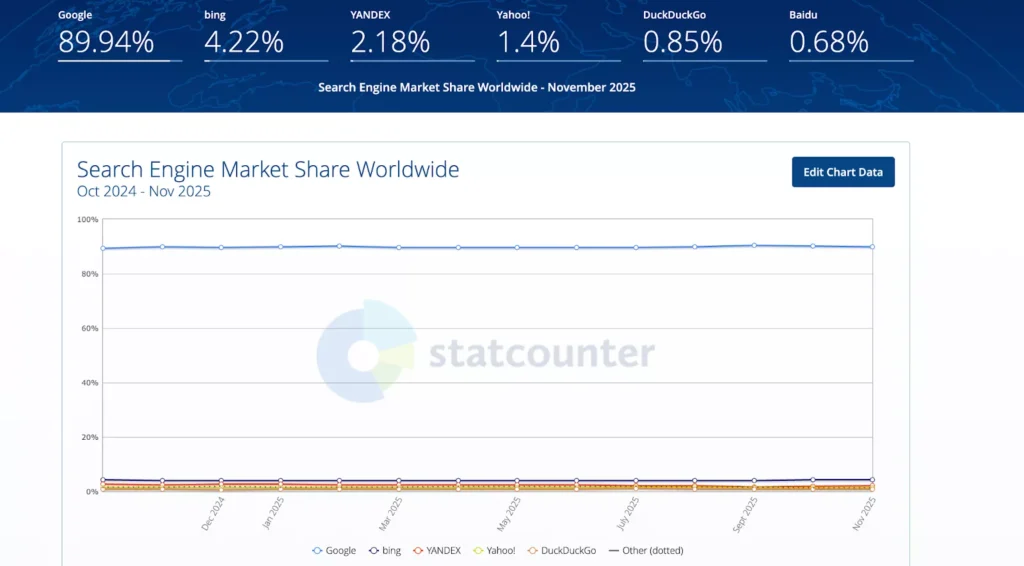
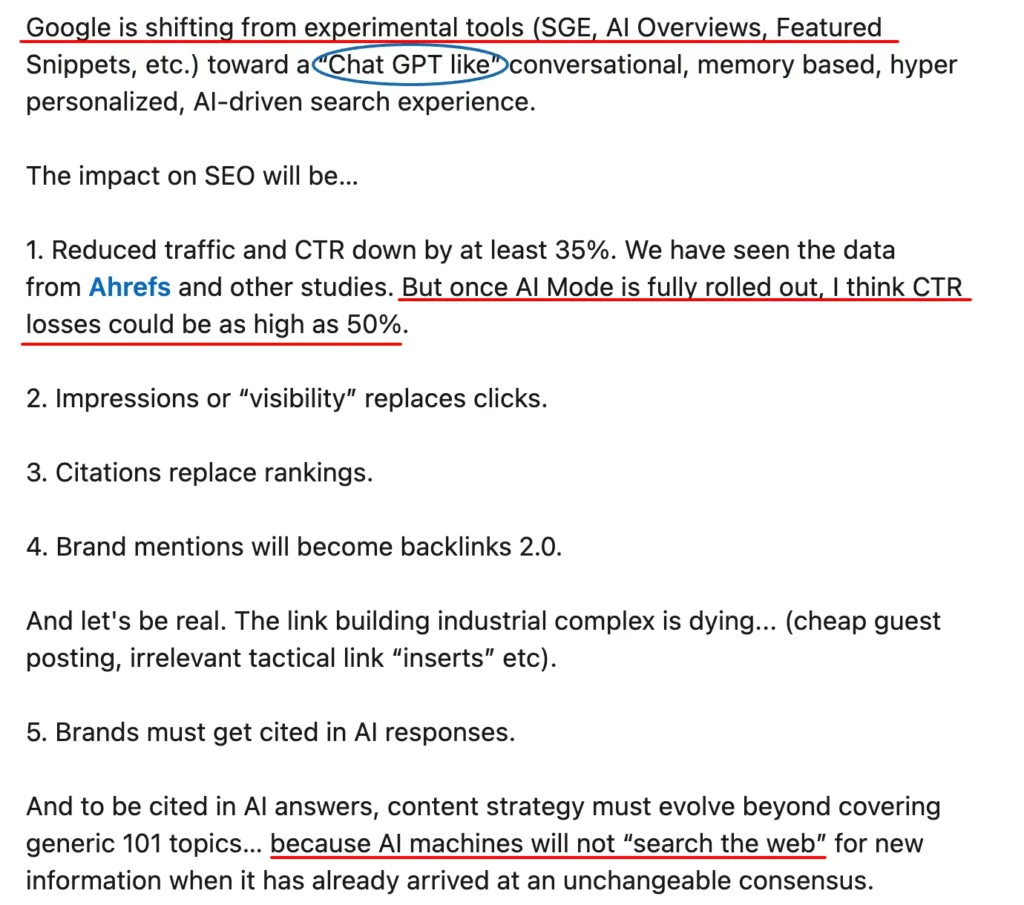
Some would call this an ‘existential crisis’ for search, and they’d be right. AI-powered search is reshaping how B2B buyers discover and evaluate vendors. At the same time, also ‘eroding’ predictable keyword-based funnels.
Growth Advisor, Gaetano DiNardi, further confirms this:
Social advertising is also taking a hit. While still effective, it’s becoming crowded, expensive, and less trusted. In fact, 91% of consumers report they see ‘too many’ ads on social media Plus, engagement rates and ROI often declines as noise increases.
Meanwhile, cookie deprecation and privacy regulations continue to narrow the window for targeted display.
B2B marketers who’ve relied on these channels for years are now asking a reasonable question: what’s next?
The answer, increasingly, is CTV. Recent data tells the story: only 4% of B2B brands say they have no plans to use CTV, and 73% have moved beyond experimentation—they’ve integrated it into their core performance marketing strategies.
Related → Mastering Account-Based Advertising
Advantages of CTV for B2B marketers
A premium, distraction-free environment
CTV works because it’s grounded in how decision-makers actually consume content and how the channel performs relative to other tactics.
Let’s start with their behavior. Nearly 40% of business decision-makers turn to television daily to stay current on industry trends and business news. That’s a significant share of your target audience paying full attention instead of passively scrolling.
And because CTV ads run full-screen, non-skippable, in content people chose to watch, the completion rates are high. Viewers actually see the message through to the end.
For B2B, this matters more than most marketers realize. Your audience isn’t expecting to see enterprise software or professional services ads during their streaming session.
That element of surprise—delivered in a high-quality environment—creates memorability that’s hard to replicate in feed-based channels. Yes, it’s an interruption, but it’s a premium one.
Precision targeting that feels personal
Unlike linear TV, where reach is broad and undefined, CTV allows you to deliver ads directly to the accounts and decision-makers that matter most.
Through first-party data, IP-based targeting, and integrations with platforms like Demandbase, CTV can now identify when key personas or job titles within a buying committee are watching.
This makes account-based marketing (ABM) on TV fully viable. You know you’re not buying a demo and hoping your CFO falls into it.
Instead, you’re buying reach against a list of named accounts, the same way you would in display or LinkedIn, but with the creative canvas and engagement environment of TV.
Brand storytelling with measurable impact
Television has always been the brand medium. The format forces you to tell a story, establish a voice, build emotional resonance. CTV preserves all of that, but adds the measurement layer B2B marketers need to justify the spend.
You can measure brand lift within your target account list, track website visits from exposed households, monitor shifts in search behavior, and attribute pipeline influence through post-view engagement.
The measurement isn’t perfect, but it’s closer to closed-loop than TV ads ever got.
And what makes this powerful is the duality. You’re telling a story that builds brand equity and category positioning at the top of the funnel, while simultaneously generating trackable actions that connect to revenue at the bottom.
Proven cross-channel lift
When CTV works, it amplifies the performance of everything else. We see this with companies running integrated campaigns that include CTV reporting measurable increases in search and social performance.
Our performance data also backs this up when we examined customers running CTV campaigns alongside display. 46% more domains visited, 21% higher engagement, and 54% more clicks.
The logic behind this is straightforward. Someone sees your message on CTV, and when they encounter your brand again on LinkedIn or in search results, there’s familiarity and credibility.
That recognition compounds across touchpoints, making your entire media mix more efficient.
Essential resources for successful B2B CTV campaigns
Connected TV is not a ‘quick experiment’ channel. Unlike paid search or social, where you can spin up campaigns overnight and pivot weekly, CTV requires commitment. You need a proper budget, strategy and high-quality creative assets.
Here’s what every B2B organization should have in place before launching or scaling a CTV program in 2026.
Budget and testing timeline
CTV is a premium environment, and its effectiveness compounds over time. The learning curve is both creative and analytical. That’s why you need enough time to collect meaningful data, understand audience behavior, and fine-tune targeting.
- Plan for a 90-day minimum testing window: CTV operates on longer attribution cycles than direct-response channels. You’re measuring brand lift, incremental reach, and cross-channel influence. It takes time for exposed audiences to move through awareness, consideration, and intent. Pulling the plug at 30 days because you didn’t see immediate pipeline is a mistake. You need at least a full quarter to assess whether the channel is working and how it’s influencing downstream behavior.
- Allocate sufficient budget: A meaningful geo-lift typically requires at least $25,000 to start. This is enough to compare exposed vs. control regions and quantify lift across the funnel. Anything smaller risks inconclusive data, and that can lead to premature conclusions about channel viability.
The good news is you’re not alone in this commitment. Ninety-eight percent of B2B organizations plan to increase their CTV ad spend in the coming year. The market has already decided this channel matters.
- Ensure your measurement infrastructure is in place before launch: Your attribution model needs to handle non-click conversions. CTV doesn’t drive clicks the way display or search does. People see your ad on their TV, then take action on their phone or laptop hours or days later. If your attribution is ‘last-click’ only, you’ll systematically undervalue CTV’s contribution. You need view-through tracking, cross-device matching, and ideally, a multi-touch model that gives credit to upper-funnel touchpoints.
Personnel and expertise
Running CTV campaigns effectively isn’t the same as running search, social media, or display.
It requires an understanding of programmatic buying, media supply chains, and advanced targeting data. And these are areas where most traditional marketing teams have skill gaps.
- Invest in education: Train your marketing team on the fundamentals of programmatic CTV. E.g., how inventory is bought, what influences CPMs, and how data partnerships affect reach and quality. This foundational knowledge helps your team ask the right questions of vendors and partners.
- Secure programmatic expertise: Whether you hire in-house or work with a specialized agency, you’ll need someone fluent in demand-side platforms (DSPs), data onboarding, and bid optimization. These professionals can ensure that your media spend isn’t wasted on irrelevant or low-quality inventory.
- Maintain internal oversight: Even when outsourcing, retain a clear internal understanding of traffic sources, targeting logic, and audience data ownership. CTV success depends on transparency —i.e., your team should always know where your ads are showing and which segments are performing.
Creative assets
The type of creative assets you ‘display’ will determine if you’ll earn attention or get skipped. So this comes down to having concepts that resonate with the target audience, and formats that perform.
- Build a creative library: Develop multiple short-form and mid-length video variations (15s, 30s, and 60s). Each should test a different value proposition, tone, or call-to-action. This allows you to identify which narrative connects best with your audience and at which stage of the buying cycle.
- Lean into what actually resonates on CTV: B2B audiences at home aren’t in work mode. They’re relaxed, receptive, open to being entertained. That means authenticity, and relatable humor perform better than dry product explainers or feature dumps. Consider testing more narrative-driven concepts, influencer-style storytelling, or short educational snippets that mirror how professionals engage with creators online.
- Prioritize concept over production: AI tools have made video production ‘easier’. You can produce decent-looking ads without a large budget. But no amount of polish saves a weak idea. A simple, well-scripted video with strong emotional pull will always outperform a high-cost cinematic ad that says little.
Data infrastructure and measurement tools
The effectiveness of your CTV strategy depends on how seamlessly it connects to your data and measurement ecosystem.
- Integrate with your CRM and ABM platform: Sync audience data, engagement signals, and account activity so you can measure how CTV exposure correlates with pipeline progression.
- Implement unified reporting dashboards: Centralize CTV metrics (impressions, reach, completion rate, lift, pipeline influence) in the same analytics environment as your other paid channels.
- Make sure your measurement stack supports real-time data ingestion: Some platforms now provide exposure logs with timestamped IP addresses, allowing you to connect viewership directly to account-level engagement in CRM or ABM systems.
Recommended → How to Use Advertising Performance Metrics to Elevate Your Account-Based Strategy
7 Proven strategies for implementing CTV in B2B campaigns
Connected TV is a flexible channel you can deploy across the entire funnel to solve specific business problems. The best CTV strategies start with a clear objective, then build targeting, creative, and measurement around that goal.
Here’s how to think about applying CTV at each stage:
1. Building brand awareness and creating demand
At the top of the funnel, you’re solving for reach and recall. The goal is to introduce your brand to high-fit accounts that don’t know you exist yet, or to stamp your position as a category leader among those who do.
How to apply it:
Start by mapping your total addressable market (TAM) or ideal customer profile (ICP) using first-party data. Then, use contextual targeting to place ads alongside business news, financial programming, and industry-relevant content where your buyers are already paying attention.
Also layer in lookalike modeling to expand beyond your known accounts. Find companies that share firmographic and behavioral traits with your best customers. Your creative here should focus on your positioning and core value proposition.
Measurement focus: Track brand lift (aided and unaided awareness), increases in branded search volume, and direct traffic from exposed accounts.You’re looking for signals that people now know who you are and what you stand for.
Related → 9 Reasons Why Buying Groups Will Be The Next Big Thing In B2B
2. Engaging and nurturing active buyers
The goal here is to deepen engagement and nurture accounts that are showing early buying signals or are already aware of your brand. You’re reminding them why you matter as they weigh options.
How to apply it:
Deploy retargeting and intent-based targeting to stay visible to accounts researching your category. For example, serve ads to decision-makers from target accounts who visited your pricing or product comparison pages in the last 30-90 days.
Combine this with keyword intent data to reach organizations researching relevant solutions.
Your creative here should shift from broad storytelling to solution-focused messaging. Aim is to highlight customer success stories, product differentiation, or ROI proof points.
Related → B2B Retargeting: Strategies That Convert
3. Supporting active deals
At the bottom of the funnel, CTV becomes a sales enablement tool. It keeps your brand in front of buying committees as negotiations unfold.
How to apply it:
Upload first-party CRM data (from Salesforce or HubSpot) to your CTV platform to target active opportunities. These ads provide “air cover,” for your sales team, ensuring your brand stays visible to the entire buying committee while a deal is being negotiated.
Pull a list of open opportunities from your CRM and target those specific accounts with tailored messaging. This provides “air cover” for your sales team, ensuring your brand stays visible to the entire buying committee while a deal is being negotiated.
Your messaging here should be highly specific. Address common objections, reinforce ROI, or remind buyers of time-sensitive offers.
Measurement focus: Win rates, deal velocity, and average contract value for CTV-exposed opportunities versus non-exposed.Also, work with your sales team to get qualitative feedback. For example, are buyers mentioning the ads in conversations? Are objections being preempted?
Related → The Consensus Economy: Why Every Deal Now Depends on Collective “Yes”
4. Driving customer retention and loyalty
Your existing customers are often your highest-LTV audience, but they’re frequently undermarketed to. CTV gives you a channel to reach them outside of email and in-product messaging.
How to apply it:
Target your customer list with ads announcing new features, promoting upsell opportunities, or inviting them to user conferences and training programs.
This is also a place to reinforce partnership value. Celebrate customer wins, share product roadmap updates, or highlight community initiatives.
The goal is to deepen engagement and reduce churn risk by staying top-of-mind in a premium environment.
Measurement focus: Net revenue retention, upsell/cross-sell conversion rates, and product adoption metrics.Track whether CTV-exposed customers are more likely to renew, expand, or advocate (through referrals, reviews, or case study participation).
5. Geographic expansion into new market
When you’re entering a new market or region, CTV offers a way to build presence quickly without the long lead times of field marketing or events.
How to apply it:
Use geo-targeting to focus spend on specific DMAs or regions where you’re launching.
Combine this with firmographic filters (company size, industry) to ensure you’re reaching the right accounts within those geographies. Pair this with localized creative, using region-specific references, language nuances, or industry visuals to build instant relevance.
This is particularly effective for companies with regional sales teams who need marketing support to open doors in new territories.
Measurement focus: Track awareness and inbound interest from the target geography.
Also measure inbound leads or brand searches from new territories, partner inquiries, and early-stage pipeline from those regions. Then compare performance to control regions where you’re not running CTV.
6. Promoting events to accelerate pipeline
If you’re hosting a major industry event, user conference, or webinar series, CTV can drive registrations and ensure attendance from your highest-value accounts.
How to apply it:
Target your ICP with ads promoting the event 4-6 weeks out. Use urgency-driven creative as the event date approaches.
For in-person events, consider geo-targeting the host city in the weeks leading up to maximize local attendance. And for virtual events, prioritize accounts with open opportunities or high intent signals. These are the attendees most likely to convert.
Measurement focus: Registration rates, attendance rates, and post-event pipeline creation from CTV-exposed accounts.Track whether event attendees who saw CTV ads engaged more deeply (attended more sessions, asked more questions, booked follow-up meetings).
Related → Data-Driven B2B Pipeline Generation: Advertising Channel Study
7. Strengthening cross-channel performance
One of CTV’s most underused advantages is its ability to amplify other marketing channels. A strong CTV presence can increase engagement rates across your entire mix — especially search, display, and social.
How to apply it:
Integrate your CTV platform with your marketing automation and attribution tools. Use unified frequency caps to ensure prospects don’t get overexposed across devices.
Align creative themes so your message feels cohesive from TV to LinkedIn to email.
Related → Mastering Cross-Channel Marketing
Overcoming common challenges in B2B CTV adoption
We can agree that CTV’s potential is clear. However, execution is where most B2B marketers seem to have a problem.
And that’s because they require a different problem-solving approach and a willingness to operate differently than you would in more familiar channels.
Here are the obstacles that come up most often, and how to navigate them.
Proving incremental value and measuring attribution
CTV doesn’t fit neatly into last-click attribution models. Someone sees your ad on their television at 8 PM, then visits your website on their laptop the next morning, and later converts via a Google search two weeks after that.
In a last-click model, search gets all the credit. CTV gets none. This creates a measurement problem that makes it nearly impossible to justify continued investment, even when the channel is working.
The problem compounds in B2B, where sales cycles stretch across months and involve multiple touchpoints. You need to prove that CTV is moving deals forward, not just generating impressions.
The solution: Implement multi-touch attribution (MTA)
MTA models distribute credit across all touchpoints in the buyer journey. As such, CTV gets weighted appropriately as an upper-funnel or mid-funnel contributor, and you can see how it interacts with other channels over time.
This requires integrating your CTV exposure data with your CRM and marketing automation platform so you can map ad exposure to account-level engagement and pipeline progression.
- In a geo-lift test, you run CTV campaigns in specific markets and compare business outcomes (website traffic, demo requests, pipeline) to control markets where no CTV ran. The difference is your incremental lift.
- Holdout tests work similarly but use audience segments instead of geographies. You exclude a random sample of your target accounts from CTV exposure and measure whether the exposed group performs better.
Both approaches require upfront planning, but they produce the cleanest proof of value.
Recommended → Modern B2B Advertising Measurement
Scaling creative production
CTV demands video, and video is expensive and time-consuming to produce. B2B marketers are used to churning out ad copy variations for search or static images for display. You can test 10 headlines in an afternoon. Video doesn’t work that way.
A single 30-second spot can require scripting, filming, editing, revisions, and approvals that stretch across weeks.
But CTV campaigns need creative variety to avoid frequency fatigue. If you’re only running one or two videos, your audience will see the same ad repeatedly, and performance will degrade.
You need a library of assets to rotate through, but building that library is resource-intensive for most teams.
The solution: Repurpose existing content strategically.
Leverage modular creative frameworks. Instead of producing entirely new videos from scratch, build a template system. Swap out key elements like voiceover, headlines, b-roll, CTAs, while keeping the core structure consistent.
For example, customer testimonials, event footage, product demos, and even internal all-hands presentations can be edited down into CTV-ready spots.
The key is aggressive editing—i.e., cut ruthlessly to get to the core message in 15-30 seconds. Add captions (many CTV viewers watch with sound off or low), punch up the pacing, and ensure the first three seconds grab attention.
Fragmented data and platform complexity
CTV is a fragmented ecosystem of streaming services, device manufacturers, and programmatic exchanges.
You’ve got Netflix, Hulu, YouTube TV, Roku, Amazon Fire TV, Samsung TVs, and dozens of smaller players, each with different ad products, audience capabilities, and buying processes.
For marketers used to the simplicity of Google Ads or LinkedIn’s self-serve interface, CTV feels different.
- Do you buy directly from publishers? Through a DSP? Via a managed service?
- How do you ensure you’re not overpaying for inventory or running ads on low-quality content?
- And how do you manage frequency caps across platforms when a single household might stream on three different devices?
The complexity of the data worsens this. Different platforms support different targeting parameters. Some allow first-party data matching and others don’t.
Some offer household-level targeting, while others only serve demographic proxies. Navigating this system without expertise is overwhelming, and mistakes are expensive.
The solution: Opt for a demand-side platform (DSP) that aggregates inventory.
DSPs give you access to multiple CTV inventory sources through a single interface.
Platforms like The Trade Desk, Amazon DSP, or Google DV360 let you buy across streaming services and devices without managing dozens of separate relationships. This centralizes your targeting, creative management, frequency capping, and reporting.
A better option is working with partners that specialize in B2B CTV. They know which inventory sources perform, and can move faster than you would on your own—especially for B2B audiences.
Pro tip: Implement universal frequency capping via your DSP. This prevents a single household from seeing your ad 20 times in a week because they stream on Roku.
For example, you can set reasonable exposure limits (e.g., 3-5 impressions per week per household) and let the DSP manage delivery across the ecosystem.
Limited access to performance data
Another challenge with CTV platforms is that they don’t always offer the granular performance data that you get from digital channels.
You might see impressions, completion rates, and high-level demographics, but detailed engagement metrics, placement-level performance, or audience overlap reports can be sparse or entirely unavailable.
This lack of transparency makes optimization difficult. If you don’t know which publishers, shows, or dayparts are driving the best outcomes, you can’t reallocate budget effectively.
And if you can’t see where your ads actually ran, you can’t ensure brand safety or prevent waste on low-quality inventory.
The solution: Prioritize getting data access upfront.
When selecting a DSP, agency, or managed service provider, make data transparency a non-negotiable part of the contract. You should have access to log-level data (every impression, every placement, every audience segment) and the ability to pull custom reports.
Next, integrate and export exposure data (which accounts were reached, when, and how many times) into your data warehouse or BI tool.
From there, you can join it with your CRM, web analytics, and intent data to build custom analyses.
Read case study → Visier sees a 234% higher click-through rate with an ABM approach using Demandbase + LinkedIn
Is your B2B brand ready for CTV? (We have a checklist for you)
CTV isn’t for everyone, and it’s certainly not for every stage of a company’s growth. Jumping in prematurely—without the right infrastructure, budget, or strategic clarity—is expensive and demoralizing.
Here’s how to assess whether now is the right time for your organization to commit to CTV.
Note: You don’t need to check every box perfectly, but the more boxes you check, the higher your odds of success.
Budget and resources
- You can commit at least $25,000-$50,000 for an initial 90-day test.
CTV requires scale to generate statistically significant results. Underfunding a test produces inconclusive data that makes it harder to justify future investment. If you can’t commit this level of budget without jeopardizing other essential programs, wait until you can.
- You have video creative assets or budget to produce them.
You need at least 3-5 video assets to start (15-30 seconds each). If you don’t have these and can’t allocate $10K-$30K to production, CTV isn’t viable yet. Repurposed content can work, but only if it’s edited specifically for the format.
- You have programmatic expertise in-house or budget for an agency partner.
CTV is bought programmatically. If no one on your team understands DSPs, bid strategies, or audience layering (and you can’t afford an agency) you’re not ready. This isn’t a ‘learn-on-the-fly’ channel when you’re spending five figures a month.
- Your leadership team understands this is a 6-12 month investment.
If your CMO or CFO expects immediate pipeline impact, set expectations now or don’t launch. CTV works, but it requires patience. Make sure decision-makers are aligned on the timeline before you begin.
Measurement and infrastructure
- Your attribution model can handle view-through conversions.
If you’re locked into last-click attribution with no ability to implement multi-touch or run incrementality tests, you’ll systematically undervalue CTV. You need the technical infrastructure to measure what CTV actually does
- You can integrate CTV exposure data into your CRM or MAP.
For account-based campaigns, you need to know which target accounts were exposed to your ads and track their engagement over time. This requires passing household or account-level data into Salesforce, HubSpot, Marketo, or wherever you manage pipeline. If that integration isn’t possible, your measurement will be incomplete.
- You have a plan for measuring incrementality (geo-lift, holdout tests, or brand lift studies).
Don’t launch without knowing how you’ll prove CTV worked. Design your test methodology upfront. Whether that’s geo-testing, control groups, or brand surveys.
- You have access to web analytics and can track traffic and conversions by source.
You need to see whether CTV-exposed accounts are visiting your site, what they’re doing there, and whether they’re converting. If your analytics are broken or siloed, fix that first.
Go-to-market maturity
- Your target market is large enough to support CTV scale.
If your ICP is extremely narrow—say, 200 companies globally—CTV may not be the right channel. You need enough addressable accounts to achieve meaningful reach without burning out your audience through over-exposure.
- You have a clearly defined ICP and target account list.
CTV works best when you know exactly who you’re trying to reach. If your targeting is still “mid-market companies in tech,” you’re not specific enough. You need firmographics,and behavioral or intent signals to layer on top.
- Your sales cycle is long enough to justify upper-funnel investment.
If your average deal closes in two weeks and buyers make snap decisions, CTV’s brand-building value is limited. The channel shines in complex, multi-stakeholder sales processes where awareness and consideration phases stretch across months. If that’s not your reality, direct-response channels will serve you better.
- You have competitive pressure or market share goals that require broad reach.
CTV makes sense when you need to shift market perception, establish category leadership, or reach decision-makers at scale. If you’re a market leader with strong inbound and no competitive threat, CTV may not be a priority. But if you’re fighting for share or trying to break into new segments, then it’s a good strategy.
Strategic clarity
- You know what business problem CTV is solving.
Are you building awareness in a new market? Supporting active deals? Reaching buying committees you can’t access through email? Accelerating sluggish sales cycles?
The tactic should map directly to a business objective.
- CTV fits into a broader, integrated marketing strategy
CTV works best when it’s part of a cohesive plan that includes search, social, email, events, and sales outreach.
- You have the organizational bandwidth to manage another channel.
CTV requires ongoing optimization—creative refreshes, audience adjustments, performance analysis, stakeholder reporting. If your team is already underwater, adding CTV will either fail or take away attention from channels that are already working. Make sure you have the capacity to do this well.
Verdict
- If you checked 11+ boxes: You’re ready. Start planning your test, align stakeholders, and get moving.
- If you checked 7-10 boxes: You’re close, but there are gaps. Identify the missing pieces, and address them before launching.
- If you checked fewer than 7 boxes: Hold off. CTV isn’t the right move yet. Focus on improving your foundational marketing capabilities and revisit CTV in 6-12 months when you’re better positioned to succeed.
Read case study → Sagility finds 40% of niche segment visited website for the first time
CTV platforms weren’t built for B2B—until now
Most CTV platforms were designed for consumer brands. The targeting, the measurement, the workflows—all built around household demos and mass reach.
That doesn’t work when you’re selling enterprise software to a seven-person buying committee across a six-month sales cycle.
You can’t afford wasted impressions, vanity metrics, or broad awareness that never converts to pipeline.
We understand that. In fact, we heard it directly from customers like Kate Coppola, Senior Advertising Manager of Brand and Digital Marketing at Unisys, who told us:
Continue reading…
And that’s why we built Demandbase CTV—the only platform built specifically for B2B from the ground up. Powered by the Piper B2B DSP, it delivers the precision, transparency, and control that modern marketing and sales teams need.
Here’s what changes when your CTV platform understands B2B:
- Every impression reaches the right company: Demandbase’s B2B CTV connects directly to your CRM and target account list, so your ads only reach the organizations that matter most.
- You get visibility into real business outcomes: With account-level analytics, you can see which companies watched your ad, which engaged with your site afterward, and which moved into active opportunity stages. This is the first time CTV ties directly to account engagement, pipeline creation, and deal velocity.
- You surround your buyers across every screen: Demandbase CTV integrates seamlessly with display, social, and search, giving you a unified ABM experience. Your target accounts see your brand consistently—on the biggest screen in their homes and the smallest screen in their hands.
- You control your campaigns (no middlemen required): With Self-Serve Targeting, you can adjust budgets, audiences, and creative without waiting on external teams.
As Oleg Solodyankin, CEO of Ignitium, put it:
“A lot of enterprise customers need to plan upfront what they want to spend on display for the whole quarter. You have to kind of guess what you’re looking to allocate per target account. Whereas with Self-Serve Targeting, marketers can see the available impressions per account and make a data-driven decision on the necessary budget before even launching a campaign.”
How Ignitium used self-serve targeting ads to maximize 1:1 ABM strategies
And overall Demandbase consolidates CTV data into your ABM analytics dashboard, giving you one source of truth for pipeline attribution, ROI tracking, and cross-channel optimization.
Schedule a demo →
Related content
![Top 10 CTV advertising platforms for B2B [according to real users]](https://www.demandbase.com/wp-content/uploads/2026/02/img-top-10-ctv-advertising-platforms-featured.webp)



We have updated our Privacy Notice. Please click here for details.