

Top 10 CTV advertising platforms for B2B [according to real users]

What is CTV Advertising?
CTV Advertising refers to delivering video ads to viewers who are streaming content through internet-connected devices. It allows you to place advertisements within the streaming content that viewers watch on-demand, outside of traditional cable or satellite programming.
CTV ads are shown on devices like:
- Smart TVs: Televisions with built-in internet connectivity and app ecosystems (e.g., Samsung TV Plus, Vizio WatchFree+).
- Streaming devices: External hardware that plugs into a TV to enable streaming (e.g., Roku, Apple TV, Amazon Fire Stick).
- Gaming consoles: Consoles that offer streaming apps (e.g., PlayStation, Xbox).
This form of advertising serves ads ‘programmatically’ to specific audiences based on firmographics, interests, behaviors, or even account-level intent data.
This means, you no longer have to buy ad slots during a TV show and hope your target audience is watching.
Instead, you can reach verified decision-makers at companies that match your ideal customer profile (ICP)—whether they’re streaming business news on a smart TV in their office or watching industry content from home.
Example: Let’s you’re a cybersecurity platform targeting CIOs and IT directors across mid-market financial firms.
Instead of purchasing a 30-second ad during a generic TV program, you can run your video on ad-supported streaming apps that executives are watching —e.g., Bloomberg, CNBC, or YouTube TV. You can even filter and target specific company types, roles, and intent signals.
The ad is still on TV, but this time, it’s precise and targeted.
- Traditional (or “linear”) TV follows fixed schedules. It broadcasts ads to everyone watching a specific channel at a specific time, regardless of who they are.
- CTV, on the other hand, uses data-driven audience targeting to serve personalized ads on-demand, across streaming content.
What are CTV advertising platforms?
CTV advertising platforms are the technology systems that enable marketers to plan, buy, deliver, and measure ad campaigns across the CTV ecosystem.
In simpler terms, they’re the ‘control centers’ that help you reach precise audiences at scale. They manage everything from who sees your ads to which streaming apps and devices they appear on, all while tracking how those impressions influence pipeline and revenue.
In general, these platforms provide three major capabilities:
- Inventory access: They offer a gateway to buy ad space from a wide range of publishers, from major streaming services like Hulu and Peacock to niche content apps.
- Audience targeting: They equip you with tools to segment and target audiences based on data like demographics, geographic location, viewing habits, and interests.
- Campaign management and measurement: They allow you to launch an ad using your preferred video content, control spending, and track viewership and campaign performance metrics like impressions, video completion rates, and reach.
With these capabilities your campaigns can engage CFOs watching Bloomberg, CTOs streaming tech documentaries, or procurement leaders catching up on industry-specific content.
Now, don’t confuse CTV advertising with demand side platform (DSPs).
- DSPs primarily focus on programmatic ad buying across multiple digital channels,
- while CTV ad platforms specialize in the specifics, inventory, targeting, and measurement unique to the connected TV ecosystem.
Related → Creating Compelling B2B Ads for CTV | Demandbase
Why use a CTV advertising platform for B2B?
As B2B buyers spend more of their off-work hours streaming content, CTV has emerged as a vital channel for reaching them.
Using a dedicated CTV advertising platform gives marketers the tools to tap into this audience in a way that traditional television simply cannot match.
Here are the primary benefits for any B2B organization:
Access to a massive and engaged audience
One of the most powerful advantages of connected TV advertising is access to an audience that is both large and intentional.
For context, in the U.S alone there are more than 250 million CTV viewers, with 1.2 billion households globally owning at least one smart TV. And the growth seems to be consistent at 16% YOY [*].
But unlike traditional television viewers, CTV audiences aren’t just watching whatever happens to be on. They’re actively choosing their content, logging into apps, and engaging with long-form programming that captures their full attention.
Targeting professionals in such a ‘high-focus’ environment—through a content that’s curated by their choice—means they’re far more likely to recall your brand.
Advanced targeting over traditional TV
Linear TV campaigns rely on assumptions. They target based on audience demographics, geographic estimates, and program-based profiles. All of which are too broad for the complexity of B2B buying.
Meanwhile, CTV platforms use precise identifiers like first-party data and behavioral insights. This allows you to segment audiences by age, region, company size, job function, industry, device type, and even purchase intent.
This level of specificity gives B2B marketers confidence that their message is being seen by the right audience.
And because CTV operates ‘programmatically’, you can continuously refine campaigns mid-flight. You can adjust underperforming audience segments in real-time, while expanding or retargeting high-engagement clusters.
Centralized management and measurement
CTV platforms unify what was once a fragmented process. They give marketers a centralized interface to plan, execute, and measure campaigns across dozens of apps, networks, and devices.
This centralization delivers two critical benefits: operational efficiency and measurable accuracy.
Operationally, your team can launch a campaign across Hulu, YouTube TV, Roku, and Amazon Fire TV from one platform.
In terms of measurements, CTV platforms report on:
- Impressions and reach (how many people saw your ad).
- Video Completion Rate (VCR) (how many watched it all the way through).
- Frequency and exposure (how often the same audience saw your ad).
With all of these, every view becomes a data point. You can see if people watched, who within your ICP did, and how that correlated with subsequent website visits, or content engagement.
High-impact, unskippable ad formats
CTV ads appear within long-form, immersive content on the largest screen in the home or office.
Most premium streaming platforms, including Hulu, Peacock, and Paramount+, feature non-skippable ad formats, ensuring that your message is fully delivered— visual, audio, and emotional impact intact.
For B2B, this is a crucial differentiator. Complex messages like showcasing a new SaaS platform or explaining a transformation story require more than a simple ‘here’s our story’ banner.
They need visual storytelling, tone, and repetition to land. CTV gives you that format. Plus it holds the highest viewer attention, especially when compared to desktop and mobile ads [*].
Additionally, unskippable CTV ads operate in trusted content environments. It doesn’t serve your ads next to user-generated videos or questionable content.
Instead, you appear beside professionally curated programs —e.g., business news, documentaries, and technology-focused shows that elevate brand perception.
Jodi Lebow, Director, Global Demand Center at Hexagon.
Related → Why Should You Care About Connected TV? ROKU’s Jordan Rost Shares His Take
What to look for in a CTV advertising platform?
While many options exist, the best platforms share several key characteristics. Here is what to look for when evaluating your options:
Advanced targeting capabilities
You want to choose a platform that goes beyond basic demographic or regional targeting.
That means being able to target not just “viewers in the U.S.,” but “IT directors at enterprise SaaS companies who have recently consumed cybersecurity content.”
The more granular the targeting, the more relevant your campaigns become.
Look for platforms that support:
- Account-level targeting through CRM or ABM integrations
- Persona targeting based on job title, seniority, or department
- Intent-driven targeting to reach accounts currently researching your category
- Contextual targeting based on industry-relevant streaming content
B2B data integrations
Your CTV platform must be able to ingest CRM data, ABM lists, and firmographic attributes to build audiences from your own target accounts.
Ask critical questions during evaluation:
- Can it connect to your CRM or ABM platform (like Salesforce, HubSpot, or Demandbase)?
- Does it support uploading account lists or contact segments as a targeting layer?
- Can it enrich your audience with intent or engagement signals in real time?
With these answers, you’ll be aligning your ad spend around verified companies already in your pipeline or showing signs of intent.
Comprehensive attribution and analytics features
Basic metrics like video completion rates and impressions don’t mean anything if they can’t be linked to business outcomes.
That’s why your CTV platform must provide end-to-end attribution visibility, showing how ad exposure contributes to account engagement, opportunity creation, and pipeline acceleration.
Look for platforms with multi-touch attribution and account-level analytics that integrate into your CRM or ABM dashboard.
This lets you measure things like:
- Spikes in web traffic from exposed accounts
- Increased engagement in sales sequences post-viewing
- Acceleration in open opportunities or higher win rates
Access to premium inventory
Ensure your preferred platform provides access to premium, brand-safe inventory across major streaming services and trusted networks.
Ads shown within respected environments (like CNBC, Bloomberg, or Discovery+) carry more credibility, especially when targeting senior decision-makers.
This ensures your message is seen in trusted, high-engagement environments — places your audience already values for information and entertainment.
Transparent and flexible pricing models
CTV campaigns typically run on a CPM (Cost Per Mille) model. However, the pricing structure can vary widely between platforms.
A trustworthy provider should offer:
- Clear reporting on how your budget is allocated across inventory and audiences.
- Visibility into effective CPMs by publisher and audience segment.
- Tools to dynamically optimize spend toward higher-performing placements.
A good platform should make it easy to optimize spend mid-campaign, reallocating budgets toward higher-performing segments or channels.
Cross-channel orchestration
Look for platforms that integrate with your multi-channel strategy, allowing you to sync campaigns across display, social media, search, and programmatic channels.
This alignment ensures consistent messaging and cohesive storytelling at every stage of the buyer journey.
For example: A target account sees your CTV ad → clicks your retargeting ad later on LinkedIn → receives a personalized email from your SDR the next day.
10 Best CTV advertising platforms on the market right now
1. Demandbase
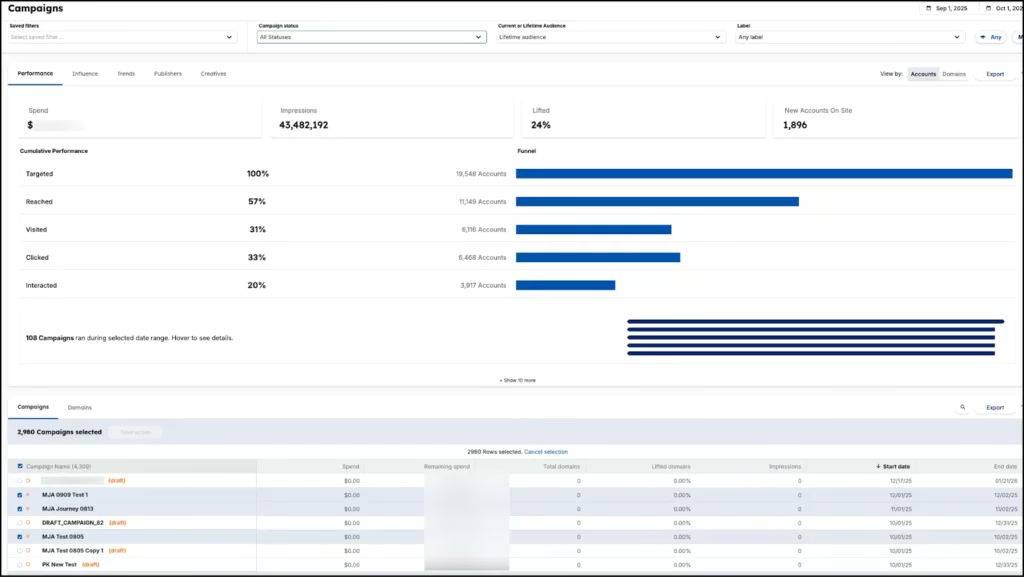
Demandbase stands out as the first and only Connected TV (CTV) advertising solution designed specifically for B2B marketers. This is powered by the proprietary Piper B2B DSP, a demand-side platform built from the ground up for B2B audience identification and targeting.
It connects ad delivery directly to known business accounts and verified buying committees. This means marketers can deliver high-impact video ads on premium streaming platforms like Hulu, Pluto, Tubi, Sling, and Roku.
With Demandbase CTV, you can identify and engage the specific accounts, buying groups, and decision-makers that are in-market, researching your category, or actively showing intent.
Plus, every impression is tied to account-level data, ensuring that your budget directly supports generating new pipeline and sales.
Key features
- Premium CTV inventory access: Offers access to high-quality, brand-safe streaming platforms, ensuring your ads appear only in professional, high-attention environments.
- Cross-channel measurement suite: Provides full visibility into how CTV exposure impacts downstream performance. You can track metrics like account reach, ad frequency, engagement lift, and pipeline influence.
- Account-level CTV targeting: Enables direct upload to target account lists from CRM or ABM system, enabling hyper-specific ad delivery.
- Intent-based campaign optimization: Continuously ingests third-party and first-party intent signals, prioritizing ad delivery to accounts actively showing research or purchase behaviors in your category.
- Bidding and budget optimization: Leveraging AI, the system adjusts bidding strategies dynamically based on audience performance and engagement metrics.
What customers say about Demandbase
Jay Civitillo, Market Development Manager at Caregility
Kate Coppola, Senior Advertising Manager, Brand and Digital Marketing at Unisys.
Oleg Solodyankin, CEO of Ignitium
Pricing
Demandbase offers custom pricing based on campaign scope, ad spend, and data volume. But you can get the CTV solution as a bundle with the Demandbase One platform, which combines advertising, data, and sales intelligence capabilities into a unified GTM suite.
2. The Trade Desk
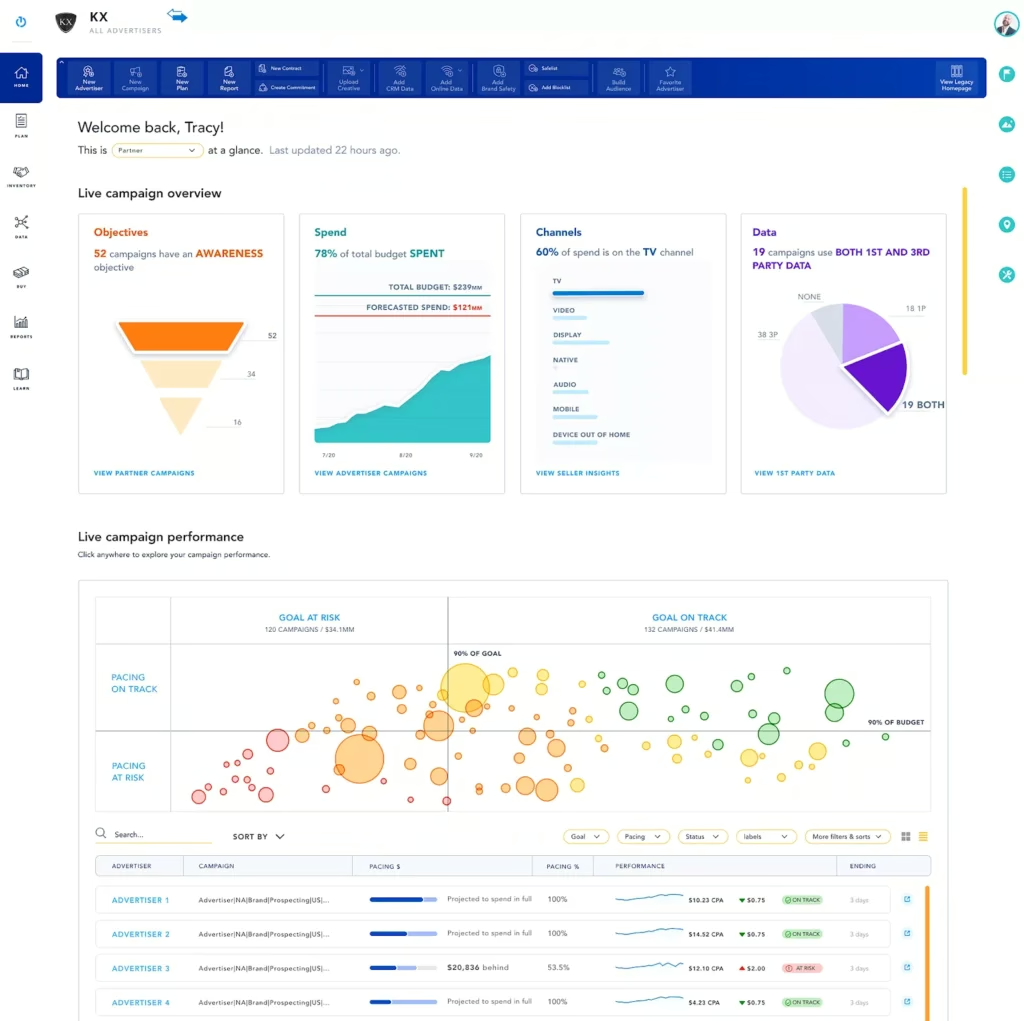
The Trade Desk (TTD) is a programmatic demand-side platform (DSP) in the world that powers advertising campaigns across Connected TV, display, mobile, and digital audio.
The platform features an open, omnichannel ecosystem, providing access to the largest library of premium streaming inventory. This includes partnerships with major publishers like Hulu, Disney+, Peacock, Paramount+, and YouTube TV.
It also combines first-party CRM data, ABM lists, and third-party intent data to build granular audience segments. This ensures CTV ads are served only to the most relevant business decision-makers.
Key features:
- Unified ID 2.0 (UID2): This is a next-generation identity framework that replaces third-party cookies with encrypted email-based identifiers. It enables advertisers to target audiences across CTV and digital environments while maintaining full data privacy compliance.
- Koa: Analyzes billions of data points in real-time to optimize bidding, targeting, and performance. It continuously learns from campaign outcomes to predict which audience segments and ad placements are most likely to drive engagement and conversions.
- Cross-device and cross-channel audience management: Allows marketers to unify audience targeting across devices (from smart TVs and desktops to mobile and audio).
Pros
- “I really like how much control and transparency The Trade Desk gives me when running ad campaigns. The real-time reporting is super helpful — I can track performance, adjust budgets, and tweak targeting on the fly. It also has a huge range of audience targeting options, and the data integrations make it easy to reach the right users. Overall, it feels like a very powerful and flexible platform once you get the hang of it.” (Read full review).
Cons
- “In some cases, the data fees end up being higher than the total media cost, which is frustrating. For my campaign, I used display ads with Experian data and a custom audience, but the technology fees turned out to be extremely high.” (Read full review).
Pricing
The Trade Desk operates on a transparent CPM-based pricing model tied to the volume of media spend, data usage, and targeting complexity.
This is calculated using its ‘hybrid rates’ pricing model which combines a percentage of media cost (%) with a maximum CPM (cost per thousand impressions) cap.
The exact details of this aren’t exactly clear, and can vary based on geography and inventory type. But most advertisers can expect:
- Average CPMs ranging between $15-$40 for premium CTV placements.
- Platform access through an agency or direct enterprise relationship. No fixed minimum spend but typically $20,000-$50,000 monthly for meaningful campaign reach.
- Additional fees for third-party data integrations and measurement add-ons (such as brand-lift studies).
And even their customers find their model a bit confusing too:

3. Google Display & Video 360 (DV360)
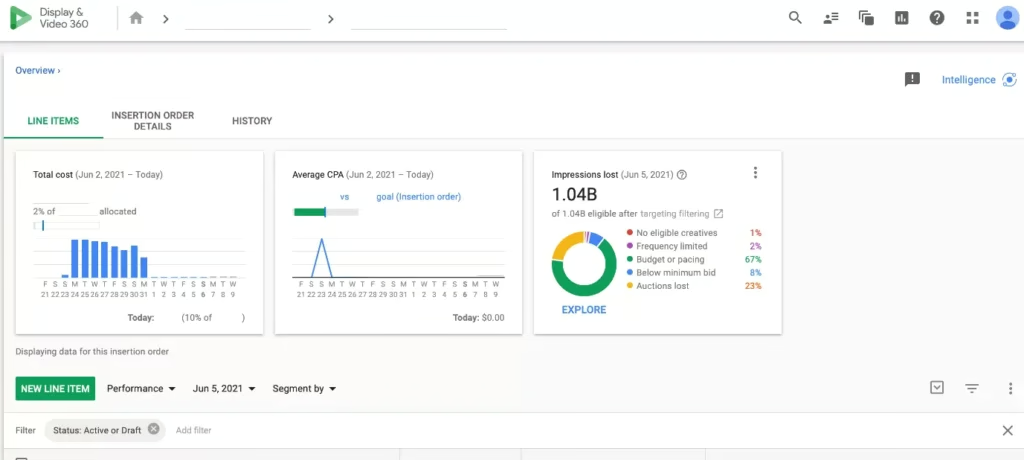
Google Display & Video 360 (DV360) is Google’s enterprise-grade DSP within the Google Marketing Platform ecosystem, designed to manage programmatic media buying across display, video, mobile, audio and other channels.
It gives you access to the global Google inventory including YouTube TV, Hulu, and Sling, enabling wide-scale visibility among professional audiences.
But the major advantage is the integration with other Google apps such as Ads, Search, and Analytics 360. With this ecosystem, marketers can align brand campaigns with performance outcomes. They can also track how CTV exposure influences search lift, website engagement, and account-level actions.
Key features:
- Custom bidding and budgeting for CTV line items: DV360 offers line-item types specific for CTV, including CPM-only buying, and supports automated bid strategies optimized for viewability or reach. This allows you to tailor bidding logic to your B2B goals.
- Audience targeting via Google-built segments: DV360 brings Google’s audience signals (affinity, in-market, demographic) into CTV campaigns. You can target viewers based on interests, purchase intent, and behavior that align with your ICP.
- Unified reach reporting: Includes features like reach/deduplication across devices, household-level insights, and cross-media reach reports.
Pros
- “Pretty straightforward platform for your display and video campaigns with an intuitive look and feel especially if you’ve ever ran Google Search Ads before. This is the perfect partner to your Adwords to ensure you’re covering the full funnel from top (display and video) to bottom (if you also run search ads on the side).” (Read full review).
Cons
- “It is sometimes tough to get answers when problems arise. There are multiple avenues to submit complaints to Google and it’s not always easy to know the right one.” (Read full review).
Pricing
Because pricing depends so much on scale, targeting, and supply, Google does not publish a fixed “entry price” for DV360. You should expect to negotiate based on spend and targeting complexity.
You’ll also pay for platform access (often bundled via agency/Google partnership) and any premium data or measurement add-ons.
4. Amazon DSP
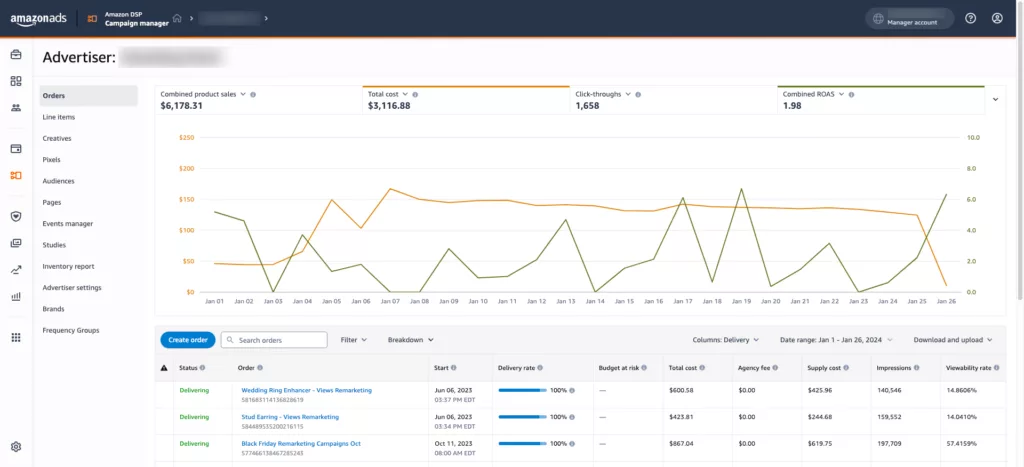
This is Amazon’s demand-side platform that enables advertisers to buy programmatic display, video, audio and CTV inventory across Amazon’s owned properties (such as Prime Video, Twitch, Fire TV) and third-party publishers.
Initially, it was developed with a strong consumer focus, but it has since evolved into a complete omnichannel CTV solution, offering B2B marketers access to its premium streaming inventory.
Amazon has also formed strategic partnerships with Roku, and Netflix, to access large scales of streaming-household inventory.
Key features
- Complete TV: Allows advertisers to set streaming budgets, plan reach and frequency across streaming environments, and optimize pacing in real time with AI recommendations.
- Amazon identity graph: Leverages browsing, purchase, and streaming behavior from its e-commerce and video ecosystems to build deterministic and modeled audiences.
- For B2B, this means you can layer in business-relevant signals (for example: people who live in households where streaming of business programming is high + recent interest in enterprise software) to create highly relevant segments.
- Data and clean room capabilities: Amazon offers the Amazon Marketing Cloud (AMC) and integrates with other clean-room technologies, enabling advertisers to merge Amazon’s data with their CRM or ABM system securely.
Pros
- “The Amazon DSP is easy to use and set up. Their customer service is fast and reliable whenever you have an issue with it. It is easy to integrate and advertise new products. The features that it has are good and easy to use.” (Read full review).
Cons
- “Sometimes the platform takes time to update the user interface. So it becomes little time taking thing. The ad uploading is quite a time taking process. The platform glitch is the only thing where it needs to improve.” (Read full review).
Pricing
Amazon DSP offers three main pricing modes:
- Cost + fees pricing model where advertisers can add ‘la carte’ fees for opt-in features and services.
- Fixed CPM campaigns where the price is set based on a variety of supply-demand factors. This can also be pre-negotiated.
- Fee-based services from services from third-party service providers.
Also, the minimum spend depends on whether you are using self-service (lower threshold) or managed service (higher threshold) modes.
5. StackAdapt
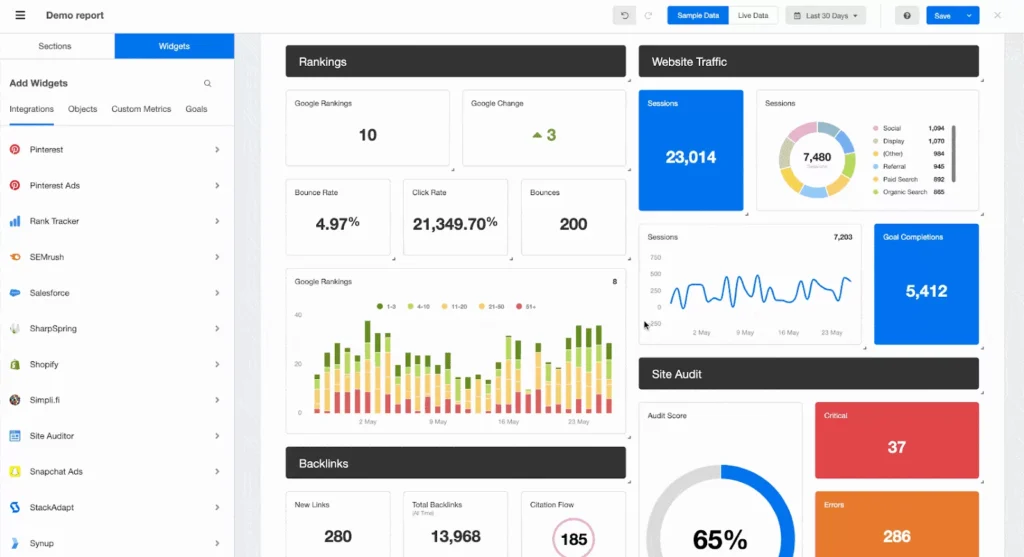
StackAdapt is an ai-powered, self-serving (with optional managed service) programmatic advertising platform that supports Connected TV alongside display, video, audio, native, and even in-game formats.
While it serves both B2B and B2C, its audience activation toolkit makes it particularly well suited for B2B marketers in mid-market organizations. For example, you can upload first-party data, layer it with lookalike models or intent-driven signals, and deploy ads in high-quality streaming environments via CTV.
For many B2B teams that are newer to CTV or lack the heavy infrastructure of large DSP platforms, StackAdapt is a practical choice. You get CTV access, multi-channel flexibility and AI optimization in one platform.
Key features
- Premium inventory access and “CTV Properties” classification: StackAdapt partners with a wide set of streaming apps and networks, providing access to “hundreds of networks” and ensuring big-screen placements.
- They also introduced the ‘CTV Properties’ framework which categorises streaming inventory more granularly (FAST, AVOD, BVoD, OEM, etc) to enhance transparency and planning.
- Cross-channel reach: Allows CTV alongside display, native, audio and more within the same UI. For example, you can coordinate a video-first big-screen campaign with supporting digital follow-up in one system.
- Creative transcoding: You can upload current creative and the platform formats it for multiple publisher specs at no extra cost.
Pros
- “I love using StackAdapt for running programmatic campaigns as it provides excellent client service, saving precious time and allowing me to focus on strategic planning and decision-making. Their client services always deliver best-in-class support to all accounts, which makes a significant difference in managing campaigns.” (Read full review).
Cons
- “StackAdapt struggles with budget burn, which can result in unexpectedly high financial costs, especially during large or robust campaigns. The platform would benefit from stronger controls or limitations, particularly regarding financial management for ads and other advertising strategies.” (Read full review).
Pricing
StackAdapt uses flexible pricing models tailored to your campaign objectives, including CPM (cost per thousand impressions), CPC (cost per click), and CPE (cost per engagement).
6. OpenX
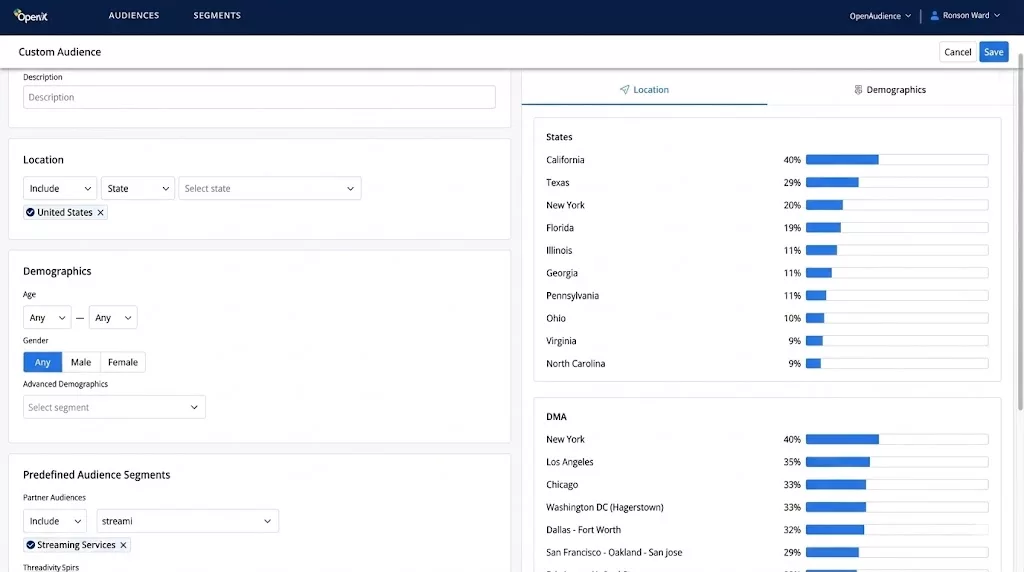
OpenX is a supply-side platform (SSP) that powers programmatic ad inventory across web, mobile, and app channels. Unlike the DSPs we’ve discussed, OpenX’s initiative called TV by OpenX is particularly interesting for CTV buyers.
Through this program, OpenX has committed to eliminating non-TV content (like gaming, UGC, mobile apps) from its “CTV” inventory definition. It also removes resellers from key supply paths, and provides direct access to premium devices and verified streaming placements.
What this means is, when you buy through OpenX’s CTV offerings, you’re buying into a curated, transparent supply-path.
Key features
- TV by OpenX: Provides access to direct-publisher, glass-on-wall CTV placements (110+ million devices) and eliminates resellers and non-TV inventory types to improve transparency and placement quality.
- Results by OpenX: Applies machine-learning to curate the highest-value supply, filtering for inventory with the strongest likelihood of driving desired outcomes.
- OpenXSelect: Enables buyers to layer audience data (via their identity graph of 237M+ U.S. users) for more precise activation of segments across connected devices.
Pros
- “Good targeting and campaign management; fairly easy to deploy; excellent customization ability; as a free solution, an excellent value.” (Read full review).
Cons
- “Sometimes the reporting gets delayed and the data is updated only after 24 hours for the previous day’s data. It sometimes gets tricky when we are calculating the discrepancies for Ad Partners.” (Read full review).
Pricing
- OpenX offers programmatic access via deal IDs or private marketplace packages. Pricing varies based on inventory tier, targeting complexity, geography and placement quality.
7. MNTN
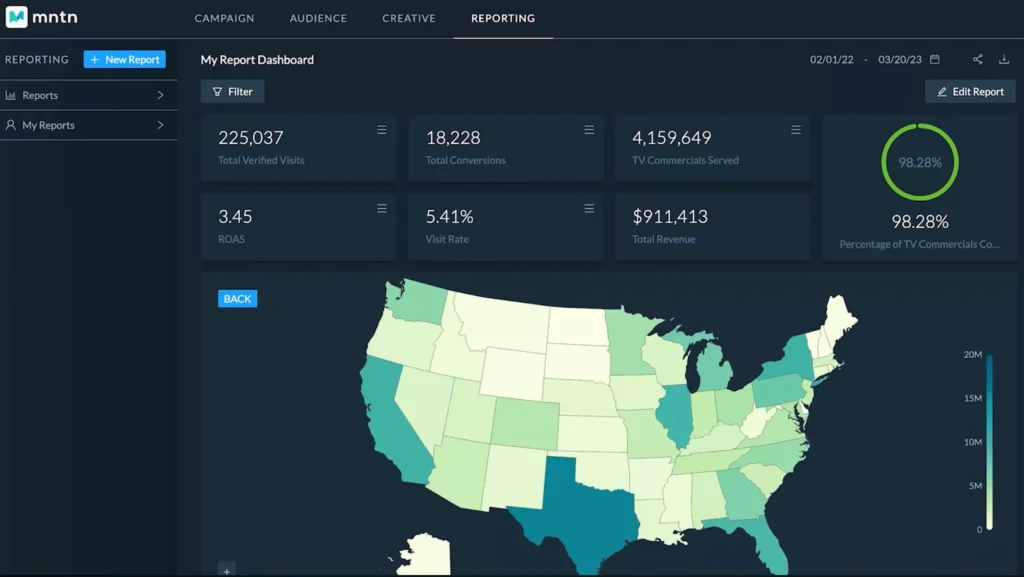
MNTN is another self-serve, performance-first CTV advertising platform that enables B2B marketers to launch, optimize and measure streaming-TV campaigns.
It focuses on quick activation, clear measurement and a workflow that feels familiar to paid search or social. MNTN lets you target audiences using first-party data or intent segments, deliver video ads on major streaming networks, and then tie exposure to site visits and conversions.
Its ease-of-use is also a compelling factor. Because many B2B organizations struggle with moving from digital ads to TV-like environments, MNTN reduces the friction:
- You upload your video ad (or use their creative services),
- upload your target audience (CRM list, lookalikes, etc.),
- set your goal and budget,
- and the platform optimizes toward outcomes like website visits, conversions or ROAS.
Key features
- MNTN matched. Enables advertisers to upload CRM lists, or use on-platform audience signals, to retarget or prospect streaming viewers who match high-value business profiles.
- Verified visits attribution: Unique to MNTN, this feature links streaming ad exposure to site visits, conversions and performance outcomes
- Creative-as-a-Subscription: For brands without ready video assets, MNTN offers creative solutions so you can launch fast. This is great for B2B teams new to TV-style ads.
Pros
- “MNTN is one of the best implementations of a digital first video production platform that I have seen. They have gotten rid of the worst and least efficient parts of the traditional agency model, and set up a site that helps makers get access to quality projects at decent budgets.” (Read full review).
Cons
- “As a Maker, I think it would be incredibly valuable if we were able to see how our ads were performing after launch. This would enable us to evolve our strategy and ultimately deliver better results for future clients.” (Read full review).
Pricing
- MNTN operates primarily on a media-spend basis rather than fixed large minimums. The platform is designed for self-serve and performance-driven budgets, meaning you can often start from more modest levels compared to enterprise-only DSPs.
8. Brandzooka
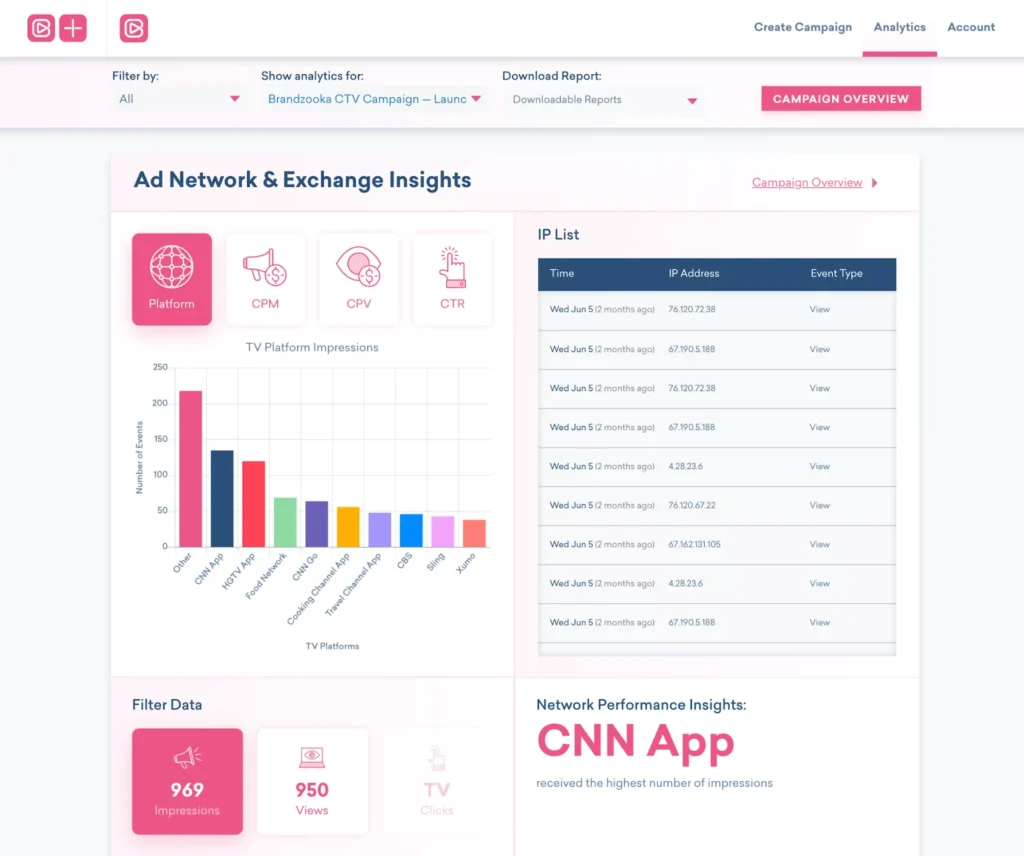
Brandzooka is an ad tech platform designed to make premium video and CTV ad buying accessible—especially for smaller brands and agencies.
For B2B teams, Brandzooka offers an interesting value proposition: you get access to premium streaming services (such as Hulu, Peacock, Pluto TV) and a platform that lets you activate campaigns with lower budget thresholds (starting from ~US $1,000) and with fewer contract hurdles.
That said, while it may not offer the advanced account-based workflows of specialized B2B CTV DSPs, its ease of use and access-friendly model make it a viable option.
Key features
- Audience access and data partners: Brandzooka claims relationships with over 200 data and inventory partners (including LiveRamp, Bombora, Acxiom) and offers targeting by geo, device, audience attributes, and content-level flows.
- Media mix capability: Since the platform spans multiple channels, B2B teams can test CTV alongside display or other medium to evaluate which screen drives the best incremental impact.
- Real-time analytics: The platform provides live performance metrics including placements, impressions, and estimated view rates.
Pros
- “Very knowledgeable team, their digital buying platform is by far the easiest and most responsive I have seen. We have increased our digital budgets because of Brandzooka.” (Read full review).
Cons
- “I can not create an article ad that shows up on a channel to look like an article from that channel. I don’t like that their Upload Youtube feature doesn’t work at all.” (Read full review).
Pricing
- Brandzooka’s pricing model is relatively transparent and suitable for experimentation. You can create an account for free with no subscription or contract required.
9. Verve
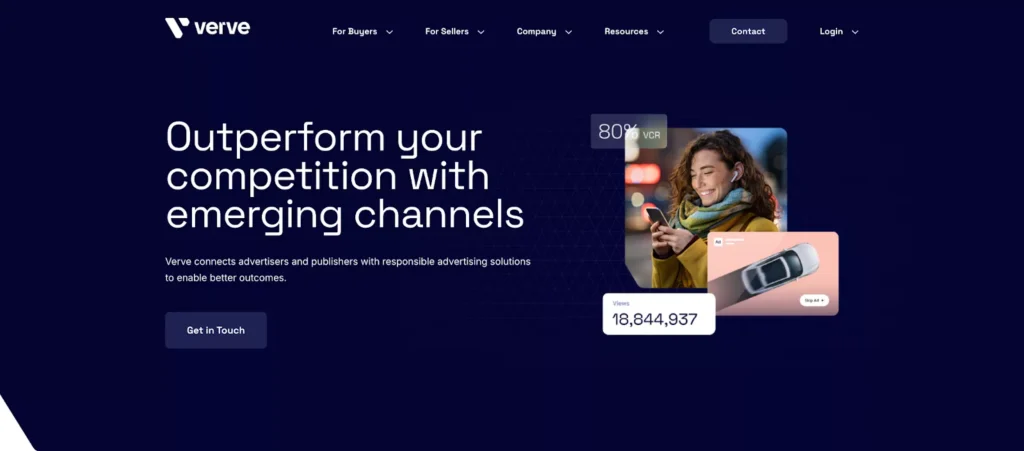
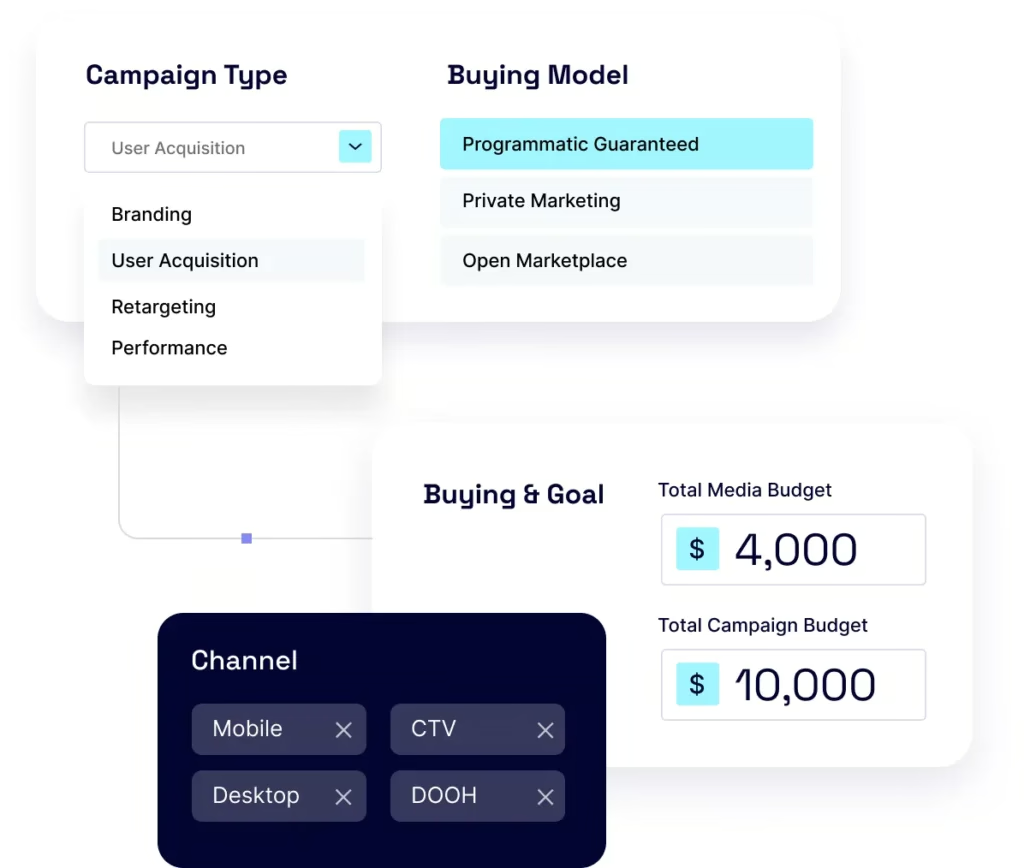
Verve is a global ad-tech company whose DSP offering enables programmatic media buying across mobile, web, digital out-of-home (DOOH) and CTV.
It offers cross-screen consistency, contextual precision, ID-less targeting, and transparent supply quality. This makes it a good option for B2B marketers who are navigating privacy shifts and want to expand reach in a more flexible way.
For instance, instead of solely relying on deterministic first-party account lists, Verve augments campaigns with contextual and location-based signals. This enables outreach to professional audiences across screens even when explicit identity data is restricted.
Key features
- Fraud prevention infrastructure: Verve’s supply chain is accredited (e.g., by TAG) and uses independent verification (e.g., Pixalate) to reduce invalid traffic and ensure quality inventory.
- Advanced contextual targeting engine: Uses real-time content & contextual signals to match ads to relevant streaming content environments, enhancing relevance when audience identifiers are limited.
- Omni-screen activation: Allows you to plan and activate campaigns across multiple screens, including CTV, from one platform. For example, you can coordinate your big-screen ads (e.g., CTV) with mobile and web campaigns targeting the same decision-makers.
Pros
- “Easy to use for first time users to generate demand.” (Read full review).
Cons
- “For new users who never used any DSP in the past it will be tough to understand quickly how to buy traffic and optimize it.” (Read full review).
Pricing
Specific pricing tiers depend on inventory quality, geographic region, targeting complexity, and data usage.
10. SmartyAds
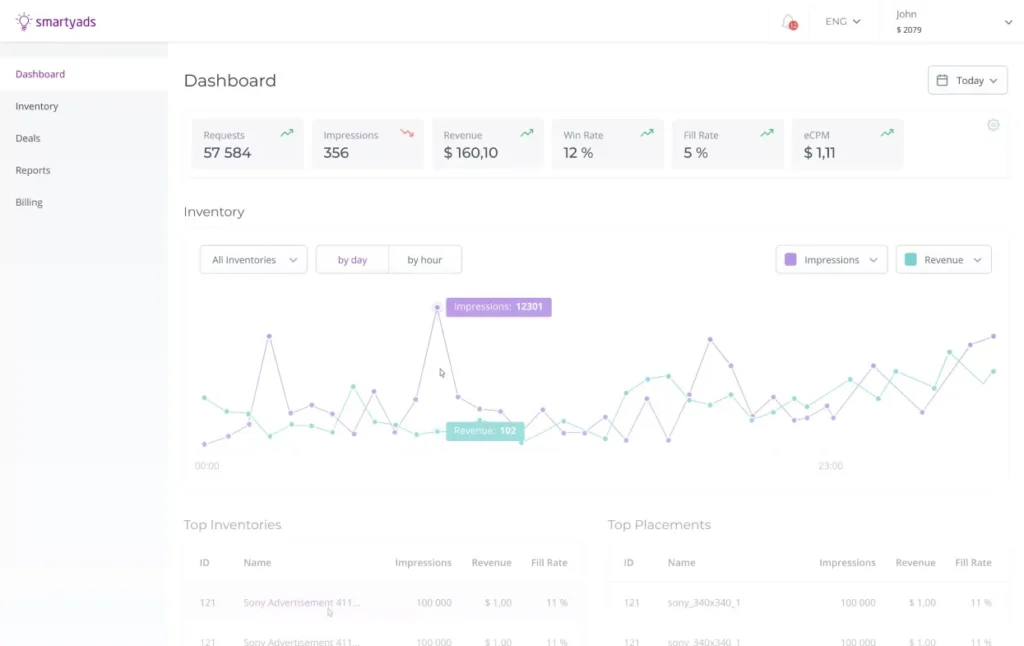
SmartyAds is a full-stack programmatic advertising platform. It offers a DSP, SSP, and access to global ad inventory across mobile, video, rich media, and CTV, and OTT (over-the-top).
It provides an interface that allows you to manage CTV line items alongside other channels in a unified workflow. This makes it a flexible, scalable solution for advertisers that want to manage ad campaigns across channels with unified tools.
SmartyAds can also serve as a cost-effective entry or supplemental option for CTV advertising. It gives you access to big-screen reach, programmatic buying and multi-channel orchestration. And you never have to worry about the overhead and commitments of more enterprise-focused DSPs.
Key features
- Self-serve interface: Offers a user-friendly, self-serve model. This lowers the barrier to entry, making it ideal for testing CTV or running small-to-mid size campaigns without complicated onboarding.
- Programmatic buying: Uses real-time bidding (RTB), machine learning, and adaptive bid optimization to manage media buys. You can dynamically adjust bids, pacing, and spend to deliver optimal results even on CTV inventory.
- List-based activation: Advertisers can upload their own first-party or CRM-derived lists and combine them with contextual, behavioral, geographic or device-based filters.
Pros
- “SmartyAds has been very helpful to us in generating qualified leads at a great value. Our cost per impression and click are amongst the best of all the media sources in our marketing mix.” (Read full review).
Cons
- “I don’t like the delay in the approval of creatives.” (Read full review).
Pricing
- As with any programmatic platform, actual cost will vary depending on factors like targeting precision, inventory quality, geography, and data overlays.
| Platform | Key strengths | Best for | Measurement and attribution |
|---|---|---|---|
| Demandbase | Only CTV platform built specifically for B2B. Also connects ads to verified accounts and buying committees via Piper B2B DSP | Enterprise GTM teams that want to directly link CTV performance to pipeline and revenue. | Full pipeline attribution, opportunity influence, ROI tracking |
| The Trade Desk | Massive reach, premium CTV inventory, AI-driven bidding, Unified ID 2.0 identity graph | Global B2B brands needing broad reach, scale, and cross-media consistency. | Cross-channel attribution, reach & frequency reports |
| Google DV360 | Part of Google Marketing Platform. Unifies YouTube, display and CTV | B2B organizations already invested in Google stack needing cross-screen measurement. | Deep analytics via GA360, post-view tracking, brand lift |
| Amazon DSP | Access to Fire TV, Prime Video, Twitch, all powered by Amazon’s first-party insights | B2B marketers seeking data-driven precision and household-level reach with premium inventory. | Reach, conversions, offline-to-online attribution |
| StackAdapt | Multi-channel platform (CTV, display, native). Also includes great AI optimization | Mid-to-large B2B teams seeking CTV integration inside existing programmatic workflows. | Unified analytics dashboard, conversion rates tracking |
| OpenX | Direct CTV supply (TV by OpenX), strong data partnerships (Experian, etc.) | B2B advertisers prioritizing transparency, quality supply, and brand-safe placements. | Publisher-level transparency, impression verification |
| MNTN | “Performance TV” model with self-serve simplicity. Verified Visits attribution | GTM leaders seeking pipeline visibility and performance tracking through CTV. | Full-funnel attribution (site visits, conversions, ROAS) |
| Brandzooka | Self-serve platform with low budget minimums and quick activation | SMB or growth-stage B2B brands testing CTV proof-of-concept or pilot campaigns. | Real-time reporting, engagement metrics |
| Verve | Focus on contextual, ID-less targeting across CTV, mobile and DOOH | B2B advertisers needing cross-channel continuity and privacy-based targeting. | Contextual engagement analytics, brand safety metrics |
| SmartyAds | Full-stack DSP/SSP ecosystem, self-serve and AI optimization. | B2B teams exploring entry-level or low-cost global CTV campaigns. | Real-time analytics, transparency reports |
Demandbase CTV: From the big screen to your bottom line
The days of television being a ‘one-way’ awareness channel are over. It’s now switched to Connected TV, and is driving both brand equity and measurable pipeline impact.
But most CTV platforms were built for consumer brands. They’re not compatible for the complex buying groups in B2B.
We figured we might as well change that.
Demandbase brings the precision of account-based marketing to the most immersive screen in your house.
And this is powered by our proprietary ‘Piper’ B2B DSP, which enables you to deliver video campaigns that reach the right accounts already in-market and showing intent. Plus it connects every ad impression to downstream activity, closing the gap between awareness and revenue.
Here’s what one of our customers had to say:
Robert Bramley, Demand Generation Manager (UK & Ireland) GoCardless
GoCardless unifies sales and marketing to deliver 11X ROI with Demandbase
For the first time, B2B marketers can treat television like a performance channel.
You can build brand authority while fueling pipeline velocity. And all of this from a single platform that unites data, targeting, and measurement in one place.
Related content



We have updated our Privacy Notice. Please click here for details.