

AI for marketing campaign personalization in B2B

Personalization drives a 10-15% revenue lift for the companies that get it right, according to McKinsey’s research. But getting it right is the operative phrase.
A 2025 Gartner survey found that for 53% of buyers, personalization created a negative user experience in their most recent purchase journey.
The difference between those two outcomes usually comes down to execution. And for B2B teams running campaigns across multiple accounts and buying committees, execution at scale is where things fall apart fast.
When it goes wrong, this is what it feels like:

This guide breaks down how to use AI for B2B campaign personalization so you land on the revenue-lift side of that equation, not the buyer-regret side.
What is AI personalization?
AI personalization in B2B marketing means using artificial intelligence to adapt campaigns, content, and outreach to individual accounts and the buyers within them.
It processes intent signals, engagement data, firmographics, and behavioral patterns to serve the right message to the right person at the right time, across whichever channel they’re active on.
This is a harder problem in B2B than in most other settings. You’re personalizing for an entire buying committee of five to twenty people, each with different priorities, at different stages of evaluation, across multiple channels at the same time. That’s not something a team can do manually at scale.
Before AI, B2B personalization typically looked like this →
- Segmenting by industry, company size, or job title and sending the same campaign to everyone in that bucket.
- Swapping in a first name or company name in email subject lines and calling it “personalized”.
- Building static drip sequences triggered by a single action, like a form fill, with no adjustment based on what happened next.
- Running one version of a landing page or ad for all accounts in a target list.
- Manually researching accounts one by one to tailor outreach, which worked for five to ten top-tier accounts, but fell apart after that.
With AI in the stack, that same process looks very different →
- AI tools adjust campaigns on the fly based on how each account and customer interacts across channels.
- Each buyer sees relevant content that matches their role, where they are in the funnel, and what they’ve engaged with before.
- Third-party intent signals tell your team which accounts are actively researching and when to prioritize them.
- Landing pages, ads, and emails change automatically based on who’s visiting and what their company looks like.
- Your team can personalize across hundreds of accounts without needing to grow the team to match.
Example: A target account starts showing intent signals around marketing automation. AI responds by serving the CFO a cost-focused ad creative and sending the VP of marketing a case study from a similar company. All of it runs across LinkedIn, email, and your site without your team manually spinning up separate campaigns for each person.
Benefits of using AI for marketing campaign personalization
AI personalization touches almost every part of the B2B marketing funnel. It changes how buyers engage, how fast deals move, and how much it costs to get there.
Here are the benefits that come up most often:
- Better engagement across the buying committee: 82% of B2B marketing decision-makers say buyers expect personalized experiences, according to Forrester’s data. AI technologies make that possible across entire accounts by adapting what each stakeholder sees based on their role and where they are in the evaluation.
- Lower customer acquisition costs: When AI handles targeting, your budget goes toward accounts and buyers who are actively in-market rather than spreading thin across low-intent prospects. McKinsey’s research found that personalization can reduce customer acquisition costs by as much as 50%.
- Faster pipeline velocity: When buyers get content that matches their role and where they sit in the evaluation, they move forward faster. AI handles that matching automatically, so deals don’t lose momentum waiting for a rep to follow up or marketing to queue the next touchpoint.
- Mid-campaign adjustments that happen automatically: AI monitors performance across channels and adjusts budget, messaging, and targeting mid-campaign. You don’t have to wait for the post-mortem to find out what didn’t work.
- Improved win rates across complex deals: Demandbase’s B2B AI GTM Report found that buying group engagement leads to 2-3x higher win rates and larger contracts. AI makes this feasible by mapping the committee and coordinating outreach to each member based on their role and behavior.
- Less content waste: A 2024 B2B personalization study found that over half of buyers consider vendor content useless. AI narrows that gap by matching content to each buyer’s journey stage instead of sending the same asset to everyone on the list.
- Personalization that scales without scaling the team: Manual 1:1 ABM personalization eats up hours per account between research, content creation, and campaign setup. AI handles the heavy lifting, so a small team can personalize across hundreds of accounts without growing headcount to match.
What this means in practice: Put simply, AI personalization lets a B2B marketing team punch above its weight. Your team covers more accounts, gets more out of every campaign dollar, and gives sales something useful to work with on every handoff.
And none of that demands a complete overhaul of how your team operates. It starts with letting AI take over the parts of personalization that eat up the most time for the least return.
Examples and applications of AI personalization in marketing campaigns
Every B2B marketing team runs personalization differently depending on their stack, their audience, and where they are in their ABM maturity. But a handful of applications keep showing up across the board:
Account-specific content recommendations
The manual version: Most B2B teams have a growing content library and no reliable way to match the right asset to the right buyer. Everyone on the target account list gets the same nurture sequence with the same attachments, regardless of role, industry, or where they are in the evaluation.
How AI handles it: AI cross-references intent data, past customer engagement, and firmographic details to figure out which asset fits which buyer at which account. It pulls from your existing content library and serves the asset most likely to resonate with each person, without anyone on your team making that call manually.
Example: Say you’re targeting mid-market fintech companies. Demandbase’s account intelligence combines intent, firmographic, and engagement data to show that one account is researching compliance, and their security lead has visited your integrations page twice.
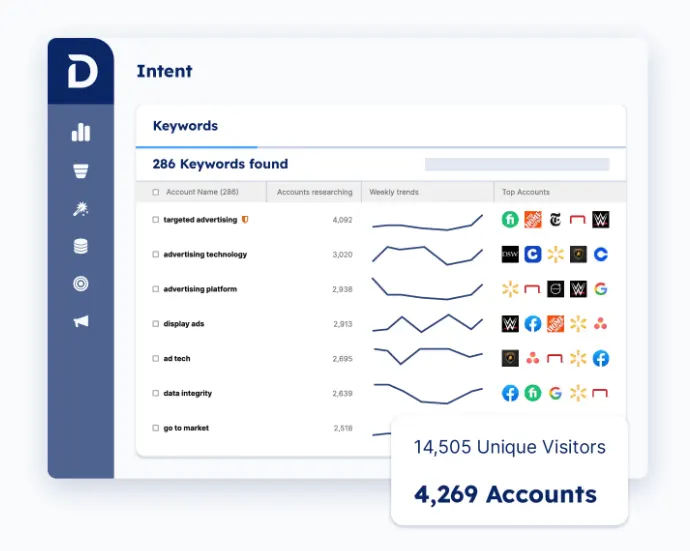
That buyer gets a compliance case study from a similar fintech company. The VP of ops at the same account, who has been engaging with workflow content, gets a product comparison focused on automation. Both assets already existed in your library. AI handled the matching.
AI-powered conversational marketing
The manual version: Without AI, live chat and chatbots run on pre-built decision trees that ask the same questions in the same order, no matter who’s on the other end. A CTO at a top-tier target account gets the same experience as a random visitor who stumbled in from a blog post.
How AI handles it: AI identifies who’s on your site in real-time and adjusts the conversation based on their account, role, and behavior. A visitor from a target account researching a specific use case gets a relevant response and a direct path to sales. A visitor from an unknown company gets a lighter-touch experience that qualifies them first.
Example: A buyer from a target account hits your site after engaging with two of your emails. AI identifies the account, sees the engagement history, and opens a chat that picks up where the email sequence left off. The conversation adapts based on the buyer’s role and what they’ve already seen, and routes them to the right rep if they’re ready to talk.
Dynamic website experiences
The manual version: The default B2B website experience is one-size-fits-all. Every visitor sees the same hero section, the same CTAs, and the same case studies regardless of their industry, role, or how far along they are in the buying process. Building custom pages for specific accounts or segments is possible, but it eats up design and dev hours fast.
How AI handles it: AI uses account data, intent signals, and engagement history to change headlines, CTAs, case studies, and page layouts in real time. Two visitors can land on the same URL and see completely different versions of the page, tailored to their industry, role, and where they are in the buyer journey.
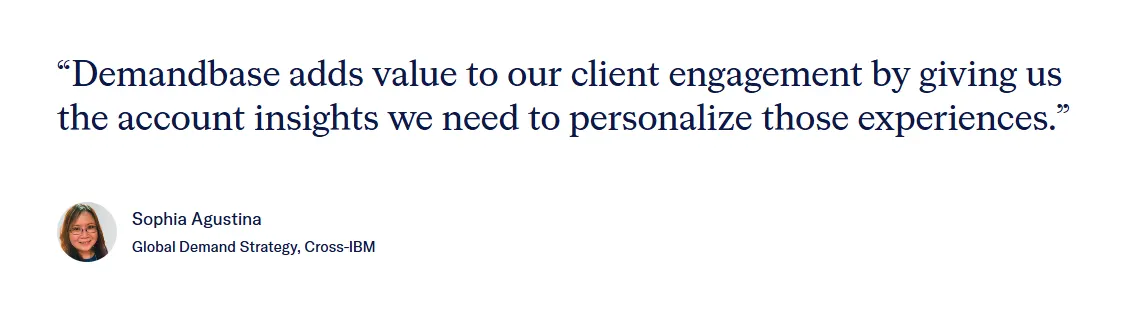
Example: IBM used Demandbase Personalization to build a custom website experience around its US Open sponsorship campaign. Demandbase identified over 9,500 accounts engaging with the campaign, which is 3x what IBM captured with similar campaigns in previous years.
Of those, nearly 200 were top-tier target accounts, double the number from prior campaigns. IBM then routed that data to sales with recommended follow-ups based on intent. [Read Full Case Study]
Related ebook → The B2B Marketer’s Guide to Website Personalization and Engagement
Intent-based advertising
The manual version: The majority of B2B ad campaigns target a fixed list of accounts with the same creative and the same budget allocation across the board. There’s no signal telling you which accounts are actively in-market, so your spend is spread evenly between accounts that are ready to buy and accounts that won’t be ready for months.
How AI handles it: AI reads intent signals in real-time and reallocates ad spend toward accounts that are actively researching your category. It also adjusts the creative each account sees based on their journey stage and the topics they’re engaging with.
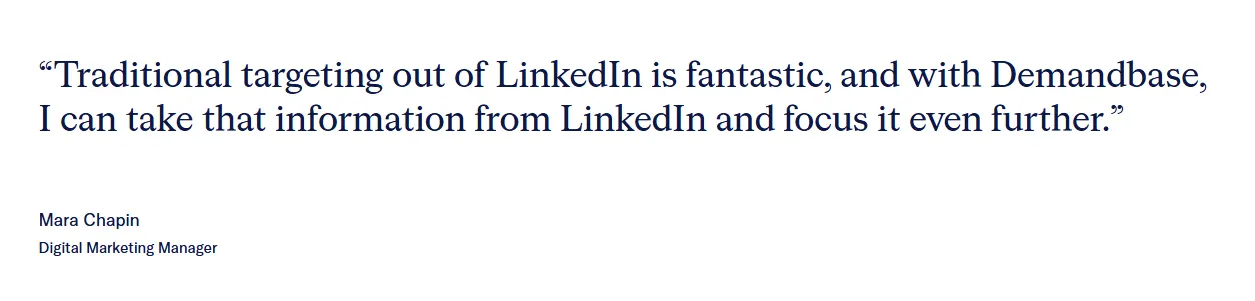
Example: Visier, a people analytics company, used Demandbase Intent keywords to figure out which products their target accounts were most interested in, then built ad campaigns around those topics. They pushed targeted account and person lists through Demandbase’s LinkedIn integration as dynamic audiences, so the right message reached the right buyers.
Click-through rates were 234% higher with this approach, 84% of top enterprise prospects visited the site from an ABM ad, and they were 206% more likely to close won vs. lost deals. [Read Full Case Study]
Related → The complete guide to intent-based marketing for B2B teams
Real-time campaign optimization
The manual version: Campaign optimization in B2B typically happens after the campaign ends. Someone pulls a report, reviews the numbers, flags what underperformed, and applies those lessons to the next campaign. The problem is that by the time you’ve learned what didn’t work, the budget is already spent.
How AI handles it: Performance data flows in, and AI acts on it continuously. Budget moves toward high-performing segments, and underperforming channels lose allocation before they drain the budget. The campaign you launched on Monday doesn’t look the same by Friday, because AI has been fine-tuning it the entire time.
Example: You’re running ads, email, and content syndication against a target account list. AI notices that one segment is engaging heavily with technical content while another is responding to ROI messaging, so it splits the creative and reallocates the budget accordingly.
Predictive lead scoring and orchestration
The manual version: Points-based lead scoring hasn’t aged well. It rewards activity over fit and treats leads as individuals in a world where B2B purchases involve five to twenty stakeholders. A marketing intern at a non-target company can rack up the same score as a CFO at your top account who visited your pricing page once.
How AI handles it: AI models score at the account level, not just the lead level. It weighs fit signals like firmographics and technographics alongside behavioral signals like intent activity, content engagement, and buying committee coverage. An account where three decision-makers are engaging, and intent is trending up, gets prioritized over a single lead who downloaded two PDFs.
Example: Demandbase’s Pipeline Predict uses machine learning trained on your past opportunities to score how likely each account is to become pipeline in the near future. Scores update nightly as new engagement and intent activity come in.
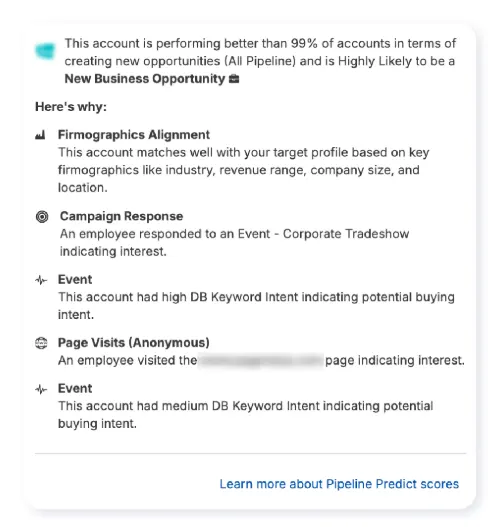
When an account moves into “Highly Likely” territory, Demandbase Orchestration can kick in automatically. It can enroll the account in a targeted campaign, alert the assigned rep, or push it into an ad audience.
Challenges in implementing AI personalization in marketing
AI personalization has a clear upside for B2B marketing teams. But it also comes with a specific set of challenges that are easy to underestimate until you’re in the middle of implementation.
Here are the most common ones:
- Data silos across teams: A 2024 DATAVERSITY survey found that 68% of organizations rank data silos as their biggest challenge. When marketing, sales, and customer success each operate on separate data, AI personalization strategies can’t coordinate messaging across the full buyer journey.
- Data privacy and compliance pressure: Gartner predicts that by 2027, 40% of AI-related data breaches will be caused by cross-border misuse of generative AI. B2B teams collecting behavioral and intent data across regions need to stay on top of GDPR, CCPA, and newer regulations, and that complexity grows with every market you operate in.
- Data that isn’t clean enough for AI to use: Forrester found that data quality is the primary limiting factor for B2B AI adoption. Outdated contacts, incomplete account records, and inconsistent fields across systems mean AI is personalizing based on a version of your accounts that may no longer be accurate.
- Too much personalization, not enough relevance: A 2025 Gartner survey found that buyers who experienced hyper-personalization were 2x more likely to feel overwhelmed by information volume and 2.8x more likely to feel rushed. AI makes personalization easy to scale, but scaling without restraint pushes buyers away instead of pulling them in.
- Few teams have the foundation to scale: Adobe’s B2B Customer Experience research found that only 33% of businesses feel ready to scale personalization with AI. The rest are stuck between knowing what they want to do and having the infrastructure, data, and processes to do it across accounts and channels.
Quick readiness check → Ask these five questions before rolling out AI personalization:
- Is our account and contact data clean enough for AI to use reliably?
- Can data flow between our CRM, MAP, and ad platforms without manual exports?
- Do we know who’s on the buying committee for our highest-priority accounts?
- Are marketing and sales working from the same account list?
- Do we have someone who can own the tool setup and interpret the outputs?
- If you’re shaky on two or more, focus on the foundations before scaling.
AI personalization best practices
These best practices follow a natural progression – what to get right first, what to build on once the basics are working, and how to keep improving as you scale.
The first step is getting your foundations in place. Clean data, aligned teams, and a clear starting point set the tone for everything that follows. You can start here:
- Clean and connect your data first: Audit your CRM for stale contacts, duplicates, and missing fields. AI will use whatever account and contact metrics it can access, and it won’t know the difference between a current record and one that’s two years out of date.
- Define your ICP and target account list with your sales team: AI algorithms need clear inputs on which accounts to prioritize. If marketing and sales aren’t aligned on who the best-fit accounts are, AI will optimize toward the wrong targets. Get both teams to agree on a shared list before you launch anything.
- Map the buying committee for your top accounts: AI can coordinate messaging across a buying group, but it needs to know who’s in the group first. For your highest-priority accounts, identify the key stakeholders, their roles, and what each one cares about. Even a rough map is better than nothing.
Once those foundations are working, the next step is scaling personalization across more accounts and channels. This is where AI starts compounding its value, but only if you give it the right inputs to work with:
- Use intent data to get the timing right: First-party data shows you who’s engaging with your content. Third-party intent data shows which accounts are actively researching solutions in your category. When AI has both, it can prioritize accounts at the right moment and serve content that matches where they are in the process.
- Create content that speaks to specific roles: Most B2B teams organize content by industry or buying stage. That’s a good start, but AI personalization gets sharper when you also have content built for specific roles. The CFO needs ROI proof points, the end user needs to see ease of implementation, and AI can match each person to the right asset.
- Scale one channel at a time: Pick the channel where personalization efforts will have the most visible impact and focus there first. Once it’s working, bring in the next one. Going from email campaigns to landing pages to ads to website experiences gives AI a growing set of touchpoints and engagement data to learn from.
Everything up to this point gets AI personalization running. These next three practices are what keep it improving over time:
- Give AI new content to work with regularly: AI can serve different variations to different audiences, but it needs options to choose from. If the same three assets have been running for months, performance will plateau.
- Measure what’s happening at the account level: A high click-through rate on one email doesn’t mean a target account is any closer to buying. Track whether the buying committee is engaging across touchpoints, how quickly accounts move through the pipeline, and whether personalized accounts close at higher rates than non-personalized ones.
- Watch for signs you’re sending too much: AI can deliver content across every channel at high frequency, which means it can also overwhelm buyers if nobody is monitoring the output. Keep an eye on engagement trends by account and segment.
AI personalization tools and technologies
Different platforms handle different parts of the personalization process, from identifying in-market accounts to running targeted ads to adapting your website for each visitor.
Some vendors specialize in one of those areas, while others consolidate most of them into a single platform.
Knowing what each category covers makes it easier to figure out what you need and what’s redundant:
| Platform type | What it does | Examples |
|---|---|---|
| Full-stack ABM platforms | Handle the full personalization workflow in one platform – account identification, intent tracking, predictive scoring, ad targeting, web personalization, and campaign orchestration | Demandbase, 6sense |
| Marketing automation platforms | Execute triggered emails, nurture sequences, and campaign workflows that adapt based on customer behavior and engagement signals | HubSpot, Marketo |
| Website personalization tools | Swap headlines, CTAs, case studies, and page layouts in real-time based on who’s visiting and where they are in the buying process | Mutiny, Optimizely |
| Conversational AI platforms | Engage site visitors in real-time with chat experiences that adapt based on account data, intent signals, and buyer role | Drift (Salesloft), Qualified Intercom |
| Generative AI content engines | Generate personalized marketing variations of emails, ad copy, and landing page content at scale so each buyer sees messaging that fits their industry, role, and stage | Jasper, Copy.ai |
Demandbase sits in the first row for a reason. It covers account intelligence, intent data, advertising, web personalization, orchestration, buying group mapping, and predictive analytics natively.
For teams that want to consolidate, that means fewer integrations to manage, faster time to action on intent signals, and cleaner attribution across channels.
Related → 16 Best AI Tools for B2B Marketing in 2026
Run AI-powered personalization at scale with Demandbase
We’ve covered what AI personalization can do across content, ads, website experiences, and campaign optimization.
Demandbase is the platform that ties all of those together. It gives B2B marketing teams a single system to identify the right accounts, reach the right buyers, and personalize every touchpoint at scale.
Here are the features that make that possible:
- Account intelligence: Demandbase pulls from over 40,000 sources to build detailed customer profiles on more than 100M companies. That includes firmographics, technographics, account hierarchies, and financial datasets. Your team gets a full picture of each account without manual research.
- Intent data: The platform also monitors intent activity across millions of B2B websites using a library of over 810K keywords. When an account starts researching topics tied to your product, the platform flags it for your team to react.
- Pipeline Predict: Looks at your historical win data, learns the patterns behind your best deals, and scores each account on how likely it is to open an opportunity in the near future. Demandbase’s internal benchmarks show Pipeline Predict is 2.9x more effective at spotting accounts that will open an opportunity than ranking by engagement alone.
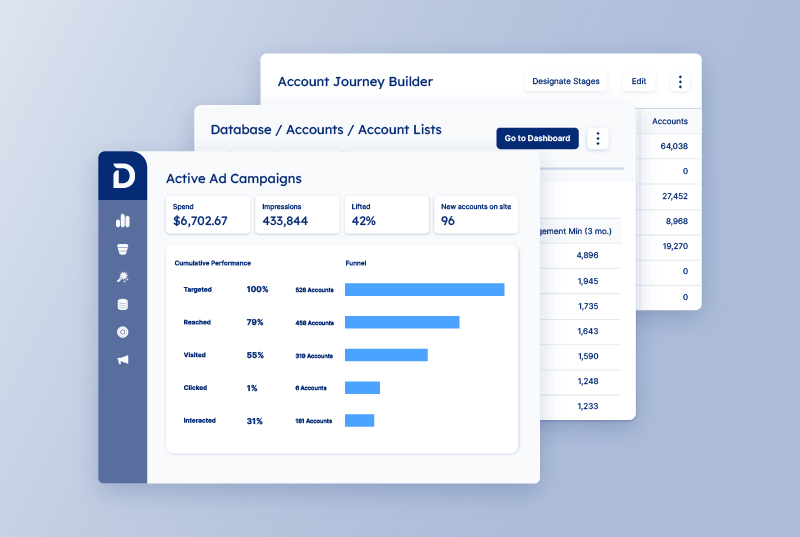
- Advertising (Native B2B DSP): Demandbase has its own demand-side platform built specifically for B2B. It runs display, video, LinkedIn, and CTV campaigns targeted at the account and buying group level. The platform automatically bids higher on high-intent accounts, so your budget flows toward the buyers most likely to engage.
- Orchestration: Instead of waiting for someone to notice a signal and act on it manually, Orchestration automates that entire loop. Intent surges, score changes, and customer journey stage changes all become triggers that launch campaigns, alert reps, or adjust targeting on their own.
- Buying group tools: The platform identifies who’s on the buying committee at each account and tracks engagement across the full group. AI builds out the personas automatically and flags where coverage is thin. If three out of five key roles are engaged but two haven’t been touched, your team sees that and can act on it.
- Agentbase (AI Agents): They automate repetitive GTM tasks, recommend next steps based on account signals, and keep outreach sequences running without manual input. Because the agents share the same data as every other Demandbase feature, nothing falls through the cracks between teams.
If your team is ready to move past basic customer segmentation and run AI-driven personalization across your full target account list, Demandbase is built for that.
Book a meeting and see for yourself.
FAQs
How does AI personalization work differently in B2B vs. ecommerce?
In ecommerce, AI personalization focuses on the individual customer or individual user. It tracks browsing history, purchase history, and user behavior to serve product recommendations that match what that one person is likely to buy next.
B2B works on a different level. You’re personalizing for an entire buying committee across a single account, and each person on that committee has different customer needs and priorities.
The signals are different, too. Instead of cart activity and past orders, B2B AI relies on intent data, firmographics, and engagement patterns across channels to figure out what content fits each buyer.
What role does a customer data platform play in AI personalization?
A customer data platform (CDP) pulls customer data from your CRM, marketing automation platform, ad tools, and website into one unified view.
That gives AI a clean, connected dataset to work with instead of fragmented records scattered across systems. Most CDPs connect to your existing stack through an API, so real-time data flows between tools without manual exports.
When AI has access to that unified data, it makes sharper audience segmentation decisions and supports more data-driven decision-making across campaigns. Without it, you’re asking AI to personalize based on an incomplete picture.
Can AI personalize campaigns across social media and mobile apps?
Yes, and that’s where omnichannel personalization becomes important.
AI tracks customer interactions and user interactions across every touchpoint, including social media, mobile apps, email, ads, and your website.
It uses that cross-channel data to coordinate messaging so each buyer sees content personalization that matches their full engagement history, not just what happened on one platform.
How does AI personalization improve conversion rates and revenue growth?
AI improves conversion rates by matching personalized content to each buyer based on where they are in the evaluation and what they care about.
When the right message reaches the right person at the right time, buyers engage more and move through the pipeline faster. That compounds into revenue growth over time.
AI also strengthens customer relationships and customer loyalty by keeping outreach relevant after the deal closes. Teams that stack A/B testing on top of AI-driven campaigns can fine-tune messaging even further and push conversion rates higher with each iteration.
How do you keep AI personalization scalable without sacrificing quality?
The key is to streamline your foundations before you scale. Start with clean data, a shared target account list, and marketing strategies that align with sales.
From there, AI makes personalization scalable by handling the matching, timing, and delivery that would eat up your team’s time if done manually.
But scalable doesn’t mean set-and-forget. You need high-quality content for AI to pull from, and you need to monitor engagement trends so personalization stays relevant.


We have updated our Privacy Notice. Please click here for details.