

B2B programmatic advertising: How to target high-intent buyers at scale

Most B2B programmatic campaigns leak budget. A 2025 ANA study put wasted programmatic ad spend at $26.8 billion, a 34% jump in just two years.
For B2B, scale works in reverse. With buyers concentrated in a small set of accounts and decisions made by committees, broad audience buys burn budget on the wrong people before a single form fills.
The teams that win with paid media have rebuilt their approach around account data. They feed firmographics, technographics, and intent signals into programmatic platforms so ads reach buyers already in research mode. Every dollar works harder because the audience is smaller and far more relevant.
This guide walks through how to make programmatic work for B2B. We’ll cover how intent data powers targeting, which signals predict pipeline, and how to structure account-based campaigns for each funnel stage.
What is B2B programmatic advertising?
B2B programmatic advertising is the automated, auction-based purchase of digital ad inventory across websites, apps, and connected TV.
Targeting is built from account data, which lets marketers reach specific B2B companies, job titles, and buying committees inside their ICP.
The mechanics come down to four pieces working together:
- Demand-side platforms (DSPs) are the buyer’s side of the stack, where marketers set targeting, bid strategy, creative, and budget for each campaign.
- Supply-side platforms (SSPs) handle the sell side. Websites, apps, and CTV providers use an SSP to make their ad inventory available to buyers across the open web.
- Ad exchanges are the marketplaces that connect DSPs and SSPs and run the auction for every impression.
- Real-time bidding (RTB) is the auction mechanic itself. Every time a page loads, a millisecond auction runs, and the highest qualifying bid gets the impression.
The plumbing is identical across B2B and B2C, but almost everything on top of it changes when the buyer is a business. Here’s a table that summarizes the main differences:
| B2C programmatic | B2B programmatic | |
|---|---|---|
| Audience size | Millions of consumers | A few thousand target accounts |
| Targeting inputs | Age, interests, browsing behavior | Firmographics, technographics, and intent signals |
| Buyer | One person, one decision | Buying committee of 6–10 across months |
| Campaign shape | Short bursts, a single impression can convert | Sustained exposure across the full committee |
| Key metrics | CTR, CPC, conversions | Account engagement, reach across ICP, pipeline influence |
Example → A cybersecurity vendor with a 1,500-account target list runs a broad LinkedIn display for a quarter and burns budget on impressions across thousands of companies outside their ICP. They switch approaches. The target account list goes into the DSP, intent data narrows it to accounts actively researching SIEM alternatives, and creative runs against three roles per account. Same budget, a fraction of the impressions, and every one of them on a buyer who could sign the deal.
A B2B marketer described this exact dynamic on Reddit:

How does programmatic advertising work in B2B marketing?
The technical stack runs the auctions automatically, but your job as a marketer happens upstream of all that. You build the audience, source the data, pick the channels, and tune the campaign as performance signals come in.
Here’s how that workflow usually works in practice:
- Anchor the campaign to your account list: Every campaign starts from your ICP. Pull the list from your CRM or ABM platform, and tier it if it helps (strategic, enterprise, mid-market). The list caps everything downstream, so keep it current with pipeline priorities.
- Narrow by buyer and intent: Account-level targeting on its own is too broad. Narrow by job function, seniority, and department. Use intent data to find which accounts are researching your category right now. Spend stays on in-market buyers and skips accounts that aren’t ready.
- Set up the audience in your DSP: Push the account list and buyer criteria into your DSP and set frequency caps so buyers don’t get hammered. Then, add geo and device parameters. Weak data quality shows up here as poor match rates, so stress-test the list before you go live.
- Choose the right channels and inventory: Display, video, CTV, native, and audio all show up in B2B programmatic, and the right mix depends on the funnel stage. Awareness benefits from CTV and video for the visual punch. Consideration runs well on native and display formats that hold attention. Decision-stage retargeting brings warm prospects back to the site to convert.
- Match creative to buyer and stage: A CISO and a SOC manager weigh different priorities, and a cold prospect needs different messaging than someone who attended your webinar. Build creative variants that flex across role and funnel stage, then run them in parallel so the right ad reaches the right person.
- Launch and monitor the data: The DSP takes over once the campaign goes live, bidding on impressions in real-time based on audience match, inventory quality, and your bid strategy. Give the data two weeks to settle. By then, the patterns around which channels, formats, and creative variants are pulling weight start to show clearly.
- Make optimization decisions on account signals: The optimization step is where B2B programmatic earns or loses its budget. Clicks tell you somebody reacted to an ad, which means very little when the wrong account did the clicking. Watch reach across your target accounts, engagement lift at those accounts, and pipeline tied to accounts the campaign exposed. Move the budget toward what produces account-level movement.
Done well, this workflow puts a coordinated ad sequence in front of every buyer at every in-market account on your list. That’s the whole point. Pipeline moves because the right people see the right message at the right time, repeatedly, across the channels they actually use.
B2B programmatic marketing examples
The clearest way to see what B2B programmatic looks like at scale is to look at what real teams have done with it. The three companies below use account-based programmatic for very different reasons, from breaking into cold accounts to compressing sales cycles to coordinating cross-channel ABM. And the results show what a well-run program can deliver across each scenario.
Diebold Nixdorf broke into cold financial services accounts with shorter, sharper campaigns. The global leader in banking and retail technology faced a tough acquisition challenge in North America. Their target list of banks and credit unions had little to no prior engagement with the brand, so the team had to figure out which products would resonate without burning through the budget on broad awareness.
Their approach scrapped the conventional 90-day campaign in favor of shorter 30-60 day runs across four different product offerings, all targeted through the Demandbase ad platform. Sales and marketing met biweekly to assess engagement and allocated spend toward what was performing.
The results:
- 100% reach across the target account list
- 83% of accounts engaged, with 64.9% engaging for the first time
- 850% CTR lift over industry benchmarks
Takeaway → The lift came from operational discipline, not bigger budgets. Shorter campaign cycles, multiple product angles in parallel, and tight feedback loops between sales and marketing did the heavy lifting.
SAP Concur, the leader in travel, expense, and invoice management, faced a familiar problem for enterprise marketers. A large universe of target accounts and a limited budget that could not cover all of them properly.
The digital marketing team turned to Demandbase intent signals to prioritize the list, then segmented accounts into cohorts and ran personalized programmatic campaigns aligned with sales outreach. The program also tightened alignment across digital marketing, field marketing, marketing development, and sales, with all four teams working off the same insights.
The results:
- 60% lift in website visits from advertised accounts compared to the same accounts before advertising
- Nearly 500 dormant accounts re-engaged through targeted advertising
- 95% engagement across seven ad campaign groups, against a pre-advertising benchmark of 51%
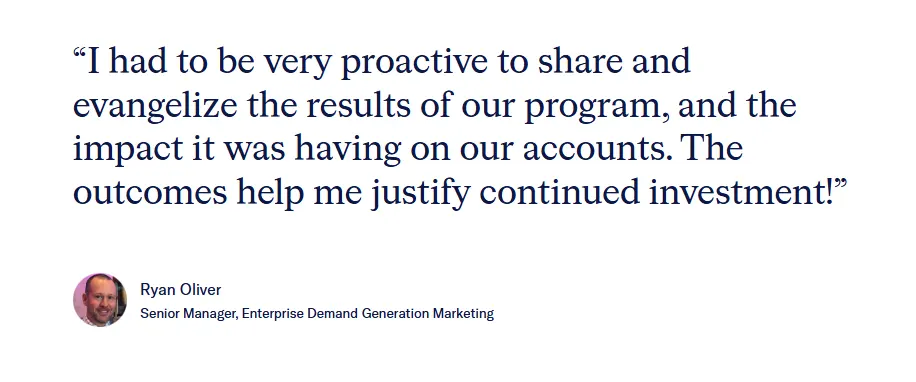
Takeaway → The SAP Concur play is a useful template for any team running a target list bigger than its budget can cover. Intent data does the prioritization, and account-based advertising does the re-engagement.
Deep Instinct’s program shows what happens when programmatic gets coordinated across the full GTM stack. The cybersecurity vendor sells deep-learning threat prevention into enterprise security teams, and a new VP of marketing pushed for a rebuilt stack designed around account data. The team kept Salesforce and HubSpot, then added Demandbase to handle account identification, intent data, and advertising.
The decisive move was the LinkedIn integration. Demandbase pushed account audiences into LinkedIn daily by buyer journey stage, so programmatic display ads and LinkedIn ads ran from the same target list with messaging tuned to each account’s research stage.
The results:
- 900% year-over-year pipeline growth
- 333% increase in SDR calls-to-conversations ratio
- 269% increase in conversations-to-meetings
Takeaway → Coordination beats scale here. Deep Instinct’s pipeline lift came from connecting programmatic to LinkedIn and sales, not from spending more on either one.
Benefits of B2B programmatic marketing
The benefits of B2B programmatic show up across the full marketing funnel, from cheaper impressions at the top to higher contract values at the bottom.
We’ll walk through seven of those benefits:
- Targets the buyers who matter, not the broad market: Account data, firmographics, and intent signals replace generic demographic targeting, so campaigns reach the companies and titles that match your ICP. Around 80% of B2B programmatic campaigns now rely on firmographic targeting because broad demographic buys waste too much budget on the wrong companies.
- Lower wasted ad spend: Programmatic auctions and account-level targeting cut the waste that broad B2B campaigns leave behind. Research from Demandbase and eMarketer in 2025 found that 58% of B2B marketers see ad waste as a major problem, with over half estimating that 16–45% of their budget reaches the wrong accounts.
- Higher conversion rates from the buying group: Reaching buyers in active research at accounts that fit the ICP lifts conversion rates across MQLs, demos, and form fills. Forrester research shows that delivering a verified buying group to sales improves conversion rates by 20% to 50%, which is exactly what coordinated programmatic produces at scale.
- Smoothly reaches the full buying committee: Coordinated ad sequences across roles and funnel stages keep the brand top of mind for every stakeholder on the deal. Gartner research shows that B2B buying committees include six to ten decision-makers, each with four to five pieces of independent research, and programmatic is the only paid channel built to reach all of them at once.
- Faster path to closed deals: Account-based programmatic warms up buying groups before the sales team picks up the phone, which compresses the runway to a closed deal. Demandbase Labs found that buying groups receiving 180–190 coordinated touches reach a 94% conversion rate to opportunity, a number you cannot hit without paid media doing part of the lift.
The pre-flight check for B2B programmatic → Account-based programmatic works when these are in place:
- A clean target account list, current with sales priorities
- An ICP backed by firmographic and intent data
- A sales cycle long enough for sustained committee exposure to matter
- Creative built around the role and the funnel stage, not a single message
Without those four, programmatic usually underperforms LinkedIn or content syndication for the same budget.
B2B programmatic advertising platforms
The five categories below cover the platforms most B2B teams evaluate when building a programmatic program:
| Platform type | What it does | Why it matters for B2B | Leading vendors |
|---|---|---|---|
| Demand-side platform (DSP) | The buying interface for programmatic. Marketers use a DSP to define audiences, set budgets, and bid on inventory across exchanges in real-time, covering display, video, CTV, native, and audio. | A B2B-suitable DSP needs more than demographic targeting. It has to collect firmographic and technographic data, support account-level audience building, and integrate with intent feeds. | The Trade Desk, Google DV360, StackAdapt, Demandbase Advertising (the only DSP purpose-built for B2B account-based marketing campaigns) |
| Data management platform (DMP) | Collects, organizes, and segments anonymous audience data from multiple sources, then pushes segments into a DSP for targeting. | DMPs help B2B teams build broader audiences for top-of-funnel, brand awareness work. The trade-off is heavy reliance on third-party data, which is getting harder to maintain as cookies phase out. | Oracle, Adobe Audience Manager, Lotame, Salesforce Audience Studio |
| Customer data platform (CDP) | Unifies first-party data from the CRM, marketing automation, website behavior, and product usage into a single identifiable profile. | CDPs anchor account-based programmatic because they hold the cleanest version of the customer record. They let campaigns target known accounts and exclude existing customers from acquisition spend. | Segment, Tealium, Salesforce CDP, Treasure Data |
| B2B intent data platform | Tracks research signals across the open web and publisher networks, then flags which accounts research your category, competitors, or specific topics. | Intent data is what separates precise account-based programmatic from broad firmographic targeting. An account in active research is the signal that tells the DSP to bid harder on every connected impression. | Bombora, G2 Buyer Intent, TechTarget Priority Engine, Demandbase Intent |
| ABM and account intelligence platform | Unifies account data, buying group identification, intent signals, advertising, and sales engagement into one system, turning a target account list into coordinated full-funnel programs. | This is the platform category built for B2B from the ground up. Other platforms handle a piece of the work. ABM platforms connect those pieces so paid media, sales activity, and account engagement live in one place. | Demandbase, 6sense, Terminus, RollWorks |
The platforms above rarely operate in isolation. Most mature B2B programs use a CDP or ABM platform as the system of record, pull in intent data for in-market signal, and feed both into a DSP that handles the actual media buying.
The strength of any stack comes down to how cleanly the pieces connect, which is why teams running serious account-based programs increasingly look to platforms like Demandbase that combine account data, intent, and B2B-native advertising in one system.
Related read → The Demandbase Advertising Playbook
B2B programmatic marketing best practices & strategies
The seven practices below cover what it takes to run B2B programmatic well, grouped by the phase of work each one belongs to.
The first phase is targeting and target audience setup, which is where most B2B programmatic campaigns are won or lost. A sloppy foundation here will undercut even the strongest creative work later in the campaign.
- Anchor every campaign on a clean target account list: When a B2B programmatic campaign underperforms, the list is usually the first place to look. Pull it from current CRM data, sort accounts by tier, and refresh on a quarterly cadence so it tracks current pipeline priorities. The list caps the ceiling for every decision downstream.
- Combine firmographic, technographic, and intent signals together: A single data input rarely tightens the audience enough for B2B. Firmographics confirm fit at the company level, technographics filter by tech stack, and intent finds accounts in active research right now. Stack the three, and the company size and quality both fall into a workable range.
- Suppress current customers, lost deals, and out-of-ICP accounts aggressively: Suppression rarely makes the setup checklist, which means a meaningful chunk of paid spend reaches accounts the campaign should never touch. Add the rules at launch and review them every month, especially as new customers close and old deals reopen.
Once the audience is dialed in, creative and execution decide whether the campaign performs across the long arc of a B2B sales cycle. B2B audiences run small, attention spreads across roles, and creative fatigue arrives sooner than most teams expect.
- Build creative variants for role and funnel stage: A CISO and a SOC manager respond to different angles, and a cold account needs different messaging than one already in active evaluation. Run several variants in parallel and let the audience targeting decide which one each buyer sees.
- Sequence creative across the buying committee, not just across funnel stages: Each role moves through research at its own pace and responds to different proof. Build a sequence per persona, where the CISO sees one progression, the security architect sees another, and procurement sees a third, all tied to the same account engagement signals.
- Refresh creative every two to four weeks: B2B audiences run small, so the same buyers see the same ads quickly, and campaign performance drops within the first month. Mature programs treat creative refresh as a recurring rhythm, with production planned well ahead of launch so the cadence holds.
- Coordinate paid media with sales activity at the account level: When sales is working on an account, programmatic should reinforce the conversation with relevant creative. When the account is dormant, programmatic should warm the committee until sales is ready to re-engage. Coordination between the two compresses the cycle time.
The practices above are not exhaustive, but they cover most of the operational decisions that separate strong B2B programmatic programs from average ones.
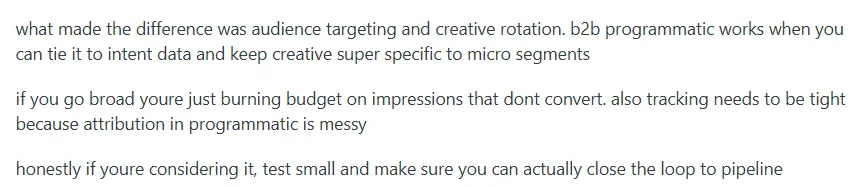
One marketer summed up the same set of trade-offs on Reddit, from the operator side:
The first 30 days of a B2B programmatic program → Most teams overcomplicate the first month. Here’s the shortlist of what has to be in place by day 30:
- Target account list pulled fresh from CRM, tiered by priority
- Audience built from at least firmographics and intent
- Two creative variants per priority role
- Suppression rules set up in the DSP
- Weekly review cadence between marketing and sales on the account list
How to measure B2B programmatic ads
Standard digital ad metrics rarely hold up under B2B conditions. CTR and last-click conversion logic come from consumer ecommerce, where short cycles and single buyers make clicks a reasonable proxy for intent.
In B2B, the buying committee never clicks together, and a campaign can perform perfectly without a single ad click that maps to a closed deal. The table below maps the metrics worth tracking, along with the failure modes teams hit with each one.
| Metric | What it tells you | What to watch out for |
|---|---|---|
| Account reach | The percentage of the target account list that the campaign touched in a given period | High reach with low engagement means the audience is right, but the creative or frequency is off |
| Buying committee coverage | The share of priority roles per account that the campaign reached | A campaign hitting one role at every account is not the same as one hitting the full committee |
| Account engagement lift | The difference in web visits, content views, and return rates between exposed accounts and a non-exposed control | Needs a control group to be honest. Without one, the number is just total engagement |
| Sourced pipeline | Pipeline created from the accounts, the campaign was the first paid touch on | Last-touch attribution dominates most reporting and tends to understate programmatic’s full contribution |
| Influenced pipeline | Pipeline where the campaign reached the buying committee at any stage | Easy to over-claim. Pair with holdout groups or control accounts to keep the number honest |
| Win rate at exposed accounts | Whether exposed accounts close at higher rates than the baseline | Requires sales data integration, most teams skip. Worth the work because finance respects this number more than any other |
| Pipeline velocity at exposed accounts | Whether deals at exposed accounts close faster than deals at non-exposed accounts | Hard to attribute cleanly without account-level control groups, but a strong signal of cycle acceleration once you have one |
Keep in mind → The campaign that scores well on reach, engagement, and pipeline is the one worth scaling, while the campaign that scores well on only one needs a closer look at where the funnel is leaking.
Why B2B teams choose demandbase for programmatic advertising
If you’ve been running B2B programmatic on a general-purpose DSP, you already know how much manual stitching the setup demands.
Demandbase Advertising is the only DSP that handles all of it natively. Account intelligence, intent data, AI-driven bidding, and cross-channel orchestration run from one B2B-native platform.
Here’s exactly what Demandbase brings to a B2B programmatic program:
-
- Account-level targeting built on firmographics, technographics, and trillions of intent signals from across the open web, so audiences are narrowed to the companies that match the ICP and are actively researching the category.
- AI-powered bidding through AdsIQ, the only B2B bid engine that weighs user intent and account intent together, automatically directing spend toward high-intent buyers at high-priority accounts.
- Buying group identification that maps every stakeholder on the deal to the right account, so campaigns reach the full committee instead of one champion at each company.
- Cross-channel orchestration across display, video, CTV, native, retargeting, LinkedIn, Google, Meta, YouTube, and X, all running from one platform with shared targeting and consistent messaging across every touch.
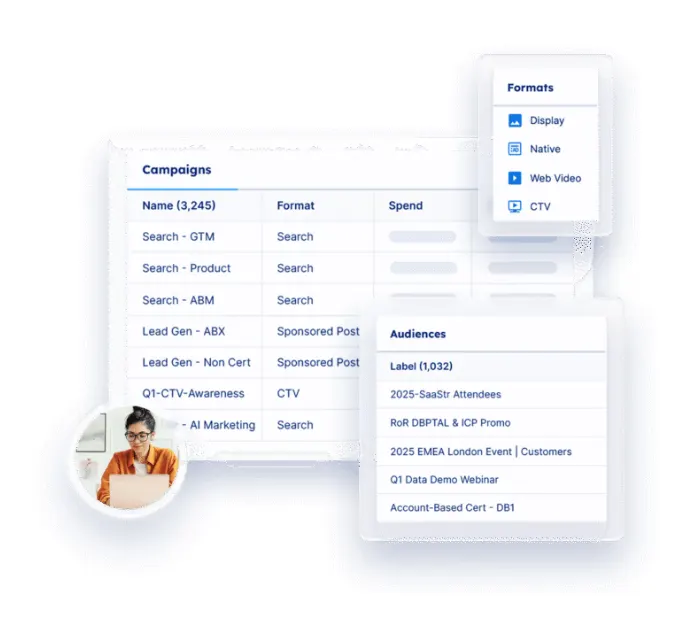
- Journey-stage automation that aligns every ad to where each account is in the buying process, so awareness creative reaches new accounts and decision-stage creative reaches accounts already in evaluation.
- Account-level suppression is built into the audience setup, which automatically excludes current customers, lost deals, and out-of-ICP accounts from acquisition campaigns and keeps customer expansion campaigns separate from new-business spend.
- Closed-loop reporting that traces impressions to pipeline and closed-won revenue, with dashboards that show which accounts moved through the journey and which creative drove the most pipeline impact.
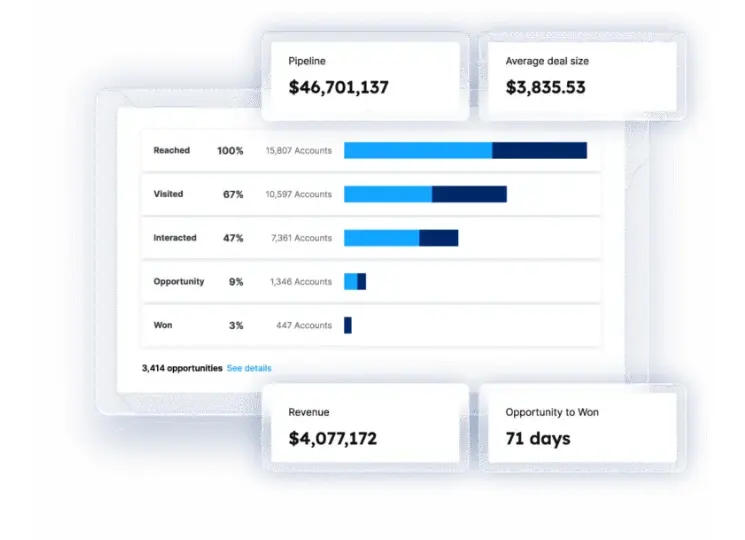
The hardest part of B2B programmatic is rarely the marketing strategy. It’s getting the data, the targeting, and the channels working as one system.
Demandbase Advertising is built to do exactly that, which is why so many of the strongest B2B programs run on it. Book a meeting to see what the platform could do with your data.
FAQs
How much does B2B programmatic advertising cost?
B2B programmatic costs vary widely based on the audience size, the channels in the mix, and the platform you run it on. CPMs typically range from $10 to $50 for account-targeted display, with video and CTV running higher at $25 to $80.
Most B2B teams budget between $10,000 and $50,000 per month for an active programmatic program, though enterprise teams running across display, video, CTV, and LinkedIn often spend $100,000 or more.
Three factors usually drive the variation:
- A smaller, more precise target list raises CPMs because the audience is harder to reach at scale.
- Premium channels like CTV and video carry higher CPMs than standard display.
- B2B-native platforms (like Demandbase) with account data and intent built in cost more upfront than general-purpose DSPs, but tend to produce better cost per qualified account.
Cost per engaged account is usually the best lens for B2B programmatic. A $50 CPM campaign that reaches the buying committee at 200 ICP-fit accounts produces more pipeline than a $5 CPM campaign reaching 50,000 random users.
When should businesses consider using programmatic B2B advertising?
The simple answer is when account-based targeting will do more work than a broad demographic reach.
That usually means a defined target account list, a sales cycle long enough that buying committees form, and a data feed that can power firmographic, technographic, and intent-based filters.
Teams without those pieces tend to get more return from LinkedIn, content syndication, or paid search until the foundations are in place.
How does B2B programmatic compare to Google Ads and social media advertising?
Google Ads and social media platforms each cover one slice of digital advertising, while programmatic connects the slices into a single buy. A B2B-native DSP runs display, video, native ads, and CTV inventory against the same audience segments, then coordinates ad creative across every channel from one workspace.
The split shows up in two places. Google Ads catches demand at the moment of search, social media picks up engagement on LinkedIn or Meta, and programmatic warms the buying committee through premium ad space across the open web. Most teams run all three, with programmatic doing the heavy lift on account-based reach.
How does programmatic support lead generation for SaaS companies?
SaaS lead generation tends to break under the weight of long sales cycles, large buying committees, and limited target account universes. Programmatic handles all three.
A SaaS team running account-based programmatic warms a high-value account list across months, finds qualified leads as buying signals build, and keeps messaging coordinated across the full committee.
The data-driven approach streamlines what used to take three separate teams to coordinate, so a smaller marketing org can produce high-quality pipeline at the same rate as a much larger one.
How can organizations ensure compliance in programmatic advertising?
Most B2B programmatic compliance work falls into data privacy or ad placement. A few practices cover the basics of both:
- Use platforms with built-in privacy controls for consent management and regional data handling
- Audit data sources regularly and drop providers that cannot document compliant sourcing
- Apply brand safety filters to block low-quality domains, MFA sites, and off-brand content categories
- Run third-party fraud monitoring through tools like DoubleVerify or IAS to catch what internal checks miss
- Document consent, data sources, and audits so the paper trail holds up under regulatory review
B2B-native platforms handle most of this natively. General-purpose DSPs need more manual oversight.
How to choose the right programmatic ad platform
Run any B2B programmatic platform you’re evaluating against this checklist:
- Can the platform target by account and job title, not just user-level demographics?
- Does it include firmographic, technographic, and intent data natively, or do you have to stack them on top?
- Can it run display, video, CTV, native, and LinkedIn from one workspace with shared audiences?
- Does the bidding logic factor in account intent, or only user-level signals?
- Can reporting tie ad spend to pipeline and closed-won revenue, or does it stop at clicks and impressions?
- Are CRM and marketing automation integrations native, or do they need engineering work?
- Does the platform support buying group identification, or only individual user targeting?
If most of the answers are no, the platform is general-purpose and will need significant data and integration work to run B2B campaigns at scale.
Related content
![Top 10 CTV advertising platforms for B2B [according to real users]](https://www.demandbase.com/wp-content/uploads/2026/02/img-top-10-ctv-advertising-platforms-featured.webp)


We have updated our Privacy Notice. Please click here for details.