

10 best market intelligence tools for GTM engineering teams

At any given moment, only about 5% of your total addressable market is actively in-market for a solution like yours. The other 95% are months or years from a buying decision.
Market intelligence is how B2B teams find that narrow window early, understand what pushes those accounts toward a purchase, and outflank competitors who chase the same revenue.
For years, market intelligence ran on spreadsheets, analyst reports, and quarterly business reviews, where insights arrived weeks after they mattered. But AI has rebuilt the category around speed.
The leading market intelligence tools in 2026 track intent signals, account data, competitive moves, and buying group activity in real time, then route the highest-priority ones to the people who can act.
Below are the 10 worth a serious look this year.
Types of market intelligence platforms
A few years ago, “market intelligence” meant industry reports and competitor briefings buried in a shared drive. But in 2026, the category covers a lot more ground.
Today’s platforms span account intelligence, intent signals, sales data, competitive moves, and industry research, and each one handles a different part of the same revenue problem.
Here are the four main groups that make up the modern market intelligence stack:
- AI GTM platforms: These platforms bring account data, intent signals, and competitive context together in one system that runs marketing, sales, and advertising from a shared system. They rank accounts by buying readiness and coordinate the next play across every channel.
- Sales intelligence and B2B data platforms: They hold contact-level data, technographics, firmographics, and prospect signals that sales teams use to decide which accounts deserve outreach. SDRs and AEs work from accurate, current information about the people and companies worth a conversation.
- Competitive intelligence platforms: Tools that track competitor pricing, product updates, positioning changes, and customer reviews across the open web and feed the findings into Slack, email, and CRM. Sales reps and product marketers see the moves competitors are making in time to respond.
- Market and industry research platforms: These platforms pull together financial data, web traffic, industry reports, and macro market trends into searchable views of where a market is headed. Strategy teams use them for long-range planning, category bets, and executive-level competitive positioning.
Many B2B orgs run two or three of these together →
A typical mid-market or enterprise stack pairs an AI GTM platform as the anchor with a sales intelligence database for contact data and a competitive intelligence tool for battlecards. Industry research platforms come in for strategy teams and corporate development. The four categories overlap on signal types but rarely replace each other.
Key features to look for in a market intelligence platform
The market intelligence category has expanded. Platforms that used to do one thing now claim end-to-end coverage, and the lines between intent data, sales intelligence, and AI orchestration keep blurring.
You can use the features below as a checklist when you’re evaluating options:
- Unified data layer: Your tool should pull buyer intent, account data, contact data, technographics, and competitive context into one view that every team works from. Disconnected dashboards force reps and marketers to reconcile data manually, and the buying window closes before anyone agrees on what the account looks like.
- Coverage breadth and source quality: The platform should pull from a wide range of sources, including web activity, third-party intent providers, financial filings, social, review sites, and product engagement, with documented refresh rates and source transparency.
- Real-time updates and alerting: Intelligence loses value the longer it waits. The platform should refresh data continuously and push alerts to the right people the moment a signal crosses a threshold, whether that’s a competitor pricing change or a new stakeholder joining the evaluation.
- AI summarization and synthesis: The volume of competitive moves, account activity, and market signals coming through these platforms is too much for any team to read manually. You want a platform that produces daily or weekly summaries and tells sales reps which battlecards changed, marketers which accounts heated up, and leadership which industry trends changed.
- CRM and revenue stack integration: Native integrations matter more than the number of integrations. Check that the platform writes data back into Salesforce or HubSpot records, triggers sequences in Outreach and Salesloft, and feeds lead scoring without custom work.
- Native LLM and AI assistant integration: Revenue teams already use ChatGPT, Claude, Copilot, and Gemini for research and prep. The platform should connect directly into those workflows through open standards like MCP, so reps pull market intelligence into the assistant they’re already in.
- Configurable workflows and triggers: No two GTM motions look the same, and platforms with rigid logic force teams to compromise. Your tool should give ops the flexibility to define triggers, alerts, scoring rules, and orchestration paths in the UI, so the system fits the existing motion.
10 best market intelligence tools on the market right now
Before the deep dives, here’s how the ten platforms compare on the dimensions that matter most when you’re shortlisting:
| Platform | Best for | Key differentiator | Pricing |
|---|---|---|---|
| Demandbase | End-to-end AI GTM across marketing, sales, and ads | Full-stack GTM platform that covers every part of the market intelligence motion | Custom |
| Apollo.io | Outbound teams that want contact data and sequences in one tool | 275M+ contact database paired with built-in engagement and AI agents | From $59/seat/mo (free tier available) |
| ZoomInfo | Enterprise sales orgs that need the deepest B2B database | A contributory data network and proprietary collection that few rivals match on coverage | Custom |
| Similarweb | Strategy and growth teams measuring web, search, and ad activity | Digital business intelligence across 100M+ sites and 6B+ keywords | From $125/mo (self-serve), custom for enterprise |
| 6sense | Account-based teams that want predictive scoring tied to buying stages | Six-stage AI buying model with dark funnel de-anonymization | Custom |
| Crayon | Product marketers tracking competitor digital moves at scale | Automated competitor website change detection within hours of a live update | Custom |
| Klue | Sales enablement leaders connecting win-loss research to battlecards | Direct link between buyer interview findings and competitive content | Custom |
| LinkedIn Sales Navigator | Sellers who run most of their prospecting on LinkedIn | First-party access to a 900M+ professional graph with warm relationship paths | From $99.99/mo |
| HubSpot Breeze Intelligence | B2B teams already running on HubSpot CRM | Clearbit-grade enrichment built natively into HubSpot workflows | Bundled with HubSpot subscription (credit-based) |
| AlphaSense | Strategy and corporate dev teams running deep market research | 500M+ business documents and 250K+ Tegus expert transcripts | Custom |
1. Demandbase
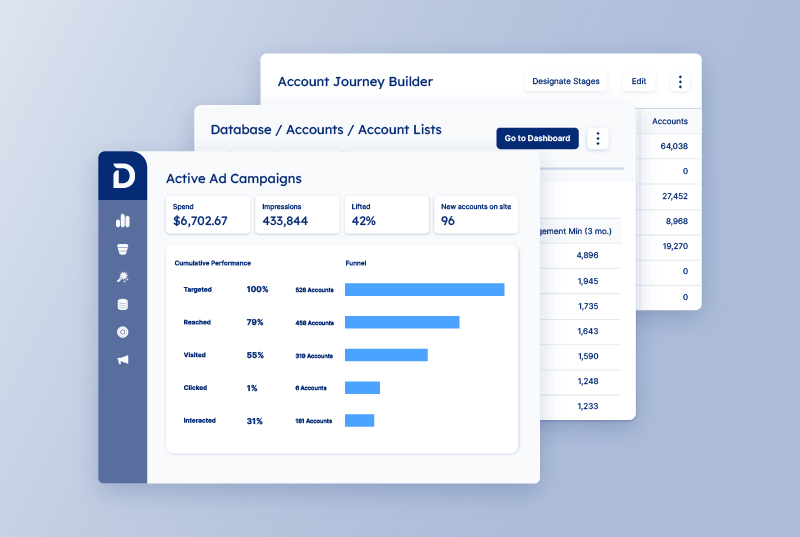
Demandbase is an AI GTM platform that brings account intelligence, intent data, advertising, and AI orchestration together for B2B revenue teams.
The other tools in this list mostly specialize in one part of market intelligence. Demandbase handles the full motion, from finding in-market accounts and mapping the buying group to running ads, triggering sales outreach, and personalizing the website experience.
Key features
- Demandbase AI and Context Intelligence: Demandbase AI runs as a chat-based control layer over the platform, with Context Intelligence as the engine underneath that scores every signal against the customer’s specific ICP and historical wins.
- Pipeline Influence reporting and revenue attribution: Pipeline Influence connects every program, channel, and account back to pipeline impact. There’s also chat-based reporting that lets teams ask plain-language questions about what’s driving revenue.
- Account Intelligence and intent data at enterprise scale: Demandbase tracks first-party and third-party intent signals across thousands of B2B topics, with account scoring that updates continuously as new customer behavior comes in.
- JourneyIQ AI-powered advertising: JourneyIQ personalizes ad creative, targeting, and budget for each account based on its current buying stage.
- Cross-channel orchestration across marketing, sales, and advertising: The platform coordinates plays across email, ads, sales outreach, and web personalization based on real-time account signals and stage progression.
Advantages of using Demandbase
Demandbase makes the most sense for B2B teams whose deal cycles depend on intent data, account research, advertising, and sales outreach moving in lockstep. The longer the deal cycle and the bigger the buying committee, the more obvious the case becomes.
G2 users keep coming back to the intelligence-to-action loop. One user describes how site visit data shows which target accounts are browsing the website and which pages they’re on, with real-time Slack alerts hitting reps the moment an account reaches peak interest. That signal lets sellers reach out exactly when the buyer is most engaged, which the same reviewer credits with materially higher connection rates. [ Read Full G2 Review]
The numbers back up what users describe. Deep Instinct rebuilt its GTM motion around Demandbase and saw 900% pipeline growth in the first year, with quarterly marketing-sourced pipeline jumping from a few hundred thousand to $8.4 million within a few quarters.
SDR conversion rates climbed 200-300% across the same period, all driven by intent data, account intelligence, and the ability to focus reps on the accounts most likely to convert. [Read Full Case Study]
Another G2 reviewer points to the same focus from a different angle. Demandbase makes it easy to spot accounts that match the ICP and concentrate outreach on them, instead of stretching reps thin across the full target list. Native CRM and LinkedIn integrations keep that focus intact across the stack, so teams work the right accounts and manage the resulting opportunities through to close. [ Read Full G2 Review]
2. Apollo.io
Apollo.io is a sales intelligence and engagement platform that connects a 275M+ contact database to outbound sequences, intent signals, and AI agents that handle research and outreach preparation.
Pricing accessibility separates Apollo from the rest of this list. Plans start at $49 per user with a free tier that has onboarded over a million users, which is rare in a category where six-figure annual contracts are the norm.
Key features
- B2B contact and company database: The platform holds 275M+ contacts and 30M+ companies, with verified emails, direct dials, firmographic data, and technographic data across most regions.
- Advanced search and filtering: Apollo’s filters cover job title, seniority, company size, industry, location, technology stack, funding stage, hiring patterns, and dozens of other attributes.
- Apollo AI and agentic workflows: The AI module runs autonomous agents that handle account research, lead scoring, and next-step recommendations inside the platform. The platform also recently shipped a native connector for Anthropic’s Claude, so users can run outbound workflows from a Claude conversation.
Pros
- Built-in outreach without a separate engagement tool: Apollo includes outreach sequences directly inside the platform. Users can connect their mailbox and start sending without buying a separate engagement vendor. [ Read Full G2 Review]
- Fast access to verified contact data for hard-to-reach roles: Reps targeting niche decision-makers get verified emails and direct dials without scraping company websites or chasing LinkedIn profiles. [ Read Full G2 Review]
- Advanced filters built for high-precision list-building: Apollo’s search supports filters like VC funding stage, technology stack, and hiring signals, which let teams build narrowly targeted lists for specific GTM motions. [ Read Full G2 Review]
Cons
- Credit-based pricing is hard to predict: The credit system makes it difficult for teams running high-volume prospecting sprints to forecast usage accurately, and burn rates often climb faster than expected. [ Read Full G2 Review]
- LinkedIn extension caps bulk saves at 25 contacts: The Chrome extension limits each save to 25 leads at a time, which slows down list-building for reps working through larger Sales Navigator searches. [ Read Full G2 Review]
- Data accuracy gaps drive higher bounce rates: Some users report outdated contact records, particularly direct dials and emails, which lead to bounce rates higher than what Apollo’s verified data should produce. [ Read Full G2 Review]
Pricing
Apollo runs four plans, with annual billing about 20% cheaper than monthly:
- Free ($0): 75 credits and capped features. Good for a test drive.
- Basic ($59/seat/mo): 2,500 credits with sequences and CRM integrations. Fits solo sellers.
- Professional ($99/seat/mo): 4,000 credits plus automation, A/Z testing, and analytics. Apollo’s “Most Popular” pick for full-cycle teams.
- Organization ($149/seat/mo, annual only, 3-seat min): 6,000 credits with SSO, custom dashboards, and tighter security.
Add-ons cost $149 per team per month. There’s Inbound for visitor tracking and Advanced Dialer for global calling.
Keep in mind → Apollo’s credit system means usage drives cost as much as headcount. A phone number burns 8 credits, an email 1, AI research 1 per run, and US dialer minutes 2 each.
3. ZoomInfo
ZoomInfo is a GTM intelligence platform that pairs one of the largest verified B2B contact databases with real-time buying signals, AI-powered sales workflows, and execution agents through Copilot Workspace.
The differentiator is data scale, with a contributory network and proprietary data collection technology that few competitors can match on coverage or refresh rate.
Key features
- B2B contact and company database: ZoomInfo holds verified contact records, firmographics, and technographics across most major industries and regions, with refresh cycles powered by proprietary technology and a contributory data network.
- ZoomInfo Copilot AI agents: Copilot runs autonomous AI agents that handle account research, write follow-ups, monitor signals, and update CRM fields inside the platform.
- CRM and Microsoft Copilot integrations: Native two-way integrations with Salesforce, HubSpot, and Microsoft Dynamics push intelligence directly into CRM workflows.
Pros
- Smooth interface and fast support response: ZoomInfo’s interface is straightforward to navigate, and the platform’s customer support team responds quickly when issues come up. Integration with the rest of the GTM stack tends to go faster than the typical enterprise data platform onboarding cycle. [ Read Full G2 Review]
- Scoops for real-time news, events, and content engagement: Teams appreciate that the Scoops feature outlines news, hiring moves, funding rounds, and other trigger events as they happen, plus shows which target contacts are reading specific articles or guides. [ Read Full G2 Review]
- Continuous database expansion and accuracy improvements: ZoomInfo regularly adds new contact records and runs ongoing accuracy checks on existing data, so the database stays current as people change roles and companies. [ Read Full G2 Review]
Cons
- Job title filters lack granularity: Searching for a role like “maintenance manager” returns broad title matches without deeper sub-filters for specialization, seniority, or scope. [ Read Full G2 Review]
- Alerts page doesn’t connect cleanly to CRM accounts: The alerts homepage is difficult to navigate at scale, and users can’t filter alerts to show only the accounts already in their CRM. [ Read Full G2 Review]
- Industry taxonomy lacks depth in specialized verticals: Some industry categories combine sub-sectors that don’t belong together. This is especially the case in fields like oil, gas, and petrochemicals, where users need to run 3-4 separate industry searches to cover their market. [ Read Full G2 Review]
Pricing
ZoomInfo doesn’t publish prices on its official website. Everything runs through sales and depends on features, license count, and credit volume (one credit equals one contact or company export).
Public estimates from third-party sources put ZoomInfo deals in the low five figures annually for small teams and well into six figures for enterprise, but the actual number depends entirely on the build.
Related read → Is ZoomInfo Worth It? We Did the Research
4. Similarweb
Similarweb is a market intelligence platform that measures website traffic, search demand, app usage, and competitive ad activity across the open web, with data covering 100 million sites and 6 billion keywords.
The reason teams pick Similarweb over alternatives is breadth, with web, search, and app data on competitors and prospects that don’t show up in traditional B2B databases.
Key features
- Web traffic and engagement analysis: Similarweb shows monthly visits, unique users, time on site, bounce rates, and engagement metrics for any website, plus the same data for direct competitors and entire industries.
- Traffic source breakdown across channels: The platform breaks down where website traffic originates across direct, organic search, paid search, social, referral, and email, with named referring sites and source-level conversion patterns.
- Keyword and search intelligence: Similarweb covers 6 billion keywords across organic and paid search, with search volume, intent classification, ranking competitors, and ad copy data for each one.
Pros
- Dedicated customer success and ongoing support: Similarweb assigns named contacts to enterprise accounts who handle questions, training, and platform optimization on a recurring basis. [ Read Full G2 Review]
- Context that explains the “why” behind traffic shifts: The platform pairs traffic and engagement data with channel breakdowns, audience demographics, and competitor patterns, so teams understand what’s truly driving the numbers. [ Read Full G2 Review]
- Fast competitive snapshots without manual data pulling: It produces a complete view of competitor traffic and benchmarking inside a few clicks, which would otherwise need hours of cross-referencing across multiple sources. [ Read Full G2 Review]
Cons
- Traffic estimates skew directional for smaller sites and niches: Similarweb’s data is highly accurate for high-traffic websites and broad markets, but smaller sites and niche categories produce estimates that feel approximate. [ Read Full G2 Review]
- Pricing puts the platform out of reach for smaller teams: Enterprise plans run into five and six figures annually, which makes Similarweb hard to justify for smaller marketing teams and startups. [ Read Full G2 Review]
- Feature density makes onboarding slower than expected: Similarweb covers so many use cases that the interface can feel dense for users coming in with one specific question. [ Read Full G2 Review]
Pricing
Similarweb prices by buyer type. Solo researchers and marketers get three public plans (annual billing, single seat):
- Competitive Intelligence ($125/mo): Entry tier for traffic and competitor work.
- Competitive + SEO & AEO ($333/mo): Mid-tier with SEO and AI visibility tools. Marked “Most Popular.”
- Competitive + SEO, AEO & Ads ($542/mo): Top self-serve tier with ad intelligence.
Business and enterprise pricing stays behind a sales call, with quotes based on feature scope, data depth (up to 37 months), and API access.
5. 6sense
6sense is a B2B revenue platform built on account-level intent data, predictive AI scoring, and pre-built AI agents for B2B marketing and sales teams running account-based motions.
The platform’s central strength is its predictive scoring engine, with AI models that classify accounts by buying stage based on a combination of intent signals, engagement data, and historical buying patterns.
Key features
- Predictive AI scoring and buying stage models: 6AI scores accounts against a six-stage buying model (Target, Aware, Consideration, Decision, Purchase, Customer), so revenue teams can prioritize outreach to accounts further along in the journey.
- Account-based advertising and audience activation: The platform syncs target audiences directly to LinkedIn, Google, Meta, and other ad networks, plus runs display advertising through 6sense’s own ad network.
- AI agents for sales and marketing workflows: 6sense includes pre-built AI agents that handle account qualification, ad creative optimization, keyword recommendations, and email outreach.
Pros
- De-anonymization of dark funnel research activity: The platform identifies accounts conducting early-stage research at the keyword level, well before any contact fills out a form on the website. [ Read Full G2 Review]
- Account and persona prioritization based on real-time intent: Teams operating in markets with smaller TAMs find the precision particularly valuable, since wasted cycles on cold accounts cost more when the universe of potential buyers is limited. [ Read Full G2 Review]
- Buying stage predictions that guide outreach intensity: 6sense’s six-stage buying model tells reps how far along an account is in the journey, which informs whether outreach should be soft (early-stage) or aggressive (decision-stage). [ Read Full G2 Review]
Cons
- Heavy onboarding investment for full value: 6sense rewards teams that commit a dedicated admin to managing segments, keyword lists, and scoring models, but that’s a major headcount cost most smaller teams don’t budget for. [ Read Full G2 Review]
- Direct dial accuracy varies and slows outbound cadence: Account intelligence holds up well across the platform, but specific contact details (especially phone numbers) sometimes contain outdated or unverified information. [ Read Full G2 Review]
- Limited coverage for LATAM and other non-core markets: 6sense’s Sales Intelligence database holds fewer prospects in LATAM and several other non-North-American regions. There’s thinner contact-level data than teams need for daily prospecting. [ Read Full G2 Review]
Pricing
6sense splits into three products – Revenue Marketing, Sales Intelligence, and Predictive Modeling. Only Sales Intelligence has a public pricing page, and even there, paid tiers stay custom-quoted.
Related read → 6Sense reviews: Is 6Sense really worth it? (based on 100+ user reviews)
6. Crayon
Crayon is a competitive intelligence platform that watches competitor digital footprints across web, news, and social channels, with AI features that produce battlecards, summaries, and sales-ready content from the raw activity.
There aren’t many platforms that can match Crayon’s depth in automated competitor website tracking, with change detection that picks up pricing tweaks and feature page updates within hours of going live.
Key features
- Sparks AI for competitor analysis and content synthesis: Sparks pulls together competitor activity across news, social, web, and PR. It then summarizes it into SWOTs, win themes, objection-handling content, and weekly digests for the team.
- Battlecards in seller workflows: Crayon creates and updates battlecards that exist inside Salesforce, Slack, Microsoft Teams, Highspot, and other tools reps already use.
- Win/loss analysis and competitive deal tracking: The platform connects competitive intelligence to deal outcomes, with reporting on which competitors give your team the most trouble and which battlecards correlate with higher win rates.
Pros
- Slack integration with AI Answers for in-flow research: Crayon’s recent Slack integration lets reps and product marketers ask questions about competitors directly inside Slack, with AI Answers pulling responses from the platform’s competitive content. [ Read Full G2 Review]
- Smooth onboarding and quick day-one usability. Setup is straightforward, and most teams reach functional usage within the first few weeks of deployment. [ Read Full G2 Review]
- Researcher role for distributed access without admin overhead: The Researcher permission tier lets admins give individual users controlled access to Market Insights, where they create custom searches and save them for repeated use. [ Read Full G2 Review]
Cons
- Filtering competitors with generic names creates filler: When a tracked competitor has a common word as part of its name, Crayon often pulls in unrelated content that needs manual filtering. [ Read Full G2 Review]
- Alert volume needs careful setup to stay useful: Without thoughtful configuration of alert rules, Crayon can flood teams with notifications that drown out the signals worth acting on. [ Read Full G2 Review]
- Occasional data source interruptions: Crayon sometimes loses tracking on specific sources for short stretches, with normal service typically restoring within a few days. [ Read Full G2 Review]
Pricing
Crayon keeps pricing off the page. Every deal gets quoted through sales, scoped mainly by how many competitors you track, with seats playing a secondary role.
7. Klue
Klue is a competitive enablement platform that combines market intelligence, win-loss analysis, and AI-powered deal-level briefings into one system for revenue teams.
The differentiator is a direct link between win-loss data and competitive intelligence, where buyer interview findings inform the battlecards, talk tracks, and objection handling sellers rely on in deals.
Key features
- Win-loss analysis integrated with CI: Klue Win Loss aggregates buyer feedback through automated interviews and surveys, then connects the findings directly to competitive content.
- Compete Agent for deal-level competitive intelligence: Compete Agent automatically delivers personalized competitive briefings to sellers within minutes of a competitor being mentioned on a call or in CRM activity.
- Usage analytics and content performance reporting: The platform reports which battlecards and assets get used, by which reps, and how usage correlates with deal outcomes.
Pros
- Live sync between CRM, sales tools, and battlecards: Klue’s integrations with Salesforce and sales asset management platforms keep battlecards updated in real time, so reps work from current content. [ Read Full G2 Review]
- AI capabilities that find the right content at the right moment: Users appreciate that the AI matches sellers to relevant content based on the deal context, the competitor in play, and the questions reps need answered. [ Read Full G2 Review]
- Customer support invested in program outcomes: Klue’s team handles the standard support requests, but also helps with rep training, building internal success metrics, and refining the CI program over time. [ Read Full G2 Review]
Cons
- Curator interface has rough edges in content creation: Some curation features (swim lanes, formatting controls) feel clunky when building battlecards, which slows down content design. [ Read Full G2 Review]
- No native export to PowerPoint or PDF: Klue lacks a clean way to export battlecards into PowerPoint or PDF formats for sharing with non-Klue users, which limits how easily teams distribute competitive intel outside the platform. [ Read Full G2 Review]
- Battlecard creation flow lacks clear hierarchy: Competitor boards hold rich information, but the path from board to finished battlecard isn’t always intuitive, especially for new users trying to build a simple card. [ Read Full G2 Review]
Pricing
Pricing runs through sales. Per Vendr data, teams of 5–15 users typically pay in the mid-five figures annually, and the per-seat rate drops as headcount goes up.
8. LinkedIn Sales Navigator
LinkedIn Sales Navigator is a market and sales intelligence platform built on LinkedIn’s network of 900M+ members, with advanced search, AI-powered account research, relationship mapping, and InMail outreach for B2B sales teams.
The main competitive edge is access to the LinkedIn graph, with first-party data on professional moves, company changes, and warm connection paths that no competitor can replicate.
Key features
- Advanced search across the LinkedIn network: Sales Navigator’s 40+ search filters cover seniority, job function, company size, industry, geography, recent job changes, content engagement, and dozens of other professional signals.
- Account IQ for AI-driven account research: Account IQ generates instant, AI-powered summaries of target companies, with strategic priorities, recent news, leadership moves, and competitive positioning pulled together in one view.
- Real-time buyer signals and account alerts: Sales Navigator sends signals when target prospects change jobs, post content, get promoted, or engage with industry topics.
Pros
- Rich filter set for prospect identification: Sales Navigator’s 40+ search filters (seniority, function, geography, company size, recent job changes, and more) let teams narrow down to the right buyers across LinkedIn’s full network. [ Read Full G2 Review]
- Continuous account updates and prospect signals: The platform pushes regular updates about saved accounts, including job changes, leadership moves, hiring patterns, and content activity from target prospects. [ Read Full G2 Review]
- Familiar UI built on LinkedIn’s professional network: Sales Navigator extends the LinkedIn experience most professionals already know, with an interface that feels intuitive from day one and a focus tailored for sellers. [ Read Full G2 Review]
Cons
- Limited contact-level data depth: Sales Navigator covers professional information from LinkedIn profiles, but stops short of the direct dials and personal emails that dedicated B2B databases provide. [ Read Full G2 Review]
- The walled garden problem with data exports: LinkedIn restricts how easily users can export prospect lists, contact information, and account data out of Sales Navigator. [ Read Full G2 Review]
- High pricing relative to ROI for some teams: Advanced and Advanced Plus plans run $135-$300+ per user per month, which adds up fast for larger sales teams. Some users also report that LinkedIn’s ad load on the consumer side affects how prospects perceive the platform. [ Read Full G2 Review]
Pricing
Sales Navigator runs three plans, with the first two priced publicly and the top tier custom-quoted.
- Core ($99.99/month or $1,079.88/year): Built for individual sellers. Includes 50+ advanced filters, 50 InMails per month, and Relationship Explorer. Annual billing saves around 25%.
- Advanced ($149.99/month or $1,799.88/year): Built for sales teams (2+ sellers). Adds Account IQ, Lead IQ, team seat management, and centralized billing. Annual billing saves around 6%.
- Advanced Plus (Custom pricing): Built for teams of 10+ using an integrated CRM. Adds CRM sync (Salesforce, HubSpot, Microsoft Dynamics, Oracle) and lead/contact creation directly from Sales Navigator.
Prices exclude VAT/GST and change slightly by region and device.
9. HubSpot Breeze Intelligence
HubSpot Breeze Intelligence is a B2B data enrichment and buyer intent platform built on Clearbit’s data assets. It includes company and contact enrichment, anonymous website visitor identification, and form shortening native inside the HubSpot ecosystem.
Breeze Intelligence brings Clearbit’s enrichment data into HubSpot natively, with deep integration into workflows, lists, and lead scoring that no third-party tool can match for HubSpot users.
Key features
- B2B data enrichment for company and contact records: Breeze Intelligence fills in missing fields on CRM records with firmographic data (company size, industry, location), technographic data, and contact-level information.
- Anonymous website visitor identification: The platform finds exactly which companies are browsing the website, even when no one fills out a form, by matching IP addresses to company records in Clearbit’s database.
- Form shortening for higher conversion rates: Breeze Intelligence also detects what it already knows about a visitor and removes those fields from forms automatically, while still collecting the full data set behind the scenes.
Pros
- One asset can become a full marketing campaign in minutes. Marketing teams feed Breeze a single piece of long-form content (a webinar transcript, a customer story, a blog post) and pull out social media copy, nurture emails, ad variations, and short-form video scripts on the back of it. [ Read Full G2 Review]
- Each function gets a workspace designed for its job: Sales, support, and customer success log into different home screens, with the customizable dashboards, queues, and workflows that match what they do day to day. [ Read Full G2 Review]
- First-day usability that holds up against the category: Most users describe HubSpot as one of the platforms a new hire can open and immediately understand, without a multi-week training program or a dedicated admin walking through every screen. [ Read Full G2 Review]
Cons
- Cost climbs faster than expected once the platform expands: HubSpot’s published pricing covers the base subscription, but most teams end up paying multiples of that once Breeze credits, additional hubs, contact volume bumps, and implementation services get added. [ Read Full G2 Review]
- Breeze results vary too widely to predict: A handful of customers report immediate wins from Breeze enrichment and intent data, while others switch it on, wait six weeks, and struggle to attribute any concrete pipeline lift. [ Read Full G2 Review]
- Constant rebrands and menu reshuffles eat productivity: Familiar tools get renamed, moved, or merged on a regular cadence, which means standard operating procedures and internal training docs need updates every few months. [ Read Full G2 Review]
Pricing
HubSpot ties Breeze Intelligence to your subscription tier, with basic enrichment included free for paid seats. Anything more advanced – buyer intent signals, the Prospecting Agent, the Data Agent – pulls from HubSpot Credits.
Monthly allowances scale from 500 on the Starter to 5,000 on the Enterprise. Additional packs cost $10 per 1,000, credits don’t carry over month-to-month, and exceeding your cap auto-upgrades the account.
Related read → How to Use Demandbase and HubSpot to Unify and Scale Your ABM Efforts
10. AlphaSense
AlphaSense is an AI-powered market intelligence platform that searches and synthesizes 500M+ business documents, including earnings calls, expert transcripts, broker research, and filings.
Premium content is the moat. With 250,000+ Tegus expert transcripts, exclusive broker research deals, and AI-led expert calls, AlphaSense built a research layer competitors would need years and acquisitions to assemble.
Key features
- Tegus expert transcript library and AI-led expert calls: AlphaSense includes 250,000+ expert interview transcripts (75% of all private transcripts on the market) plus AI Interviewer agents that conduct on-demand expert calls with vetted industry sources.
- Generative Grid for side-by-side analysis: Generative Grid lets users compare multiple companies, products, or markets across custom dimensions in a structured grid view.
- Financial Data and quantitative integration: AlphaSense combines structured financial data (revenue, margins, KPIs) with qualitative content like broker research and management commentary in a single conversational interface.
Pros
- Vast premium content library paired with context-aware AI search: AlphaSense brings together an extensive collection of premium financial, corporate, and industry content with AI search that interprets queries in context and returns relevant passages in seconds. [ Read Full G2 Review]
- Easy navigation across millions of companies and documents: The platform holds dense information from thousands of companies, but the interface keeps it easily accessible and findable. [ Read Full G2 Review]
- Primary research and expert insights ready for board-level business decisions: Includes expert interview transcripts and proprietary research alongside its standard content. This gives analysts source material they can defend in front of executive audiences. [ Read Full G2 Review]
Cons
- Mobile experience lags behind the desktop platform: The mobile app covers basic search and content access, but doesn’t match the depth of the desktop experience that analysts work in daily. [ Read Full G2 Review]
- Pricing increasingly faces scrutiny against newer AI tools: Some users find AlphaSense’s premium pricing harder to justify as new AI research tools deliver comparable depth at lower price points. [ Read Full G2 Review]
- Search volume can overwhelm narrow research questions: The same content depth that makes AlphaSense useful occasionally works against users running tightly scoped queries. [ Read Full G2 Review]
Pricing
AlphaSense keeps pricing off the page. Sales quotes every deal as an annual subscription, scaled either per seat or as an enterprise-wide package.
The platform runs on two main tiers:
- Market Intelligence: Access to AlphaSense’s full external content library (filings, broker research, expert transcripts, news) plus AI search and workflows.
- Enterprise Intelligence: Adds your company’s internal content into the same search layer, with private cloud hosting, IT support, and custom training.
How to choose the right market intelligence software for your B2B organization
Most market intelligence evaluations get framed as a feature comparison, which is the wrong frame. Two platforms with the same feature checklist can produce completely different outcomes depending on how the data flows into the rest of your stack and how quickly your team can act on it.
The better starting point is the motion you’re running, and the breakdown below sorts the ten platforms by the motion each one fits best:
- For an end-to-end AI GTM that runs marketing, sales, and advertising from one system, Demandbase is the obvious pick. Account intelligence, intent data, advertising, and sales orchestration all run from the same platform, which suits B2B teams with long deal cycles and large buying committees that need every channel to read the same signal.
- For competitive intelligence and battlecard delivery, Crayon and Klue cover the category. Crayon suits marketers who need automated competitor tracking pushed into Slack and Salesforce, while Klue fits sales enablement leaders who want win-loss research included in deal-level briefings.
- For predictive AI scoring tied to buying stages, 6sense is the specialist pick. The six-stage buying model and dark funnel de-anonymization help account-based teams reach prospects during early research, before competitors notice the activity.
- For web traffic, search demand, and digital competitive analysis, Similarweb is the category leader. Coverage across 100M+ sites and 6B+ keywords gives strategy and growth teams visibility into channels, search behavior, and ad activity that B2B databases never see.
- For sales teams that spend most of their time on LinkedIn, Sales Navigator is the best choice. A 900M+ professional graph, 40+ search filters, and Account IQ summaries give sellers warm relationship paths and prospect signals no third-party platform can replicate.
- For deep industry research and financial document analysis, AlphaSense stands apart. A 500M+ document library and 250K+ Tegus expert transcripts give strategy teams and corporate development leaders source material that sits well outside standard B2B intelligence.
- For B2B teams already running on HubSpot, Breeze Intelligence is the natural next step. It brings Clearbit-grade enrichment, anonymous visitor identification, and form shortening into the HubSpot ecosystem without the integration headaches that come with stacking a third-party market data tool.
Red flags to watch out for → Most of the issues teams run into post-contract are visible during the evaluation if you know what to look for.
- Account scores and signal alerts arrive without an audit trail, and the rep can’t explain what changed when a score moves
- The pricing model runs on credits, and the vendor won’t help you forecast usage for a team your size
- The case studies all feature companies several stages ahead of yours, with workflows your team won’t run for another two years
- Onboarding services run as a separate SOW that costs as much as the first year of licenses
- The customer success team rotates often, and your assigned CSM changes two or three times in the first year
- Source attribution is missing from the contact and intent data, so your team can’t gauge how to weight any of it
- Standard MSA terms come back with heavy redlines on data residency, deletion, and breach notification
Demandbase — the #1 market intelligence platform
Market intelligence only pays off when the signal reaches the right person quickly enough to act on. Demandbase is built for that, with account data, intent signals, advertising, and sales orchestration running from one platform that every revenue team operates from.
The longer the deal cycle and the larger the buying committee, the more obvious the case for a single system gets.
Here’s a quick recap of what Demandbase brings to the table:
- Context Intelligence weighs every signal against your ICP and past closed-won deals, which keeps the accounts at the top of the list relevant to how your team sells
- Intent coverage spans first-party and third-party signals across thousands of B2B topics, and account scores update continuously as new activity comes through
- JourneyIQ personalizes ad creative, targeting, and budget for each account based on its current buying stage
- Pipeline Influence ties every program, channel, and account to revenue impact, and the chat-based reporting answers plain-language questions about what’s working
- Cross-channel orchestration coordinates plays across email, ads, sales outreach, and web personalization based on real-time account signals
- Native CRM and LinkedIn integrations keep reps focused on the right accounts and manage the resulting opportunities through to close
Picking the right anchor for your market intelligence stack is the call that shapes the next two years of your GTM motion.
Book a meeting to see how Demandbase handles yours.
FAQs
How much does market intelligence software typically cost in 2026?
Market intelligence pricing covers a wide range in 2026, depending on the platform tier and how your team uses it. Most B2B teams fall into one of three buckets:
- Self-serve tools ($50–$200 per user per month): Fit solo sellers and small teams that need contact data or competitor traffic without a sales call to get started.
- Mid-market platforms ($1,000–$5,000 per month): Fit teams of 10 to 50 that need competitive intelligence, win-loss research, or prospecting at scale.
- Enterprise platforms ($50,000–$250,000+ per year): Fit organizations running coordinated GTM motions across marketing, sales, and advertising, with custom quotes based on data volume, seats, and AI usage.
Credits, AI features, and CRM integrations push the final number higher than the base subscription on most platforms.
What should large enterprises prioritize in a market intelligence platform?
Large enterprises running coordinated GTM motions need platforms built for scale, not single-team tools stretched into broader use.
The right system handles data aggregation across web activity, intent signals, CRM records, and third-party sources, then runs machine learning models on top to surface accounts and emerging trends worth attention.
Real-time data matters more at this size, since a signal that lands a week late is often a deal already lost to a competitor. In-depth account intelligence, user-friendly dashboards, and data visualization that non-analysts can read separate platforms that get used from ones that sit idle after rollout.
The payoff is faster decision-making backed by actionable insights, not gut calls from the loudest voice in the room.
How do market intelligence tools support data-driven decisions?
The point of market intelligence is to replace gut calls with data-driven decisions backed by valuable insights from across the competitive landscape.
Modern platforms pull in account behavior, competitor moves, search engine activity, and trend analysis from review sites and earnings calls, then turn that volume into output revenue that leaders can act on.
Visualization layers help teams spot patterns fast, and the better tools surface a clear strategic decision path instead of forcing analysts to interpret raw data. Speed matters here too, since intelligence loses value the longer it waits in a dashboard for someone to notice it.
Can market intelligence platforms streamline marketing strategies?
Yes, especially when marketing strategies depend on knowing which accounts to prioritize and which competitors to outflank.
Market intelligence platforms streamline the work by feeding intent data, account scoring, and competitive context directly into the channels marketers already run, so teams stop pulling reports out of Excel and start acting on signals as they come through.
Can market intelligence tools help with SEO and digital marketing?
Yes, though the depth depends on the platform.
Tools focused on digital intelligence cover keyword research, competitor traffic analysis, paid ad tracking, and search ranking data, which feeds directly into SEO and paid media planning.
AI GTM platforms handle a different angle, with intent data showing which target accounts research specific topics, so marketers can align content and campaigns to what buyers are actively looking into.
How does AI-powered sentiment analysis work in these platforms?
Sentiment analysis runs across reviews, social posts, support tickets, news, and call transcripts, with AI models classifying each mention by tone and topic.
The platform tracks how sentiment moves over time and alerts teams when negative coverage, competitor mentions, or product feedback spike.
Revenue teams use the output to predict churn risk early, tighten messaging, and respond to competitive moves before they show up in pipeline.
Is it better to have an all-in-one platform or a specialized tool?
The answer depends on the size of your motion. Small teams running outbound or competitive research get more value from a specialized tool that does one job well, since the workflow doesn’t need a coordinated platform.
Larger revenue orgs with marketing, sales, and ad teams running on the same accounts benefit more from an all-in-one platform, where one system feeds every channel from the same buyer view.
Related content



We have updated our Privacy Notice. Please click here for details.