
15 best intent data and intent-based marketing tools for B2B
Answered on September 18, 2026
What are intent-based marketing tools?
Intent-based marketing tools help B2B marketing and sales teams identify accounts that may be actively researching a problem, category, product, or competitor—and turn those signals into action.
Unlike tools that rely only on firmographic data or static contact lists, intent platforms analyze behavioral signals such as website activity, content consumption, keyword research, product comparisons, and engagement across first- and third-party sources.
The strongest intent data platforms help revenue teams answer four questions:
- Who is showing intent? Identify accounts and, where possible, members of the buying group that are actively researching.
- What are they interested in? Understand the topics, products, competitors, or business problems attracting their attention.
- How strong is the signal? Combine recency, frequency, account fit, engagement, and other signals to distinguish meaningful buying activity from noise.
- What should we do next? Use intent to prioritize accounts, trigger sales alerts, build audiences, personalize campaigns, and coordinate outreach across the GTM stack.
Intent is most useful when it is combined with account fit, first-party engagement, CRM data, and buying-group information. A signal can indicate increased research activity, but it does not by itself prove that an account is ready to buy.
Related → What is B2B intent data? How to get it, use it, and more
What are the best intent-based marketing tools?
The best intent-based marketing tool depends on what your team needs to do with the signal. Some platforms focus primarily on collecting third-party intent data, while others combine intent with account intelligence, sales intelligence, advertising, orchestration, personalization, or attribution.
For B2B teams comparing intent data platforms, these are the main use cases represented in our list:
- Full-funnel account intelligence and intent activation: Demandbase combines intent signals with account intelligence, advertising, sales insights, orchestration, and measurement so teams can identify in-market accounts and act on those signals across the GTM motion.
- Predictive account prioritization: Platforms such as 6sense use behavioral data and predictive models to identify accounts that may be moving through an active buying journey.
- Third-party topic intent: Providers such as Bombora specialize in identifying increases in research activity around specific B2B topics.
- Buyer-review and comparison intent: Platforms such as G2 can surface accounts researching software categories, vendor profiles, reviews, and comparisons.
- Sales intelligence plus intent data: Platforms such as ZoomInfo and Cognism combine company or contact intelligence with behavioral signals for prospecting and prioritization.
- Website visitor and first-party intent: Tools such as Leadfeeder (formerly Dealfront) and Lead Forensics help identify companies visiting your website and use their behavior as a sales or marketing signal.
- Attribution and journey analytics: Platforms such as HockeyStack, Factors.ai, and Dreamdata connect account activity and intent signals with campaign, pipeline, and revenue measurement.
Pro Tip → Don’t choose an intent platform based on the number of signals it collects. Evaluate whether the platform can connect those signals to the right accounts, buying groups, workflows, and revenue outcomes.
How do intent-based marketing tools work?
Step 1: Gathering intent data
Intent-based marketing tools rely on behavioral data to understand buyer readiness. This data comes from two key sources:
- First-party intent data: Signals collected from your own digital ecosystem. E.g., website visits, resource downloads, event registrations, product page views, chat interactions, or pricing inquiries.
These behaviors show direct engagement with your brand.
- Third-party intent data: Broader activity happening outside your owned channels. E.g., what topics users read about on industry blogs, review sites, or communities.
- For example, if multiple employees from a target company start engaging with content about “data loss prevention software,” that’s a strong indicator of category-level interest, even if they haven’t visited your site yet.
By combining both data sets, intent-based tools build an enriched profile of buyer behavior, showing who is researching, what they care about, and how close they are to making a decision.
Step 2: Identifying intent signals
Once data is collected, these tools use algorithms and AI models to identify specific intent triggers—i.e., patterns that suggest elevated buying interest.
Common examples include:
- Repeated visits to product or pricing pages
- Increased searches for “best [product/service]” or “[competitor] alternatives”
- Consuming multiple pieces of content around a single pain point
- Comparing solutions on third-party review platforms
- Downloading buyer-stage assets (e.g., case studies, demos, pricing guides)
Each of these behaviors contributes to an “intent score,” which helps marketers and sellers prioritize high-potential accounts and ‘de-emphasize’ those still in early research stages.
Related → How to identify accounts for ABM: A step-by-step guide for B2B marketing teams
Step 3: Activating and tailoring marketing efforts
Once an account or individual is flagged as “in-market,” the tool integrates that insight across your martech stack. These include ABM platforms, CRMs, ad networks, and sales engagement systems—to trigger timely, personalized engagement.
Here’s how it typically plays out:
- Personalize content and outreach: Create dynamic ad or email campaigns that match the buyer’s research intent (e.g., highlighting ROI content for CFOs researching cost efficiency).
- Prioritize outreach: Route high-intent accounts to sales teams with relevant context, ensuring they reach out while the buyer’s interest is still fresh.
- Optimize campaign spend: Focus budget and messaging on the accounts that show actual buying behavior, maximizing efficiency across every channel.
Types of intent-based marketing solutions
Intent-based marketing is powered by an interconnected system of tools. With each responsible for capturing, interpreting, activating, or measuring buyer intent across the customer journey.
But to better understand how they work, we’ve split these tools into four categories:
1. Core account-based marketing (ABM) and intent data platforms
These are the ‘command centers’ of intent-based marketing. They serve as the central hub that unifies your data, orchestrates engagement across channels, and gives every revenue team a single source of truth about who’s in-market, and why.
What they do:
These platforms combine first-party data (from your CRM, website, and marketing automation system) with third-party intent data collected across the web.
Using AI and machine learning, they analyze this data to identify which accounts are showing strong buying signals. Next, it scores them by likelihood to convert. And then, activate personalized campaigns across advertising, email, and sales outreach.
Key examples:
- Demandbase: A unified Smarter GTM platform that connects advertising, account intelligence, and sales plays.
- 6Sense: Predicts which accounts are in-market and recommends the best next actions for revenue teams.
- DemandScience: Focuses on multi-channel orchestration to deliver cohesive, intent-driven experiences across the funnel.
Related → What is ABM intent data & how to use it effectively in your ABM strategy
2. Specialized intent data providers
These systems are responsible for gathering and refining high-quality intent signals across the digital ecosystem.
What they do:
These providers track content consumption across thousands of B2B websites, publisher networks, research portals, and forums.
By analyzing patterns in topic-level engagement, they identify which companies are showing spikes in interest around specific themes or products.
For example, when a company’s employees start consuming an unusual volume of content around a specific topic—say, “data warehouse migration” or “cybersecurity compliance”—the platform flags it as a signal of active research.
This is called surge intent, and it’s one of the most predictive signals available.
Most organizations feed this data into a larger platform like Demandbase or 6Sense, or directly into their CRM, to enrich targeting and segmentation.
Key examples:
- Bombora: The market leader, best known for its Company Surge data collected through a cooperative of B2B publishers.
- ZoomInfo: Combines deep company intelligence with behavioral data to pinpoint both who is in-market and who to contact.
DB Nuggets → If your team already runs campaigns through an ABM platform, integrate one of these providers as a data enrichment layer.
You’ll improve accuracy, expand your addressable market, and uncover new buying signals that might not appear in your first-party data alone.
Related → 40 Best account-based marketing (ABM) solutions
3. AI-powered activation tools
These are specialized systems that take buyer intent data as an input and use it to trigger real-time engagement across specific channels.
What they do:
These tools activate intent insights the moment a relevant signal appears. They specialize in optimizing one engagement channel (chat, personalization, email, or ads) and make that channel more intelligent by adapting content or experiences to match known intent.
For example, let’s say a high-intent account lands on your site. Now instead of seeing a generic homepage, they see a personalized landing page with a case study from their industry and a CTA to book a demo. Or they’re instantly routed to a live sales rep via chat. The experience adapts based on what you know about them.
Key examples:
- Conversational AI tools like Drift or Qualified can identify when someone from a high-intent account is visiting your site and immediately alert a sales rep or initiate a personalized chat.
- Website personalization platforms like Mutiny can dynamically change headlines, CTAs, and content blocks based on a visitor’s company, industry, or topic interest.
4. Attribution and analytics solution
Knowing who’s interested is one thing. Proving how that interest turned into revenue is another.
That’s where attribution and analytics tools complete the intent-based marketing loop. They connect your marketing campaigns directly to business outcomes.
What they do:
These solutions analyze the complex, multi-touch buyer journey that defines modern B2B decisions. They map every marketing and sales interaction (from the first ad view to the final closed deal) to show which touchpoints actually influenced the pipeline.
Key examples:
- Multi-touch attribution platforms (e.g., Dreamdata, HockeyStack): Assign credit across all touchpoints, giving full visibility into the journey from first exposure to conversion.
- ABM platforms (e.g., Demandbase, 6Sense): Offer built-in analytics that measure how intent-driven campaigns perform across every stage of the funnel, right inside the same platform where campaigns run.
The role of AI in intent-based marketing
Artificial intelligence is the foundation that powers modern intent-based marketing.
Without it, you’d just have a lot of unstructured behavioral data (clicks, views, article reads, and searches) that no human team could possibly interpret fast enough.
But with AI, those actions become patterns that reveal who is most likely to buy, what they care about, and when they’re ready to engage.
Here’s how AI drives every stage of the intent-based marketing process:
Large-scale behavioral data analysis
Intent signals exist across millions of accounts, thousands of topics, and countless digital touchpoints. Every day, B2B buyers consume content, search for solutions, compare vendors, and engage with ads. Capturing and analyzing that activity manually is impossible.
AI algorithms do the heavy lifting, processing billions of behavioral data points in real-time. They track content consumption across publisher networks, monitoring search patterns, analyzing website visits, and correlating engagement across channels.
They do this continuously, updating intent scores as new signals arrive, so your view of account readiness is always current.
The scale also matters because intent is contextual. A single page view means nothing. But 15 content interactions from five different employees at the same company over two weeks on the same topic is a buying signal.
AI identifies those patterns across your entire total addressable market simultaneously, something human teams might struggle to do.
Related → How to use intent data for B2B sales and marketing
Intelligent signal detection
Not all behavior signals intent. Someone casually reading a blog post is different from someone downloading three competitive comparison guides in a week.
But traditional rules-based systems struggle with nuance. They treat all engagement as equal or rely on basic thresholds that miss context.
Meanwhile, machine learning models analyze the type, frequency, recency, and context of behaviors to score intent strength. They learn from historical data what patterns correlate with actual purchases, then apply those learnings to predict which current behaviors indicate buying readiness.
For example, AI can recognize that:
- A single pricing page visit from a small account might be exploratory noise
- But three pricing page visits from a Fortune 500 account, combined with competitor research and case study downloads, is high intent
- And if five different people from that account are researching simultaneously (multi-threading), intent strength spikes further
AI also adjusts for topic relevance and account fit. It understands that research on “implementation best practices” from an account that matches your ICP is more valuable than the same research from a company outside your target market.
Predictive forecasting and opportunity modelling
By the time intent is obvious—e.g., an account is on your pricing page, requesting demos from three vendors—it’s already late.
The early research phase is when buyers form opinions, build shortlists, and develop preferences. If you’re not visible then, then it becomes difficult.
But with predictive AI models, you can analyze historical buyer journeys to identify leading indicators.
These models can detect patterns like:
- Accounts that suddenly increase research activity (surge intent) are 3x more likely to enter an active evaluation within 60 days
- When multiple personas from the same account start researching (buying committee activation), deal velocity increases by 40%
- Accounts that engage with bottom-funnel content (ROI calculators, implementation guides) within 30 days of initial awareness are twice as likely to convert
AI uses these patterns to forecast which accounts are moving toward a buying decision, even if they haven’t exhibited the most obvious intent signals yet.
Related → How to create a B2B go-to-market strategy
Automated personalization
Once AI identifies high-intent accounts, it automatically triggers contextually relevant experiences across touchpoints (ads, website content, chatbots, and even outbound sequences).
For example, an account researching “account-based advertising platforms” might see:
- A targeted CTV ad about data-driven account-based marketing strategy.
- A personalized website homepage emphasizing “cross-channel orchestration.”
- A chatbot offering a resource titled “How to Build a Smarter GTM Motion.”
All these activations are automated and updated dynamically based on live intent changes.
Multi-touch attribution and impact measurement
AI-powered attribution models analyze the full buyer journey and assign credit to each touchpoint based on its statistical contribution to the outcome.
Unlike simplistic first-touch or last-touch models, AI considers:
- The sequence and timing of interactions
- The influence of different channels at different stages
- The impact of multi-threading (multiple contacts from the same account engaging)
- How intent strength correlates with conversion likelihood
This gives you a detailed view of what’s working (and what’s not). You can see that;
- CTV ads drive initial awareness,
- intent-triggered email nurtures keep accounts engaged,
- personalized website experiences accelerate consideration, and
- timely sales outreach closes deals.
With all of this, it’s easy to quantify the contribution of each.
How to choose an intent data platform
The right intent data platform should do more than tell you that an account is researching a topic. It should help your team determine whether the signal is relevant, connect it to the right account or buying group, and turn that insight into a measurable GTM action.
When comparing intent data tools, evaluate these capabilities:
1. Intent data coverage and signal quality
Start by understanding where the provider gets its signals, how frequently the data is refreshed, and how much visibility it provides into the activity behind an intent score.
Look for a combination of signals that can include:
- First-party website and content engagement
- Third-party research and topic consumption
- Product or competitor research
- Review and comparison activity
- Advertising engagement
- CRM and marketing automation activity
A large signal volume is not automatically better. The goal is to identify meaningful activity that is relevant to your market and target accounts.
Related → Learn about the different types of B2B intent signals
2. Account identification and buying-group visibility
B2B purchases are rarely made by one person. An intent platform should help you connect anonymous or individual activity to accounts and, when possible, understand which roles or members of a buying group may be involved.
This becomes especially important for enterprise sales, where activity from several stakeholders can be a stronger signal than repeated engagement from a single person.
3. Account scoring and prioritization
Intent should be evaluated alongside fit and engagement. Look for tools that can combine behavioral signals with firmographic, technographic, CRM, and engagement data to help teams prioritize accounts rather than treating every intent spike equally.
A useful scoring model should help answer whether an account fits your ICP, whether its level of research is increasing, and whether known members of the account are already engaging with your company.
Related → Learn how account scoring helps prioritize the right accounts
4. CRM, marketing automation, and sales integrations
Intent data loses value when it stays inside a standalone dashboard. Your platform should connect with the systems your teams already use, including your CRM, marketing automation platform, sales engagement tools, advertising platforms, and analytics environment.
Look for integrations that can automatically update account records, create audiences, trigger workflows, alert sellers, or change account prioritization when meaningful signals appear.
5. Real-time activation and orchestration
The strongest platforms help teams act on intent rather than simply report it.
Depending on your GTM motion, useful activation capabilities can include:
- Adding high-intent accounts to advertising audiences
- Alerting account owners when research activity increases
- Triggering personalized sales or marketing workflows
- Changing website experiences based on account or intent data
- Recommending the next best action for an account
6. Measurement and revenue attribution
Finally, evaluate whether the platform can connect intent-driven activity with pipeline outcomes. Marketing and sales teams should be able to see whether prioritized accounts progressed, created opportunities, moved faster through the buying journey, or generated revenue.
Account-level measurement is especially valuable because it reflects the collective activity of a B2B buying group rather than measuring each contact in isolation.
7. Data transparency, privacy, and governance
Ask vendors how signals are collected, matched to accounts, refreshed, stored, and used. Your team should understand which data is first party, which comes from partners or third-party networks, and what controls are available for privacy, consent, and governance.
Pro Tip → Before buying an intent platform, test a sample of your own target accounts. Compare the signals the platform surfaces with known CRM activity, open opportunities, website engagement, and sales feedback. That will tell you more than a generic signal-volume claim.
How should intent data integrate with your GTM stack?
An intent data platform becomes significantly more useful when its signals can move directly into the systems where marketing and sales teams already work.
A practical intent workflow usually looks like this:
- Detect: The platform identifies meaningful research or engagement from an account.
- Enrich: The signal is combined with account fit, CRM data, known contacts, engagement history, and buying-group information.
- Prioritize: The account is scored or moved into a higher-priority segment based on the strength and relevance of the signal.
- Activate: The account enters the appropriate advertising, personalization, marketing automation, or sales workflow.
- Measure: Revenue teams track whether the account progresses to meetings, opportunities, pipeline, or revenue.
For marketing teams:
That might mean automatically adding accounts researching a relevant topic to an advertising audience, changing website messaging, or moving the account into a targeted nurture.
For sales teams:
It might mean alerting the account owner that an account is researching a competitor, surfacing the people most likely to be involved in the buying process, and recommending relevant messaging or content for outreach.
For revenue operations:
It means making sure intent signals are consistently mapped into CRM records, scoring models, account stages, routing rules, and reporting so the signal can be measured rather than treated as a standalone data point.
15 Best AI-powered solutions for intent-based marketing in 2026
1. Demandbase
Best for:
Enterprise B2B teams that want to connect intent data with account intelligence, advertising, sales insights, orchestration, and pipeline measurement.
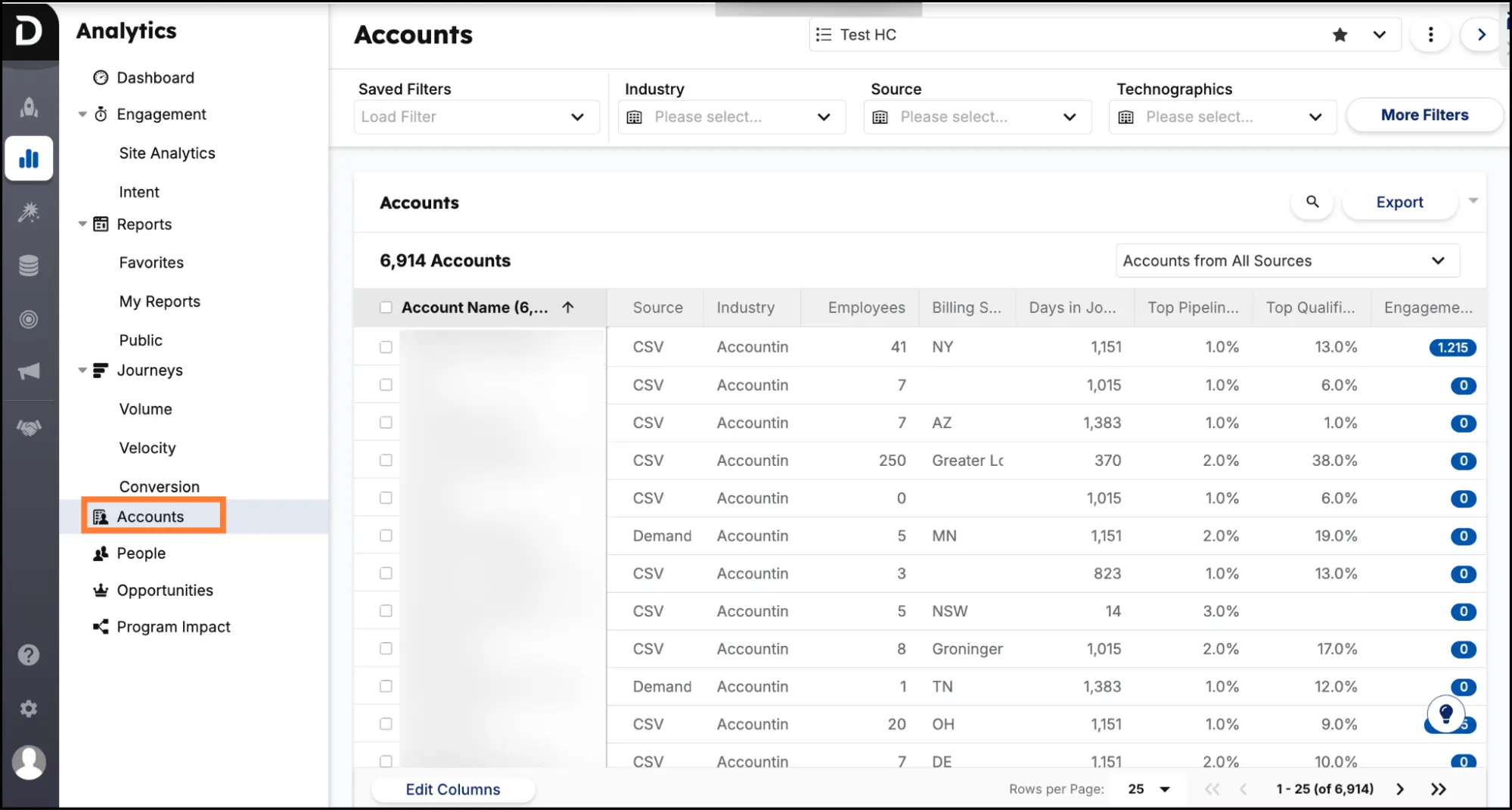
Demandbase is the leading account-based marketing (ABM) and intent-data platform that empowers B2B organizations to identify, engage, and convert high-value accounts.
It offers the ability to connect first-party behavioral data from your website and CRM with third-party intent signals captured across the B2B web.
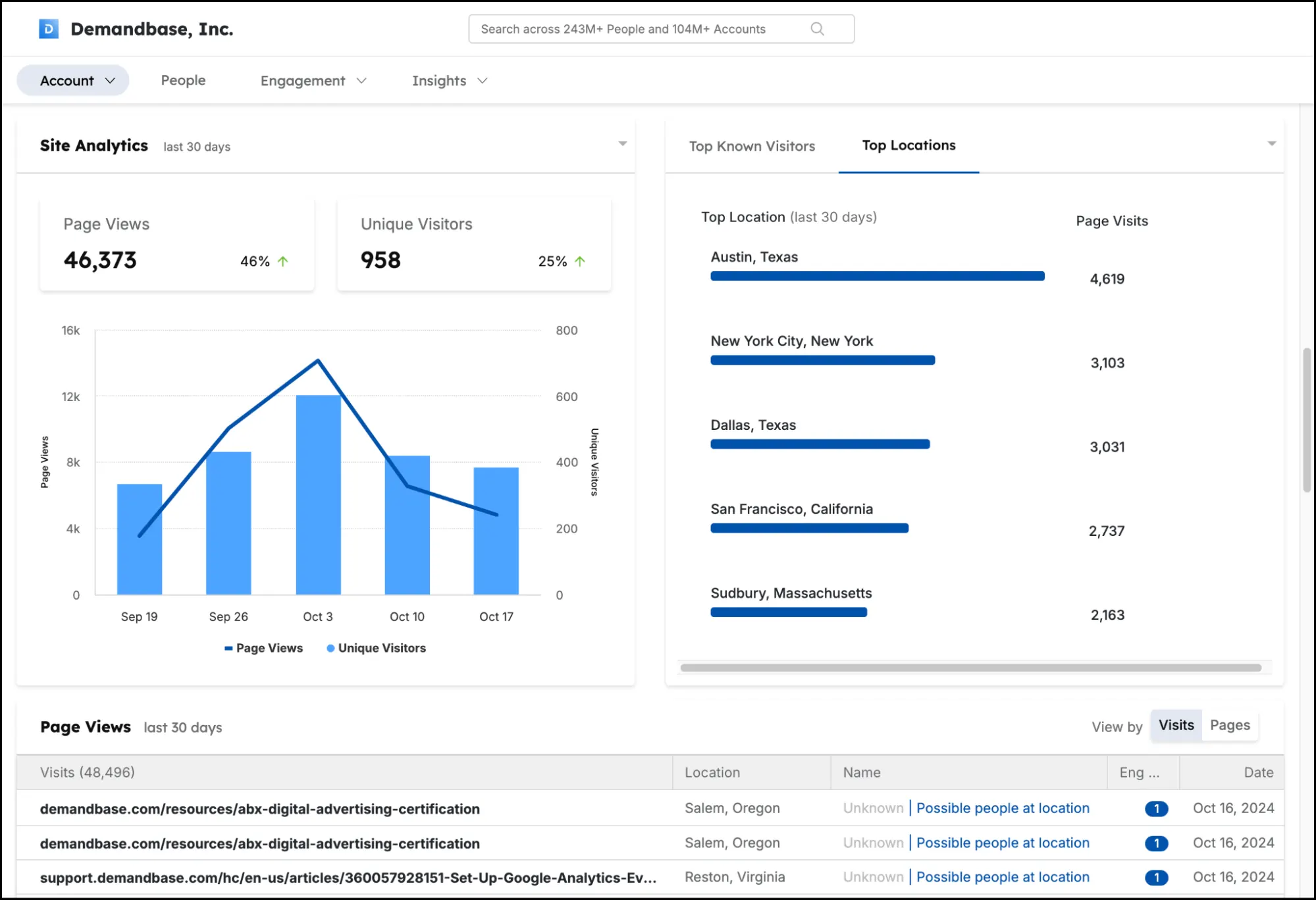
Then it layers on proprietary Account Intelligence that identifies which companies are in-market, what they’re researching, and where they sit in the buying journey.
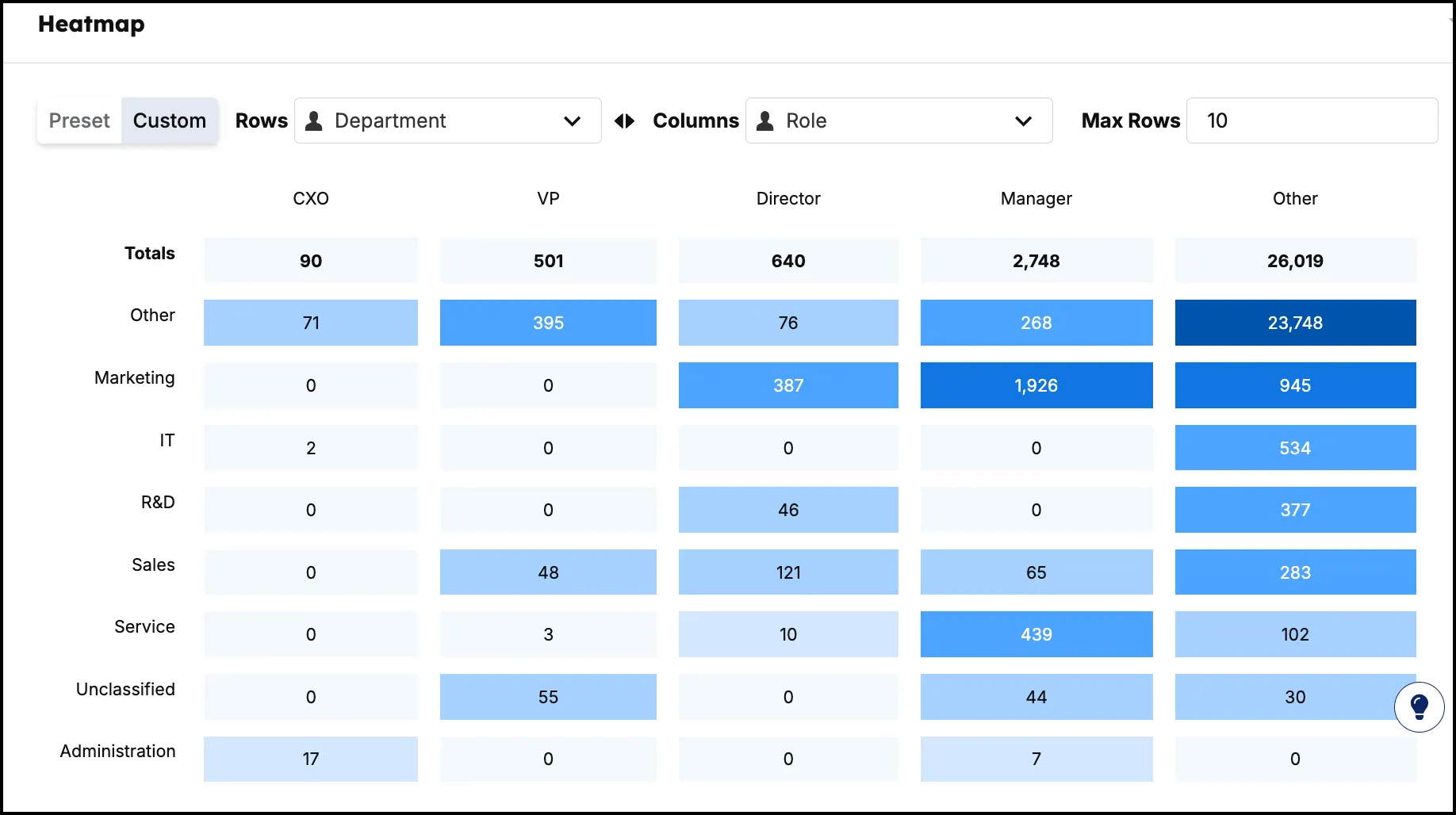
This unified data model powers everything from programmatic advertising to sales outreach to pipeline analytics, ensuring every team operates from the same account-level truth.
Demandbase also enables coordinated action across marketing, sales, and customer success based on real-time account behavior.
For example, when an account shows surge intent, Demandbase can automatically adjust ad targeting, personalize website experiences, trigger sales alerts, and update CRM records without manual intervention.
Demandbase ranks #1 G2’s Winter 2026 Enterprise Grid® for Account-Based Advertising
Key features of Demandbase
Account intelligence
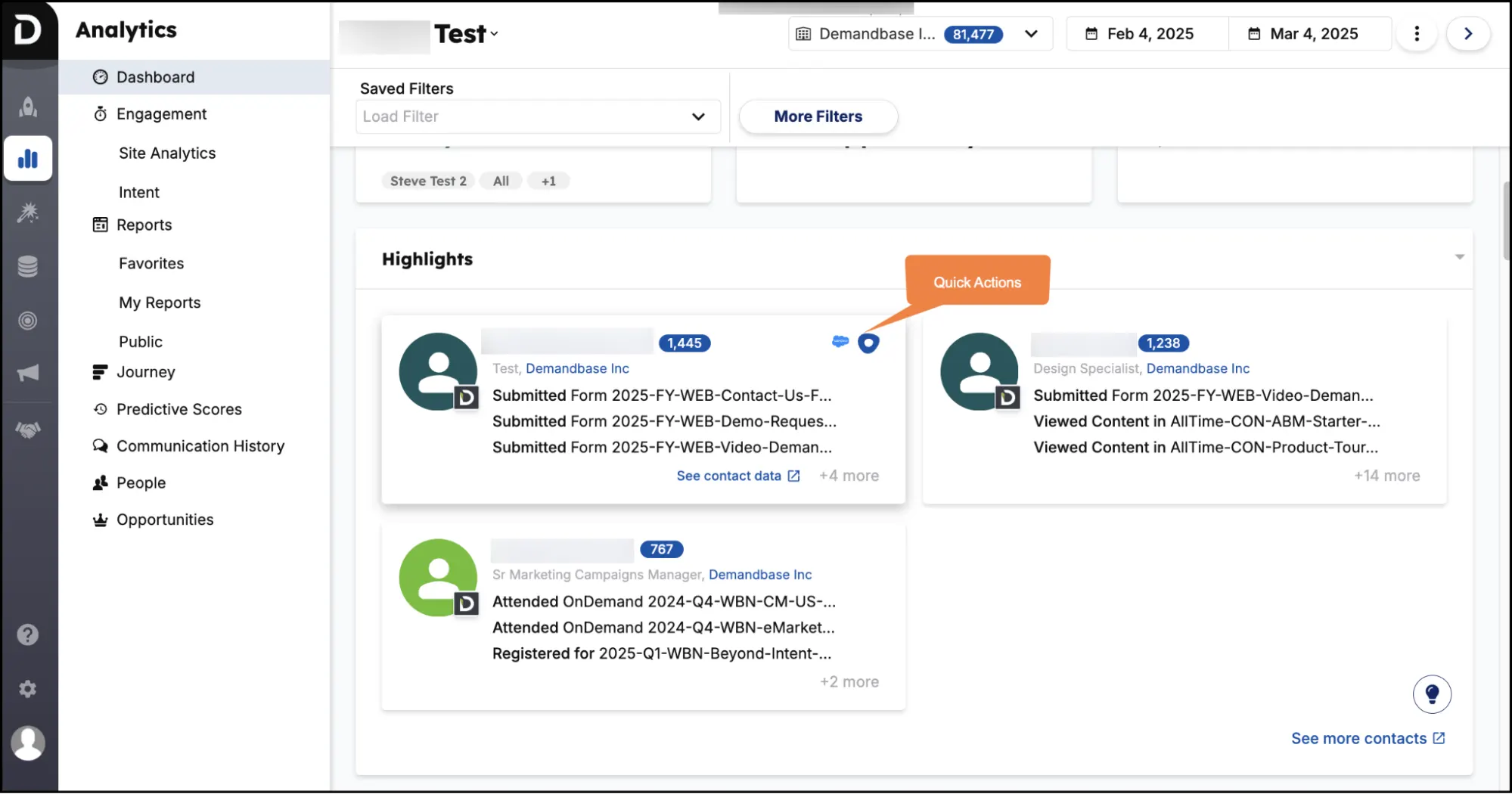
This is Demandbase’s proprietary intelligence layer that combines firmographic data, technographic signals, and behavioral intent to create comprehensive account profiles.
It identifies which companies are visiting your website (even anonymous traffic), matches them to your target account lists, and enriches each account with detailed attributes—e.g., employee count, revenue, technology stack, business initiatives, competitive landscape.
This intelligence helps targeting precision across all downstream activities, ensuring you’re reaching the right accounts with relevant context.
Intent data platform

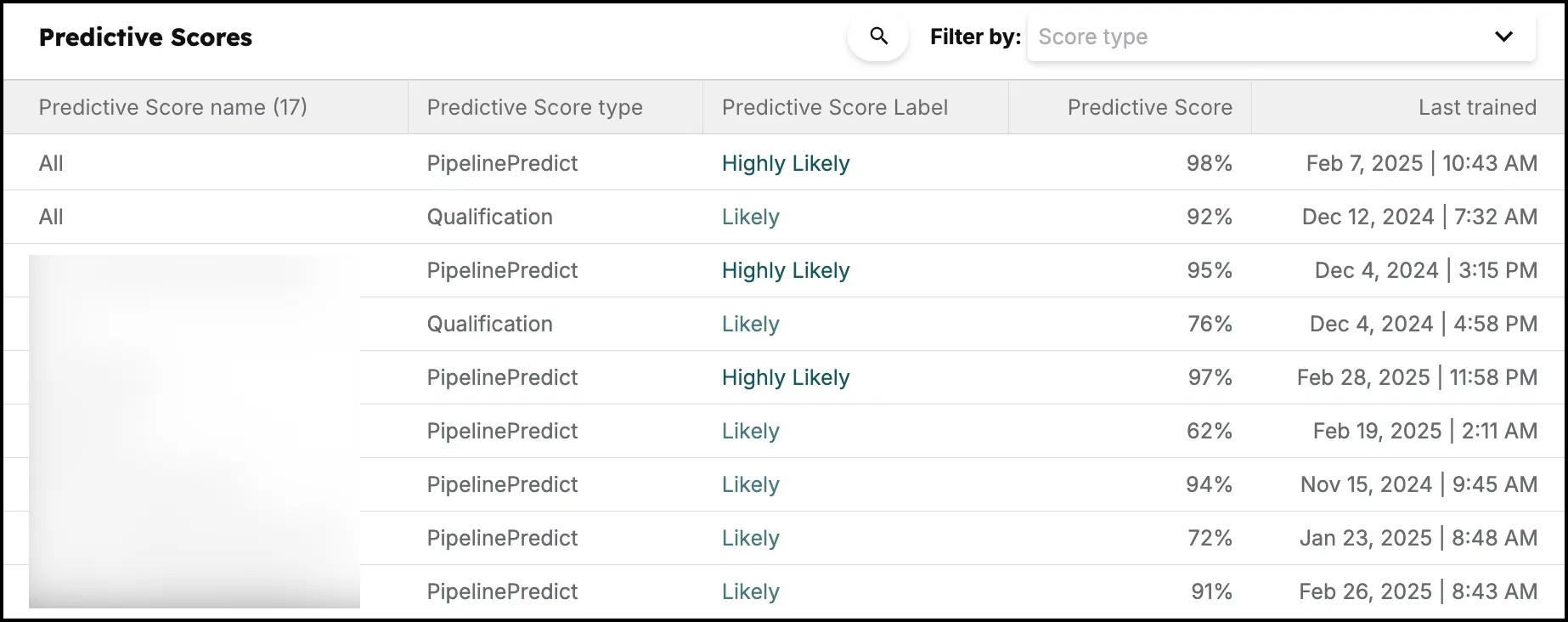
Aggregates third-party intent signals from Bombora’s Company Surge data and Demandbase’s proprietary intent network, capturing research activity across thousands of B2B publications, review sites, and communities.
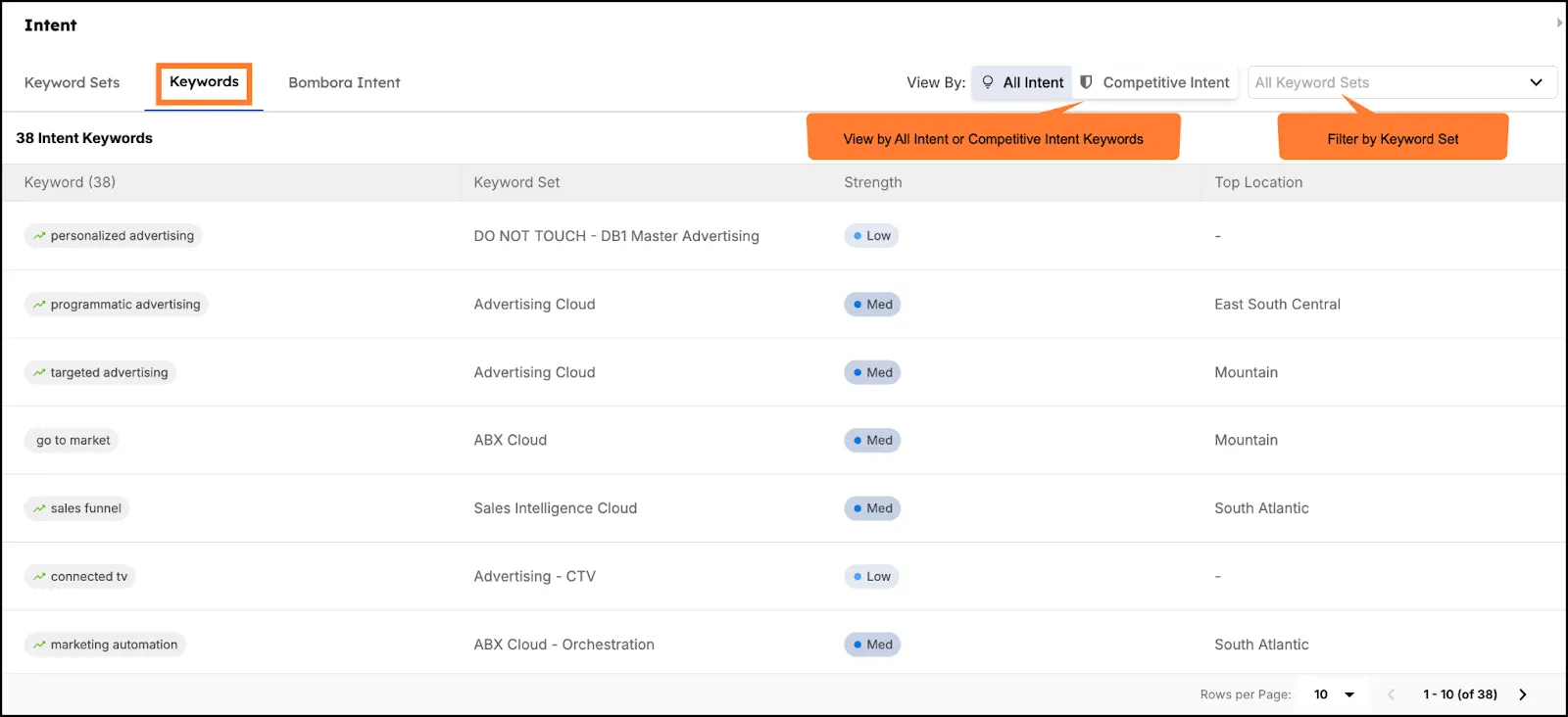
The platform identifies topic-level intent (what accounts are researching), intent strength (how actively they’re researching), and intent trends (whether research activity is increasing or plateauing).
Intent scores update continuously and integrate directly into account records, giving sales and marketing teams real-time visibility into buying committee engagement.
Advertising cloud
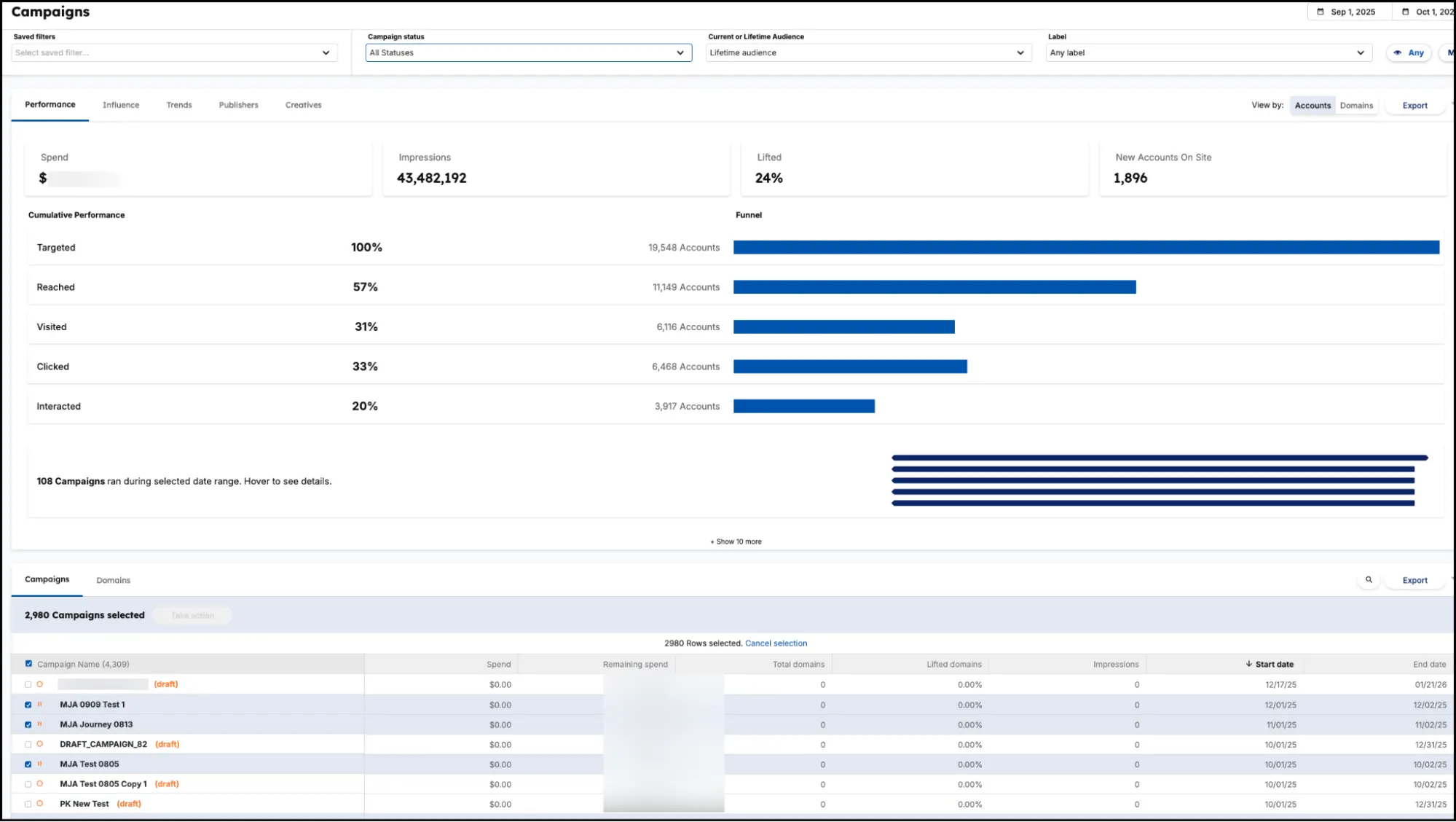
This is a B2B-native programmatic advertising platform that enables precise account-based targeting across display, social, CTV, and video.
Built on the Piper B2B DSP, it allows you to target specific companies on your account lists, and adjust creative based on account characteristics and intent signals.
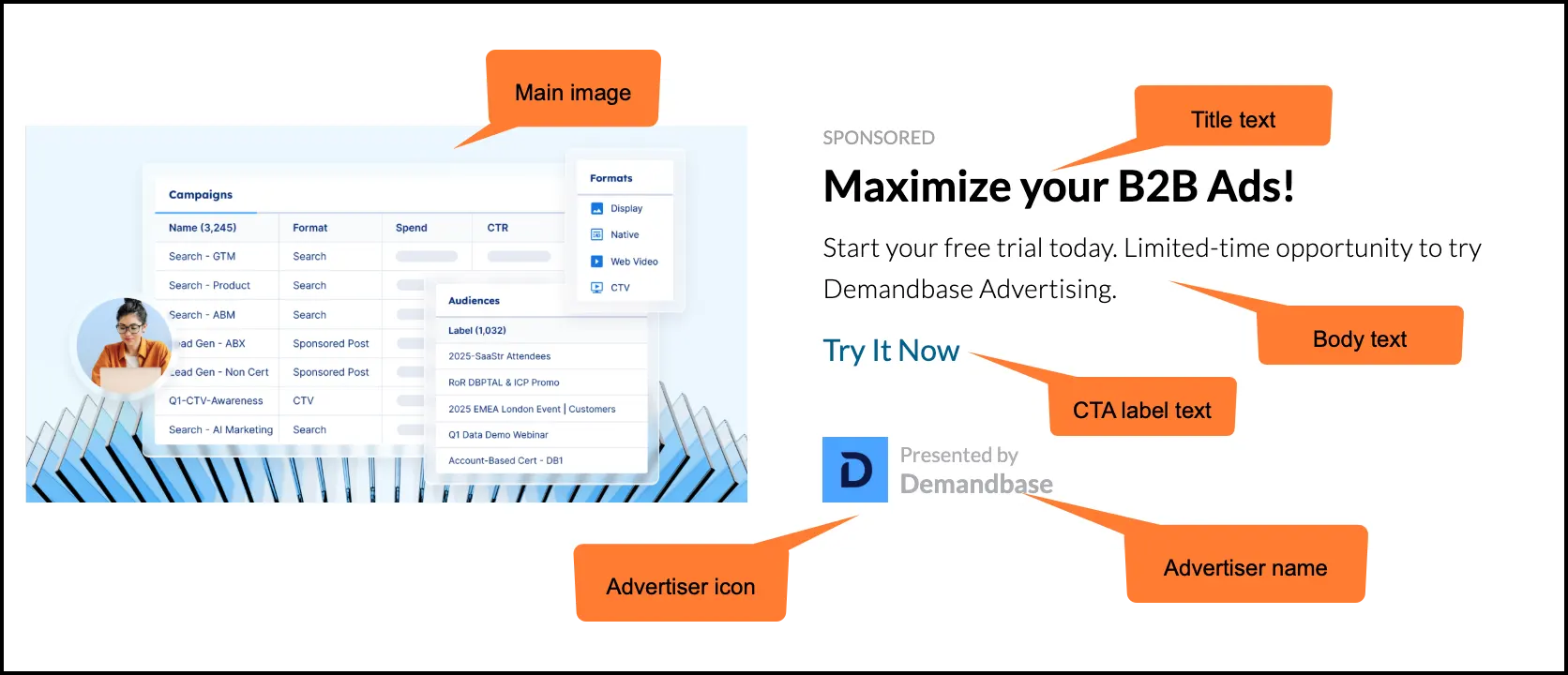
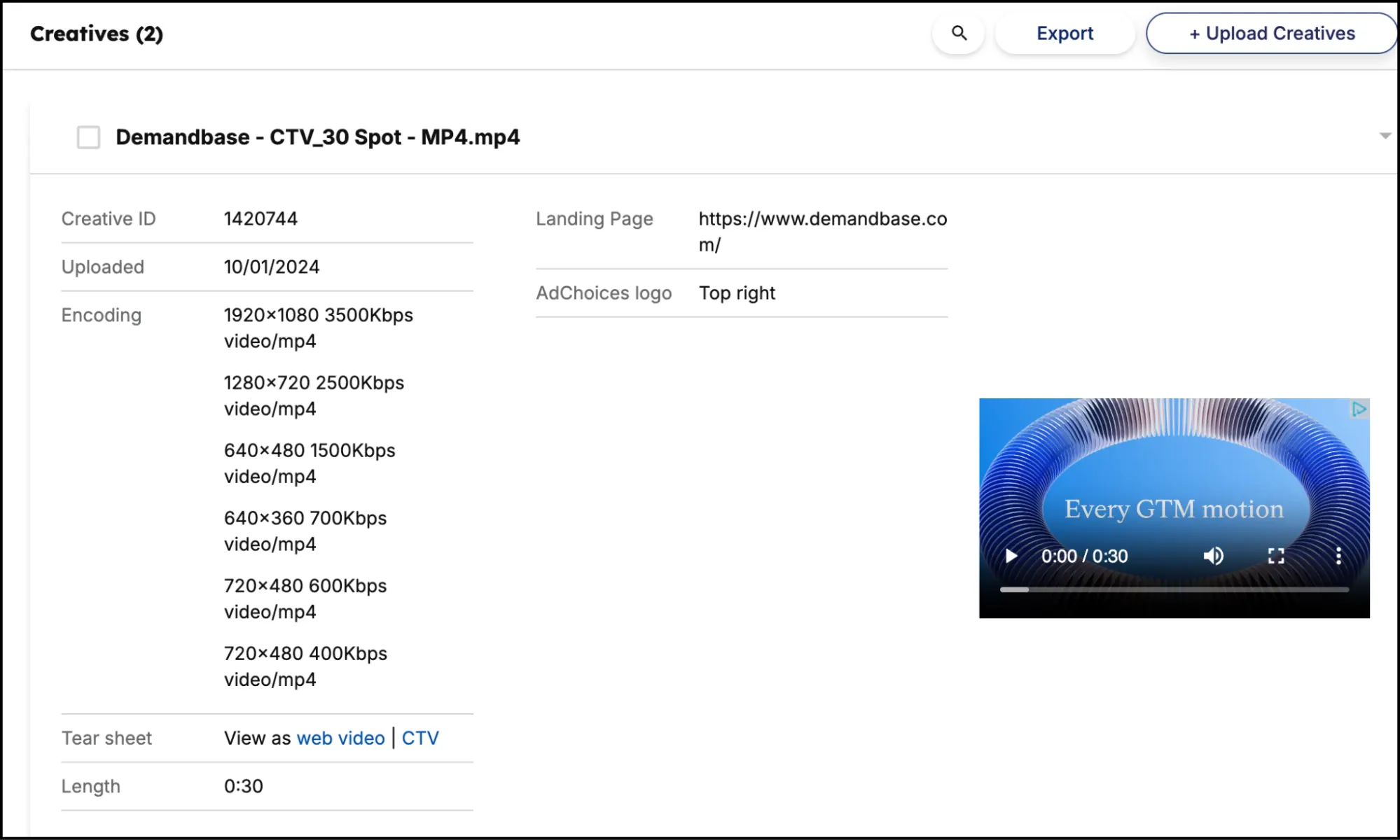
The platform also includes frequency capping at the account level (not just the cookie level), cross-channel attribution, and real-time campaign optimization.
You’re buying impressions against named accounts, which eliminates wasted spend on audiences outside your ideal customer profile (ICP).
Website personalization
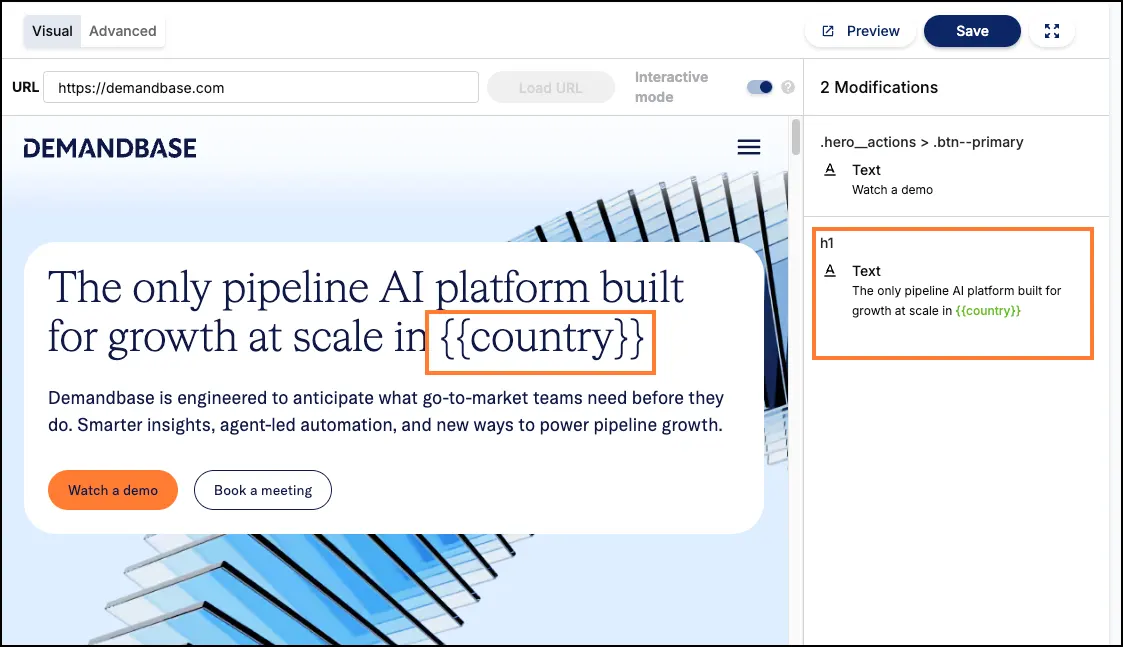
Dynamically adapts your website experience based on the visiting account’s industry, company size, technology stack, intent signals, and stage in the buyer journey.
You can change headlines, CTAs, product messaging, case studies, and even navigation based on who’s visiting.
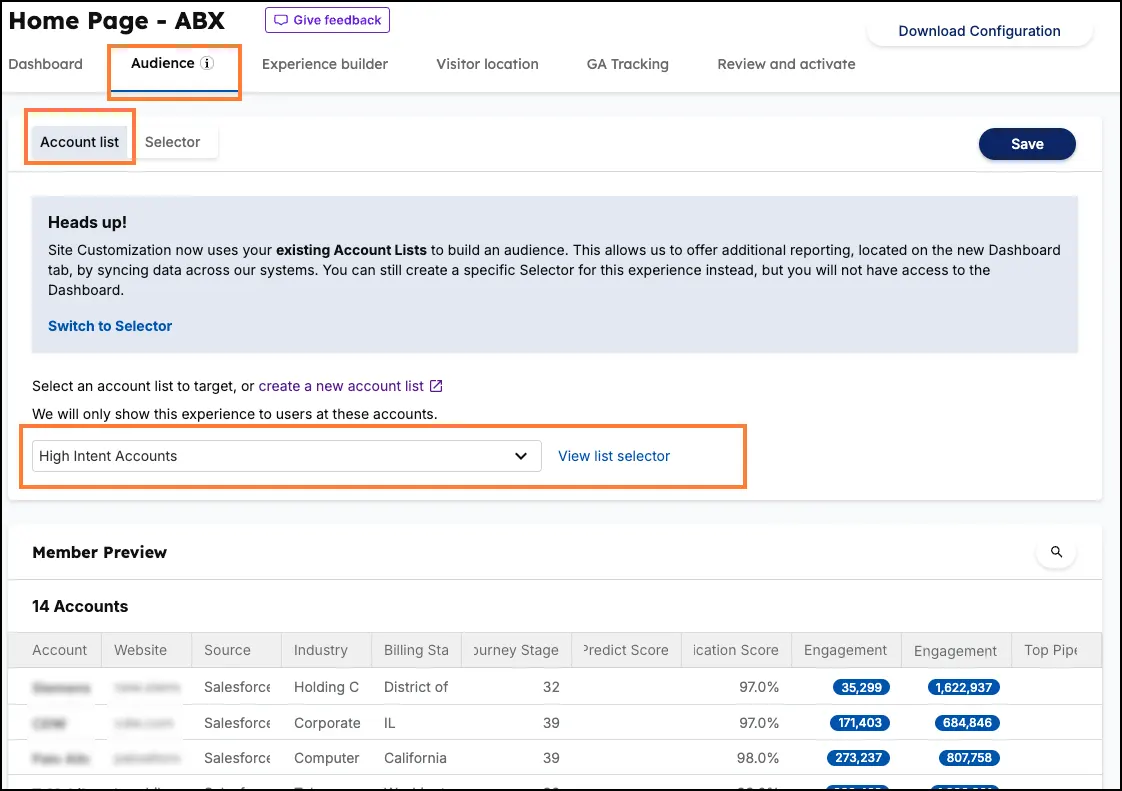
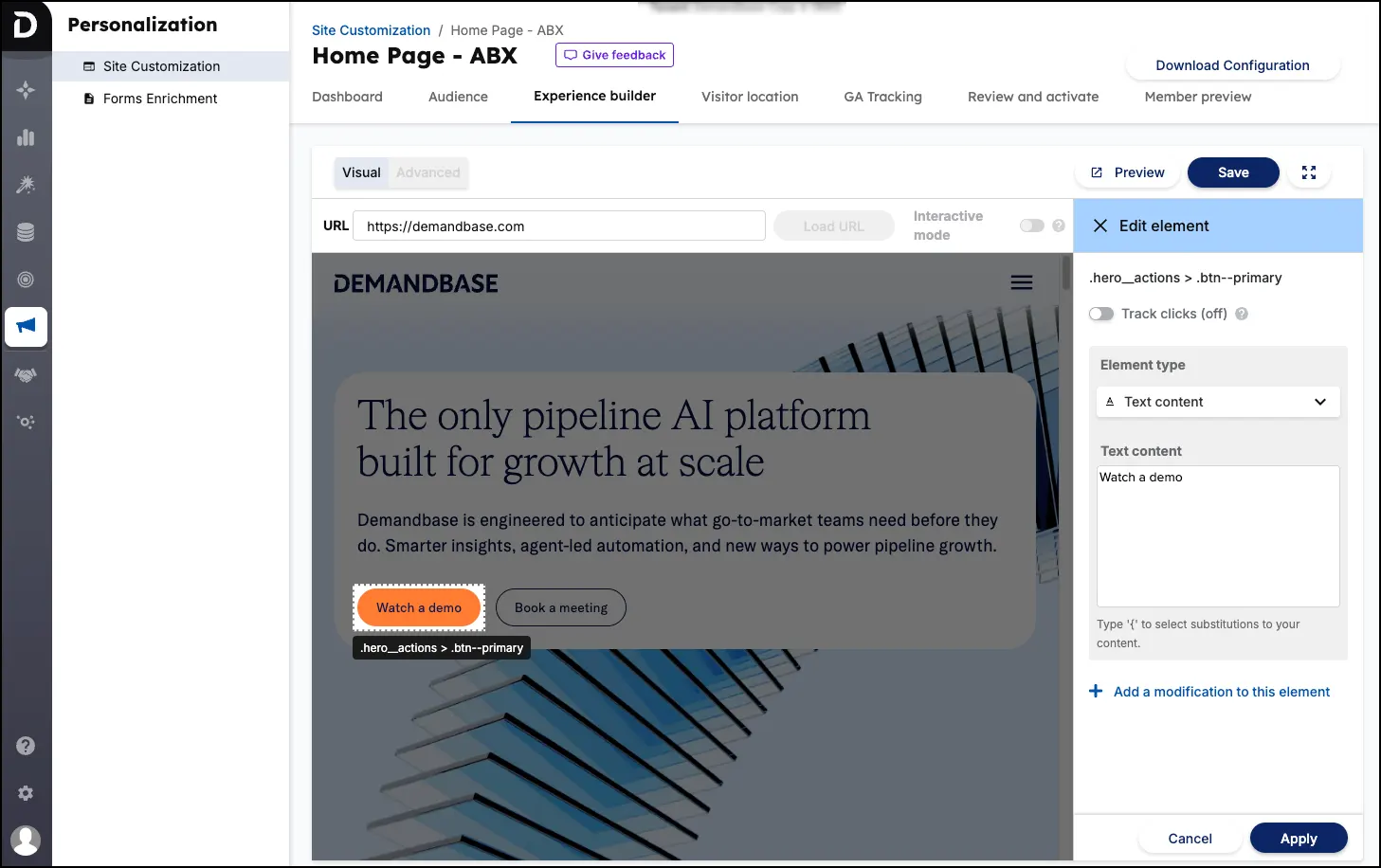
Personalization rules can be set manually or driven by AI recommendations, and A/B testing is built in to optimize performance over time.
Sales intelligence and engagement
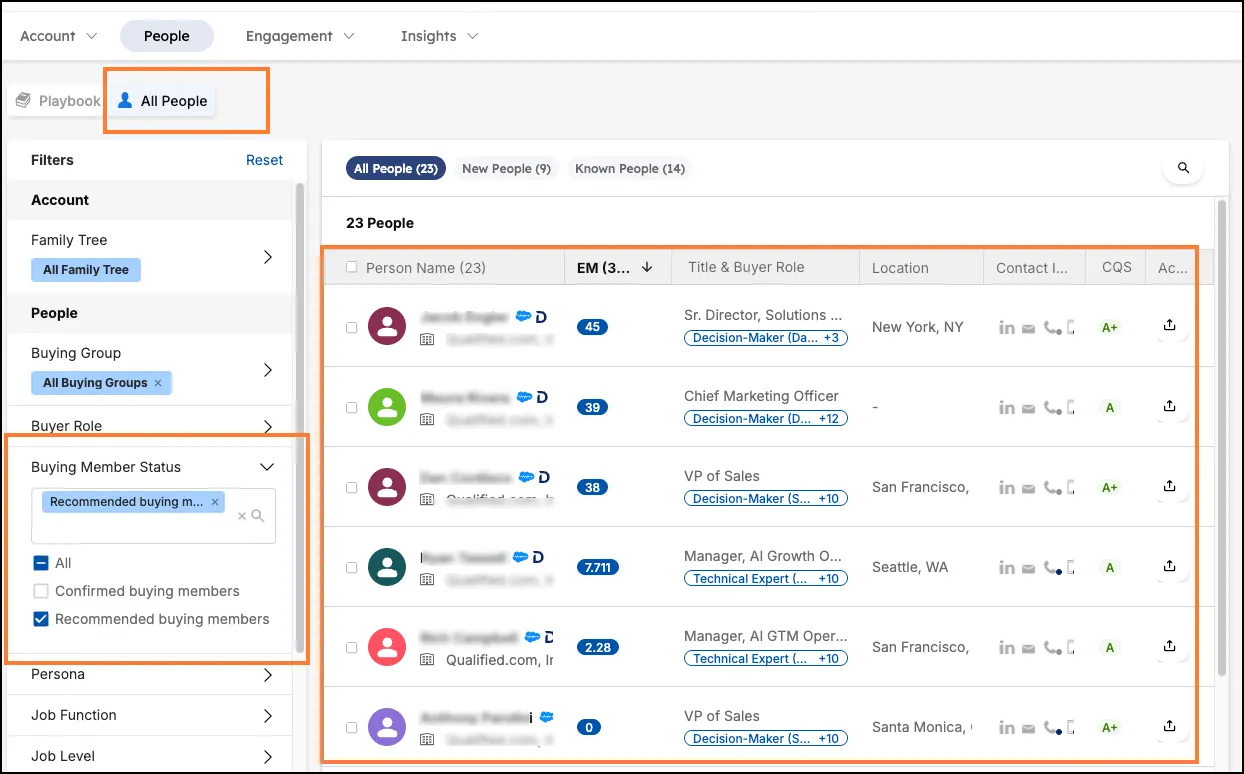
Surfaces account-level insights directly in Salesforce, including intent signals, recent website activity, engaged contacts, and recommended next actions.
Sales reps see which accounts are showing buying signals, what content they’ve consumed, and which topics are driving their research.
Demandbase also enables ‘one-to-one’ and ‘one-to-few’ outreach campaigns with personalized messaging based on account intelligence. This ensures sales engagement is informed by the same intent data driving marketing efforts.
Account-based analytics and attribution
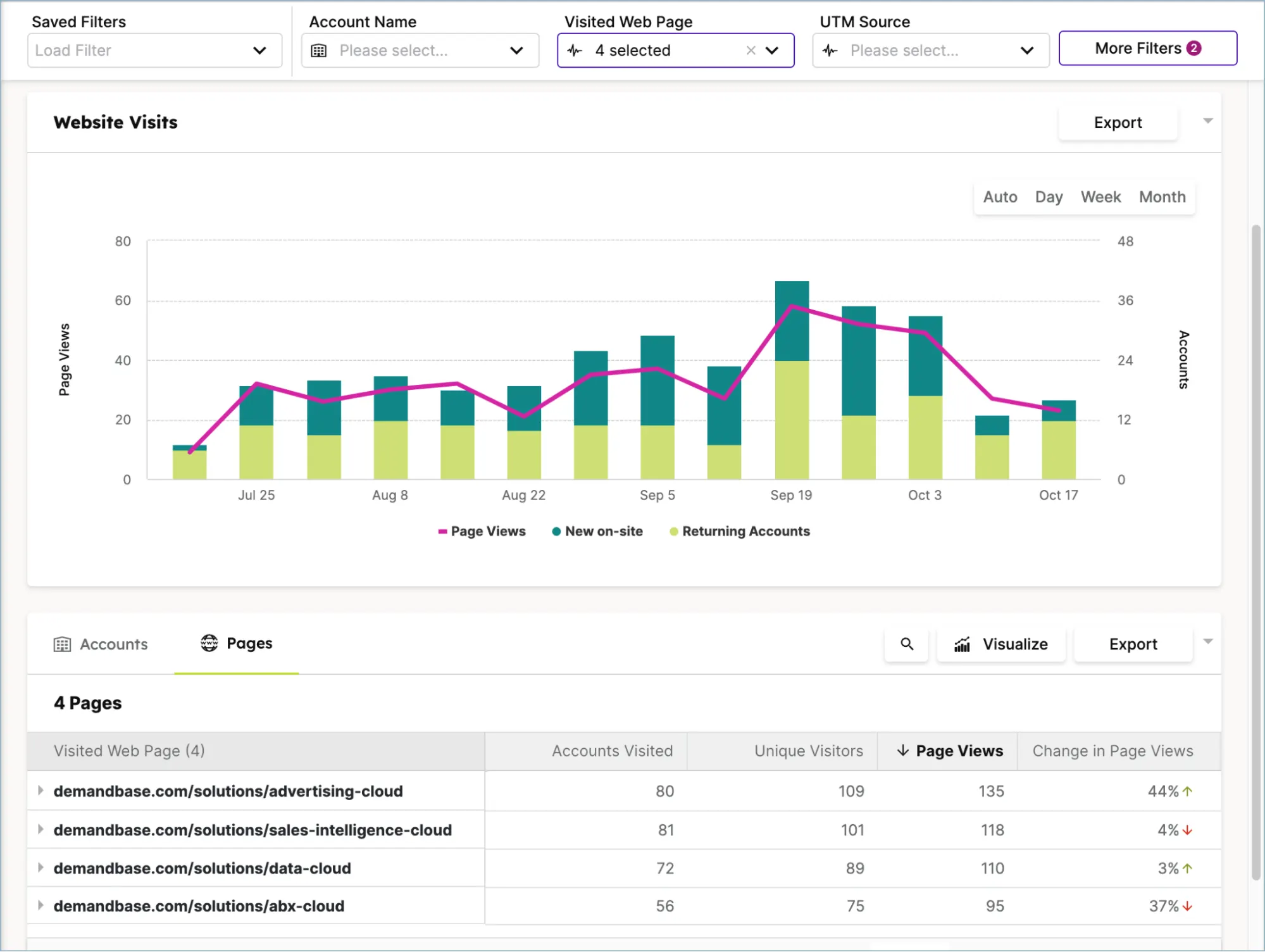
Provides closed-loop reporting that connects marketing and sales activities to pipeline and revenue outcomes at the account level.
You can track how intent signals correlate with opportunity creation, measure account engagement over time, and attribute revenue to specific touchpoints across the buyer journey.
Demandbase supports multiple attribution models (first-touch, multi-touch, custom) and allows you to segment performance by account tier, industry, or campaign.
Journey insights
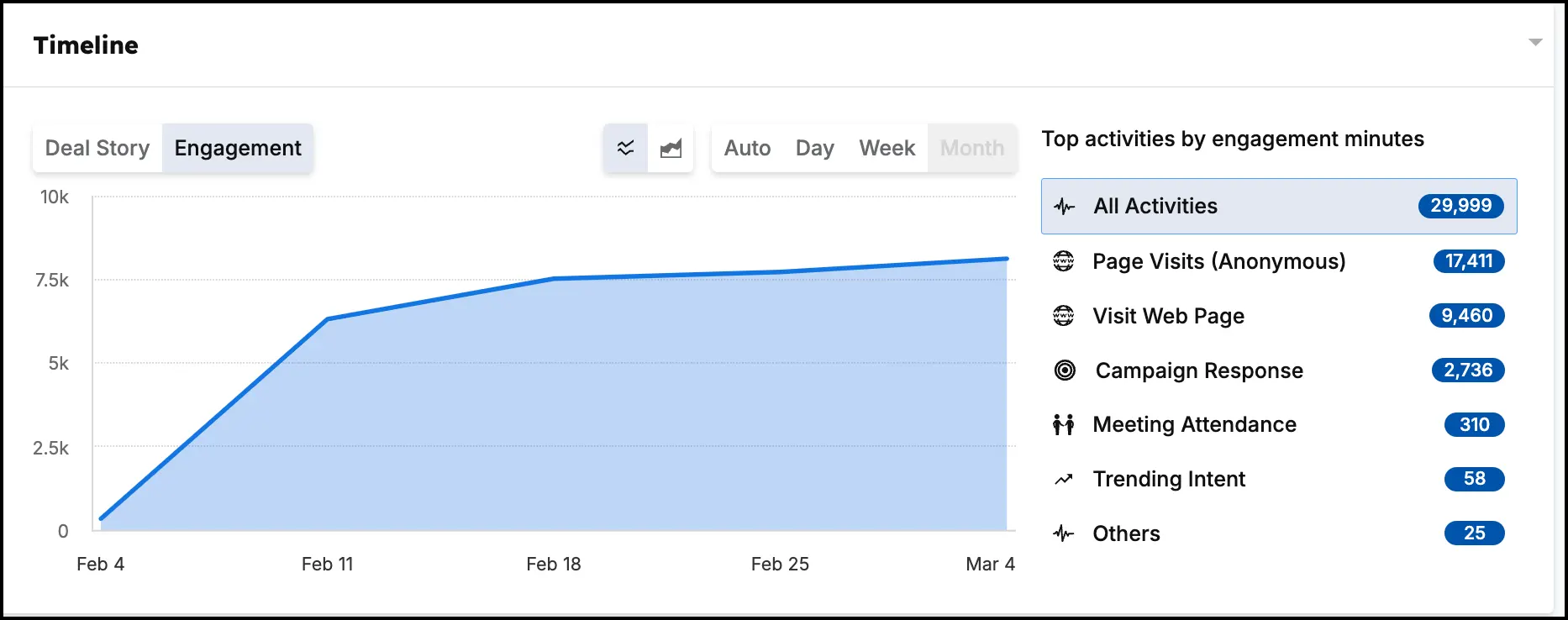
Maps the complete account journey from first anonymous website visit through closed-won deal. It shows every touchpoint including ads viewed, content consumed, sales interactions, intent spikes, and engagement patterns.
This timeline view helps revenue teams understand what’s working (which activities correlate with progression) and what’s not (where accounts stall or churn).
AI-powered recommendations
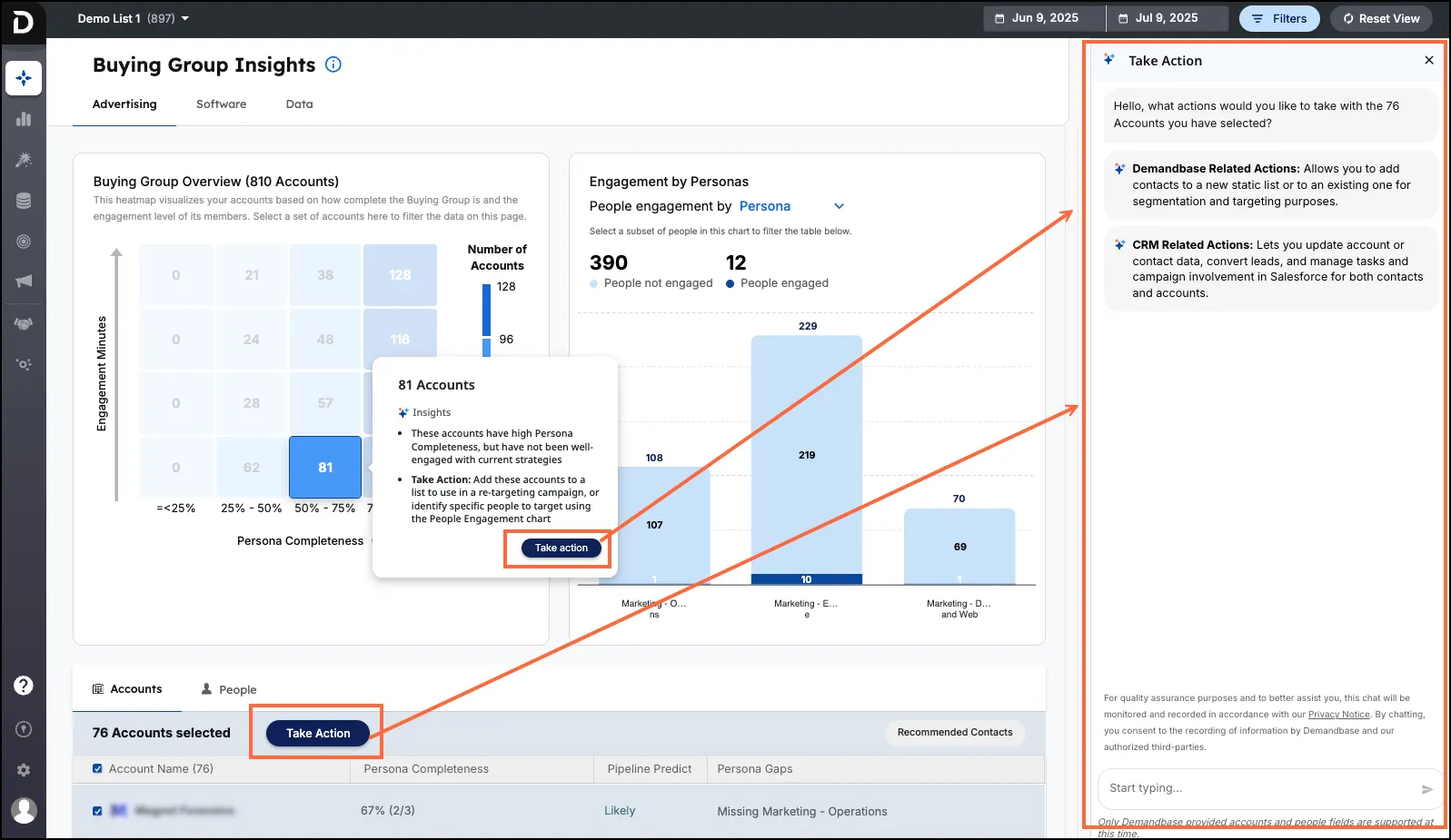
Uses machine learning to suggest next-best actions for both marketers and sales reps based on account behavior and historical conversion patterns.
- For marketers, it might recommend which accounts to add to campaigns, which messaging to test, or which channels to prioritize.
- For sales, it suggests optimal outreach timing, which contacts to engage, and what talking points to lead with.
The recommendations improve over time as the AI learns from your specific outcomes.
Self-serve targeting and campaign control
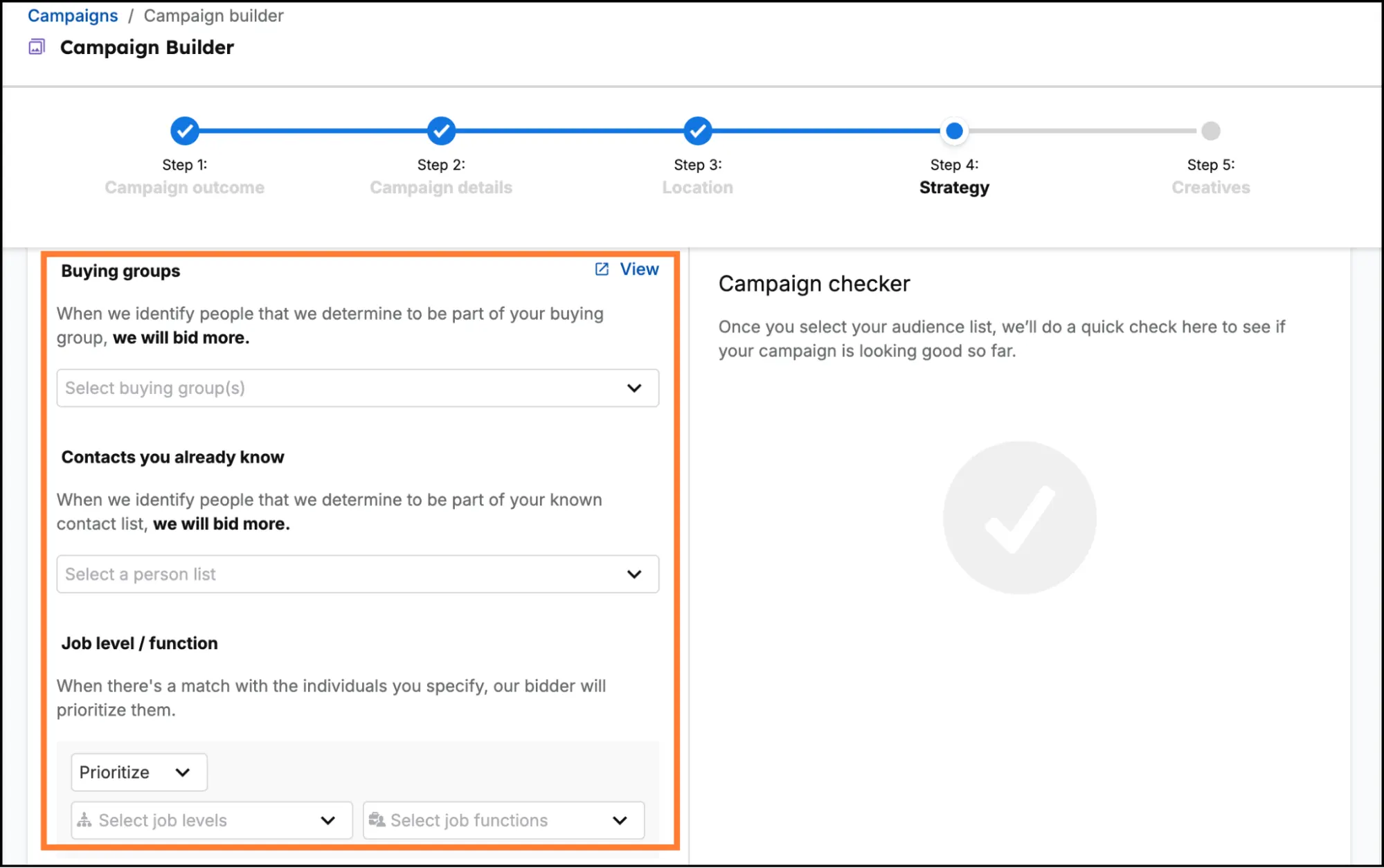
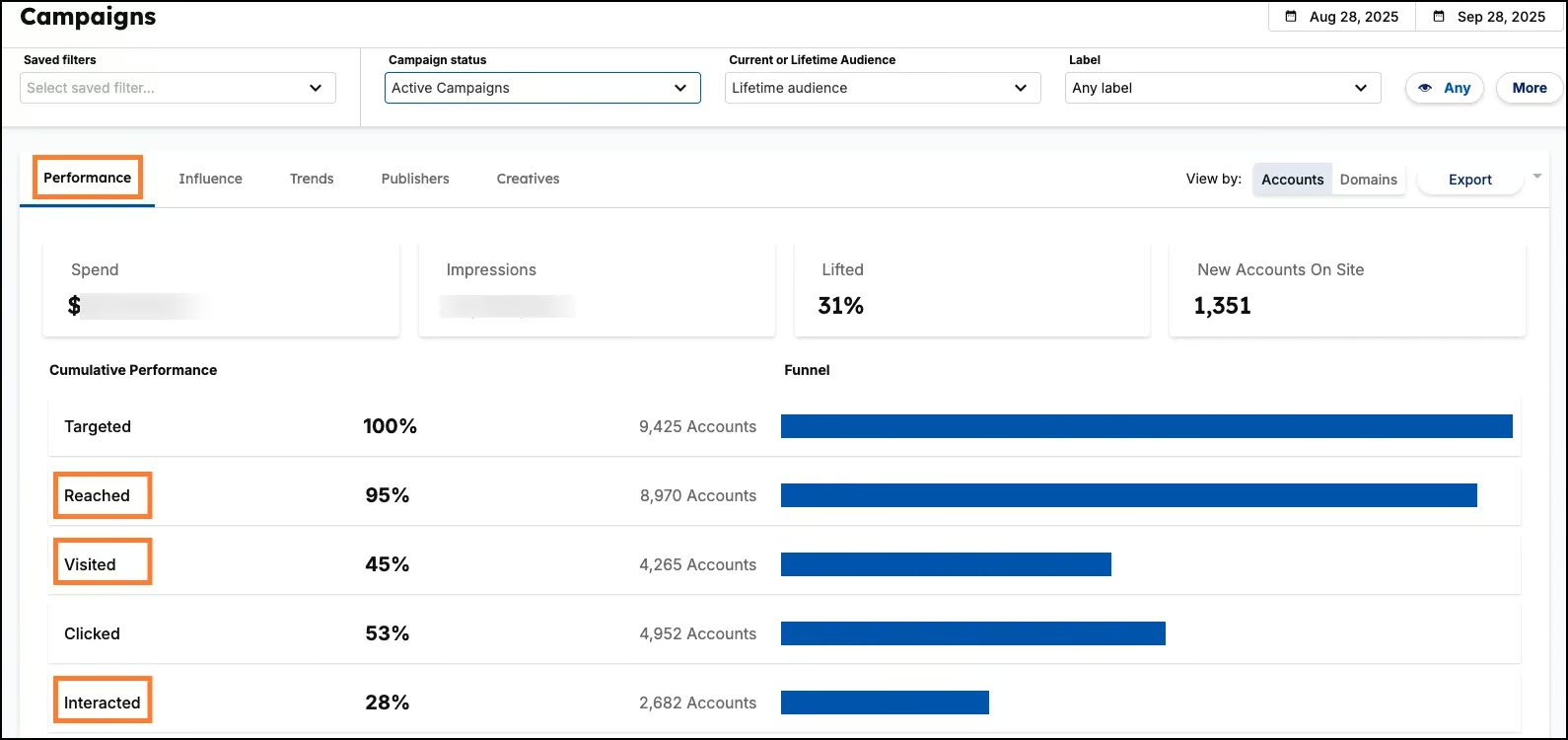
Gives marketers direct control over campaign setup, audience management, and budget allocation without requiring agency or platform support.
You can launch new campaigns, adjust targeting parameters, swap creative, and reallocate spend in real-time based on performance.
What are customers saying about Demandbase?
“With Demandbase, we effectively transformed advertising spend into qualified opportunities. Through precision targeting and actionable insights, we’ve strengthened cross-functional alignment, accelerated pipeline growth, and delivered measurable impact in the areas that matter most.”
—Jared Levy, Growth Marketing Manager at League.
“Using the two platforms together, we’re able to target specific companies with precision and increase the relevance of our ads. And we’ve increased our conversion rates by focusing on high-value accounts.”
—Thao Tran, Global Integrated Marketing Manager at Workday.
“Traditional targeting out of LinkedIn is fantastic, and with Demandbase, I can take that information from LinkedIn and focus it even further.”
—Mara Chapin, Digital Marketing Manager at Visier.
“Marketing’s contribution focused on reaching accounts who currently aren’t doing business with us. Through insights derived from Demandbase activity, we learned what solutions these accounts were interested in, which helped initiate new sales conversations. It proved to be a very successful collaboration between marketing and sales.”
—Jenny Reed, Sr. Manager, Global Marketing at Diebold Nixdorf.
Your Next Best Customer Is Already Researching. Here’s How to Reach Them.
2. 6Sense
Best for:
B2B revenue teams focused on predictive account prioritization and identifying where accounts may be in the buying journey.
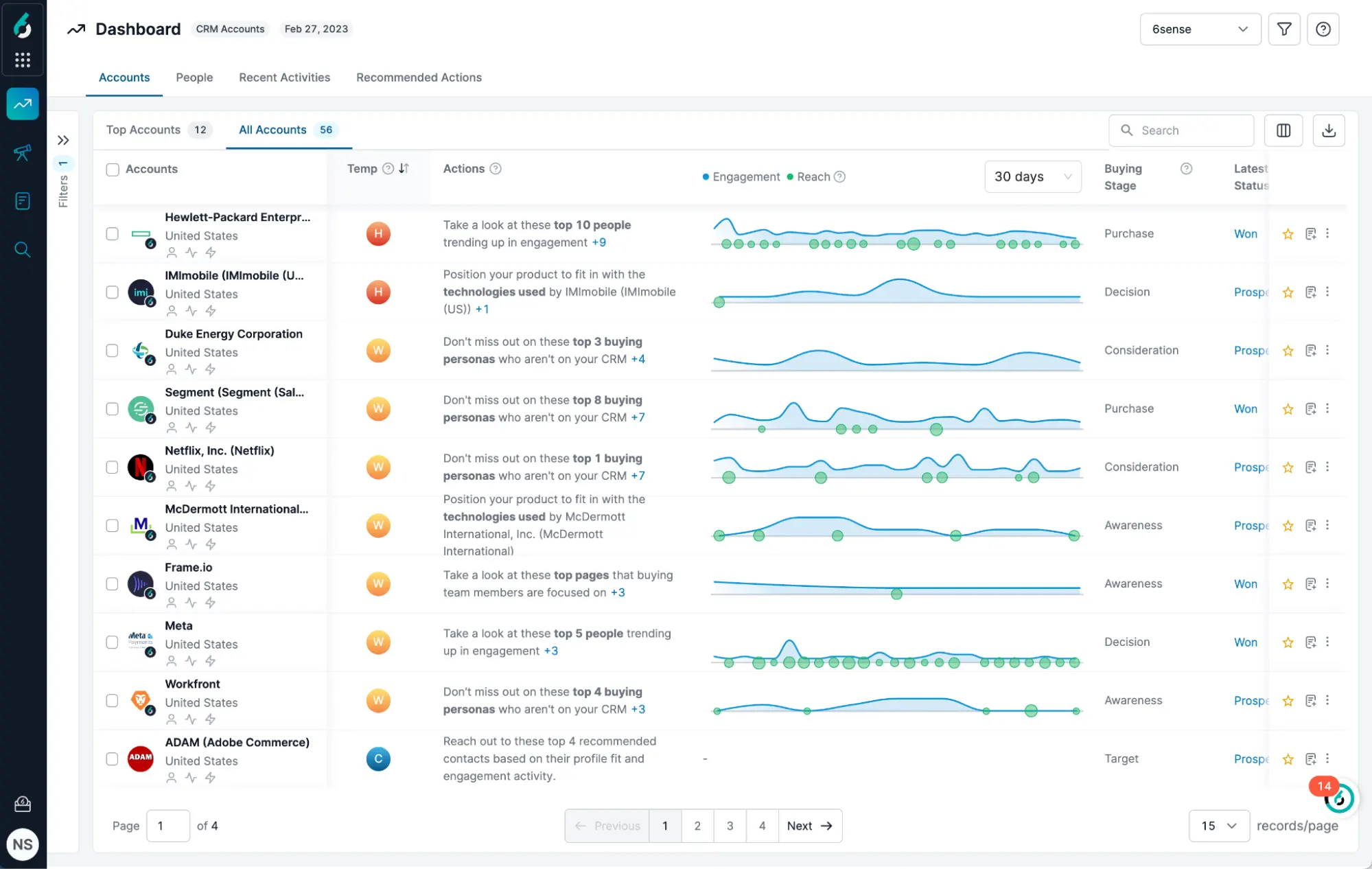
6Sense positions itself as a ‘Revenue AI’ platform designed to predict which accounts are in-market before they show obvious buying signals.
It uses AI and machine learning to analyze behavioral signals (e.g., anonymous website visits, search patterns), and correlates those signals with historical buying patterns.
This predictive engine assigns each account to a stage in what 6Sense calls the “buying journey,” from awareness through consideration to decision. This allows revenue teams to tailor their approach based on where an account actually sits.
Key features of 6Sense
- Signalverse: Ingests and processes trillions of buyer signals daily. This includes content consumption, search behavior, and external research across millions of webpages— to detect emerging intent trends from accounts.
- AI-powered predictive intelligence (6AI): This is 6sense’s proprietary AI that leverages machine learning to analyze intent patterns and predict which accounts are most likely to buy and when.
- Buyer persona data: 6Sense provides enriched contact intelligence (roles, behaviors, direct emails, technographics) to help teams engage the right personas within high-intent accounts.
Pros of 6Sense
- “I particularly value the detailed and clearly defined buying signals and intent features, which give actionable insights into a prospect’s buying intent.” (Read full review).
- “The interface is clear, the alerts are relevant, and it gives a real boost to the ABM strategy. It saves precious time in identifying active accounts, enabling intelligent prioritization and a higher conversion rate.” (Read full review).
Cons of 6Sense
- “One potential downside of 6sense Sales Intelligence is that the platform can have a steep learning curve for new users due to its rich features and data complexity.” (Read full review).
- “The platform also has a bit of a learning curve at first especially when it comes to customizing filters and interpreting buyer stage data across different segments.” (Read full review).
How much does 6Sense cost?
6Sense typically operates with enterprise-level pricing that scales with data volume, number of users, and level of orchestration required.
3. ZoomInfo
Best for:
Sales and marketing teams that want contact and company intelligence combined with intent and prospecting workflows.
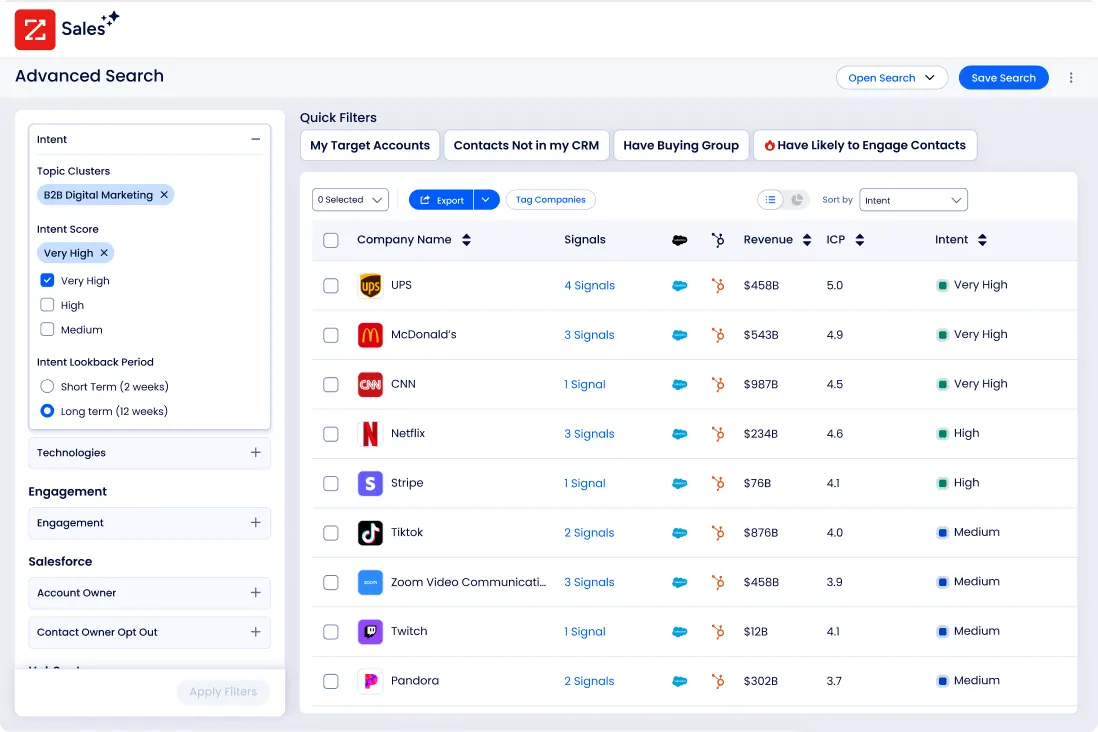
ZoomInfo operates as a go-to-market (GTM) intelligence with a large proprietary database of B2B contacts and companies.
It provides detailed profiles on over 100 million business contacts and 14 million companies, enriched with direct dials, verified email addresses, job titles, reporting structures, technology stacks, and firmographic details.
Key features of ZoomInfo
- ZoomInfo intent: Tracks billions of content engagements across the web and identifies which companies are showing surges of interest around specific keywords or topics.
- Chorus conversation intelligence: Records, transcribes, and analyzes sales calls to extract insights about deal blockers, sentiment, and recurring topics.
- Engage + Chat: This is ZoomInfo’s native sales engagement suite that allows SDRs to launch email cadences, calls, or chat outreach directly within the platform.
Pros of ZoomInfo
- “Zoominfo sales has the right contacts that I need to get our acquisitions pipeline flowing. Most companies I can find the correct contact in maintenance and indirect procurement.” (Read full review).
- “Oftentimes you have a contact with an outdated email or phone number. ZoomInfo is a great tool to use when this happens to find a prospect/customer’s current contact information.” (Read full review).
Cons of ZoomInfo
- “I find the cost of ZoomInfo Sales to be a bit expensive, especially for smaller companies. While it’s a valuable tool, the pricing can be a significant hurdle for those with limited budgets.” (Read full review).
- “Many times I find that the contact’s email, or numbers are outdated. This is my biggest concern, sometimes I find that Apollo might have the more up to date info, and they provide their services for free up to a certain usage which sort of fills in the gaps for when ZoomInfo is lacking.” (Read full review).
How much does ZoomInfo cost?
ZoomInfo pricing varies depending on the data volume, modules, and automation layers selected.
Plans typically begin at a mid-tier range suitable for scaling B2B teams, with enterprise tiers offering access to the full RevOS suite (including Intent, Orchestrator, Engage, and Chorus).
4. Bombora
Best for:
Teams that need third-party, topic-level intent data to identify accounts showing increased research activity.
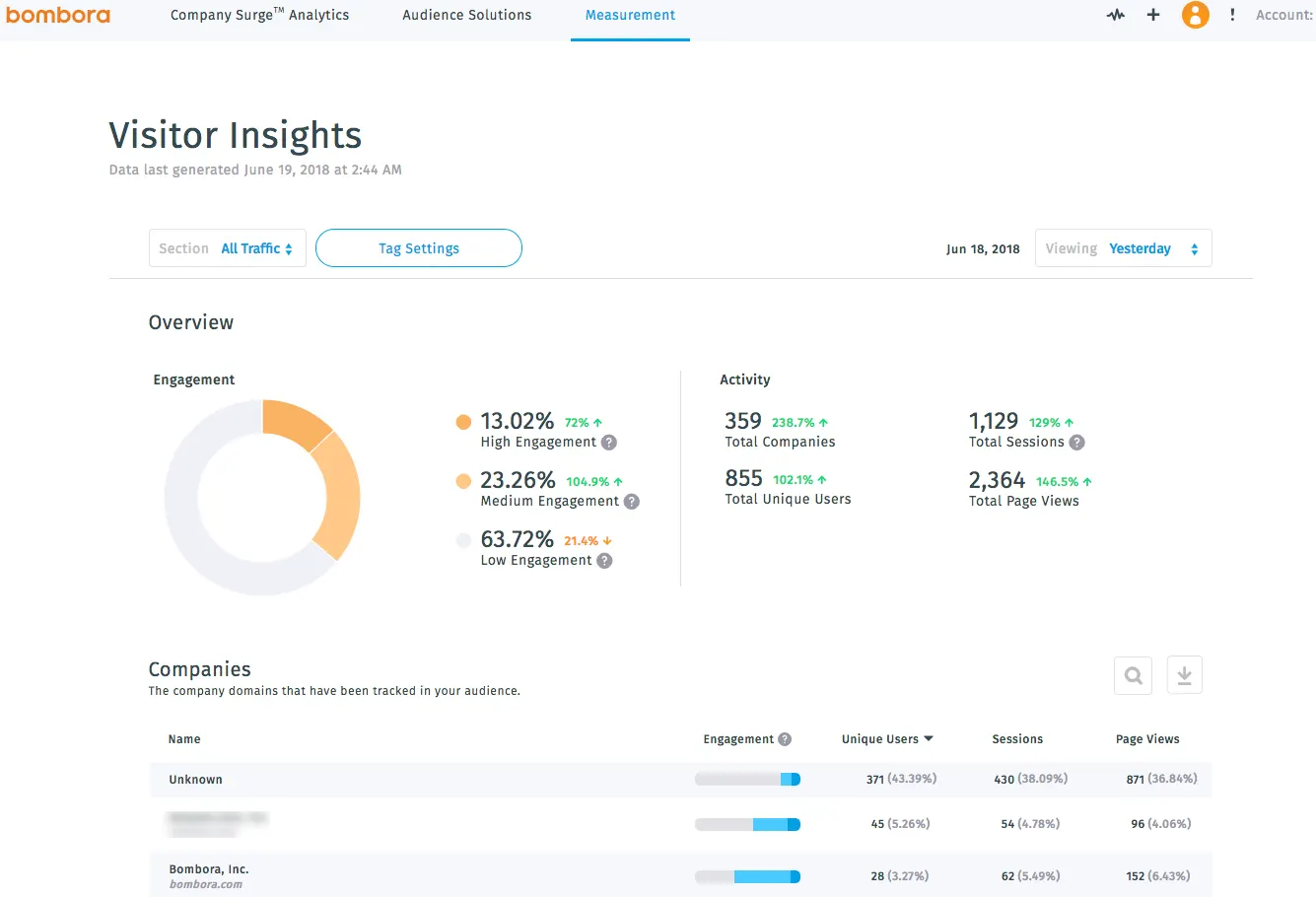
Bombora established itself as the category leader in third-party B2B intent data by pioneering the concept of ‘Company Surge’.
Bombora’s Data Co-op spans more than 200 publishers and media brands and 5,500+ B2B news and specialty sites, giving it visibility into content consumption across a large B2B research ecosystem.
For this to work, Bombora uses a co-op data sharing model where 5,000+ B2B publishers, media companies, and content sites contribute anonymized consumption data to a collective pool.
For example, when a company’s employees consume content on these sites (e.g., reading whitepapers, watching webinars) Bombora aggregates those signals at the company level to identify topics that organization is actively researching.
Key features of Bombora
- Topic taxonomy: Bombora uses AI and natural language processing to categorize B2B content across more than 21,600 intent topics.
- Custom topic modeling: Enterprises can define custom intent topics unique to their product or category (e.g., “AI-driven risk analytics”), allowing Bombora’s AI to track highly specific market trends.
- Audience solutions: Enables marketers to create high-intent audience segments using firmographic, technographic, and topic filters for precise targeting across digital advertising or content syndication channels.
Pros of Bombora
- “Bombora Company Surge is straightforward and easy to use. I came in with no prior experience and was quickly able to master the tool. It provides us with a ton of benefits.” (Read full review).
- “My favorite part of the tool is the automatic surge report and net-new account to HubSpot.” (Read full review).
Cons of Bombora
- “I wish it could go into a bit more detail about who is looking into your company or those keywords.” (Read full review).
- “The software does not support integrating or importing the contact information into this software, you need to use third-party application for storing the contact data of targeted customers, which makes the software workflow a little bit slower and even the processing speed is also affected.” (Read full review).
How much does Bombora cost?
Bombora offers custom pricing based on data usage volume, number of tracked topics, and integration type (API access, CRM sync, or ABM platform linkage).
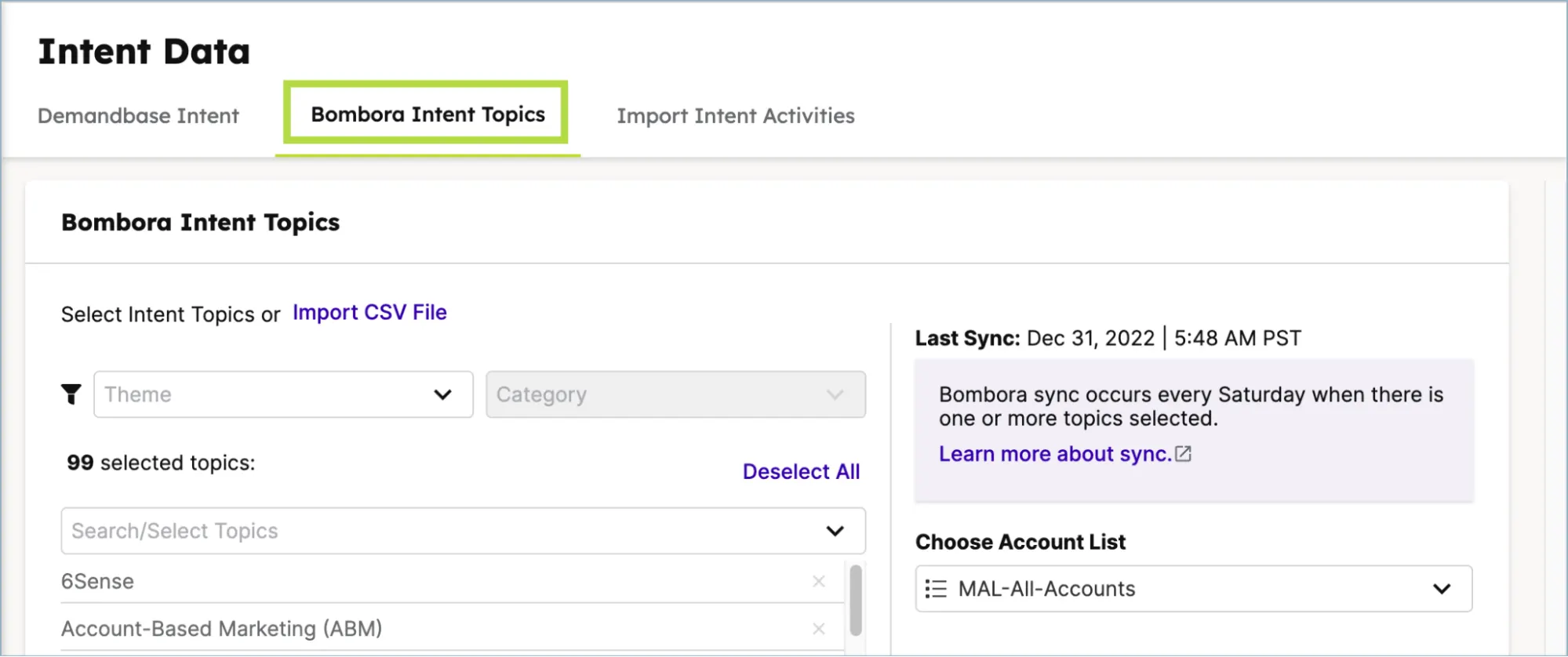
The Demandbase and Bombora partnership allows you to sync Bombora Intent Topics directly into Demandbase. You can use Bombora intent to power marketing and sales growth at every stage of the account journey.
5. Cognism
Best for:
Sales teams that need international B2B contact intelligence alongside intent signals, particularly across European markets.
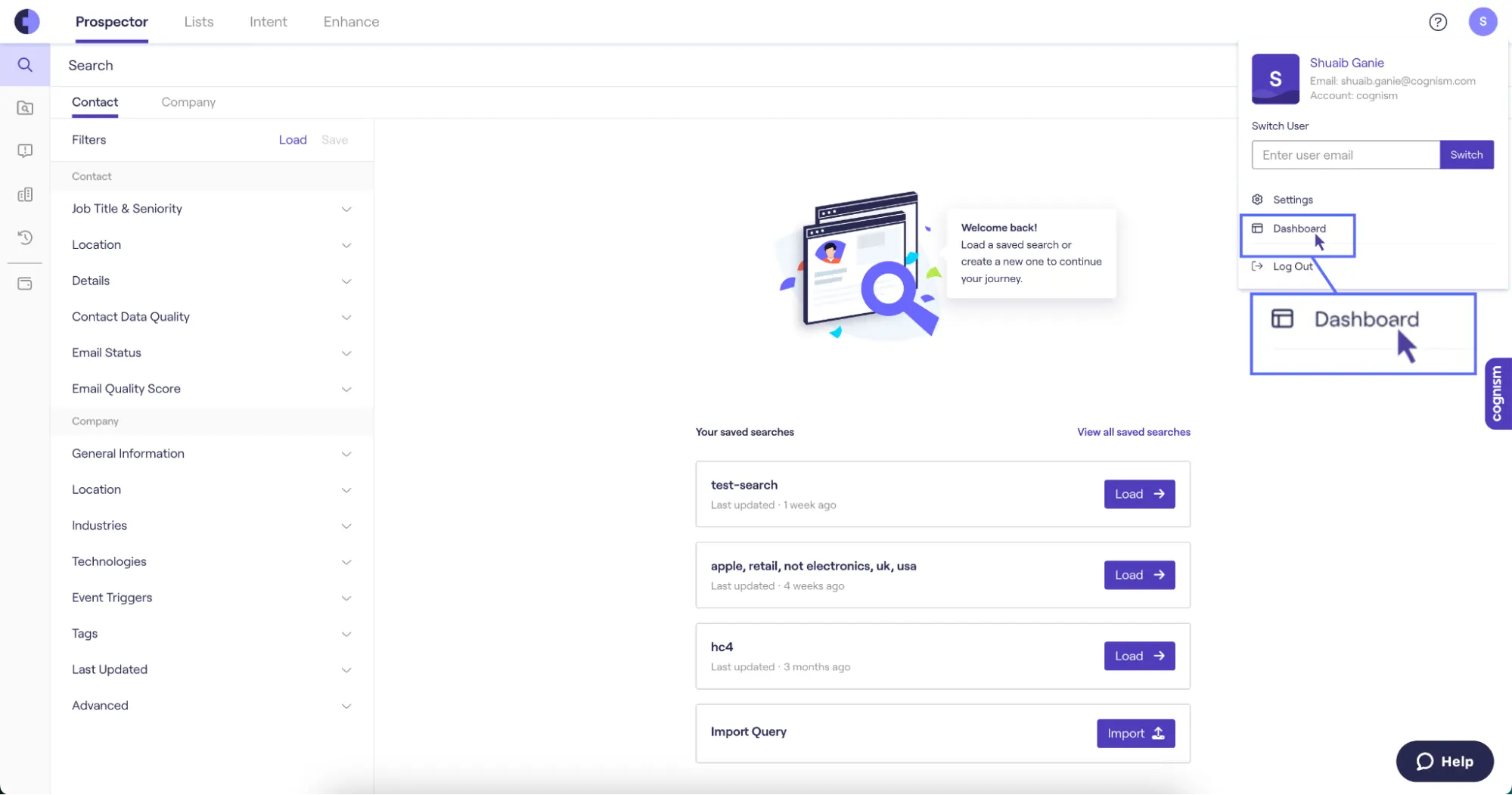
Cognism is a global sales intelligence platform that specializes in providing compliant, phone-verified contact data combined with intent signals to help B2B sales teams build pipeline in international markets.
While many intent and contact data providers focus primarily on North America, Cognism leans more to a global-first approach. It offers deep coverage across EMEA, APAC, and NAM with particular strength in European markets where GDPR compliance is non-negotiable.
Key features of Cognism
- Sales Companion: Combines B2B company and contact intelligence with AI-powered research, prospecting, and real-time buying signals.
- Diamond Data®: Cognism’s phone-verified mobile data helps sales teams reach validated B2B contacts.
- Intent data: Bombora-powered intent data helps teams identify accounts researching topics relevant to their market.
- Browser Extension: Gives sellers access to company and contact intelligence while prospecting on LinkedIn, company websites, and other supported workflows.
Pros of Cognism
- “What I like best about Cognism is how reliable and accurate the contact data is, especially for EMEA markets.” (Read full review).
- We use Cognism as one of our main data providers, and the quality of their data has always been excellent. As a UK-based outsourced sales agency, having access to accurate and compliant data is crucial, and Cognism consistently delivers.” (Read full review).
Cons of Cognism
- “I believe there needs to be greater clarity and more tools regarding data usage. Although they state that they are GDPR compliant, they do not offer any clear, GDPR-friendly methods for reaching customers.” (Read full review).
- “I think that it struggles with Scotland in particular. It doesn’t allow me to segment that out as a separate nation within The UK. Also, it’s very biased in favor of large enterprise organizations.” (Read full review).
How much does Cognism cost?
Cognism offers two primary packages: Grow and Elevate. Both include contact and company data, including phone-verified Diamond Data®, target-market analytics, and CRM integrations. Elevate adds signal data and provides access to additional intelligence and intent options. Pricing is quote-based.
6. Lead Forensics
Best for:
Teams focused on identifying companies visiting their website and turning first-party web activity into sales opportunities.
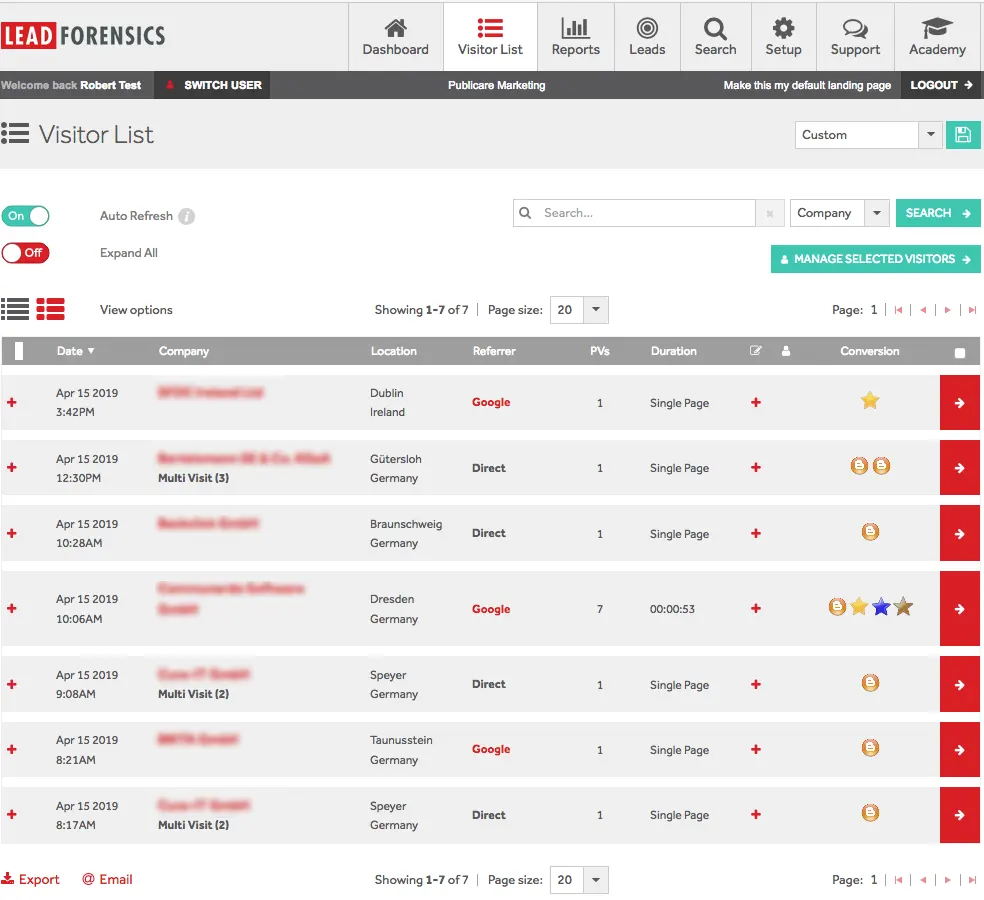
Lead Forensics is an AI-powered B2B intent identification and website intelligence platform that helps organizations uncover which companies are visiting their website.
The platform transforms anonymous traffic into identifiable business opportunities by matching IP addresses to an extensive global database of companies and decision-makers. It then enriches that visit with firmographic and contact data, behavioral metrics (pages viewed, visit duration), and inferred intent based on activity patterns.
This gives your team a clear picture of which accounts are researching your solution, even if they haven’t engaged with you directly.
Key features of Lead Forensics
- Website visitor identification: Identifies companies visiting your website and enriches those visits with firmographic and decision-maker information.
- Behavioral insights: Shows which pages companies visit, how frequently they return, and other engagement signals that can help teams prioritize follow-up.
- Real-time alerts and workflows: Notifies teams when relevant companies engage and can automate CRM lead creation and routing.
Pros of Lead Forensics
- “We can immediately see which companies are looking at our website, which pages they’ve visited, how long and how often they’ve been on there – it gives us a hot lead list.” (Read full review).
- “The system is very easy to use and gives you plenty of information to help you find and contact potential business. If you do happen to have any issues or questions, their support staff is top notch.” (Read full review).
Cons of Lead Forensics
- “The interface can feel a bit dated and the layout is not always intuitive, which can make navigating certain reports confusing at first.” (Read full review).
- “I wish it had bi-directional sync with HubSpot so that we could sync all of our prospect data back and forth automatically.” (Read full review).
How much does Lead Forensics cost?
Lead Forensics pricing is based primarily on website traffic volume. Its current packages include Essentials and Automate, and user access is unlimited.
7. Factors.ai
Best for:
B2B marketers that want to connect account activity, intent, campaign performance, and attribution.
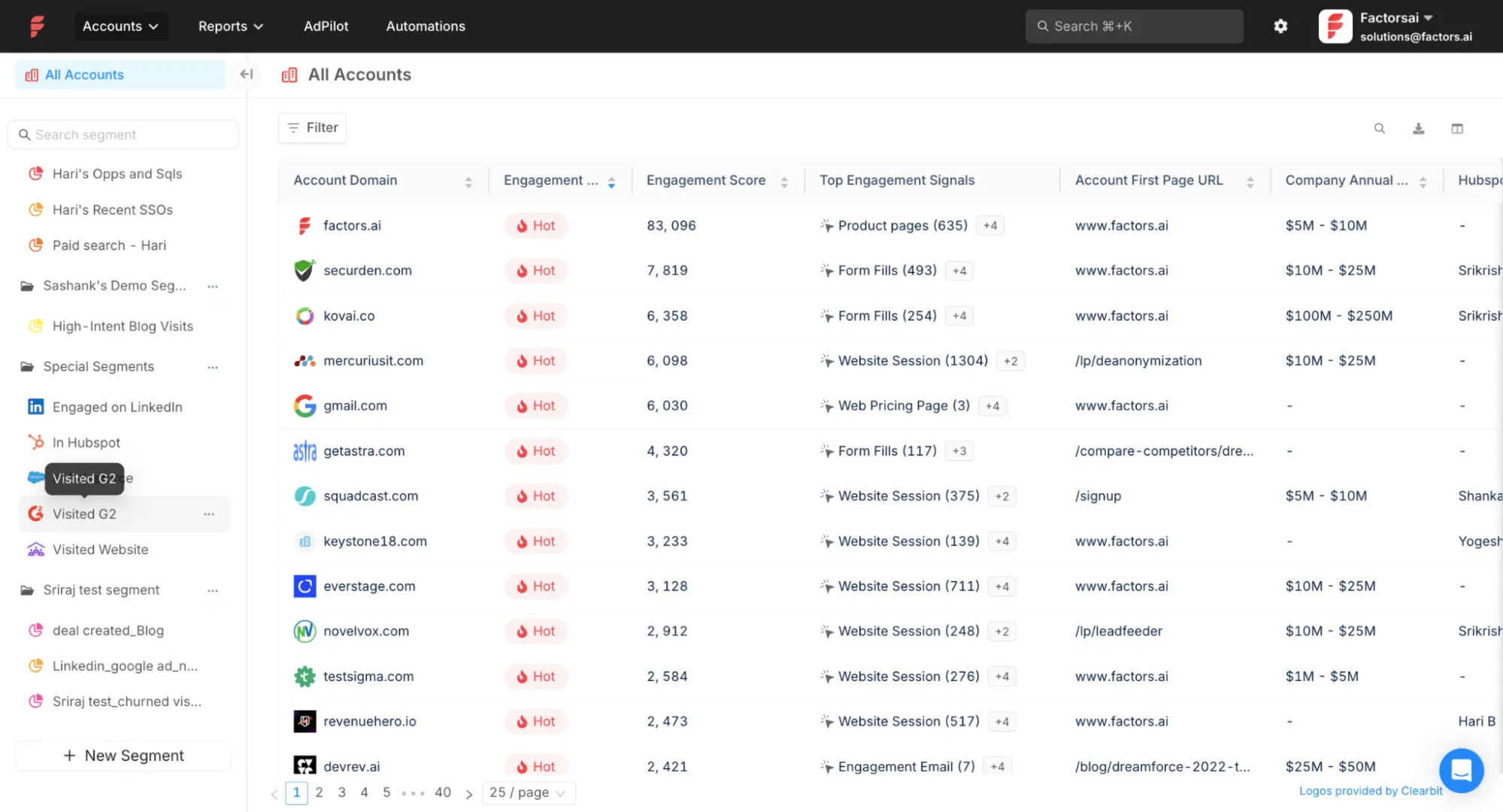
Factors.ai is an account-based attribution and analytics platform. It’s designed for B2B marketers who need to connect anonymous website behavior, multi-touch campaign interactions, and intent signals to actual pipeline and revenue outcomes.
What makes Factors.ai distinctive is how it unifies three core parts of the GTM system: account-level analytics, intent signal tracking, and multi-touch attribution.
This gives GTM teams an end-to-end picture of the buyer’s journey and how every touchpoint contributes to revenue.
Key features of Factors.ai
- Factors intent data layer: Combines first-party website behavior with third-party intent signals from Bombora and G2 to identify which accounts are actively researching topics related to your product.
- Ad campaign analytics: Integrates with LinkedIn Ads, Google Ads, and CTV platforms to measure which ad impressions and clicks contribute most to pipeline creation.
- Journey analytics dashboard: Provides a visual timeline of the buyer journey for each account. It shows how anonymous engagement evolves into qualified leads and eventually, closed revenue.
Pros of Factors.ai
- “The platform’s insights allow you to focus on real prospects and your true audience, which improves marketing efficiency. I also appreciate how easy it is to use, with a clean interface and intuitive workflow.” (Read full review).
- “Factors.ai is more cost-effective and has a much easier interface compared to other tools like Leadfeeder, which I used for over 2 years. The user experience feels smoother and more intuitive.” (Read full review).
Cons of Factors.ai
- “I found it challenging to create filters at the beginning due to the complex and extensive segmentation options in Factors.ai.” (Read full review).
- “The platform can be complex to set up for non-techies. Sometimes I feel that the data we get may not be 100% correct.” (Read full review).
How much does Factors.ai cost?
Factors.ai follows a modular pricing structure based on the size of your account base, number of tracked visitors, and integration scope.
8. DemandScience
Best for:
Demand generation teams looking to combine intent data with audience activation and content-led acquisition programs.
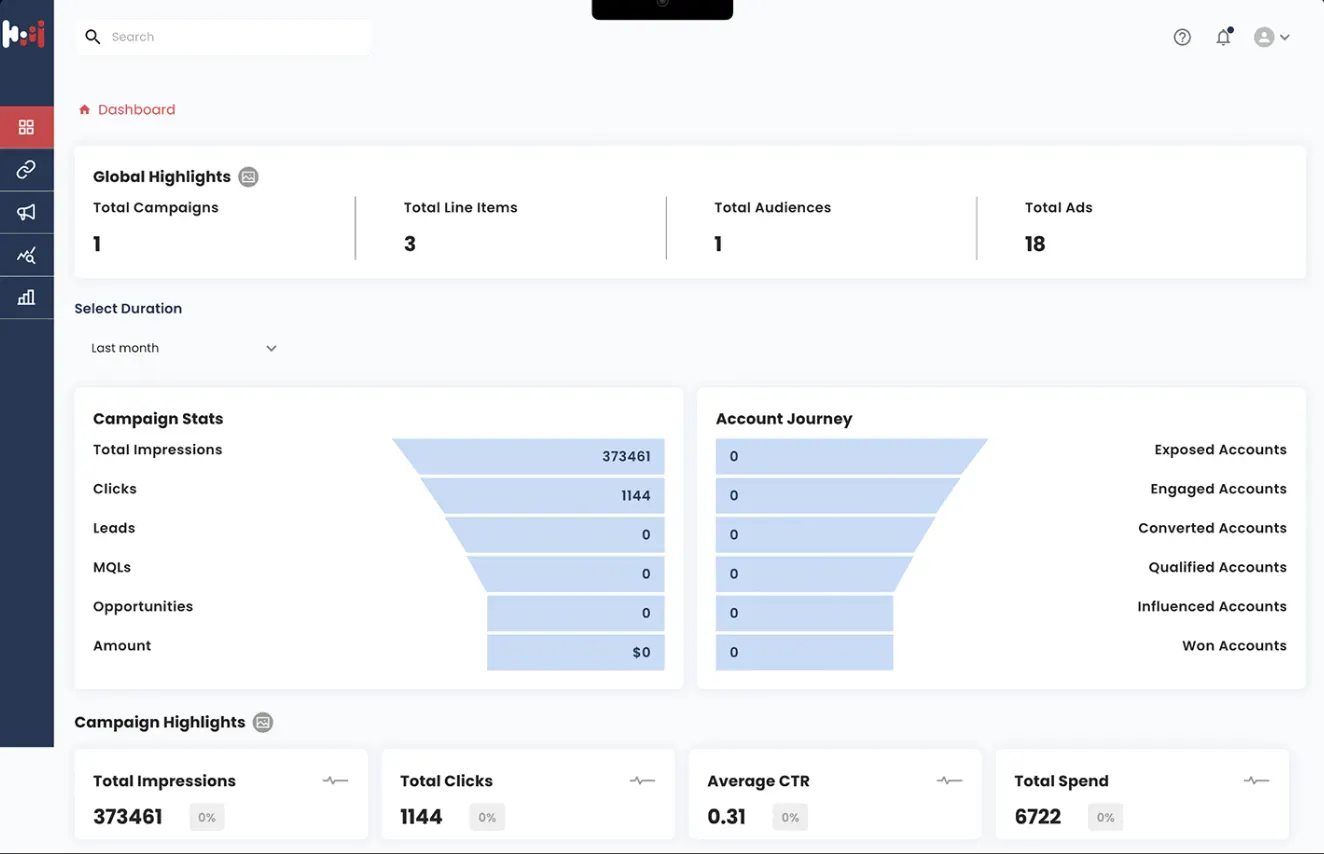
DemandScience is a global B2B demand generation and intent data platform that helps revenue teams identify, engage, and convert in-market buyers.
The platform functions as both a data engine and an activation layer. It continuously monitors online research behavior across thousands of digital properties (e.g., webinar registrations, whitepaper downloads, and content engagements) to identify surges in topic-level interest at the account level.
Once it detects intent, the system scores those accounts based on behavioral intensity, recency, and historical conversion data. From there, marketers can automatically build and deploy campaigns directly through the platform.
Key features of Demandscience
- Ionic™: DemandScience’s intelligence and orchestration layer combines verified buyer data and AI to identify, score, and prioritize in-market accounts.
- DemandScience Identity Graph: Connects more than 247 million global contacts across 26 million+ companies with firmographic, technographic, intent, hiring, job-change, and engagement signals.
- Demand activation: DemandScience supports programs including in-market buyer activation, content syndication, programmatic advertising, website intelligence, and other managed demand-generation motions.
Pros of Demandscience
- “I really like how self-serve the platform is, and how simple it is. Whether it’s building campaigns, uploading creative, or building segments in their Data Studio, the customer support articles, and information bubbles along the way tell you everything you need to know.” (Read full review).
- “Our account reps have all been great, really personable, and knowledgeable – as well as honest about potential setbacks (i.e. they don’t have a super strong database for our particular industry) but came up with great ideas to get contacts and content out there and test and pivot to build a program that (hopefully) works” (Read full review).
Cons of Demandscience
- “The sales process was a little pushy with many follow-ups, but that’s my experience with nearly every sales org, especially in software.” (Read full review).
- “Although the help desk is always available for support, it seems that some of the features just don’t load correctly when I’m updating campaigns or uploading new sender groups/targeted lists.” (Read full review).
How much does Demandscience cost?
DemandScience’s current model combines buyer intelligence with managed activation rather than requiring customers to purchase and administer a traditional ABM software license. Pricing varies by program scope and services.
9. LeadOnion
Best for:
Sales teams looking to combine intent signals, contact data, prospecting, and automated outreach workflows.
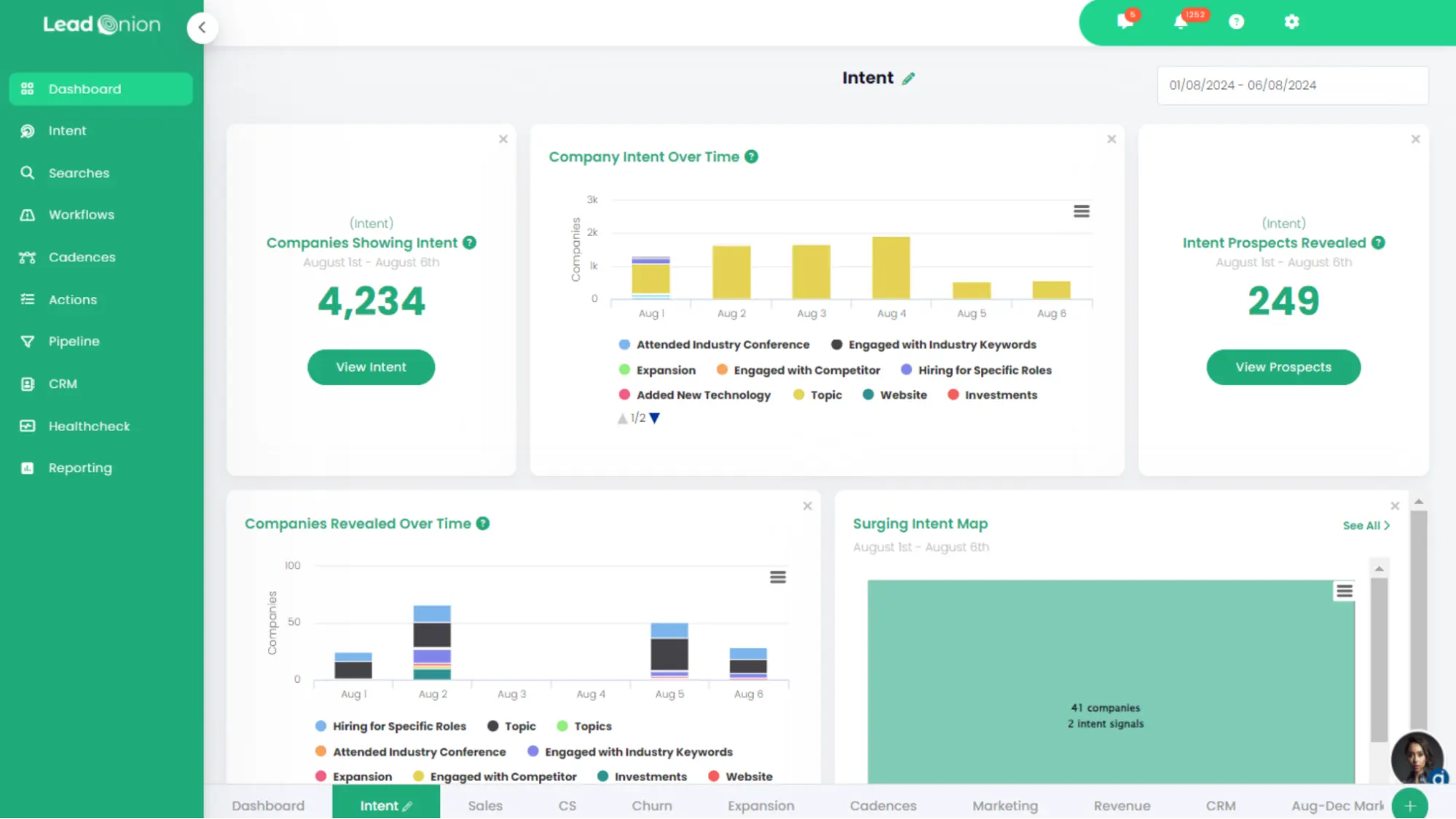
Lead Onion is an AI-powered intent data and sales intelligence platform built to help B2B organizations uncover, prioritize, and convert high-intent prospects across every stage of the buyer journey.
It goes beyond surface-level intent tracking by combining first-party, third-party, and social intent data into one unified dashboard. It also features a database of 50 billion intent signals, 209+ million verified contacts, and 1.4+ billion matched IPs.
All of this empowers both marketing and sales teams with real-time intelligence, enabling them to target active buyers, launch personalized campaigns, and engage decision-makers at the right time.
Key features of Lead Onion
- Smart workflows: Automates next-best actions by triggering personalized campaigns, CRM updates, or outreach sequences when specific intent thresholds are met
- Prospect search: Uses 30+ firmographic and engagement filters to discover the right buyers. Also features a database of 400+ million GDPR-compliant profiles.
- Reveal actions: Features AutoReveal, Lead Flows, and Quick Reveal to instantly uncover decision-makers the moment they show buying intent.
Pros of Lead Onion
- “Its intent-based prospecting feature is particularly beneficial, as it utilizes real-time intent signals from multiple sources, making my lead generation efforts more targeted and efficient.” (Read full review).
- “I enjoy how this tool handles data, contacts, and signals, and it offers scaling opportunities with minimal effort. The automated lead prospecting and sales outreach workflows add value to my experience.” (Read full review).
Cons of Lead Onion
- “The onboarding process felt a little hectic and complicated for the sales agents.” (Read full review).
- “I find the complex filtering experience in Lead Onion challenging, and I believe it could be improved by tweaking the user experience.” (Read full review).
How much does Lead Onion cost?
Lead Onion publishes multiple pricing options. Its Growth offering is currently listed at $2,000 per month and includes 100 intent triggers, 3,000 contact reveals, 10 users, and person-, account-, and website-based intent capabilities. Pricing and package availability can vary, so check Lead Onion’s current pricing page before purchase.
10. Leadfeeder
Best for:
B2B sales teams focused on website visitor identification, company intelligence, and prioritizing accounts already engaging with their site.
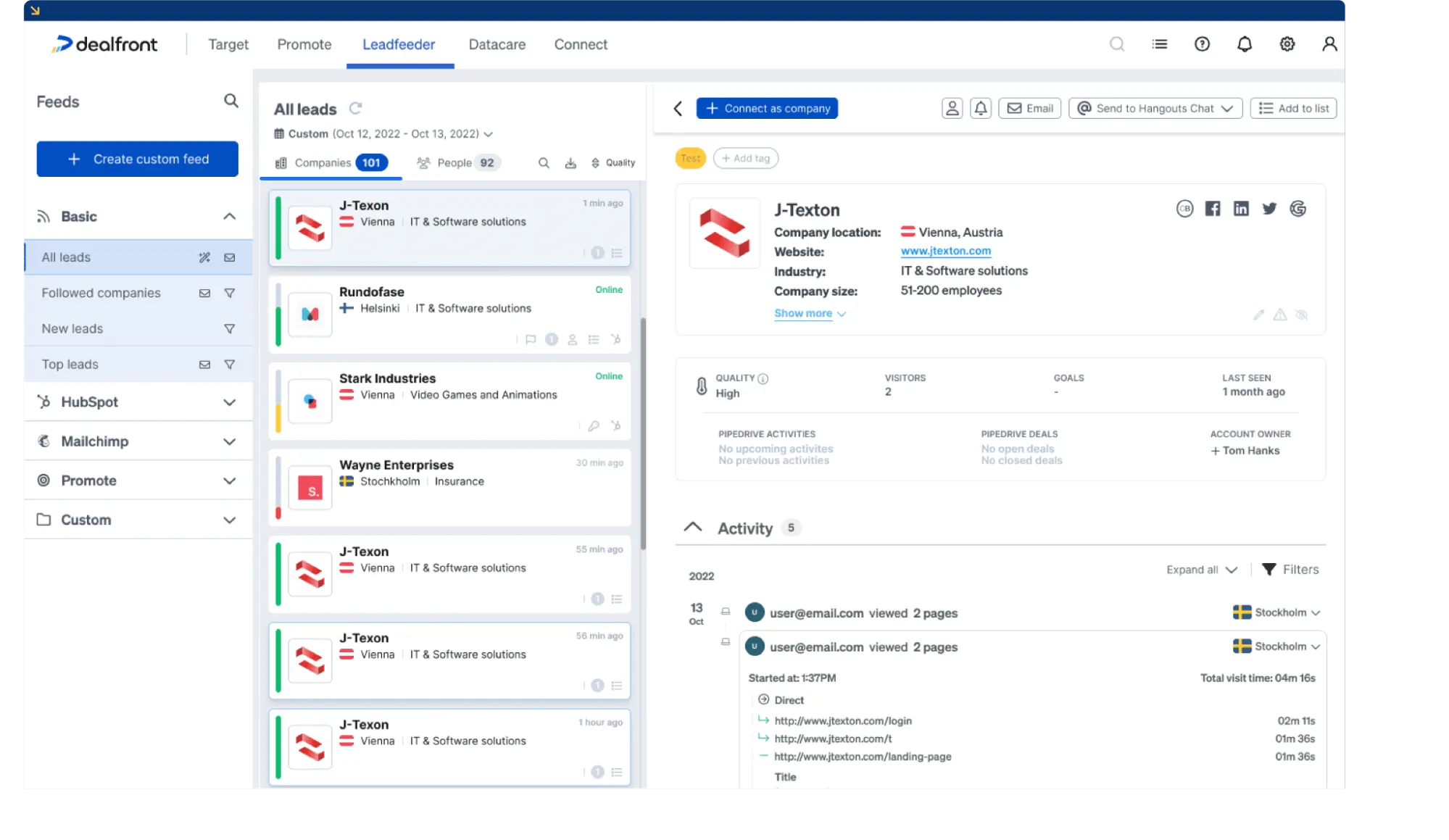
Leadfeeder is a B2B website visitor identification and account intelligence platform that helps revenue teams identify companies visiting their website, understand their buying behavior, prioritize high-value accounts, and turn anonymous traffic into sales opportunities.
The platform now combines website visitor identification with company and contact intelligence, buying intent signals, automated workflows, advertising activation, and AI-assisted account prioritization.
Key features of Leadfeeder
- Website visitor identification (Leadfeeder Core): Identifies companies visiting your website in real-time by matching visitor IP addresses to a proprietary database of business networks and organizations.
- Custom feed filters and account targeting: Allows you to create filtered views of website visitors based on firmographic criteria, behavior patterns, or custom tags.
- GDPR-compliant data framework: Leadfeeder ensures all data is first-party verified, transparent, and ethically sourced.
Pros of Leadfeeder
- “This is one of the best tools for tracking website visitors and understanding how they navigate through different pages.” (Read full review).
- “Leadfeeder gives us valuable insight into who is visiting our website and helps us identify potential clients we may not have reached otherwise.” (Read full review).
Cons of Leadfeeder
- “I find the filtering process in Leadfeeder a bit lacking. Specifically, I need better functionality to categorize and filter individuals who sign up for webinars separately from new leads just visiting the website.” (Read full review)
- “What I like less about Leadfeeder is that some identified companies sometimes lack precise details, which can complicate lead qualification.” (Read full review).
How much does Leadfeeder cost?
Leadfeeder pricing depends on your setup and needs. They offer different bundles tailored to different business sizes (Start up, Enterprise).
11. HockeyStack
Best for:
Revenue teams that want account-level journey analytics and attribution tied to pipeline and revenue.
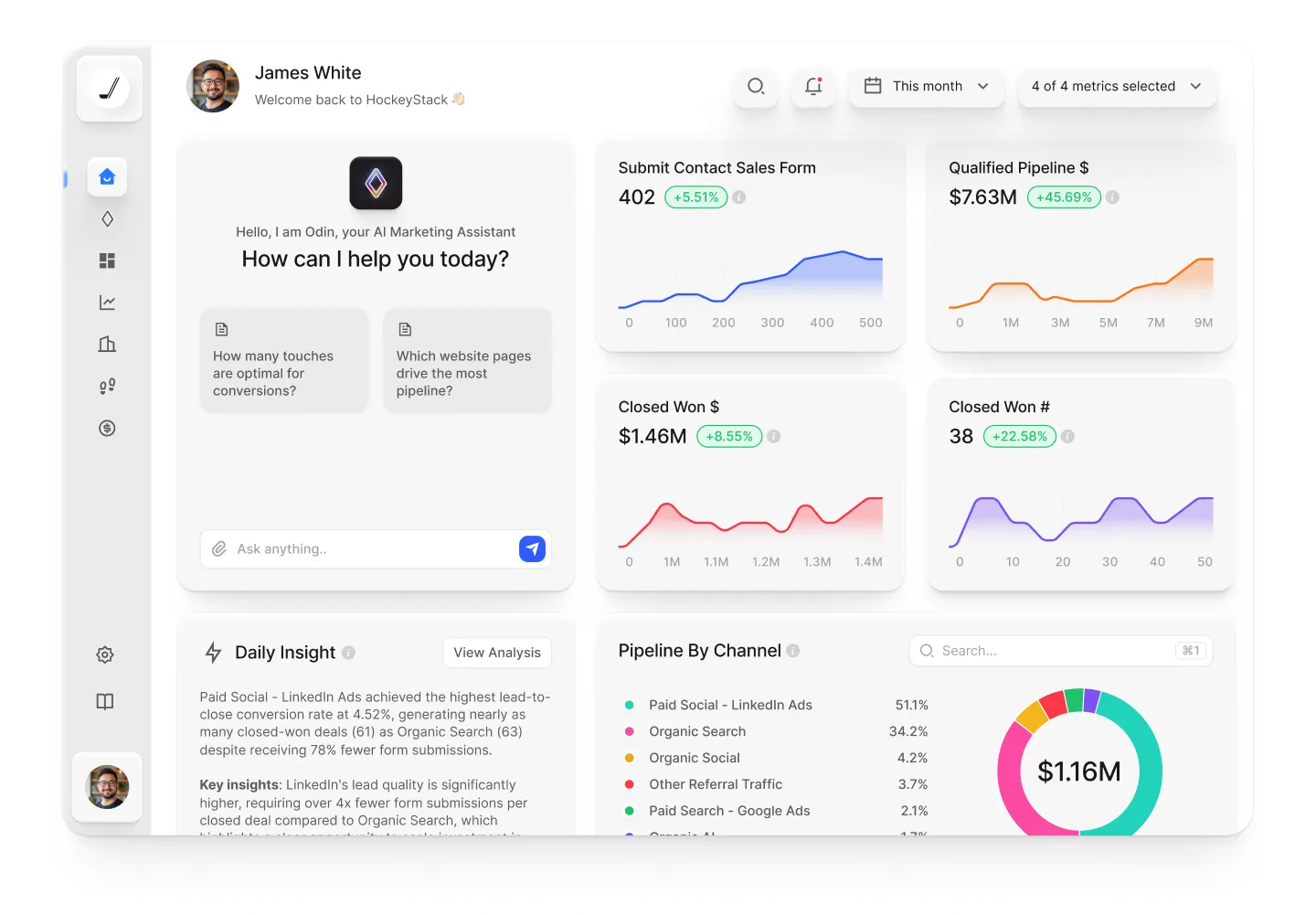
HockeyStack is a B2B revenue analytics and go-to-market intelligence platform designed to show how marketing and sales activities translate into pipeline and revenue.
Its core job is to unify data from your website, product, CRM, and marketing tools, then turn that data into reliable attribution, buyer journey visibility, and account-level insights that revenue teams can act on.
In practice, HockeyStack replaces fragmented reporting across tools like Google Analytics, HubSpot, Salesforce, ad platforms, and product analytics.
It tracks how anonymous visitors become known accounts, how those accounts engage across channels, and how specific touchpoints influence opportunities and deals.
Key features of HockeyStack
- Account-based analytics (ABA): Groups engagement data at the account level , allowing teams to measure how collective buying committees interact with your brand across channels.
- Custom attribution models (Linear, U-Shaped, W-Shaped, Algorithmic): Lets teams customize how credit is distributed across touchpoints.
- Lift reports: Measures the incremental impact of campaigns or initiatives by comparing exposed vs. unexposed accounts, helping teams understand what actually moved pipeline.
Pros of HockeyStack
- “What I like best about HockeyStack is that I was able to set everything up on my own with support from our CS rep. I didn’t need to involve our in-house data team and after learning the ropes, I’ve been able to continue building reports myself.” (Read full review).
- “The product was live and fully integrated in under 2 weeks. From day one, we had real-time visibility into what was actually driving our pipeline.” (Read full review).
Cons of HockeyStack
- “The initial configuration and setup have a steep learning curve. You’ll need a strong SME during initial configuration to build your properties correctly.” (Read full review).
- “While HockeyStack’s platform is genuinely “no-code”, you will need an adept technical user to manage the backend and enable channel-owners for your team to get value.” (Read full review).
How much does HockeyStack cost?
HockeyStack offers a custom-pricing model depending on the plan (marketing intelligence and/or account intelligence), and connected data sources.
12. UserGems
Best for:
Teams that use relationship signals, job changes, and champion movements to identify warm pipeline opportunities.
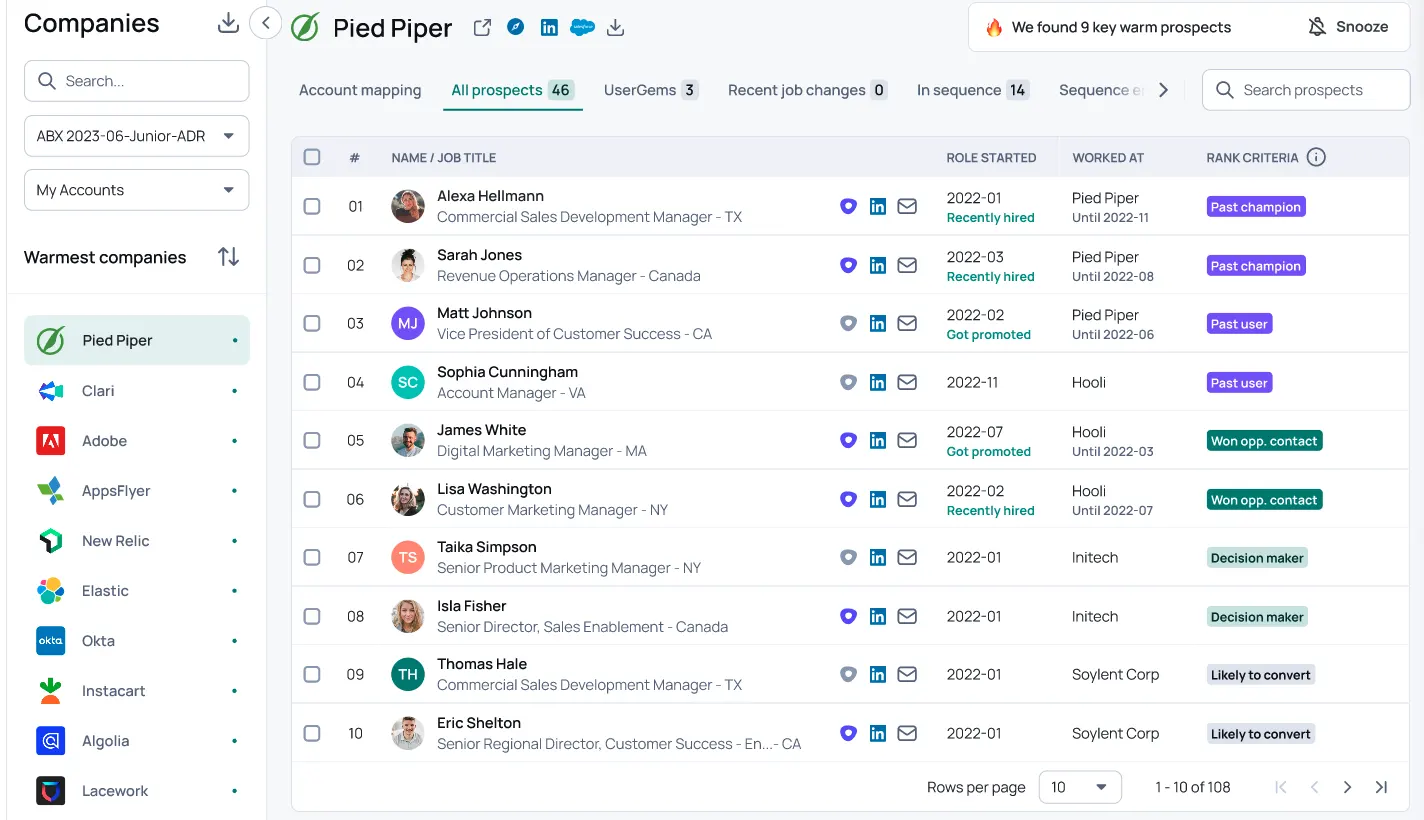
UserGems is a relationship intelligence and revenue platform that helps B2B companies identify the warmest paths to pipeline. It tracks job changes, champion movements, and buying intent across their total addressable market.
What makes UserGems stand out is that it adds a human relationship layer, analyzing who your buyers are, where they’ve gone, and when they’re most likely to buy again.
This approach helps B2B marketing and sales teams capture “hidden demand” by engaging contacts who already know, trust, or have used their product in the past.
Key features of UserGems
- Job change detection: Automatically identifies when contacts in your CRM change companies or roles.
- Champion tracking: Tracks champions and key buyers across their career journey, so sales teams can re-engage trusted contacts when they land in new buying positions.
- Account expansion alerts: Flags promotions or internal role changes within existing customer accounts that indicate upsell, cross-sell, or re-engagement opportunities.
Pros of UserGems
- “I used UserGems regularly in my previous role, and it quickly became one of my favorite sales tools. It made it so easy to stay on top of buyer and customer job changes.” (Read full review).
- “Usergems makes it easy for me to track the highest intent and warmer prospects without having to spend hours every week building manual lists for myself to track through.” (Read full review).
Cons of UserGems
- “Would love to see deeper enrichment on smaller accounts and slightly faster sync times.” (Read full review).
- “Sometimes the email pings gets to me after I am far into the deal, and would love to involve the people identified sooner. (Read full review).
How much does UserGems cost?
UserGems currently publishes three primary plans: Core at $3,333 per month ($40,000 annually), Advanced at $6,250 per month ($75,000 annually), and Elite at $12,500 per month ($150,000 annually). Usage allowances and implementation costs differ by tier.
13. Lusha
Best for:
Prospecting teams that need contact enrichment and sales intelligence with lightweight intent capabilities.
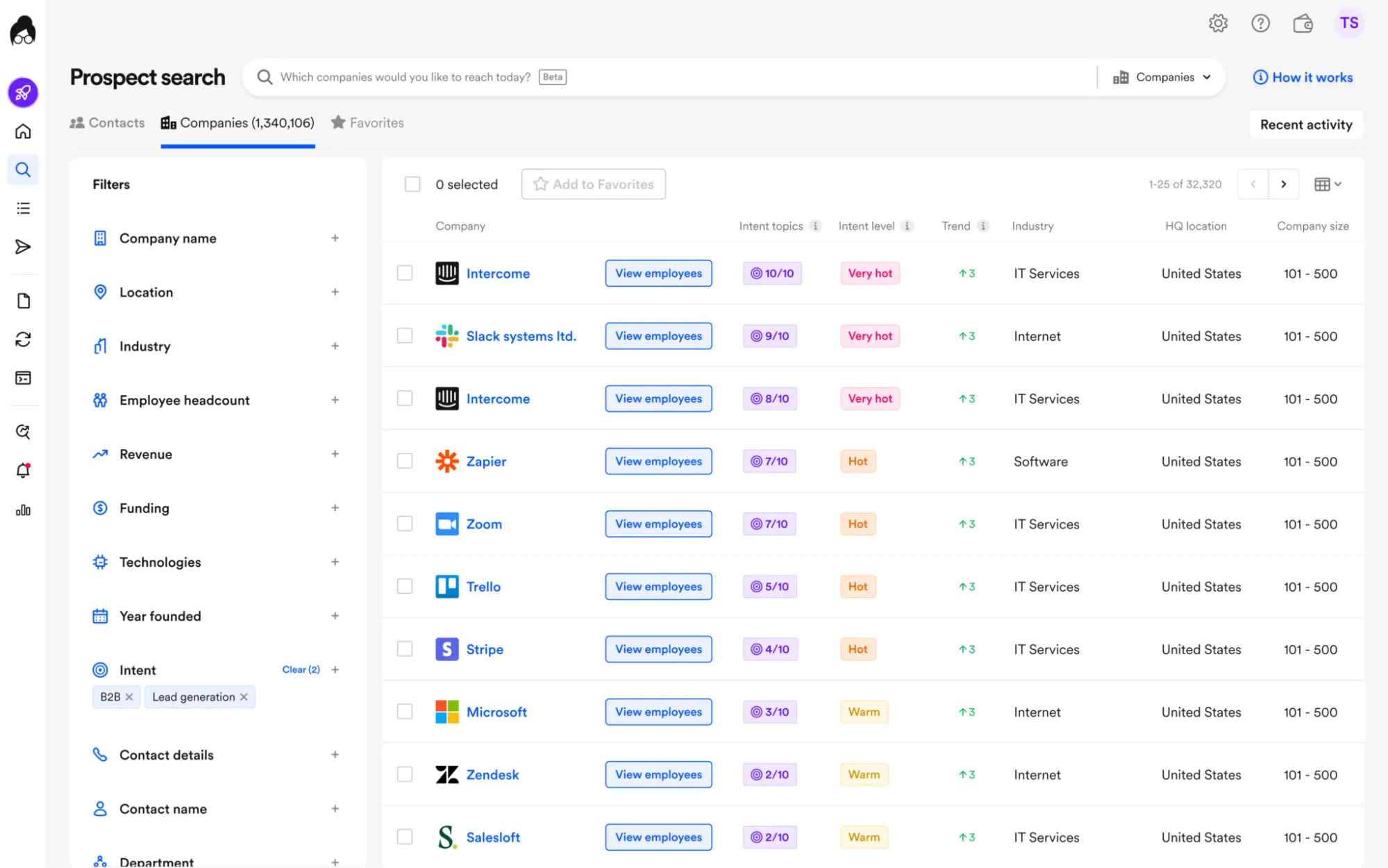
Lusha is a B2B sales intelligence and prospecting platform that helps revenue teams find, verify, and enrich contact and company data. This includes providing accurate email addresses, phone numbers, and firmographic data tied to real decision-makers.
It works by pulling together verified contact information from multiple data sources and delivers it through a browser extension, web app, and CRM integrations.
Reps then use it to identify buying personas, enrich leads and accounts, and remove friction from outbound workflows.
Key features of Lusha
- Chrome extension: Surfaces verified contact and intent data directly on LinkedIn, company websites, and CRM platforms.
- Prospect recommendations: Uses AI to analyze user search patterns and engagement history, suggesting new accounts and contacts that align with ongoing campaigns or match recent buying signals.
- Lusha Conversation: An AI notetaker that records sales meetings, generates summaries and action items, and turns conversation insights into data that can feed prospecting and CRM workflows.
Pros of Lusha
- “I really like how easy Lusha makes it to find direct contacts without jumping through multiple tools. The Chrome extension works smoothly on LinkedIn, and most of the data.” (Read full review).
- “Lusha makes prospecting so much faster and more accurate. I especially like how easily it integrates with LinkedIn and CRM tools like HubSpot and Salesforce.” (Read full review).
Cons of Lusha
- “I find the credit system frustrating because when I spend a credit to reveal a contact and the number is outdated or incorrect, I still lose that credit.” (Read full review).
- “There are too many instances where I activate the browser extension on a prospect’s profile, and Lusha either returns zero contact information or provides data that is clearly outdated, such as a previous company phone number or a bounced email address.” (Read full review).
How much does Lusha cost?
Lusha currently offers five plans: Free, Starter, Pro, Premium, and Scale. The Free plan includes 40 credits per month. Starter is designed for a single user; Pro includes two seats and can expand to 10; Premium includes five seats and can expand to 25; and Scale supports unlimited seats with custom credit volumes and terms. Self-service pricing varies by credits and billing term.
14. G2
Best for:
Software companies that want to identify accounts researching their category, product, competitors, and peer reviews.
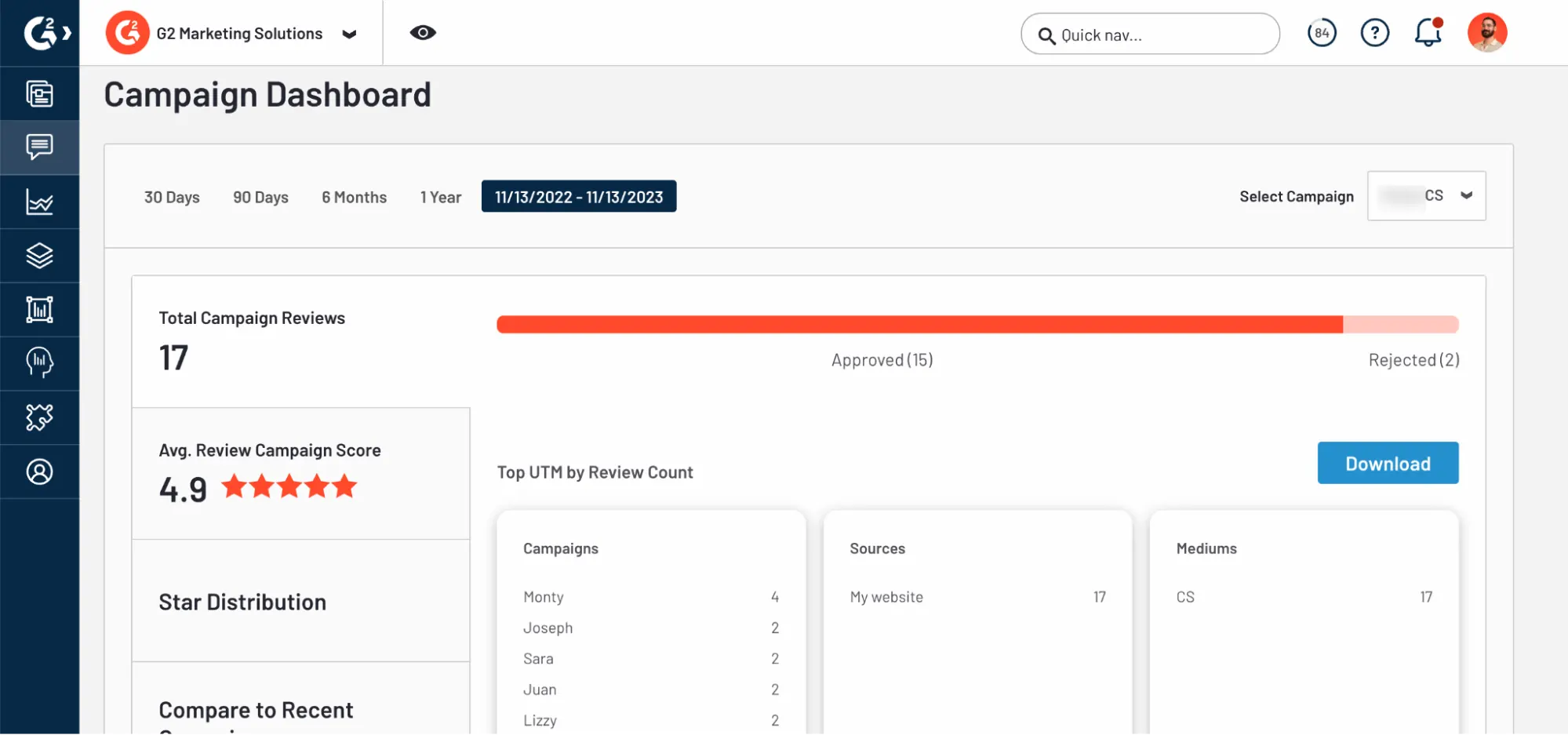
G2 is a B2B software marketplace and buyer intelligence platform that helps companies influence, capture, and convert in-market demand using verified peer reviews and buyer behavior data.
It shows which accounts are actively researching software, what they’re comparing, and how vendors can engage those buyers at the right moment.
G2 aggregates millions of authenticated user reviews across thousands of software categories. Buyers use G2 to research tools, compare alternatives, and validate shortlists.
On the vendor side, G2 turns this buyer activity into intent signals, account insights, and performance data that sales and marketing teams use to prioritize outreach and shape messaging.
Key features of G2
- G2 buyer intent: Identifies accounts actively researching your product category or competitors based on real activity on the G2 platform.
- Verified reviews engine: Collects and validates user reviews to ensure authenticity, credibility, and relevance for buyers and vendors.
- Grid reports: Visual comparison grids that rank products by customer satisfaction and market presence, influencing buyer shortlists.
Pros of G2
- “G2 Marketing Solutions offers a user-friendly interface and a wide range of marketing tools that simplify campaign management.” (Read full review).
- “It’s really user friendly, there’s a lot of support. When confused about anything Support is very easy to access.” (Read full review).
Cons of G2
- “The shortcomings of the integrations. The 6sense integration has been disappointing, especially since it was one of the main reasons we purchased G2 Marketing Solutions.” (Read full review).
- “At times, reporting lacks deeper segmentation, which makes it challenging to measure ROI for specific channels.” (Read full review).
How much does G2 cost?
G2 (review and research platform) is free. However, if you’re a company wanting to market your software on G2 or use their seller tools, there are paid plans. Solutions like Buyer Intent or advanced insights typically are custom-priced.
15. Dreamdata
Best for:
B2B teams focused on buyer-journey analytics, multi-touch attribution, and connecting marketing activity to pipeline.
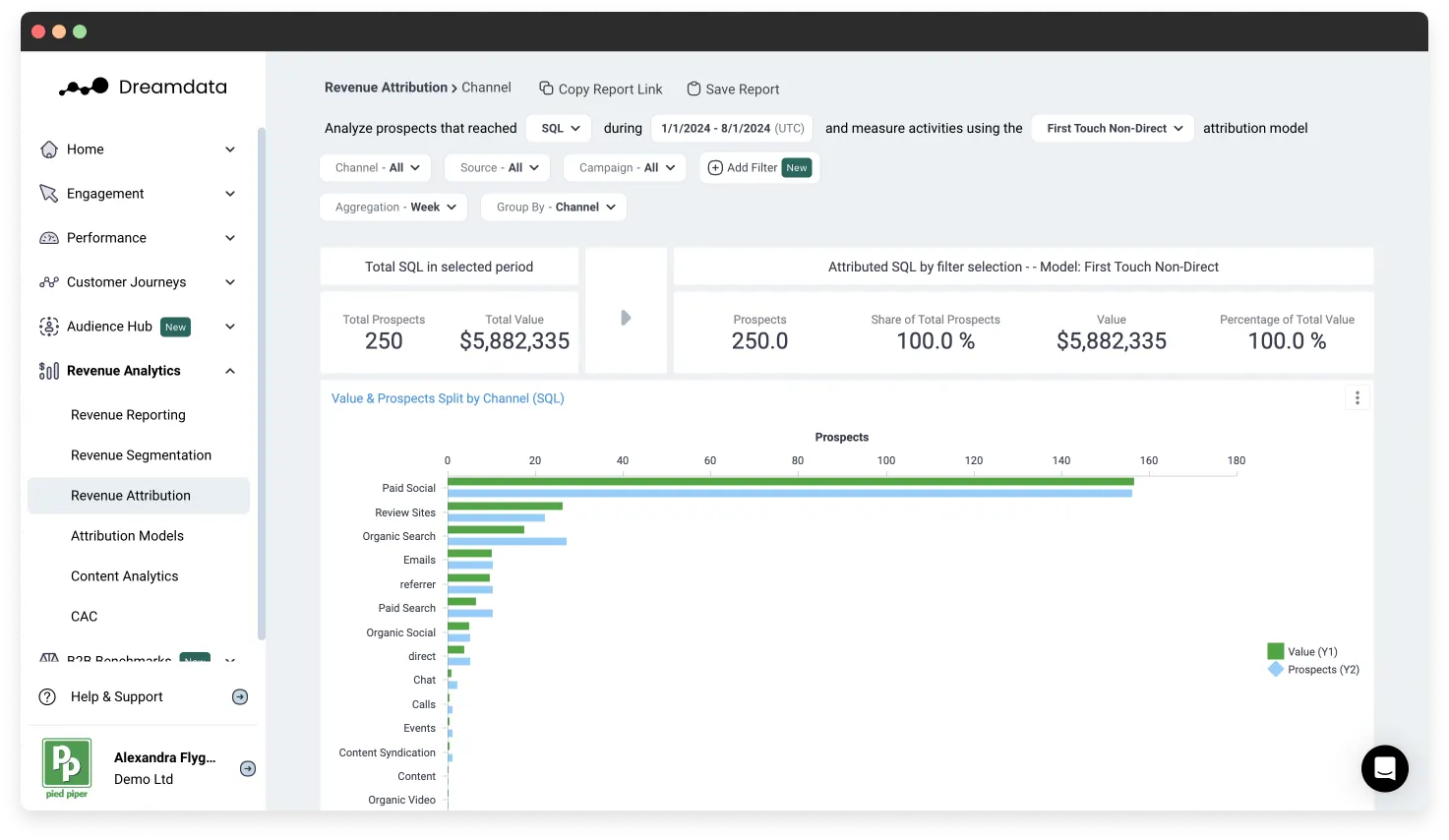
Dreamdata is a B2B revenue attribution and GTM analytics platform built to show how marketing and sales activities influence pipeline and revenue.
It connects every touchpoint (from first anonymous visit to closed-won deal) and assigns clear revenue impact to channels, campaigns, and interactions.
Here’s how it works: Dreamdata ingests data from your CRM, marketing automation platform, website analytics, ad platforms, and sales tools.
It then stitches this data together at the account and opportunity level, creating a single, end-to-end view of the B2B buyer journey. This allows teams to understand which efforts drive qualified pipeline, which touchpoints accelerate deals, and where revenue leakage occurs.
Key features of Dreamdata
- Audience hub: Helps you create relevant audiences using unlimited filters like web visits, ad engagement, pipeline stages, and intent signals.
- Customer journeys: Connects anonymous website behavior, known leads, accounts, and opportunities into one continuous buyer journey timeline.
- Signals: Uses AI to scan all your GTM data and identify hidden intent signals that correlate with actual pipeline and revenue.
Pros of Dreamdata
- “Dreamdata gives us full visibility into our customer journey and multi-touch marketing attribution right out of the box.” (Read full review).
- “Dreamdata provides the ability to visualize extended complex B2B buyer journey in a simple to understand journey map.” (Read full review).
Cons of Dreamdata
- “The user interface feels a bit outdated and not as intuitive as it could be. Simplifying navigation and improving data visualization would make the overall experience much smoother.” (Read full review).
- “Some of the naming conventions in the platform are not the same in the company and that causes some confusion.” (Read full review).
How much does Dreamdata cost?
Dreamdata offers a Free plan at $0 per month for foundational B2B analytics. Its Advanced Attribution & Activation offering uses custom pricing and unlocks advanced attribution, AI activation, and higher data volumes.
See Who’s In-Market, Know What They Want, Close More Deals
Frequently asked questions about intent data tools
What is the best intent data tool for B2B marketing?
The best intent data tool depends on how your team plans to use the signal. If you need an integrated account-based GTM platform, prioritize tools that combine intent with account intelligence, scoring, advertising, sales workflows, and measurement. If you only need third-party research signals, a specialized intent data provider may be enough.
What is the difference between an intent data platform and a sales intelligence platform?
An intent data platform focuses on behavioral signals that may indicate what an account is researching and when interest is increasing. A sales intelligence platform typically focuses more heavily on company, contact, firmographic, and prospecting data. Many modern platforms combine both capabilities.
Do intent data platforms integrate with Salesforce, HubSpot, and marketing automation tools?
Many B2B intent platforms integrate with CRMs and marketing automation systems so teams can push intent signals into account records, scoring models, audiences, alerts, and automated workflows. Integration depth varies by provider, so evaluate the specific CRM, marketing automation, sales engagement, and advertising systems your team uses.
Can intent tools identify anonymous website visitors?
Some intent and account intelligence platforms can match anonymous website activity to a company or account. That account-level identification can then be combined with CRM records, known contacts, buying-group data, and other signals to help revenue teams decide how to respond.
How should B2B teams use real-time intent signals?
Real-time intent is most useful when it changes what your team does. For example, a meaningful signal might increase an account’s priority, trigger a seller alert, add the account to an advertising audience, personalize the website experience, or initiate a relevant outreach workflow.
Should intent data be used by itself to prioritize accounts?
No. Intent is more useful when it is evaluated alongside account fit, first-party engagement, CRM activity, buying-group information, and other signals. A research spike can indicate increased interest, but your team still needs context to determine whether the account is relevant and what action makes sense.
Related → Learn more about buyer intent and how B2B teams can use it
Your next big deal is already showing intent. Demandbase finds it.
The market is full of platforms that surface intent data. What separates Demandbase is what happens after you identify intent.
- Can you act on it immediately, or does it require manual work that slows you down?
- Can you orchestrate engagement across channels, or are you running disconnected campaigns?
- Can you reach entire buying committees, or just individual contacts?
Demandbase answers “yes” to all these questions because it was built to turn intent into revenue.
You also get:
- Full-funnel orchestration: When an account shows surge intent, Demandbase automatically adds them to retargeting campaigns, personalizes their website experience, alerts the account owner, and updates your CRM.
- Direct pipeline attribution: Demandbase tracks how intent-driven campaigns influence opportunities and revenue. You can prove that accounts exposed to your campaigns generated more pipeline, closed faster, and converted at higher rates than cold outreach.
- Buying committee visibility within target accounts: Demandbase household-level targeting reaches multiple decision-makers within the same account, even when you don’t have contact data for all of them.
- Real-time sales intelligence that shortens time to action: Intent signals and account engagement data flow directly into Salesforce or HubSpot in real-time, so reps see which accounts are hot without leaving their CRM.
And Christian Lowery, ABX Programs Team Lead, Global Field & Channel Marketing at CyberArk further confirms this:
The Intent Data You Need, The Action You Can Take.
We have updated our Privacy Notice. Please click here for details.