

Insight: The state of B2B marketing
Key takeaways from Alicia Hale and Rob Jekielek’s keynote at GO NYC 2025

How do B2B marketing leaders feel about the state of their industry and the trends driving it? To find answers, Demandbase called upon Rob Jekielek, Managing Director of The Harris Poll. Founded back in 1956, Harris polls millions of people annually on the trends shaping today’s world.
Jekielek and his team surveyed over 500 B2B marketing leaders who work for companies with revenues of at least $100 million, with the majority of them working for companies generating over $1 billion annually. These leaders were asked their views on the current state of B2B marketing, the biggest challenges they confront, and their top priorities moving forward.
Alicia Hale, SVP, Growth Marketing at Demandbase, spoke with Jekielek about the survey results during a session [can we link to video here?] at the recent Demandbase GO event in New York City.
Go-to-market strategies: Account-based predominates
A whopping 96% of the B2B marketing leaders surveyed had a clear GTM strategy, with 64% having what they’d describe as a “highly-advanced strategy.”
When it comes to the structure of their GTM approaches, 65% of the surveyed leaders are using a hybrid of account-based strategies (targeting B2B buying groups) and lead-first strategies (target individual prospects).
Of the B2B organizations having a “pure play” GTM approach, which is more popular – “pure” ABM or “pure” lead-first? It turns out that ABM is more popular, with 20% of companies deploying it versus 15% who solely deploy a lead-first approach.
The bottom line on GTM approaches? A jaw-dropping 85% of B2B marketing leaders are deploying either a hybrid or “pure” form of ABM as their GTM strategy.
Top channels buyers used to engage customers
The top channels marketers invest in to engage purchasers, according to the Harris survey, are the “usual suspects”:
 Of course, engagement needs to be omnichannel in today’s B2B marketplace, meaning that sellers need to go wherever buyers go. Jekielek says that Google search has been a dominant “discovery” channel for decades, but he also mentioned the emergence of generative AI tools such as ChatGPT as an emerging channel for buyers who are researching B2B purchases.
Video content (and YouTube) is increasingly influential in the early buying stages, notes Jekielek. “Every B2B marketer knows that video content is really important for catching people’s attention” during the buying process.
As Hale explains, “it’s such an interesting balance trying to maintain the channels you have now while moving to these new channels [like ChatGPT] that are up and coming.” Hale stresses that, no matter the channel, the quality of the messaging and the consistency of your GTM approach will always matter to buyers.
“Even though there’s so much technology and so many new channels to consider,” says Hale, “we must continue to invest in the fundamental things that make us marketers. And that’s customer-centricity, it’s buyer-centricity, it’s delivering value in every action we take.”
Biggest challenges and roadblocks
With so much happening around technology and buyer behavior, it’s never been tougher for B2B marketers to define the right strategic approach and execute it effectively. Change can represent opportunity, but can also create confusion and fragmentation.
What are the biggest challenges B2B marketing leaders cite, those most impacting their ability to effectively execute on their GTM strategies?
 As Hale says, B2B sellers need strategic clarity before they can tackle any operational challenges they might face. “You need to be able to start with an outcome in mind and align it to the buying group – that helps you be more effective in a landscape of rapid change” in technology and buying behavior.
Of course, integrating your systems and aligning your teams is mission-critical. Revenue-generating success can only come after you’ve built a shared playbook (fueled by shared data) and defined a cohesive GTM strategy that aligns people and technology around target accounts.
Data quality is an essential success factor, notes Jekielek. “Data should do two very important things. It should create confidence and it should create clarity. Data freshness is also crucial as we’re moving from lead gen to accounts to buying groups. Having fresh data based on what’s happening dynamically in the marketplace is critical” for addressing customer needs as they evolve.
Hale adds that “data really is the engine that powers much of the innovation that we’re driving as marketers. So we should be ensuring that the data is clean, not duplicated, and structured for the tools you use. Having a data strategy is incredibly important for removing these barriers we see in the survey.”
AI for B2B: Opportunities and challenges
What are the capabilities that B2B marketing leaders want from AI, and what are their concerns around AI?
 Hale emphasizes that building AI capabilities takes time and a clear understanding of the specific use cases you want AI to address. “I’d encourage GTM teams to start small, identify those use cases where you can get short-term impact from using AI, and start your investment from there as you scale up small wins.”
Hale again stresses the need to have strategic clarity from the beginning: “start with outcomes in mind and figure out how to use AI to work towards those outcomes. Focus on the buying group and ensure that you’re treating them as people and targeting them the right way with the right messages as you align your tools and your teams around the buyer.”
Priorities moving forward
Jekielek closed the session by explaining the top three investment priorities of B2B marketing leaders over the next year:
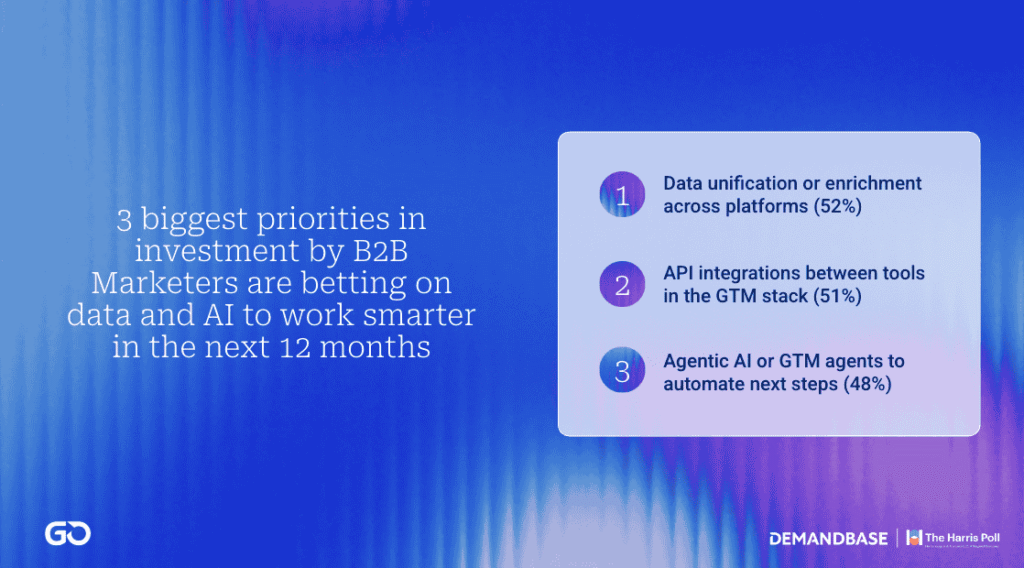
Each of these priorities involves data, as well as the integration of both data and the tools fueled by data. Among those tools fueled by data, Hale notes, are AI agents.
“It was really gratifying to see the direction towards agentic AI in the survey,” she says, “knowing that we at Demandbase are investing heavily in agents to act as assistants [on behalf of B2B GTM teams]. We have a vision of having agents serve as force-multipliers for GTM teams and providing them with faster time-to-value. After all, this is really what today’s B2B marketers are looking for.”
Want the full story? Watch the complete session today.
Related content



We have updated our Privacy Notice. Please click here for details.