

From insight to action: How sales and marketing teams drive pipeline with Demandbase + LLMs

Most sales and marketing teams don’t have an intelligence or data problem. They have an execution problem.
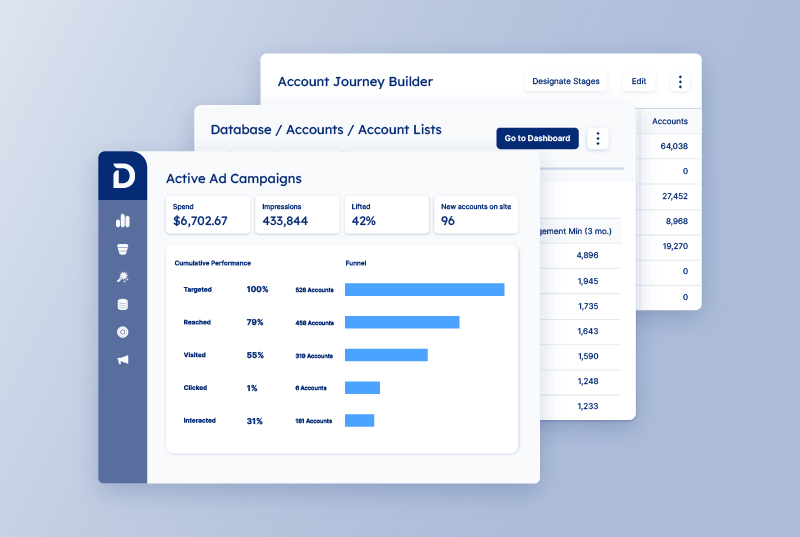
Your Demandbase platform is already surfacing intent signals, ranking accounts, and tracking buying group engagement. LLM integrations, like with ChatGPT, can transform this data into action without having to work inside the platform – minimizing administrative effort while maximizing outcomes and impact.
That’s what makes Demandbase’s new integration with ChatGPT, Claude, Copilot, and Gemini, a tangible improvement in how ABM gets executed. Instead of toggling between platforms and running queries in separate dashboards, your teams can ask a plain-language question and get a prioritized, actionable answer — right inside ChatGPT (or other).
This isn’t AI as a brainstorming assistant. This is AI as an execution arm for your go-to-market motion.
What is the MCP integration, and why does it matter?
Demandbase, and other SaaS companies, use a Model Context Protocol (MCP) to connect to AI products like ChatGPT to provide access to data for customers. It’s like an API for other non-AI integrations. The result: These LLMs can now query their Demandbase data from their tenant — such as real-time intent signals, engagement history, contact data, buying group composition — and help your team act on it immediately.
The practical impact is significant. The abundant administrative work taxes revenue teams’ ability to execute: pulling reports, enriching CRM records, building lists, and preparing for calls. The Demandbase + ChatGPT integration minimizes this administrative tax so you can focus on driving pipeline. You move from insight to execution in a single conversation — no exports, no manual steps, no context-switching.
For sales: Stop prepping, start closing
- Walk into every call fully briefed — in seconds. Ask ChatGPT to pull a full account profile including recent news, tech stack, and historical engagement with your brand. What used to take 20 minutes of research now takes 20 seconds. Your reps arrive informed and credible every time.
- Know exactly who to call, and when. Rather than sorting through territory lists manually, reps can ask: “Who are the highest-intent accounts in my territory this week?” Demandbase’s intent and engagement data gets synthesized into a ranked, ready-to-act list — so reps spend their time on the accounts most likely to convert, not the ones that are just large.
- Find the right person inside the account. Buying groups are rarely one person. Query ChatGPT: “Who are the top engaged people at [Account] in the last 30 days?” You’ll get a ranked list of contacts based on their actual engagement activity — so your outreach targets the people who are already paying attention.
- Get messaging that’s relevant, not generic. Instead of defaulting to boilerplate sequences, reps can ask: “How should I open a conversation with this account based on the intent signals it’s showing?” The response is grounded in what that account is actually researching — making outreach far more likely to get a reply.
- Eliminate manual CRM data entry. Reps can enrich CRM records with up-to-date contact information directly from within ChatGPT. No more copy-pasting between tools or chasing down outdated records.
For marketing: Build better audiences and smarter campaigns
- Build precision audiences without complex filters. Marketers can construct highly targeted segments using plain language — for example: “Find me biotech companies using Snowflake that received Series B funding in the last 12 months.” What once required a data analyst and a few hours now takes a single query.
- Trigger campaigns at exactly the right moment. Connect live intent signals to campaign activation. When an account crosses a specific buying-stage threshold — say, repeated visits to your pricing page — you can automatically trigger the right campaign rather than waiting for a weekly list review.
- Identify the gaps in your buying groups. Not every key persona at a target account is engaged. Query buying group composition to surface missing roles or under-nurtured contacts, then build targeted programs to bring them into the conversation before a deal stalls.
- Get unified revenue intelligence without the exports. Ask cross-platform questions like: “Compare our top engaged accounts in Demandbase with open opportunities in Salesforce.” You get a consolidated view of pipeline health — without manually pulling data from multiple systems.
- Build smarter event invite lists, faster. Filter contacts at target accounts by recent activity, firmographics, and buying stage to ensure your event invitations land with the people who are actually in-market — not just the ones with the right job title.
These Demandbase LLM integrations don’t change your ABM strategy. They remove the friction that was slowing down its execution. When your sales reps spend less time researching and your marketers stop manually building lists, the work that actually moves pipeline — the right conversation, at the right time, with the right person — happens faster and more consistently.
That’s what Agentic GTM looks like in practice: not AI replacing your team, but AI clearing the path so your team can do their best work.
Ready to turn insights into pipeline?
Reach out to your CSM to get started!


We have updated our Privacy Notice. Please click here for details.