
Sales–marketing alignment is quantifiable: The activity ratios that predict wins
A data-backed look at how touch distribution, buying group focus, and signal prioritization drive conversion


Contents
Sales and marketing coordination matters. More activity, however, doesn’t automatically produce more wins.
Labs research shows that fewer, well-coordinated activities focused on the right buying groups at the right time outperform higher volumes of unfocused outreach.
Volume still plays a role. What matters more is:
- Targeting the right buying groups
- Understanding their evolving needs through connected data
- Coordinating engagement across marketing and sales based on journey stage (enabled by ABM maturity).
Clarity in execution often outweighs raw activity.
To clarify terminology: an “activity” is an effort expended by a GTM team member. A “touch” is a point of contact that a buyer actually experiences. Effective alignment requires managing both deliberately.
Sales-marketing alignment: Getting the mix right
Labs findings show that the mix of touches predicts outcomes.
Closed-won deals typically include 27.5% fewer marketing touches but slightly more sales touches (64.6 vs. 61.1). More touches alone don’t drive performance. The balance between marketing and sales engagement does.
Early in the journey, marketing exposure builds awareness while sales involvement remains limited. As accounts progress into consideration and evaluation, sales engagement increases relative to marketing activity.
The shift in activity mix reflects buying stage maturity.
Sales touches and MQA conversion
Conversion correlates strongly with sustained, coordinated sales engagement once accounts reach MQA.
MQAs receiving fewer than 10 sales touches show the lowest conversion rates. Performance improves steadily as engagement deepens.
Accounts receiving 180–190 cumulative sales touches over a year reach approximately 94% MQA → Opportunity conversion.
The takeaway isn’t universal escalation of activity. It’s structured, multi-threaded engagement aligned to the buying stage and stakeholder role.
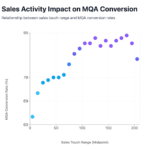
Holding sales accountable for defined touch cadence becomes a measurable driver of pipeline conversion.
Additional findings reinforce this pattern:
- Multithreading across channels: Single-thread, email-only outreach underperforms. Engaging multiple stakeholders across email, phone, LinkedIn, events, and advertising increases reach and signal density.
- Signal-driven prioritization: Third-party intent and first-party engagement allow teams to focus effort on accounts demonstrating real interest, reducing wasted outreach.
- Shared accountability: Alignment requires shared account lists, synchronized messaging, and common engagement metrics.
What aligned engagement looks like
Operational alignment is enabled by infrastructure.
Mature programs demonstrate several characteristics:
- Buying groups define targets, requiring multi-threaded engagement across personas
- Integrations connect CRM, MAP, predictive scoring, and engagement signals
- First- and third-party data sharpen qualification and prioritization
- Advertising reinforces progression through the funnel. For example, companies using four ad products see win rates increase by 71% compared to using none
When these elements operate together, coordination translates into measurable revenue performance.
- Top of Funnel (TOFU): Awareness → Qualified interest:
Advertising to target accounts showing third-party intent builds early awareness and engagement.
Marketing activity is heavier at this stage, while sales involvement remains limited.
Labs data shows:
- Advertising increases TOFU → MOFU conversion from 1.78% to 7.55%
- High-intent accounts progress 3–5× faster
- Middle of Funnel (MOFU): MQAs → Pipeline
At this stage, sales engagement intensifies while marketing remains active.
Labs findings show:
- CRM + MAP + predictive integrations increase MOFU → Opportunity conversion by 52.7%
- Sales activity is the primary contributor to progression
- Bottom Of Funnel (BOFU):
Sales leads engagement here.
Deals involving 3–4 engaged buying group personas demonstrate:
- Higher ASP
- Faster velocity
- Stronger renewal likelihood
Multi-threaded engagement at this stage materially influences outcomes.
- Expansion: Predictive scoring → Cross-sell
Predictive models identify accounts likely to generate new opportunities within a defined window.
Accounts with high Pipeline Predict scores for expansion create more cross-sell opportunities.
Note: Pipeline Predict is an AI-driven model within the Demandbase One platform that identifies accounts most likely to become new sales opportunities within the next 30 days.
Operationalizing these findings
Effective alignment requires shared infrastructure and defined execution standards.
For Sales
- Engage at least 10 buying group members per high-value account, staged by role and interest
- Design cadences targeting ~140–190 cumulative touches across channels for high-intent accounts (scaled by account value)
- Assign SDR/AE ownership by persona
For Marketing
- Reallocate spend away from accounts with high exposure but no engagement
- Prioritize accounts showing both third-party intent and first-party activity
- Align nurture content with active sales conversations
Shared dashboards and operating standards ensure signals are acted on consistently and in sequence.
Alignment becomes measurable when activity ratios, buying group focus, and signal-based prioritization operate together.
Sales–marketing coordination isn’t abstract. It appears in touch distribution, conversion lift, and revenue progression.
To explore the full benchmarks and performance data, download the full Labs by Demandbase B2B GTM Report.
More Demandbase Labs articles
Insights from 1,452 companies reveal how ABM maturity, buying groups, integrations, and ads drive higher pipeline and win rates.
Research shows four ad tiers increase win rates by 71%. Learn how buying group–level advertising accelerates MQA conversion and pipeline.
Discover how combining first-party data, third-party intent, and predictive scoring drives larger deal sizes and smarter buying group engagement.
We have updated our Privacy Notice. Please click here for details.