
The complete guide to intent-based marketing for B2B teams
Answered on October 23, 2025
What is intent-based marketing (IBM)?
Intent-Based Marketing (IBM) is a strategy that focuses on identifying and engaging buyers based on their real-time behavior, interest signals, and purchase intent, rather than just their demographic profile or job title.
In simpler terms: instead of guessing who might want your product, IBM helps you spot the people who are already showing signs that they do, and then equips you to act on it fast.
How does intent-based marketing work?
Identifying Intent Signals. Intent-based marketing hinges on buyer intent data, and this can come from two sources:
- First-party intent data: These are behavioral signals you gather on your own assets. For example, website visits, pricing page clicks, content downloads, demo requests, or even email engagement.
- Third-party intent data: These are signals from external sources: like someone from a target account reading a product comparison article on G2, or an individual from a known company searching high-frequency keywords tied to your category across publisher networks and review sites. These signals also fall into two categories:
- Explicit intent (they request a demo or sign up for a trial)
- Implicit intent (they read five blog posts on a specific pain point)
Platforms like Demandbase, Bombora, and 6Sense aggregate this type of intent data using natural language processing (NLP), machine learning, and IP reverse lookups to track topics being researched and identify the companies doing that research.
Scoring and Interpreting Intent. Once this data is captured, IBM platforms assign scores based on frequency, recency, and relevance of the behaviors.
- For example, a company reading three competitor comparison pages in one week might get a high intent score.
Personalizing Engagement. Once intent is identified and scored, marketing and sales teams use that insight to personalize their approach:
- Marketing may send highly targeted email nurtures or run personalized ad campaigns tailored to that buyer’s needs or stage in the journey.
- Sales may receive a real-time notification that a target account is “heating up” and reach out with a relevant message, like “Saw you were researching solutions for X problem—let’s talk.”
Related → How to Use Intent Data for B2B Sales and Marketing
A practical example of intent-based marketing
Let’s say you’re a B2B SaaS company offering an AI-powered customer support platform.
Now imagine a mid-sized fintech company starts reading several G2 comparison pages featuring your platform, your competitor, and general “best AI support tools in 2024” articles.
Around the same time, someone from that company also downloads an eBook from your site titled “How to Reduce Support Costs with AI.”
These are strong third-party and first-party intent signals.
With IBM:
- Your platform recognizes this surge in research activity.
- Their score goes up, marking them as a high-intent account.
- Your sales team is notified that “FinBank Ltd.” is in-market.
- Your marketing team automatically adds them to a campaign showcasing use cases for AI in fintech.
- Your sales rep reaches out within a day:
- “Hey, I noticed FinBank has been exploring AI solutions for customer support. Happy to share what others in fintech are doing and how we’ve helped them cut ticket volume by 40%.”
Intent-based marketing works because it:
- Focuses resources on buyers with actual intent, improving conversion rates.
- Reduces wasted ad spend on uninterested audiences.
- Equips marketing and sales with real-time valuable insights to act faster than competitors.
- Aligns perfectly with account-based marketing (ABM) strategies, especially in B2B.
Related → What Is B2B Intent Data? How to Get It, Use It, and More
What is the difference between intent-based marketing and traditional marketing?
| Category | Intent-Based Marketing (IBM) | Traditional Marketing |
|---|---|---|
| Core Focus | Targets users actively showing buying intent or interest based on behavioral signals. | Focuses on promoting products/services to a broad audience regardless of their current intent or readiness. |
| Audience Targeting | Highly targeted; leverages data such as search queries, website visits, content consumption, and firmographic insights. | Broad targeting based on demographics, geography, and generalized audience segments. |
| Timing | Real-time and responsive; engages prospects at the right moment based on intent signals. | Scheduled and fixed; timing is often based on campaign calendars, not user behavior. |
| Data Usage | Data-driven; uses behavioral, contextual, and intent data from multiple sources (B2B signals, 3rd-party data, etc.). | Limited data usage; relies more on historical performance, assumptions, or market averages. |
| Engagement Style | Personalized and contextual; messages are tailored based on where the buyer is in their journey. | One-size-fits-all; messaging is often generic and the same across all audience segments. |
| Conversion Efficiency | High, since outreach happens when prospects are showing intent, increasing relevance and engagement. | Lower, as outreach often hits users not ready to buy, leading to wasted impressions or low ROI. |
| Buyer Journey Integration | Integrated throughout the buyer journey; adapts content and messaging based on journey stage. | Often disconnected from the actual buyer journey—same messaging across different stages. |
| Sales Alignment | Strong sales and marketing alignment; sales teams are fed high-intent leads, improving closing rates. | Often siloed—leads may not be qualified or timely, causing friction between sales and marketing. |
| Measurement of Success | Success is measured using intent KPIs like engagement lift, pipeline velocity, and buyer journey progression. | Focuses on top-level KPIs like impressions, reach, brand recall, and sometimes click-through rates. |
| Cost Efficiency | More cost-effective due to better targeting and reduced ad waste on uninterested audiences. | Less efficient; broader campaigns often mean higher spend with low conversion rates. |
| Use of Personalization | High personalization; dynamically adapts based on the intent data and buyer signals. | Low personalization; relies on static messaging and creative. |
| Scalability | Scales based on data inputs and automation; easily optimized in real-time. | Requires manual campaign scaling and broader planning cycles. |
| Examples | Retargeting pricing page visitors, dynamic ad placements based on firm intent, sales outreach to researching companies. | TV commercials, billboard ads, trade shows, generic email campaigns. |
Assumptions vs. signals
Traditional B2B marketing efforts typically start with a simple formula: define your ICP, build a contact list, craft a message, and blast it out—through ads, emails, cold calls, you name it.
It’s structured, but it’s also predictive and assumption-heavy.
- You assume a company with 500+ employees in the healthcare space is a good fit.
- You assume that sending a whitepaper about security modernization will resonate.
- You assume that a VP of IT is the right contact at the right time.
Meanwhile, intent-based marketing focuses more on who is interested in the product.
Instead of assuming a VP of IT might be interested in your cybersecurity platform, IBM uses intent data to detect that the same VP has recently:
- Searched for “zero trust architecture,”
- Downloaded a guide on endpoint protection, and
- Visited competitor comparison pages.
Campaign cycles vs. real time signals
In traditional B2B, marketers plan campaigns quarterly (or even annually for some). You spend weeks developing assets, segmenting lists, and scheduling outreach. And by the time your message goes out, your buyer’s needs may have changed, they’ve already chosen a competitor.
Intent-based marketing, on the other hand, runs in real time. It constantly monitors buyer behavior across the web and your owned channels.
When an account surges in activity—visiting pricing pages, reading product comparisons, or increasing keyword search volume—your team is alerted instantly.
That means you can activate relevant content, sales outreach, or paid campaigns the moment interest spikes.
Reach vs. readiness
Another core difference lies in how success is measured. Traditional marketing often aims to reach as many relevant accounts as possible. Impressions, opens, and click-throughs dominate reporting.
The thinking is: the more people who see the message, the higher the chance someone bites.
IBM takes a different approach by focusing on account readiness, i.e., which accounts are actively researching, which contacts are engaged, and which ones show buying signals across channels.
In a nutshell: The biggest difference between intent-based marketing and traditional marketing lies in how they approach the buyer:
- Traditional marketing pushes messages out, hoping someone pays attention.
- Intent-based marketing pulls buyers in, based on signals that show they’re already interested.
Related → Demystifying Intent: Understanding Its Definition & Significance in Sales
Benefits of intent-based marketing for b2b teams
Higher quality leads with actual buying intent
Every sales and marketing team wants to focus on the right accounts—but “right” is usually defined by firmographics alone: industry, size, revenue. That’s helpful, but not enough.
That’s why when they launch a campaign, the MQLs they get are mostly people who filled out a form. They’re not necessarily ready to buy. They may not even be the one making the purchase decision.
With intent-based marketing, you shift from form-fills to behavior-backed leads. These are companies showing active interest—researching your product category, comparing vendors, reading in-depth content about your solutions.
That means when these B2B leads hit your CRM, they’re already problem-aware, solution-aware, and often deep into the decision phase.
Faster sales cycles and higher conversion rates
Intent-based marketing aligns your outreach with the buyer’s timeline. You don’t have to convince them or deploy some ‘shady’ sales tactic—they already know what they want.
That alignment means deals move faster through the funnel. Instead of 6-12 months of slow nurturing, sales can jump straight into value-based conversations with context already in hand.
And since the prospect is already warmed up by relevant personalized messaging and content based on their behavior, conversion rates improve. It gets even better when sales can tailor their pitch to the exact topics the buyer was exploring.
More efficient use of marketing budget
In traditional campaigns, most of your budget gets spent on people who aren’t ready to buy. That’s a waste of ad spend, email sends, SDR hours, and design resources.
Intent-based marketing makes better use of this money. You allocate your resources where there’s a real chance of conversion—and that’s people already in-market. This allows for tighter campaign targeting, higher ROI, and fewer wasted impressions.
Better personalization
B2B buyers expect relevance. If your messaging is generic, you’ll be ignored no matter how good your product is.
Intent-based marketing unlocks dynamic personalization based on real-time behavior.
If a company is researching “automated onboarding tools,” they shouldn’t get a nurture email about pricing plans. They should get a demo invite with onboarding benefits front and center.
By mapping content, offers, and campaigns to the exact stage of the buying journey, you’re able to personalize at scale without manually segmenting every message.
Smarter abm execution
Account-based marketing (ABM) works best when it’s fueled by intent data. This is because it helps you figure out which accounts are actually showing signs of life (and which aren’t).
With IBM, you can tier your ABM efforts:
- Tier 1 accounts showing high intent. Launch custom landing pages, personalized outreach, exec-level alignment.
- Tier 2 accounts with mild interest. Nurture them with helpful mid-funnel content and ads.
- Tier 3 accounts gone cold. Save your budget until they start showing signals.
This gives your ABM program precision targeting, real-time prioritization, and better use of resources.
How to implement an intent-based marketing strategy
- Step 1: Define Clear ICPs and Buyer Personas
- Step 2: Choose the Right Intent Data Sources
- Step 3: Map Buying Signals to Funnel Stages
- Step 4: Segment and Prioritize Target Accounts
- Step 5: Personalize Content and Messaging Based on Intent
- Step 6: Orchestrate Multi-Channel Engagement
- Step 7: Measure Performance and Optimize in Real Time
- Step 8: Scale and Automate Responsibly
Step 1: define clear icps and buyer personas
Intent data is only valuable if you know whose intent you’re trying to interpret. Before you start tracking signals or choosing platforms, your foundation must be solid:
Who are you trying to target, and what matters to them?
Here’s what to do:
- Build or refine your Ideal Customer Profile (ICP): Look at your highest LTV accounts and break them down by firmographic (industry, company size, location), technographic (tools they use), and behavioral characteristics (buying triggers, expansion patterns).
- Develop multiple buyer personas for each ICP segment: Each decision-making unit (DMU) has influencers, blockers, and champions.
- For example, a CMO may care about brand consistency, while a demand gen lead cares about pipeline velocity. Map out their pains, goals, and content preferences.
- Tie persona pain points to buying signals: If your platform helps reduce churn, then a sudden spike in a persona’s search behavior around “customer retention” might signal intent. These mappings guide your campaign targeting later.
DB Nuggets → Run short interviews with front-line teams to uncover nuanced buyer insights that aren’t in your CRM. For example,
- how long do deals typically take?
- what makes a champion advocate internally?
- what objection killed the last deal?
Then, validate these in customer interviews.
Step 2: choose the right intent data sources
Intent signals come in two forms: first-party (data you own) and third-party (data from external sources). You’ll want to combine both for maximum visibility.
Here’s what to do:
- First-party data: Set up tracking for online behavior (pages visited, time spent, content downloaded), email engagement, chat interactions, CRM entries, and product usage patterns (if applicable).
- Third-party data: Use platforms like Demandbase, Bombora, 6Sense, ZoomInfo, or others that provide topic-level intent data and identify which accounts are researching relevant keywords outside your website.
DB Nuggets → When choosing a provider ask:
- How fresh is the data? (Daily updates vs. weekly)
- What keywords or topics does it track?
- How accurate is account-level resolution?
- Can it show signal strength or historical surges?
- How well does it integrate into my CRM, MAP, and ABM stack?
In addition, before launching full campaigns, take historical closed-won deals and run a test to see if intent data correctly identified those accounts during their buying journey.
If the match rate is low, refine your signal topics or provider.
Related → 6Sense vs ZoomInfo: 2025 Comparison (+More Options)
Reader’s Question:
So, why is second-party intent data less commonly used in intent-based marketing?
Here’s why:
- Limited access and scale: Second-party data usually comes from one or a few partners. That means you’re only seeing a slice of buyer activity, and it’s confined to just those platforms. First- and third-party data offer far more reach—you see either everything happening on your own site or across the broader internet.
- Harder to operationalize at scale: First- and third-party data can be plugged into your intent-based marketing tools automatically—your CRM, your scoring model, your ad platforms. But second-party data often requires manual agreements, custom integrations, or data formatting. It’s not as smooth to plug in.
- Overlap with third-party signals: Many of the same behavioral patterns picked up in second-party data (like reading industry content or comparing products) are already included in third-party intent datasets. So if you’re using a robust third-party provider, you might not need the middleman.
| Data Type | Control | Scale | Relevance | Ease of Use | Common Use |
|---|---|---|---|---|---|
| First-party | High | Medium | High | Easy | Very common |
| Third-party | Low | High | Medium-High | Easy | Very common |
| Second-party | Low | Limited | Varies | Manual | Rare |
Related → Different Types of Intent Signals for B2B Marketing | Demandbase
Step 3: map buying signals to funnel stages
Not every buyer showing intent is ready for a demo. You must distinguish between early-stage researchers and high-intent buyers to avoid burning leads too early.
Here’s what to do:
- Categorize signals based on intent strength:
- Awareness-stage signals: Researching broad topics (e.g., “customer onboarding best practices”).
- Consideration-stage signals: Comparing solutions, downloading industry guides, or checking competitor pages.
- Decision-stage signals: Pricing page visits, RFP downloads, demo request form fills.
- Next, build an intent scoring model, similar to lead scoring. For example:
- +20 points for three keyword searches in a week
- +15 points for reading two product comparison articles
- +10 points for watching a competitor’s webinar
- +30 points for multiple stakeholders engaging from one account
DB Nuggets → For each signal strength, predefine a sales motion. For example:
- Low intent → Wait and nurture.
- Medium intent → SDR outreach with educational content.
- High intent → Direct AE call with tailored pitch and demo.
Step 4: segment and prioritize target accounts
You can’t act on every signal because resources are limited. So you need a way to prioritize outreach based on buyer readiness, revenue potential, and fit.
Here’s what to do:
- Build dynamic segments based on ICP match, signal strength, recency and frequency of engagement, account tier (enterprise, mid-market, SMB).
- Create a tiered approach:
- Tier 1: High-fit, high-intent → Direct sales outreach and personalized ads.
- Tier 2: Medium-fit, moderate intent → Nurture through email and content.
- Tier 3: Low-fit or low-intent → Add to awareness campaigns.
- Assign owners internally: SDRs/BDRs should get a real-time list of Tier 1 accounts daily/weekly, with context on what they’re showing interest in and recommended messaging.
DB Nuggets → Cross-reference customer intent with CRM data (open opportunities, lead scores), firmographics (size, revenue), and current engagement (email clicks, page visits).
This gives a clearer picture of account readiness.
Step 5: personalize content and messaging based on intent
Intent is only useful if it guides how you talk to prospects. A buyer searching for “AI customer support tools” should receive different messaging than one reading “Zendesk vs Freshdesk comparisons.”
Here’s what to do:
- Create content maps for each signal cluster: Build assets for each funnel stage and pain point: Case studies, product sheets, competitor comparisons, or industry-specific landing pages.
- Match assets to buyer behavior: For example;
- Companies researching “employee onboarding software” should receive a case study on onboarding ROI.
- Companies visiting your product comparison page should get a follow-up with tailored messaging about your key differentiators.
- Build dynamic landing pages and ad campaigns: Use tools like Demandbase to deliver hyper-personalized landing experiences by industry, keyword, or account ID.
DB Nuggets → Build flexible assets (e.g., case studies, landing pages) where elements like headline, industry name, pain point, and CTA can dynamically change based on account data or intent signal.
This enables scalable personalization.
Step 6: orchestrate multi-channel engagement
You need to show up where your buyers are. Intent-based marketing only works when it fuels engagement across all touchpoints: ads, emails, content, outbound, and even customer success.
Here’s what to do:
Build an orchestrated playbook per funnel stage:
- Awareness: Display ads + ungated content.
- Consideration: Retargeting, email nurture, value calculators.
- Decision: SDR follow-up, sales enablement materials, 1:1 video demos.
Sync data across platforms:
- Feed intent data into your CRM (Salesforce, HubSpot) and MAP (Marketo, Pardot).
- Trigger workflows to guide SDR action.
- Sync segments to your preferred ad platforms.
Measure engagement per channel: Use UTM parameters and platform analytics to track which channels convert best per segment. Double down on high-performing combinations (e.g., display + outbound email for Tier 1).
DB Nuggets → Use AI agents or automation platforms to trigger multi-step sequences (e.g., ad view → email drip → SDR call → SMS reminder) automatically based on real-time behavior.
Step 7: measure performance and optimize in real time
Like any marketing approach, IBM is simply another system. You need regular feedback loops to optimize messaging, scoring, content themes, and sales engagement.
Here’s what to do:
Track performance metrics by layer:
- Account engagement score.
- Pipeline influence (how many opportunities originated from intent-based outreach?).
- Deal velocity (did intent-identified leads close faster?).
- Content consumption patterns.
Run attribution reports: Use multi-touch attribution tools to see which combinations of signal + channel + content lead to the highest conversion rates. This helps you refine the scoring model and content mapping.
Refine signal thresholds: Recalibrate your scoring model every quarter.
- For example, maybe in Q1, webinar views were strong indicators, but by Q3, direct competitor keyword searches become more reliable.
Feedback loop with Sales: Set up regular check-ins with SDRs and AEs to gather qualitative insights.
- Are they finding value in the signals? Are certain accounts ‘faking’ interest? Use their feedback to tighten targeting.
DB Nuggets → Build a dashboard that pulls in real-time signal engagement and overlays it with pipeline and revenue data.
Step 8: scale and automate responsibly
Once your system works, the next goal is to scale. But scaling too fast without control will drown your marketing in noise or misfire on personalization.
Here’s what to do:
Audit your tech stack for automation readiness:
- Do you have APIs and workflows to sync data between intent vendors, MAP, CRM, and ad platforms?
- Can your sales engagement tools personalize at scale?
Roll out new verticals or geos gradually: Clone your best-performing playbooks and adapt them for new industries, regions, or buyer types.
Expand to post-sale and expansion motions: Use it to detect customer churn risk or upsell opportunities based on product usage signals, support queries, or content engagement.
DB Nuggets → Assign owners across teams (data, ops, sales, and content) to govern intent strategy. Make them responsible for testing new vendors, refining workflows, and training teams every quarter.
Did you know?
Demandbase can help you automate signal monitoring, scoring, and account tiering in real time so you don’t have to manually track everything.
Measuring the roi of intent-based marketing
Define roi goals based on funnel impact
Intent-based marketing can influence multiple parts of the buyer’s journey. So before jumping into data, define which area(s) of the funnel you’re trying to impact:
- Top of Funnel: Are you aiming to increase awareness and engagement from in-market accounts?
- Middle of Funnel: Are you trying to convert surging accounts into pipeline faster?
- Bottom of Funnel: Are you supporting sales with real-time intent signals to accelerate decision-making?
Once you define this, you can attach metrics that map to the actual business outcome you care about.
Example goal: “Increase conversion rate of surging accounts to qualified pipeline by 25%.”
Set up attribution and tracking mechanisms
To measure ROI effectively, you need to track every touchpoint that happens as a result of intent signals. That means integrating your intent platform into your CRM and marketing automation tools so you can attribute activity correctly.
Here’s what that looks like in practice:
- Track which accounts spiked in intent and when.
- Tag those accounts in your CRM (e.g., “Intent Signal: X Topic – Date”).
- Monitor if those accounts entered a nurture sequence, were contacted by sales, or booked a meeting.
- Map any opportunity creation or closed-won status back to the original intent spike.
Use first-touch, last-touch, or multi-touch attribution depending on your funnel complexity. Multi-touch is most accurate, especially for longer B2B sales cycles.
Measure pipeline metrics tied to intent signals
Once tracking is in place, you want to evaluate pipeline movement and performance for accounts influenced by intent-based campaigns versus those that weren’t.
Some key metrics to track include:
- Conversion Rate to Opportunity:
- CR = (Opportunities Created from Intent Accounts / Intent-Engaged Accounts) x 100
This shows how well your campaigns are turning intent into pipeline.
- Opportunity Win Rate:
- Win Rate = (Deals Won from Intent Accounts / Opportunities from Intent Accounts) x 100
High win rates here signal the quality of the intent leads and messaging alignment.
- Sales Velocity:
- Sales Velocity: (Number of Opportunities x Avg Deal Size x Win Rate) / Sales Cycle Length.
Use this to compare how fast deals close with intent-powered engagement versus standard campaigns.
- Average Deal Size:
- Avg Deal Size = (Number of Closed Deals / Total Revenue from Deals)
This helps you understand how much revenue you generate per customer or deal on average.
- Engagement Lift: Compare open, click-through, and conversion rates of intent-triggered campaigns vs. traditional ones to evaluate content performance.
- Engagement Lift (%) = ((Engagement After Campaign − Engagement Before Campaign) / (Engagement Before Campaign)) x 100
For example, If engagement increased from 200 clicks before a campaign to 300 after:
- Engagement Lift = ((300 – 200) / (200)) x 100 = 50%
Evaluate cost efficiency over time
Track:
- Customer Acquisition Cost (CAC) for intent-based programs:
- CAC = (Total Campaign Spend / Customers Acquired from Intent Accounts)
Compare this to your CAC from other sources (e.g., paid ads, cold outbound). If intent-based campaigns are giving you lower CAC and higher conversion, that’s a strong efficiency signal.
- Also measure Return on Ad Spend (ROAS) if you’re using paid media to retarget intent accounts:
- ROAS = (Revenue from Ads / Cost of Ads)
For example, If you made $20,000 in revenue from a $5,000 ad campaign:
- ROAS = 20,000 / 5,000 = 4.0
So for every $1 spent, you earned $4 back in revenue.
Calculate financial roi
The standard marketing ROI formula still applies here, but with more context:
- Marketing ROI (%) = ((Attributed Revenue — Intent Marketing Cost) / Intent Marketing Cost)) x 100
Where:
- Attributed Revenue = Revenue from closed-won deals that can be traced back to accounts influenced or sourced by intent data.
- Intent Marketing Cost = Sum of costs related to the tools (like Demandbase), media spend on campaigns targeting intent audiences, and internal resource allocation (e.g., SDR hours, content creation time).
Example: If you spent $20,000 on an intent-based campaign (data, ads, social media, tools) and it generated $100,000 in new revenue, your return on investment would be:
[($100,000 – $20,000) / $20,000] x 100 = 400%
Challenges in implementing intent-based marketing
Data overload without context
One of the first hurdles teams face when rolling out intent-based marketing is the overwhelming flood of data.
The moment you connect an intent provider to your system, you’re exposed to a large volume of behavioral signals: companies researching specific topics, spikes in keyword activity, page visits, ad engagement, and so on.
On paper, this looks ‘good’. But without proper filters and frameworks, it creates an even bigger problem.
Teams often fall into the trap of treating every signal as urgent, chasing every account that clicks an article, and spreading themselves too thin. The absence of a clear way to score, tier, and contextualize these signals leads to wasted time, cluttered dashboards, and misaligned outreach.
Poor integration with existing tech stack
Many companies rush to adopt intent data solutions without confirming if those platforms integrate smoothly with tools like Salesforce, HubSpot, or Marketo.
As a result, even when high-intent accounts are flagged, the data sits idle in a siloed dashboard, never making its way into active workflows. Or worse, it gets pushed into CRM as a static field that no one pays attention to. This lack of automation breaks the entire point of intent-based marketing.
For the strategy to work, intent signals need to trigger actions in real time—personalized email journeys, targeted ads, SDR alerts, or account prioritization.
If the data can’t flow into the right systems at the right moment, your strategy becomes manual, slow, and fragmented. And when your teams can’t act fast on real-time buying signals, you’re just watching opportunities pass by.
Limited visibility into buying committees
Intent data is powerful, but it often operates at the account level, missing out on the individual level. You may see that Company X is researching “automated compliance tools,” but you don’t know who within the company is doing the research.
Is it a technical evaluator? A procurement analyst? A decision-maker?
That lack of visibility creates a gap between what the data tells you and what your sales team needs to personalize outreach effectively.
The ripple effect is you’re now forced to guess, which often leads to generic messaging and missed opportunities.
This challenge is particularly painful for sales reps who need accurate personas to engage the right stakeholders. It also complicates personalization, which is one of the core advantages of using intent in the first place. Without knowing who’s showing interest, the precision that IBM promises begins to fade.
Best practices for intent-based marketing campaigns
- Time Your Campaigns Around Signal Strength
- Start With Clear Intent Theme Segmentation
- Use Multichannel Activation, But Stay Cohesive
- Align with Sales Early (And Feed Them the Right Context)
- Create Personalized Content Paths
Time your campaigns around signal strength
Just because an account showed interest last week doesn’t mean it’s still warm. Intent signals have a shelf life—and the highest-performing campaigns are those that move fast when a signal appears.
Use automation or rule-based triggers to ensure your campaigns launch as close to the signal spike as possible. Whether it’s triggering an email, launching a targeted ad set, or notifying sales—speed matters.
If your campaign takes two weeks to reach an account after they show interest, you’ve already lost the window. IBM is as much about timing as it is about targeting.
Start with clear intent theme segmentation
Every good IBM campaign starts with understanding what your buyers are signaling interest in. That means going beyond a “surge” alert and actually segmenting your accounts by intent themes—the topics, challenges, or solutions they’re researching.
- Are certain accounts engaging with content about “multi-cloud security”?
- Are others searching for “sales enablement automation”?
These intent themes are the foundation of your campaign’s relevance.
Once you’ve identified themes, build separate messaging tracks around them.
Think of each track as a micro-campaign: it has a tailored value proposition, focused assets, relevant proof points, and specific CTAs.
Use multichannel activation, but stay cohesive
Intent signals are only ‘useful’ if you meet buyers where they are. That means activating your campaign content across multiple channels, from email and paid ads to your website and SDR outreach.
But here’s the catch: the messaging and experience must feel cohesive.
If an account is surging on “digital transformation in banking,” and they see a LinkedIn ad about it, click through to a blog, then get an SDR email that talks about generic productivity tools—it breaks trust.
Your multichannel strategy should reinforce the same narrative across every touchpoint, creating a sense of familiarity and relevance as the buyer moves from awareness to engagement.
Align with sales early (and feed them the right context)
IBM campaigns are most successful when sales is looped in before the launch. That means sharing the account segments, intent themes, messaging tracks, and even sample talk tracks with your sales team early on.
And when high-intent accounts eventually engage, give reps complete context:
- What topic was this account researching?
- What assets did they interact with?
- Which personas engaged from the buying committee?
- What specific content should sales use in their outreach?
This allows SDRs and AEs to pick up the conversation where marketing left off.
Create personalized content paths
Intent-based personalization doesn’t have to mean writing everything from scratch.
The smartest approach is to build flexible content frameworks that can be dynamically assembled or slightly tailored based on the buyer’s industry, pain points, or intent signals.
This could look like:
- Dynamic landing pages that change based on the intent theme
- Email sequences personalized to the search topic or buying stage
- Paid ads that swap in relevant pain-point headlines based on account activity
With tools like GenAI, you can scale content variations faster. The trick is building a core messaging library and then tweaking based on what buyers are telling you through their behavior.
Top tools for intent-based marketing
Demandbase one: best for full-funnel intent-based abm execution
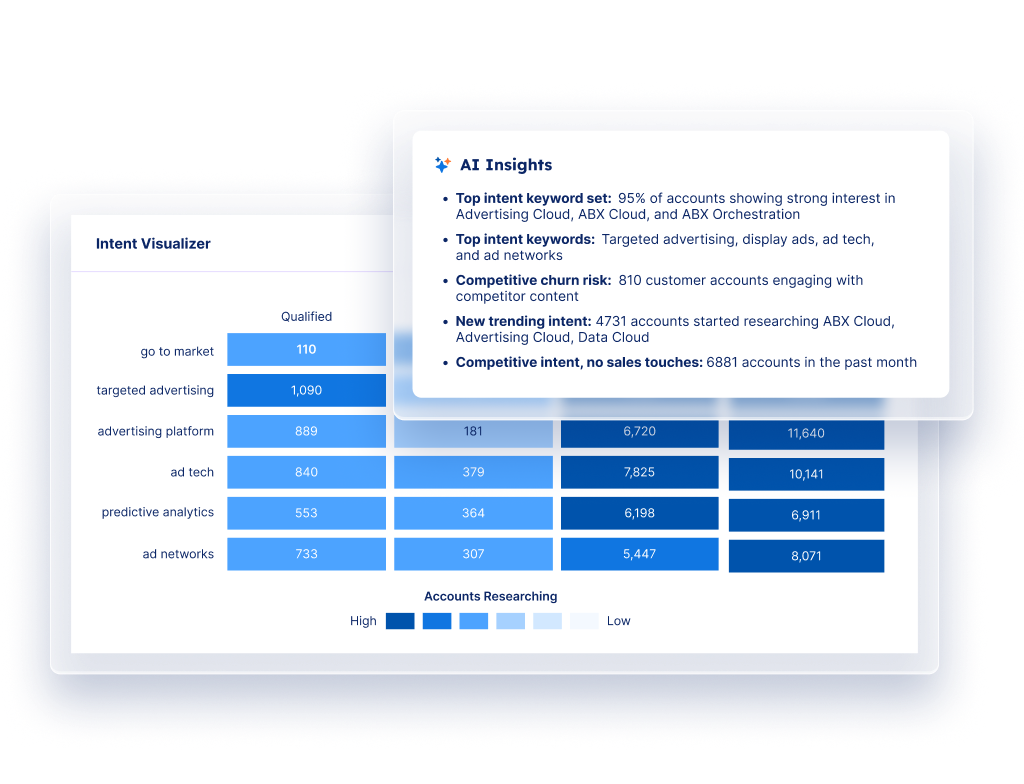
DemandbaseOne is a leading B2B go-to-market (GTM) platform built specifically for account-based marketing (ABM), sales intelligence, and intent-driven engagement.
The platform is designed to unify first-party and third-party data to help revenue teams identify, target, and convert high-value accounts across the entire buyer journey.
It also integrates AI-powered account intelligence with real-time behavioral insights, enabling marketing and sales teams to coordinate their efforts, prioritize the right accounts, and deliver highly personalized, multi-channel experiences.
Key Features:
- Intent Data (powered by Demandbase Intent). Tracks anonymous web activity and layers in third-party partner data like G2. This helps surface buying signals such as competitor research, keyword interest, and trending topics at the account level.
- Engagement Minutes. This is a scoring model that measures the depth and quality of engagement from target accounts across touchpoints (web, ads, email, and events).
- Orchestration Studio. Workflow engine that lets you build multi-step campaigns using triggers like account activity, intent surges, or CRM status. You can trigger ads, emails, alerts, or sales tasks based on specific buyer behavior.
- Website Personalization. Tailors your website experience for specific accounts, industries, or buying stages using real-time behavioral and firmographic data. Pages, CTAs, and banners can dynamically change depending on who is visiting.
- Predictive Audiences. Builds dynamic account lists based on intent signals and buying stage.
- Account Intelligence. Combines firmographic, technographic, and intent data to help you deeply understand each target account
What are users saying about DemandbaseOne?
- “The holistic account view provided by DemandbaseOne is truly invaluable. It consolidates all relevant account data into a single, comprehensive dashboard, including key insights on associated individuals from Salesforce” — [Read full review].
- “It’s easy to use and customize, easy to turn relevant data into actions, and easy to analyze data using specific filters, etc. Overall, DemandBase makes it really easy to pilot a true ABM strategy.” — [Read full review].
- “Demandbase allows our team to effectively build out ABM campaigns with speed and scale that is unique to other DSPs. We meet regularly with their reps and have found them to be the most engaged, friendly team we have encountered in the paid media space in a long time.” — [Read full review].
Case Study → Ingram Micro and CloudBlue increases pipeline velocity by 83%
6sense revenue ai
6Sense Revenue AI is a B2B intent and revenue orchestration platform that helps marketing, sales, and revenue teams uncover hidden demand, prioritize in-market accounts, and engage buyers with precise timing.
It uses AI, machine learning, and behavioral data to predict where accounts are in the buying journey—even when no form fills or direct signals exist.
Key Features:
- Profile Fit AI. Uses historical conversion data and firmographics to score and prioritize accounts based on how closely they match your ICP.
- Next Best Actions. AI-powered suggestions delivered to sales reps that tell them exactly who to reach out to, what to say, and when, based on real-time intent signals and buying committee behavior.
- Dynamic Segments. Allows marketers to create real-time audience segments based on predictive intent, firmographics, deal stage, or activity.
What are users saying about 6Sense?
- “There isn’t much to like about this tool. The user interface to me is very dull and if compared to Salesforce CRM it stands nowhere.” — [Read full review].
Recommended → Is 6Sense Worth It? An Honest Review (Based on 100+ Users)
Bombora
Bombora is an intent data provider that helps B2B companies discover which businesses are actively researching topics related to their product or category.
Unlike full-stack ABM platforms, Bombora focuses exclusively on gathering, analyzing, and delivering high-quality, privacy-compliant third-party intent data.
The platform allows marketers and sales teams to prioritize accounts that are surging in interest, enrich targeting, and personalize outreach based on real buying signals.
Key Features:
- Company Surge. It monitors over 4,000+ B2B web domains to track which companies are consuming content on specific topics.
- Surge Score. Each account-topic pair receives a Surge Score (typically on a scale of 0 to 100), representing the intensity of the interest. Higher scores mean stronger buying intent.
- B2B Data Co-op. This is a network of 5,000+ B2B websites where users are actively researching topics. Because the data is directly sourced from opted-in environments, it’s both high-quality and GDPR/CCPA compliant.
What are users saying about Bombora?
- “Wide range of topics. They really have wide range of topics plus most of the intent comes from publisher network giving it high accuracy.” — [Read full review].
- “The software does not support integrating or importing the contact information into this software, you need to use third-party application for storing the contact data of targeted customers, which makes the software workflow a little bit slower and even the processing speed is also affected.” — [Read full review].
Pro Tip → You can use Bombora intent to power marketing and sales growth at every stage of the account journey.
Zoominfo
ZoomInfo is a go-to-market platform that helps B2B sales, marketing, and revenue teams identify, engage, and convert their ideal customers through a rich mix of contact data, company intelligence, intent signals, and orchestration tools.
In addition, ZoomInfo’s intent features are powered by Clickagy technology, which captures behavioral signals from across the web and maps them back to accounts researching specific topics.
Key Features:
- Enrich + FormComplete. Enriches inbound leads and web forms with verified contact and account details in real time. So when intent matches and someone fills out a form, you get a complete, actionable profile instantly.
- WebSights. Identifies anonymous website visitors and matches them to company-level data so you know which accounts are landing on your pages, even if they don’t convert.
- Workflows. Automates GTM motion triggers based on buying intent. You can trigger outreach emails, route accounts to SDRs, and launch ads automatically when an account hits a specific intent threshold.
What are users saying about ZoomInfo?
- “ZoomInfo Sales with Copilot gives our sales directors the information they need for their targeted accounts so they reach out at the right time to the right people.” — [Read full review].
- “It can be difficult to get contact reports to sync with your account book from salesforce so that you are only getting updated contacts related to your accounts.” [Read full review].
Terminus (by Demandscience)
Terminus is an account-based marketing platform designed to turn buyer intent into orchestrated, multi-channel engagement.
It offers real-time advertising, omnichannel orchestration, and first-party engagement tracking. This helps B2B marketers surround the buying committee with timely, relevant messaging wherever they are.
Key Features:
- Chat Experiences. You can dynamically route website visitors from target accounts to SDRs or tailored chat flows based on their behavior, source, or segment.
- Measurement Studio. Provides detailed attribution and performance metrics—like influence on pipeline, engagement by channel, journey stage velocity, and revenue lift from ABM campaigns.
- Email Experiences. Terminus integrates natively with your email signature to display targeted banners in every 1:1 rep email. Every email your team sends can dynamically promote content or campaigns based on the recipient’s account intent or funnel stage.
What are users saying about Terminus?
- “I have one issue with Terminus ABM Platform, and that has to do with the steep learning curve of several of its functions. It may be difficult to grasp every tool used in the application and this may be confusing to new users.” — [Read full review].
- “I have found that the Terminus ABM Platform is most valuable when used as a tool for marketing in specific niches.” — [Read full review].
Cognism
Cognism is a global sales intelligence & intent platform tailored for B2B teams. It combines Bombora-powered third-party intent data with firmographics, technographics, and contact-level information to enable outreach based on strong in-market signals.
In addition, every contact in Cognism database undergoes rigorous verification and cleansing to meet data protection laws like GDPR and CCPA. The platform also offers a proprietary Do-Not-Call list for ethical and legally safe cold outreach across regions.
Key Features:
- Prospector Tool. Enables users to build targeted lead lists based on custom filters such as job titles, regions, technographics, and buying intent.
- Data Enrichment and Webhooks. Automatically enrich lead and account data inside CRMs like Salesforce and HubSpot, with webhooks and API integrations that keep contact records fresh and actionable.
- Chrome Extension. A lightweight plugin that surfaces contact and company data directly from LinkedIn or company websites, with one-click export to CRM and sales tools for streamlined prospecting.
What are users saying about Cognism?
- “As a BDR, what I like best about Cognism is the quality and accuracy of the contact data—especially the direct dial numbers, which significantly increase my connect rates.” — [Read full review].
- “Only downside is the limitation on saving contacts into lists. It can be a bit restrictive, especially if you’re working with larger sets of data or need to organize multiple lists.” — [Read full review].
Future trends in intent-based marketing
Ai that predicts behavior before it happens
The current state of intent marketing is largely reactive. You wait for someone to research a keyword, visit a competitor’s site, or click on a webinar invite, and then you act.
But with advances in AI, especially large language models (LLMs), we’re moving toward a world where machines can anticipate intent before it happens.
For example:
- If multiple stakeholders from an account begin reading educational content on automation, AI might predict they’ll be researching automation tools within 2 weeks.
- If a buyer usually moves from case study consumption to demo request within 10 days, AI can prompt your sales team on Day 5.
This predictive power means marketers and sales reps can engage prospects before competitors even know they’re in-market.
Hyper-personalized content for individuals in the buying committee
In the past, intent marketing was account-focused. If the account showed intent, you activated campaigns.
But today’s B2B buying decisions are made by buying committees, which requires understanding individual intent within the group. This means shifting from account-level targeting to persona-level personalization.
CMOs might be reading about budget planning. CTOs might be diving into product architecture. Procurement might be concerned with compliance. Your strategy should reflect that diversity.
The rise of AI-driven content personalization means you can now dynamically adapt messaging, assets, and experiences for each individual buyer.
Quick examples include: web pages that change headlines depending on who’s visiting. Email nurtures that mirror the role’s most pressing challenge. And SDR scripts that shift based on a stakeholder’s recent research patterns.
This level of personalization makes each stakeholder feel like your brand “gets” them. It also builds trust faster and increases the chance of buy-in from every angle of the committee.
Intent throughout the full customer lifecycle (churn, expansion, upsell)
Right now, most companies use intent data to acquire new customers. But a major emerging trend is using that same data to retain, upsell, and grow your existing customer base.
For example, you can take customers’ behaviors and link them to a signal.
- They’re researching competitors (churn risk).
- They’re exploring new use cases (upsell opportunity).
- They’re engaged with new features (retention driver).
With the right setup, you can detect these signals early and respond with an action.
Let’s say a current customer starts visiting G2 pages for one of your competitors, the account manager can step in, offer a check-in call, or share roadmap updates.
On the flip side, if they show interest in a new product category you offer, marketing can trigger a campaign offering them an exclusive preview or upgrade deal.
Ethical, privacy-first data practices
With regulations like GDPR, CCPA, and the phasing out of third-party cookies, the way we capture and use intent data is changing fast.
The future of intent marketing will be shaped by privacy-first frameworks that protect the user while still delivering value to marketers.
That means:
- Relying more heavily on consented, first-party data collected through your website, product, emails, and apps.
- Being transparent with users about what data is being collected and why.
- Moving toward zero-party data strategies—where users voluntarily share preferences, needs, or challenges in exchange for value (like a tailored report or personalized experience).
- Partnering only with data providers who meet high ethical and compliance standards.
This push for ethical intent marketing will help companies stay compliant, and might even become a competitive differentiator.
Your next deal just googled you. Demandbase knows which one.
Here’s why top-performing marketing and sales teams trust Demandbase to power their intent-based marketing strategies:
- Precision Audience Targeting. With Demandbase, you can build ultra-specific audience segments using dynamic intent filters, job function, buying stage, industry, and engagement history.
- Complete Account Visibility. Demandbase unifies firmographics, intent signals, technographics, engagement data, and first-party behavior into one cohesive account profile. You see exactly who’s in-market, what they care about, and where they are in the journey.
- Full-Funnel Orchestration. Demandbase connects your marketing automation, CRM, ad platforms, and sales tools to trigger smart campaigns based on real-time behavior.
- Real-Time Sales Intelligence. Your sales team gets notified the second an account starts surging. Demandbase automatically pushes buying signals, key contacts, and messaging recommendations into your CRM.
Spotted: Future Customer, Page 3 of Your Blog.
Frequently asked questions (faqs)
How is b2b intent data collected without cookies?
Platforms use IP-to-company matching, publisher data co-ops (where websites share anonymized behavioral data), and bidstream data from ad exchanges. These methods identify account-level research activity even without personal tracking.
How quickly can I see results from intent-based marketing?
Initial signs like better ad engagement and improved sales conversations can show within weeks. But the real impact, like shorter sales cycles and larger deal sizes, typically becomes clear over one or two full sales quarters.
What’s the difference between intent data and website analytics?
Website analytics track visitors on your site—this is first-party intent data. It tells you who’s already on your site.
Intent data captures signals from across the web—like what topics companies are researching, what content they’re consuming, and which competitors they’re engaging with. This includes third-party and sometimes second-party sources, allowing you to identify in-market buyers even before they land on your website.
Do I need a big budget to start intent-based marketing?
No. You can begin with a small-scale pilot focused on a handful of high-value accounts and key topics. This lets you test the impact and prove ROI before committing to a larger spend.
How do I get sales teams to adopt intent data?
Involve sales from the start. Let them help choose intent topics and test the data with their top accounts. Also emphasize how intent provides warm talking points that make cold calls more relevant.
How is intent-based marketing different from behavioral targeting?
Behavioral targeting focuses on first-party data. Meanwhile, intent-based marketing adds third-party data to the mix, tracking what your target accounts are researching across the web.
Can I run intent-based marketing with only my own data?
Yes, your first-party data is a great place to start, especially signals like repeated visits to pricing pages.
But for broader visibility and earlier engagement, layering in third-party intent data gives you a full view of buying activity beyond your owned channels.
What’s the best first step to align sales and marketing around intent data?
Build a shared intent playbook. Define what each signal means, set follow-up rules, and agree on KPIs. When both teams co-create the process, adoption is faster and smoother.
How does intent-based marketing support long b2b sales cycles with multiple buyers?
It tracks intent signals from different roles within the same company over time. This helps you identify the full buying committee, understand each person’s concerns, and tailor multi-threaded outreach with relevant messaging for each stakeholder.
We have updated our Privacy Notice. Please click here for details.