

Mastering B2B Retargeting: A Complete Playbook

What is B2B Retargeting?
B2B retargeting is a digital marketing strategy that helps businesses reconnect with potential customers (specifically other businesses) that have previously interacted with their website, content, or ads but didn’t take a desired action (like booking a demo, downloading a whitepaper, or making a purchase).
It’s essentially a second chance to win over decision-makers who showed interest but didn’t convert the first time.
How B2B Retargeting Works
- Visitor Tracking (First Touchpoint): When a potential buyer visits your website or engages with your content (like reading a blog, attending a webinar, or clicking a social media ad), a tracking mechanism—usually a cookie, pixel, or IP match—is triggered. This allows you to anonymously identify that visitor or company.
- Audience Segmentation: These visitors are added into specific retargeting lists based on behavior. For example:
- Visited the pricing page, but didn’t schedule a demo
- Downloaded a product brochure, but didn’t sign up
- Spent more than 2 minutes on a product page
- Ad Personalization: You create tailored ads based on the specific action the user took.
- For example, if someone looked at your enterprise pricing, you might show them ads highlighting enterprise benefits or case studies.
- Cross-Platform Retargeting: These ads are then displayed to that user or company across different platforms—Google Display Network, LinkedIn, YouTube, industry-specific websites, or even via programmatic ad platforms—while they browse the web.
- Conversion: Each retargeting ad acts like a gentle nudge to get the buyer to return and complete the desired action—whether that’s booking a demo, signing up, or requesting pricing.
The main goal of B2B retargeting is to bring potential buyers back into the sales funnel and push them toward conversion by serving relevant content that matches their intent and buying stage.
Since B2B buying cycles are long and involve multiple stakeholders, retargeting ensures your brand stays visible and relevant during that consideration process.
Let’s get practical:
Say you’re a SaaS company offering an AI-powered analytics tool for enterprise marketing teams.
- A marketing director from a mid-sized company visits your site, checks out your product features page, and reads your blog on “Predictive Analytics for B2B Growth,” but doesn’t take any action.
- Your site tags this visitor using a LinkedIn Insight Tag and Google Pixel.
- Two days later, while browsing LinkedIn, she sees a retargeting ad:
- “Still exploring Predictive Analytics? See how Company X increased pipeline by 43% using our tool.” The ad links to a case study relevant to her industry.
- She clicks, reads the case study, and this time, she books a demo.
Without retargeting, that opportunity would have been lost. But with it, you revived her interest at just the right moment with just the right message.
Retargeting vs. Remarketing: What’s the Difference?
Though often used interchangeably in marketing conversations, retargeting and remarketing are not the same thing.
Yes, they share a common goal, i.e., re-engaging past visitors or contacts—but differ in strategy, execution, and use case.
Let’s break each one down.
Concept | Retargeting | Remarketing |
|---|---|---|
| What it is | Serving paid ads to people who previously interacted with your website or digital content | Sending direct communication, usually via email, to re-engage users or leads |
| Primary Channel | Display ads, social ads (LinkedIn, Google Display, Meta) | Email marketing campaigns (sometimes also SMS or in-app notifications) |
| How It Works | Uses tracking pixels/cookies or account data to show ads on external platforms | Uses your CRM or email list to send personalized messages |
| Main Goal | Bring anonymous or known users back to your site and keep your brand top of mind | Reconnect with contacts already in your system to drive action or reactivation |
| Best For | Mid-to-top funnel engagement, anonymous traffic, brand awareness | Bottom-of-funnel push, cart abandonment, upsell/cross-sell, lead nurture |
Simple way to remember it:
- Retargeting helps keep your brand top of mind for anonymous or early-stage visitors and pulls new contacts into your funnel.
- Remarketing deepens the relationship with known leads, nurturing them toward conversion or even expansion post-sale.
Related → How to Level Up Your B2B Advertising Campaigns with ABM
Why is Retargeting Important for B2B Marketing?
It Allows You to Deliver Stage-Specific Messaging
With smart segmentation, retargeting lets you deliver messages based on where a buyer is in their journey:
- Awareness → eBooks, blogs
- Consideration → Case studies, comparisons
- Decision → Demo requests, ROI calculators
This level of journey-aware personalization is hard to achieve through other channels at scale.
For example, a user who downloaded your “Guide to Customer Data Platforms” sees an ad for your case study next. Once they view that, they get an ad offering a product tour.
B2B Sales Cycles Are Long and Multi-Staged
Unlike B2C, where a purchase might happen on the first visit, B2B decisions typically take weeks or months, involving multiple stakeholders, evaluations, and budget approvals.
Retargeting ensures you stay top-of-mind throughout that journey. Whether it’s the first visit or the seventh, your ads keep reinforcing your value proposition and guiding leads back at various touchpoints.
Say a VP of Sales reads your blog today, forgets about it, but sees your ad again next week and decides to revisit your case studies.
Multiple Decision-Makers Are Involved
B2B deals involve buying committees—often 5 to 10 people from different departments. This means one person visiting your site isn’t enough. You need to reach and influence multiple stakeholders across a target account.
Retargeting, especially when combined with ABM platforms (e.g., Demandbase), helps you target the buying committee with relevant messaging tailored to their roles.
This could be, technical deep dives for IT, ROI messaging for Finance, or user benefit stories for Operations.
Related → How to Use Advertising Performance Metrics to Elevate Your Account-Based Strategy
Types of B2B Retargeting
There are two main types of B2B retargeting. We’ve got the pixel-based and the list-based.
Pixel-Based Retargeting
This method uses a small piece of JavaScript code (called a pixel) that you install on your website.
When someone visits your site, the pixel drops a cookie in their browser, allowing you to track their activity and later serve ads to them on platforms like Google Display Network, LinkedIn, or Meta.
For example: A CMO visits your “Request Demo” page but exits. The next day, she sees a Google ad:
“Get a Personalized Demo of Our Platform—See How Fortune 500 Teams Scale Revenue.”
Pros:
- Instant audience creation
- Easy to scale
- Works across ad networks
Cons:
- Cookie-based—so users who clear cookies or use privacy browsers can’t be tracked
- Can’t capture users who haven’t visited the site.
Best for:
- Anonymous website visitors who didn’t convert
- Top- or mid-funnel awareness and nurture
- Product pages, pricing pages, blog readers
List-Based Retargeting (CRM Retargeting)
This method uses your existing CRM or email list to target known leads or accounts with personalized ads.
You upload a list of emails or phone numbers to an ad platform like LinkedIn or Facebook. The platform matches those identifiers with user accounts and serves them ads.
For example: You upload a list of 500 MQLs from your CRM to LinkedIn. The platform matches 300 of them to user profiles and begins showing them ads with messaging that speaks to their job role or past engagement, like—
“See how marketing teams like yours cut CAC by 20% with [Your Product].”
Pros:
- Highly targeted and personalized
- Can sync directly with CRMs like HubSpot or Salesforce
- Useful for win-back or renewal campaigns
Cons:
- Requires large enough lists for meaningful match rates
- Match rates can be low (~40–60%)
- Depends on clean, enriched data
Best for:
- Re-engaging cold leads
- Nurturing stalled opportunities in the pipeline
- Ad Campaigns aligned with specific personas or buying stages
Other Forms of B2B Retargeting
- Account-Based Retargeting (ABM Retargeting). This method targets entire companies (accounts) rather than individual users. This is common with ABM platforms like Demandbase where you can identify visitors based on IP address, firmographic data, or integrations with your ABM platform. You can retarget specific job titles or buying committees within those accounts.
- Engagement-Based Retargeting. Rather than focusing solely on site visits, this retargeting method triggers ads based on specific content engagement, like webinar attendance, video views, or time-on-page.
- Search & Contextual Retargeting. This is retargeting based on what your target audience is searching for or reading—even outside your website. You can use platforms like Bombora or G2 Buyer Intent to identify topics and intent signals at the account level, and then retarget them with personalized content or ads based on their interests.
Benefits of B2B Retargeting
Increases Lead Conversion Rates
Most B2B website visitors don’t convert the first time. They browse, compare, get distracted, or need time to gather internal buy-in. Retargeting brings them back into the funnel when they’re more ready to engage.
By showing relevant ads to people who’ve already demonstrated interest (visited product pages, downloaded content, watched demos), you re-capture warm intent and turn it into action.
Improves ROI on Demand Generation Efforts
You’re likely spending a lot on SEO, paid campaigns, events, content creation, and webinar promotions to drive top-of-funnel traffic. But without retargeting, many of those visitors bounce and never come back.
Retargeting ensures that you maximize the value of every visit, download, or click, converting more of that hard-earned traffic into marketing-qualified leads (MQLs) and sales opportunities. This improves your cost-per-lead (CPL) and return on ad spend (ROAS) across channels.
For example, if you spend $8 per click to bring in 500 decision-makers via paid campaigns. Retargeting ensures those who don’t convert see follow-up content, making that $4,000 spend more efficient.
Enhances Account Penetration in ABM Campaigns
You get the most out of your retargeting efforts when you layer it into an ABM strategy. This is because it lets you show custom creative to decision-makers within target accounts based on industry, persona, or behavior.
You can serve:
- Technical deep dives to IT
- Business cases to executives
- User stories to operators
This level of hyper-targeted engagement ensures that the entire buying committee sees value in your offering, increasing your chances of multi-threading and winning the deal.
Scales Nurture Without Spamming
Email nurture sequences can get ignored, deleted, or marked as spam—especially in long B2B sales cycles.
Retargeting allows you to passively nurture leads and accounts without overwhelming their inbox, showing helpful and timely content in the places they already spend time.
It’s a non-intrusive way to stay relevant without exhausting your contact list or relying solely on drip campaigns. Plus, it scales effortlessly; one campaign setup can reach thousands of users with dynamic creative, automated updates, and no manual follow-up.
Strengthens Brand Recall and Buyer Trust
B2B businesses are constantly comparing vendors, evaluating alternatives, and being bombarded with information.
This is why when it comes to making tough decisions, they often gravitate towards brands they’ve seen multiple times and perceive as thought leaders.
Retargeting becomes key in this instance, because it keeps your brand present throughout the research and evaluation phase, helping prospects associate your solution with reliability and authority.
It also increases the chance that buyers will remember your name when it’s time to choose between vendors — especially if your content has been tailored and value-driven.
How to Build a B2B Retargeting Funnel That Converts
Start With the Buyer Journey (And Not the Ad)
Before you even think about ad creatives, platforms, or budgets, you need to map the buyer journey.
Why?
Because the decision-making process of B2B buyers is a messy web of research, internal discussions, comparisons, and revisits. If you don’t align your funnel to this journey, your retargeting will feel ‘pushy’ and irrelevant.
At a minimum, break your customer journey into three phases:
- Awareness: They’ve just discovered your brand. Maybe they read a blog post or watched a video.
- Consideration: They’re comparing you with other vendors or reading educational material.
- Decision: They’re checking pricing pages, testimonials, or demo requests.
From here, assign real actions and content to each stage. For example:
- Reading an article = Awareness
- Downloading a buyer’s guide = Consideration
- Visiting the pricing page = Decision
This stage is important because you’ll later build different retargeting campaigns for each stage. However, trying to push a demo on someone who just discovered your blog is a sure way to annoy them (…and we don’t want to do that).
Segment Your Audience by Intent Signals
Once your journey is mapped, the next task is to segment your audience based on behavioral and firmographic data.
Note: You don’t want to target “website visitors”. Instead, you want to target CFOs from mid-market SaaS companies who visited your pricing page and returned twice in a week.
To do this well, you need three types of signals:
- Behavioral: Pages visited, time spent, scroll depth, number of visits
- Firmographic: Company size, industry, role (using tools like Demandbase)
- Intent: External buying signals from platforms like G2, or Bombora.
Let’s say a visitor:
- Landed on your product page
- Watched 80% of your explainer video
- Comes from a company showing intent for your category
That’s a decision-stage, high-priority retargeting segment.
But a first-time visitor from a small agency who bounced after 15 seconds is not worth much—yet.
DB Nuggets → Build audience categories like “High Intent Decision-Makers,” “Mid Funnel Engaged,” and “Cold Top-of-Funnel Visitors” inside your retargeting platform so you can tailor messaging precisely.
Align Campaign Objectives and KPIs With Funnel Stages
Now that your audiences are defined, you need to establish what success looks like at each step of the funnel.
A mistake many teams make is judging every campaign by direct conversions. But someone in the awareness stage isn’t ready to book a demo, they just need to remember your name.
Here’s how to think about it:
Top of Funnel (Awareness)
- Goal: Stay top of mind
- KPI: Click-through rate (CTR), video watch %, engagement rate
Middle of Funnel (Consideration)
- Goal: Educate and nurture
- KPI: Guide downloads, webinar signups, time on page
Bottom of Funnel (Decision)
- Goal: Convert
- KPI: Demo requests, trial signups, proposal downloads
Also set campaign-specific KPIs. That way, you can benchmark performance fairly and see where your funnel is leaking.
Design Funnel-Specific Creatives and Offers
Your messaging should change as your buyer progresses.
For top-of-funnel audiences, focus more on pitching the problem or pain points you solve, and little about your product. They’re not ready to hear about your features.
This is where thought leadership, short educational videos, and light content come in.
As they warm up, your mid-funnel retargeting should introduce comparison guides, analyst reports, or ROI calculators. These help prospects justify a potential purchase to internal stakeholders.
Finally, for decision-stage leads, be direct. Show them how companies like theirs used your product to get measurable results. Push them toward booking a demo or starting a trial.
Example Sequence:
- Day 1–5: Show a video ad on “The Real Cost of Inefficient Sales Handoffs”
- Day 6–12: Serve a carousel ad of comparison charts between you and your competitor
- Day 13–20: Run a testimonial video from a customer in their industry
- Day 21+: Direct CTA: “Book Your Personalized Demo”.
DB Nuggets →
- Design 2-3 variations per ad set (copy, format, image/video).
- A/B test headlines, CTAs, and creatives.
- Personalize by account name or industry (via dynamic creative tools).
Using Campaign Builder on Demandbase, you can select an ad campaign strategy based on the outcome you’re trying to accomplish. 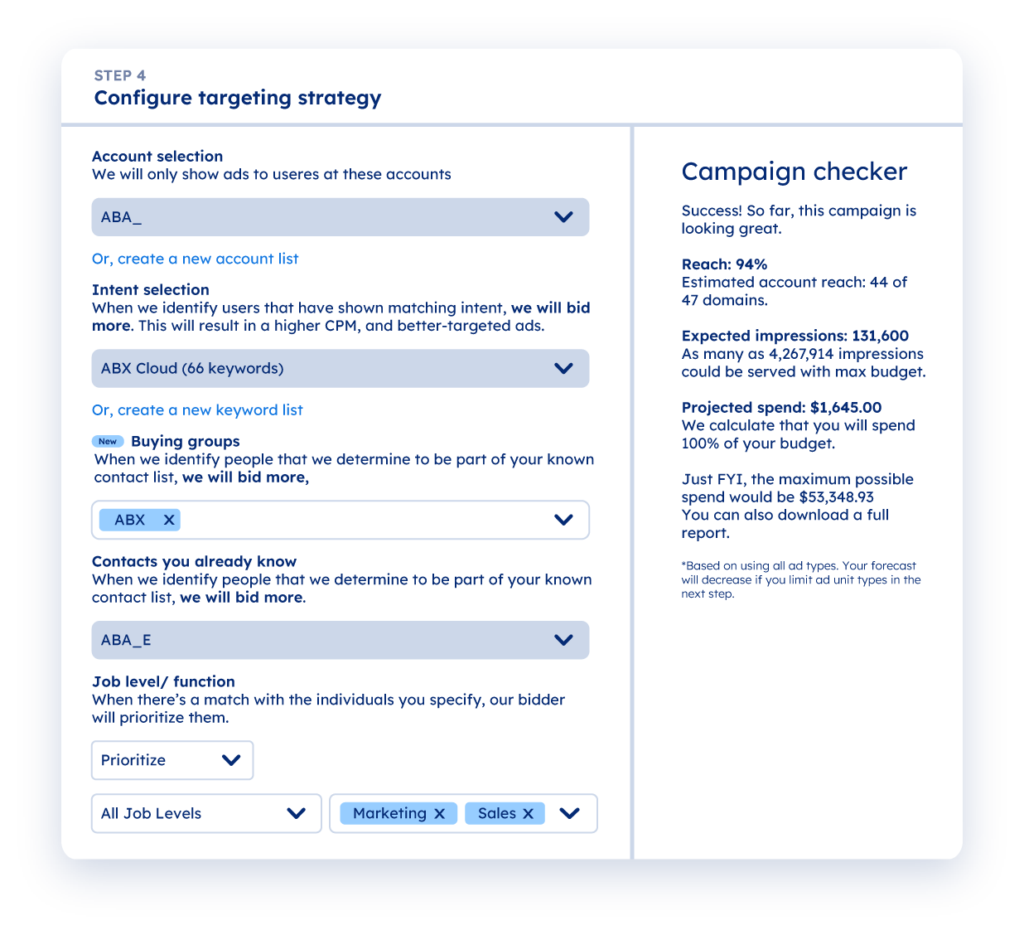
Use the Right Retargeting Channels per Stage
Not every platform works for every stage. For example, Google Display is great for top-of-funnel brand recall, but not ideal for demo conversions.
On the flip side, LinkedIn ads and CRM-based email retargeting are far better for bottom-of-funnel precision.
Here’s how to think about it:
- Awareness: YouTube, programmatic display, LinkedIn sponsored posts
- Consideration: Facebook retargeting, LinkedIn InMail, Native ads on B2B media
- Decision: LinkedIn lead gen forms, Google Search retargeting, CRM-based ads synced with HubSpot/Salesforce
Aside from audience size, choose platforms based on context and stage.
Control Frequency, Duration, and Burnout
One of the most overlooked tactics in retargeting: knowing when to stop showing your ads.
If a buyer sees the same ad 14 times in a week, they’ll start ignoring it—or worse, form a negative brand association.
Here’s how to manage it:
- Frequency capping: Set limits on how often ads are shown per user per day/week.
- Retargeting window: Shorter windows (7–14 days) work better for decision-stage ads; longer windows (30–90 days) are better for nurturing.
- Burn pixels: As soon as someone converts (books demo, downloads asset), exclude them from that audience and move them to the next stage.
This ensures you’re always relevant and respectful of attention.
Build Multi-Touch Retargeting Sequences
Think of your funnel as an automated, rule-based system. This is where advanced tools like Demandbase shine.
You can set conditions like:
- If user visits pricing page but doesn’t convert in 7 days → show them a testimonial ad
- If they watch 75% of a demo → show a lead form with “Talk to sales” CTA
- If they’ve been inactive for 30 days → re-engage with a case study or product update
This method of sequencing makes retargeting feel personal and strategic.
You can use the Pipeline Predict tab on Demandbase to see accounts likely to open an opportunity with you soon.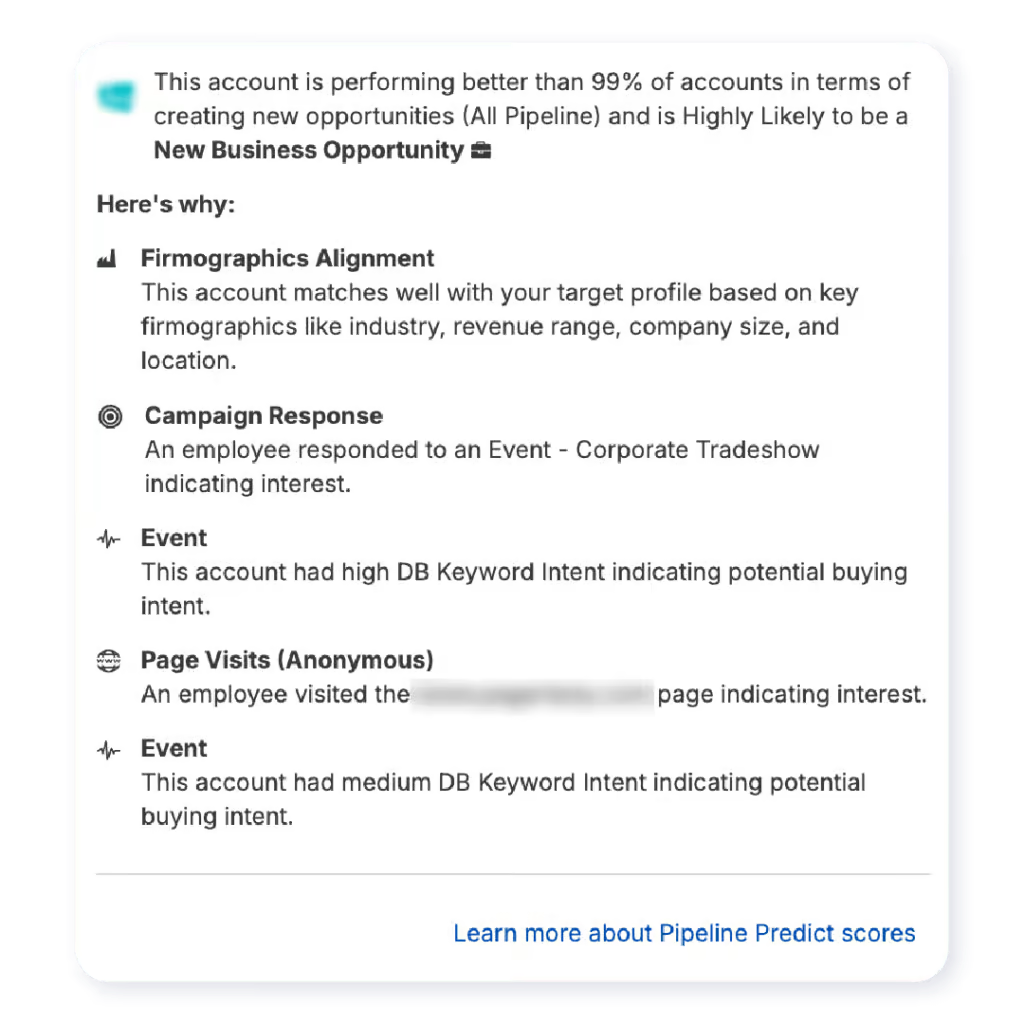
You also get to see the top five factors that contribute to the score assigned to each account. 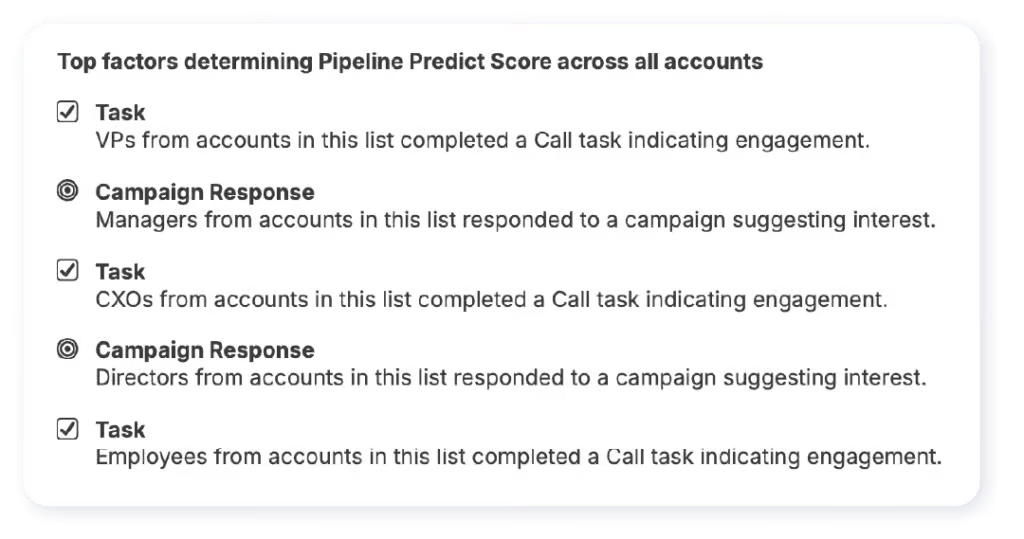
Track, Attribute, and Optimize Based on Funnel Insights
Now, measure what matters. Pull your retargeting data into your CRM or attribution tool so you can tie impressions and clicks to pipeline and revenue.
What metrics to track:
- Click-through rate (CTR) per funnel stage and creative type
- Cost per lead (CPL) vs. cost per opportunity (CPO)
- Conversion rate by intent segment
- Drop-off points in your journey (e.g., lots of pricing page views, but no demos)
For example, if your ads are getting clicks but no demo requests, maybe your landing page or offer needs fixing, and not the ad.
Meanwhile, if leads aren’t turning into revenue, maybe your audience targeting is too broad.
Missed Them the First Time? Demandbase Doesn’t
You’ve seen this movie before: One minute a CMO is deep-diving into your product page, and the next, they vanish like it never happened.
No form fills, no demo requests, not even a goodbye scroll (if something like that exists). Zero. Nothing. Zilch.
The worst part is, most platforms let them walk. They treat retargeting like a basic game of tag—show a banner, cross your fingers, hope they return.
So we thought to ourselves— “well… that needs to change.”
And that’s idea behind Demandbase:
- It knows who visited, what they cared about, what company they work for, and where they are in their buying journey. Then it shows them exactly what they need to see to return.
Curious to find how this works? See how our friends at RH use Demandbase.
Read Case Study → Why Randstad Holding NV chooses Demandbase for ABM excellence.
Now back to you, here’s what it’s actually like when you switch to Demandbase:
- It Keeps Your Brand In Front of the Buying Committee. Your original visitor might’ve been an intern. Demandbase retargets the entire buying group—from end-users to CFOs—so your brand stays visible across the org chart.
- Dynamic Targeting That Adapts Automatically. Someone downloaded your whitepaper? Demandbase moves them into a new ad sequence. Someone viewed pricing? They get a different CTA. It’s automated retargeting logic that adapts without you lifting a finger.
- Retention, Expansion, and Cross-Sell? Yep, It Does That Too. Retargeting doesn’t stop acquisition. Demandbase helps you stay in front of current customers, nurturing them toward upgrades, renewals, or new use cases.
Demandbase: Because One Visit Shouldn’t Be the Last

We have updated our Privacy Notice. Please click here for details.