

The new reality of AI in B2B: why more tools aren’t the answer

The new reality of AI in B2B: why more tools aren’t the answer
B2B teams are deep in an AI gold rush, but the real challenge hasn’t changed. It’s not about finding another tool. It’s about turning all of this data and activity into pipeline that actually moves.
Most teams already have access to signals, engagement data, and CRM insights. The issue is what happens next. Insights sit in dashboards. Context gets lost across tools. Marketing, sales, and advertising still operate with gaps between them.
That disconnect slows execution and makes it harder to see what’s driving results.
At Demandbase, we look at AI differently. It shouldn’t stop at surfacing information. It should carry that information through to coordinated action across your go-to-market.
Demandbase AI: where pipeline gets built
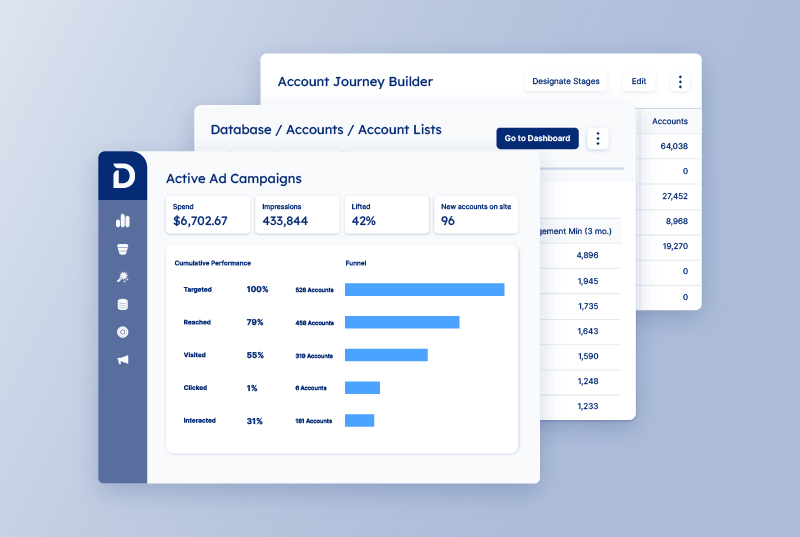
Demandbase AI sits inside the platform as the intelligence layer that connects signals, accounts, and buying group activity. Instead of asking teams to interpret data and decide what to do next, it translates that context into clear priorities and actions.
You’re not jumping between systems or piecing together what matters. The platform brings everything into one place, highlights where to focus, and helps teams act with shared context.
That shift matters. Most AI tools give you more visibility, but they don’t help you move faster or with precision. Demandbase AI closes that gap by linking insight directly to execution.
It starts with a pipeline goal and works outward from there.
What that looks like
Start with a pipeline goal. Everything builds from there.
Demandbase AI helps you:
- Prioritize the accounts and buying groups most likely to convert
- Connect engagement signals to next actions across teams
- Activate coordinated programs across marketing, sales, and advertising
- Track what’s driving pipeline and adjust in real time
At its core, it runs on a simple loop: Goal → Insight → Action → Improve → Outcome
That loop is what turns activity into pipeline you can measure and scale.
MCP integrations: extending that intelligence into daily workflows
Your team doesn’t spend the entire day inside one platform.
Sales reps move between their CRM, call tools, and AI assistants. That’s where decisions happen and where context needs to show up.
MCP integrations bring Demandbase data into those environments so teams can access the same pipeline context without switching tools or recreating it manually.
Where MCP adds value
- Pull up account and buying group activity before a call
- Generate outreach grounded in real engagement signals
- Find contacts and context without digging through multiple systems
You stay in your workflow and still work from the same source of truth.
MCP makes that intelligence easier to access and supports what happens inside the platform.
This isn’t a choice. It’s a connected system
It’s easy to frame this as: Do we use native AI or external tools?
That’s the wrong way to think about it.
Each plays a different role, and they’re designed to work together.
- Demandbase AI runs inside the platform. It prioritizes accounts, coordinates programs, and continuously improves what’s driving pipeline across your go-to-market.
- MCP integrations extend that same intelligence into the tools your team already uses, so they can access context and act without switching systems.
You can see the difference in how teams use each one.
Inside Demandbase, teams define priorities, activate programs, and measure what’s working. That’s where execution happens.
Outside the platform, MCP integrations bring that context into daily workflows before a call, during outreach, or while researching an account.
One drives execution. The other makes that execution easier to access and apply.
Together, they close the gap most AI strategies leave open: the gap between insight and action.
How this shows up day to day
The value becomes clearer when you look at how teams actually use it.
For marketing and RevOps:
- Set priorities based on real account and buying group activity
- Coordinate programs across channels and teams
- Track what’s contributing to pipeline and adjust quickly
For sales:
- Prep faster with real account context
- Engage with more relevant messaging
- Spend less time researching and more time selling
Everything connects back to the same system, which keeps execution aligned and measurable.
The bottom line
AI has made data easier to access. That’s no longer the challenge.
What matters now is how quickly teams can turn that information into coordinated action and how consistently they can improve what drives results.
Demandbase AI connects those steps.
Set a pipeline goal.
Prioritize the right accounts.
Activate across teams.
Keep improving what works.
That’s how pipeline becomes more predictable and why Demandbase AI is the pipeline engine for AI GTM.


We have updated our Privacy Notice. Please click here for details.