

Account intent tells you where. Person-based intent tells you who's researching.
Find the buyers you don't know about yet, and act on that intelligence in your apps, AI assistants, and data cloud.

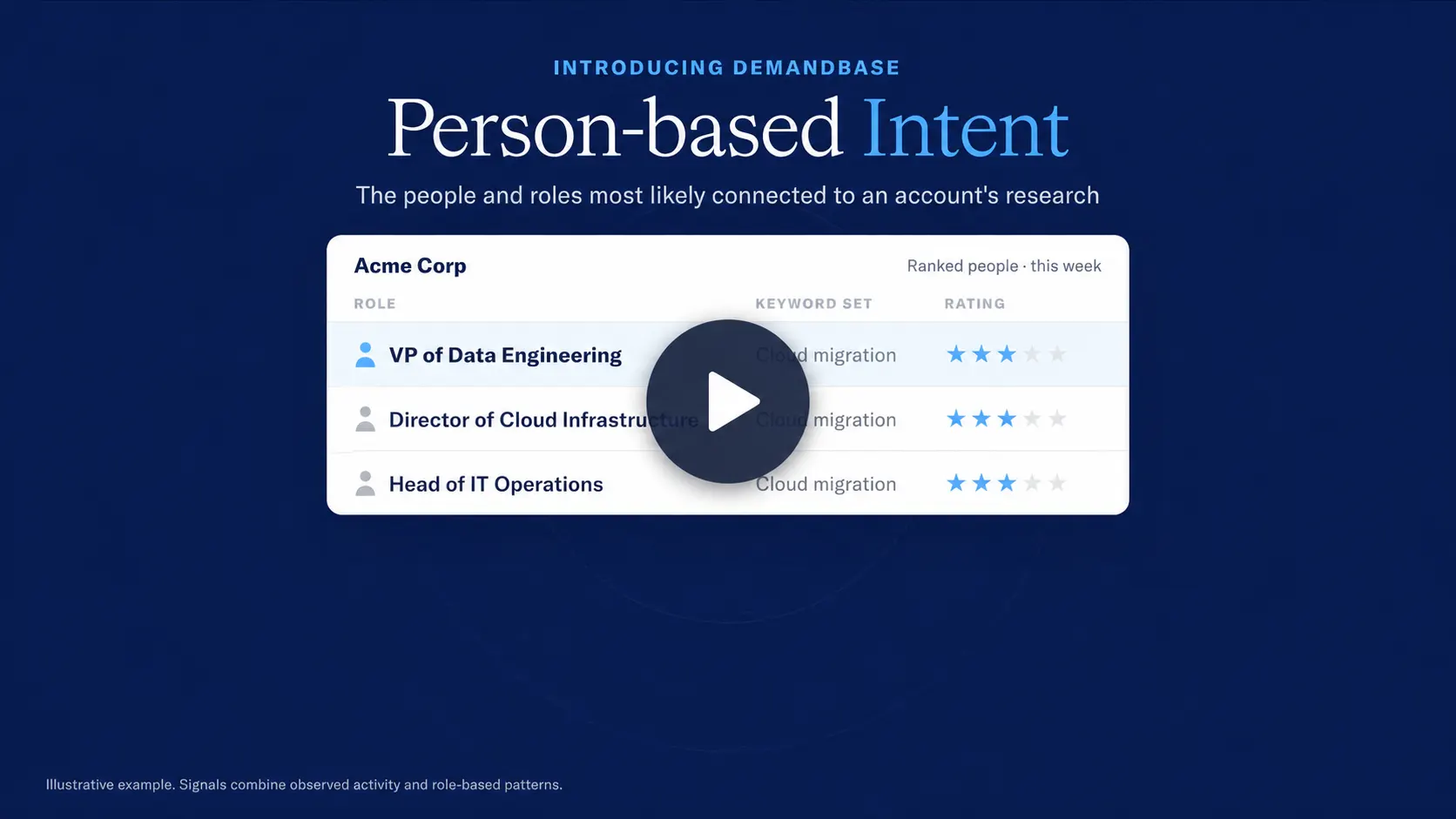 .
Account intent tells you where research is happening: which companies are in-market for a topic. It doesn’t tell you who. And who is the question every outreach, audience, and model depends on.
Demandbase Person-based Intent answers who. Here’s what sets it apart, and how to activate it across your GTM technology stack, AI assistants, and agentic workflows.
Who: the buyers you don’t know about yet
Most B2B research happens across the wider web, long before a buyer visits your site or fills out a form. Person-based Intent surfaces that third-party research: the people and roles at target accounts who are researching your category, but whom your teams don’t know about yet. Person-based Intent brings that hidden demand into view, so your teams can engage those buyers before competitors do.
Behind it is the intent data the world’s leading B2B companies rely on:
- 2.3 trillion+ intent signals a month
- 78 billion+ B2B site visits a day
- 950,000+ keywords in 133 languages
- 3.7 billion+ IP addresses in the Demandbase B2B identity graph
Each person is rated from one to five stars within your own buying groups, so teams know who to prioritize.
From knowing who to acting on it
Person-based Intent works alongside Demandbase’s proprietary intent, buying-group insights, and predictive intelligence, and feeds purpose-built GTM agents and workflows. Teams can act on it where they already work:
- Demandbase app: ranked people recommendations for each account
- Slack: alerts when a relevant person shows intent
- AI assistants, through MCP*: ask who is researching inside ChatGPT, Claude, or Microsoft Copilot Studio, or build it into your own agents
- Your data cloud, through Data Cloud Delivery: the most flexible option, covered next
Person-based Intent, inside your own stack: Data Cloud Delivery
Data Cloud Delivery puts Demandbase-sourced, third-party Person-based Intent into the data environment you already run. Your team owns the joins, the models, and the activation.
From there, it flows into the rest of your stack: your data warehouse, CDP, CRM, marketing automation, sales engagement tools, and more. Teams put it to work in the technology they’ve already invested in, with no need to log into the Demandbase UI:
- Models: add buyer-level research behavior to account and opportunity scoring, propensity and lookalike models, and forecasts.
- AI assistants and agentic workflows: give your own agents a structured, weekly view of who is researching what, so they can prioritize accounts, draft account briefs, or trigger next best actions.
- Activation: build person-based audiences for LinkedIn and Meta, micro-cohorts by shared intent, and weekly target lists for sellers.
- Retention: pair product usage drops with competitive research to flag renewal risk, and find new buying groups inside customer accounts.
- Analytics and planning: report on buyer-level intent in Tableau, Looker, or Power BI, and balance territories by person-level demand.
Proven in the field: from 70,000 employees to four buyers
A leading martech company was pursuing a multi-million-dollar customer data platform (CDP) deal with a large healthcare payer of more than 70,000 employees. The challenge wasn’t demand generation. It was precision: who inside that organization was actually in-market?
Using Demandbase Person-based Intent, the team isolated the target account, layered in intent signals tied to CDP research, applied geographic filtering where engagement was concentrated, and narrowed the focus to people aligned with the buying committee. The result: four highly relevant contacts actively researching CDPs.
The team engaged those four directly, earlier in the cycle and with more relevant outreach, and closed the deal. Account intent got them to the right account; knowing who got them to the deal..
What changes when you know who is researching
When teams know who is researching, not just where, the outcomes are measurable:
- Higher-probability leads: prioritize the accounts and people most likely to buy, including the ones your teams didn’t know about yet.
- Faster pipeline generation: turn third-party buying signals into campaigns, sales actions, and pipeline sooner.
- More accurate forecasting: add buying-group and predictive intelligence to the models behind your revenue forecast.
- Higher win rates: engage more of the buying group at the right time, in a coordinated way.
- Greater revenue efficiency: get more from the technology and teams you already have, because the data works inside your existing stack.
Account intent tells you where to look. Person-based Intent tells you who, and Demandbase puts that answer wherever your teams and systems already work.
To go deeper, read our earlier post on Person-based Intent.
Want to see who’s researching your category right now? Book a meeting to request a custom Person-based Intent data sizing analysis.
*MCP access to Person-based Intent is coming soon.




We have updated our Privacy Notice. Please click here for details.