

Turn buying signals into revenue
Demandbase Orchestration helps revenue teams act the moment buying momentum appears and stop pipeline decay.

Revenue rarely disappears overnight. It erodes quietly.
Only 5% of B2B buyers are actively in market at any given time 1. When you miss a buying window, you may not get another.
Deals stall. Engagement fades. Competitive research happens while forecasts still look healthy.
Revenue teams do not lose because they lack signals. They lose because execution lags buying momentum.
Today, we’re announcing a major evolution of Demandbase Orchestration, redesigned to turn buying signals into coordinated revenue action and stop pipeline decay before it starts.
Now faster and more intuitive, Orchestration serves as the execution layer across your go-to-market engine.
Powered by Demandbase, which uses AI to analyze billions of intent, engagement, and CRM data points, Orchestration activates the right marketing and sales motions at the right moment.
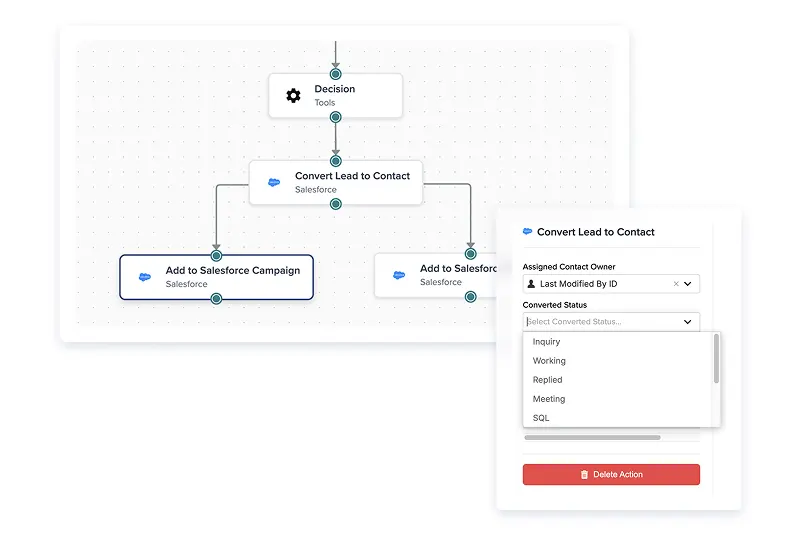
What’s new in Orchestration
This release delivers a more powerful, intuitive execution layer for modern CRO and CMO operating models.
- Build workflows faster: The Visual Builder simplifies multi-path play design.
- Deploy smarter logic: Advanced branching adapts based on account tier, engagement, journey stage, or opportunity health.
- Extend across your stack: Expanded integrations and custom actions activate signals across revenue systems.
- Gain full visibility: Detailed execution history gives RevOps governance and control.
These enhancements make Orchestration easier to adopt, scale, and measure.
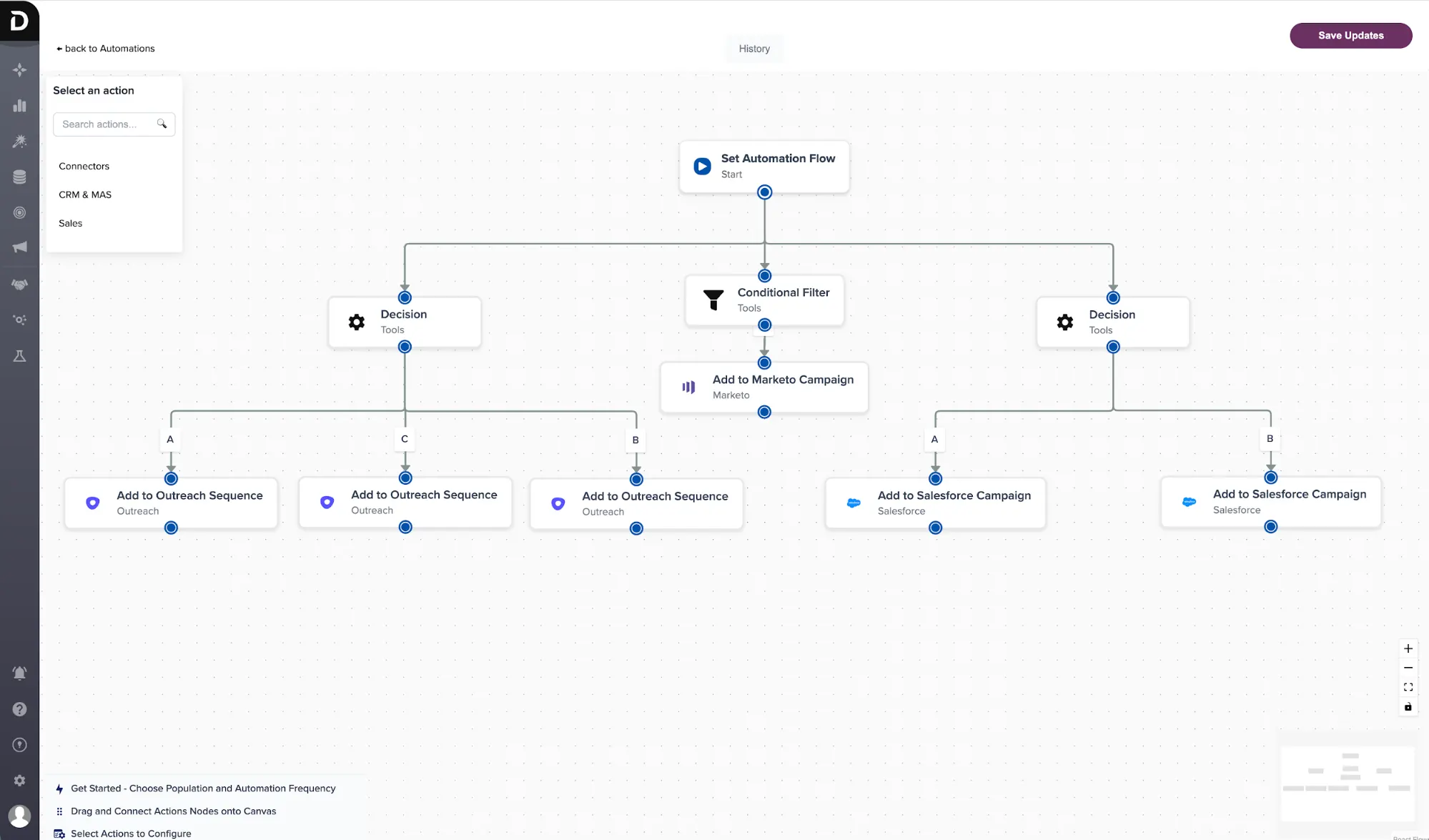
From insight to execution
Intent spikes. Engagement increases. Deal velocity slows. Competitive risk emerges.
Demandbase AI detects intent surges, engagement shifts, and buying group expansion.
Most platforms surface signals.
Dashboards don’t create revenue. Action does.
Orchestration bridges signal and execution, triggering plays that drive your highest-impact pipeline motions:
- Win the Buying Window: Engage first and convert momentum into meetings.
- Stalled Deal Recovery: Protect in-flight revenue when velocity slows.
- Competitive Intervention: Influence deals early when competitor research begins.
- Closed-Lost Resurrection: Reclaim pipeline when lost opportunities show renewed intent.
Orchestration synchronizes execution across sales engagement, CRM, marketing automation, advertising, and custom systems so sales, marketing, and RevOps move together.
Organizations with aligned Revenue Operations models are 1.4x more likely to exceed revenue goals 2 and grow nearly 3x faster 3 than siloed teams.
Speed matters
When accounts show buying intent, speed wins.
78% of buyers purchase from the company that responds first 4. The odds of contact drop 100x when response time slips from 5 minutes to 30 5.
Orchestration activates coordinated plays the moment AI-driven Qualification Scores and intent surges cross defined thresholds, including SDR engagement, targeted air cover, buying group expansion, and multi-channel outreach.
The impact is clear: faster engagement, stronger stage conversion, accelerated pipeline.
Demandbase customers have seen 83% increases in pipeline velocity and 3x increases in conversions 6 when signals are quickly activated.
Stop pipeline decay before it starts
Pipeline decays through silence.
One-third of organizations report up to 20% increases in average deal size through account-based strategies 7. Letting deals stall carries compounding cost.
Orchestration monitors opportunity health and intervenes when risk surfaces, identifying stalled velocity and declining engagement before they show up in forecast calls.
It can trigger executive outreach, expand buying committee engagement, reinforce messaging, and alert account teams with recommended next steps.
Revenue protection becomes systematic.
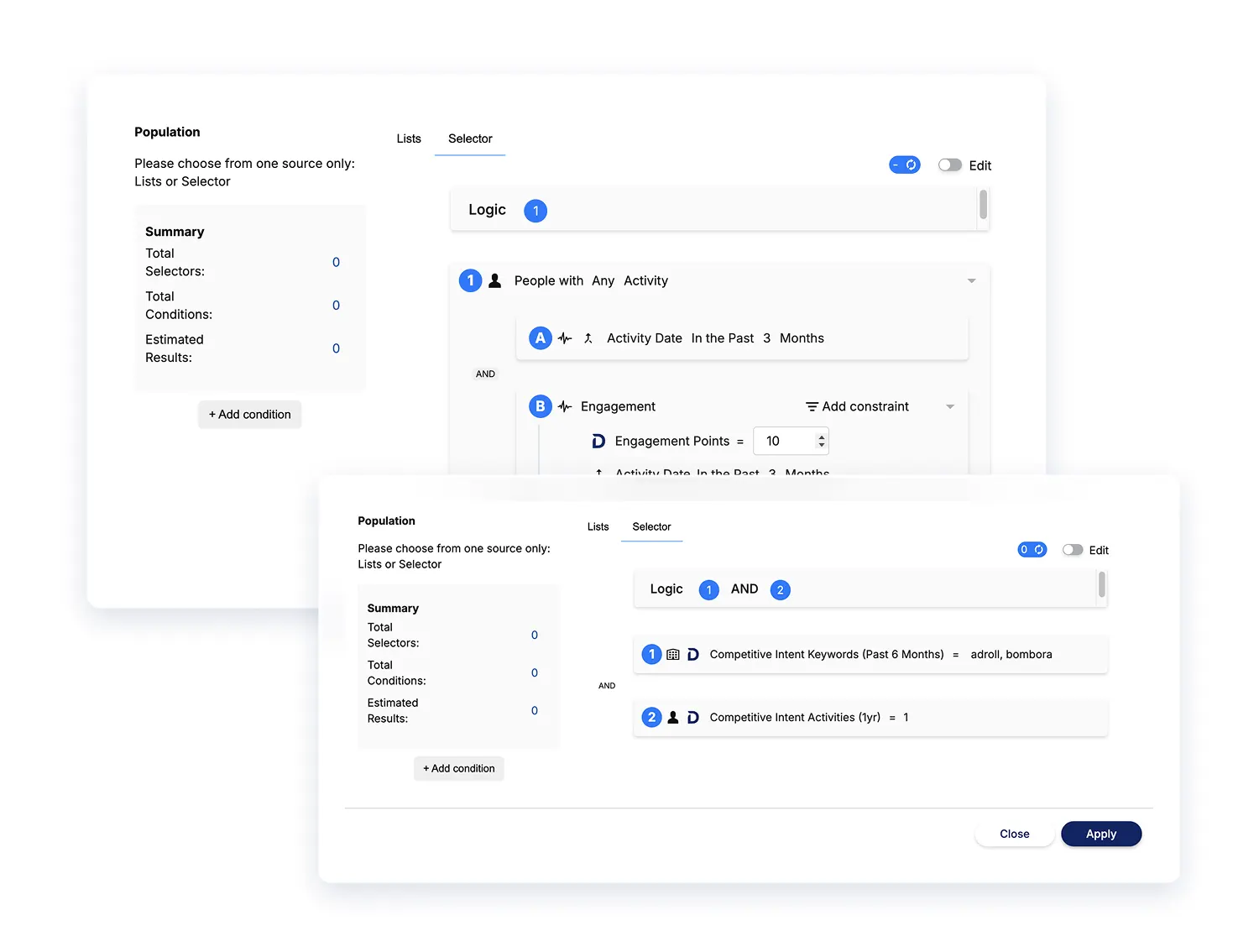
Shape competitive outcomes early
Competitive influence often enters deals before sales sees it.
The average enterprise deal over $250K involves 17 stakeholders 8, creating openings for competitors to shape the narrative.
Demandbase AI detects competitive research as it surges. Orchestration activates coordinated counter-positioning so you influence the deal while it is still forming.
Do more with the team you have
Revenue leaders face pressure to drive growth efficiently. Headcount is constrained. Expectations are not.
Top-performing teams save up to 80% of time previously spent on manual data sifting and research when intelligence and execution are unified 9.
For leaders measured on forecast accuracy and capital efficiency, Orchestration helps you:
- Eliminate manual coordination
- Reduce lag between signal and action
- Protect pipeline in motion
- Accelerate deals with synchronized engagement
Buying windows are short. Pipeline is fragile.
With only a small fraction of your market actively buying at any given time, missing a signal is lost revenue.
Orchestration ensures your teams never lose revenue because your systems failed to act.
What comes next
This MVP launch is just the beginning.
Upcoming releases will introduce real-time triggers, automation previews, deeper integration of Demandbase-sourced third-party data, unified account and person actions, and expanded marketplace integrations.
The coordination layer is evolving quickly, giving revenue leaders greater precision and control over how signals turn into pipeline and pipeline into revenue.
If you are responsible for revenue predictability in 2026, Orchestration should be part of your operating model.
_______
Works cited
1 – John Dawes, Ehrenberg-Bass Institute for Marketing Science
2- Deloitte Digital, The future of B2B sales, Is RevOps the new driver for B2B growth?
3, 6, 9 – Demandbase customer results.
4 – Lead Connect Study
5 – MIT/InsideSales.com Lead Response Management Study, Dr. James Oldroyd
7 – Forrester, Data Snapshot, Account-Based Marketing Results In Larger Average Deal Sizes Across Regions
8 – Jen Allen-Knuth, LinkedIn, February 16, 2026




We have updated our Privacy Notice. Please click here for details.