
Engagement points for Demandbase intent

Principal GTM Expert, Marketing Operations
-
Journey Stage
All Stages
-
Team
Marketing, RevOps
-
Expertise Level
Beginner
Contents
Partner with Demandbase Experts
Get tailored strategies and insights to optimize your approach, drive engagement, and unlock new opportunities.
What you’ll learn
This playbook walks you through how to properly assign and calibrate Engagement Minutes for Demandbase Intent signals. You’ll learn:
- The differences between Demandbase Intent, Geo Intent, and Trending Intent.
- How to assign Engagement Minute values across each intent variations
- How to build a consistent scoring framework that avoids inflated engagement values.
- The step-by-step configuration process in Demandbase, from keyword set creation to scoring implementation.
- Real-world examples that illustrate how to apply Engagement Minutes to generalized, competitive, and trending intent signals.
When finished, you’ll have a reliable, scalable Engagement Minute Scoring Model aligned to your GTM strategy and built to accurately reflect real intent-driven activity.
Why this is important
Intent data helps you see which accounts are actively researching your products, competitors, or category. But raw intent is noisy, it needs structure and context to be actionable. Without a proper scoring model:
- Weak signals can look like strong buying activity.
- True in-market accounts may be overlooked.
- Engagement metrics can become bloated and unreliable.
Applying Engagement Minutes transforms those raw signals into calculated insights. You’ll know exactly which accounts are worth prioritizing, and your Sales and Marketing teams can focus on the right Accounts at the right time.
What you need to get started
Before implementing, ensure a few fundamentals are ready.
Start by confirming you understand how Demandbase defines intent, as human content consumption on third-party websites that include relevant terms for your business. Then, make sure your Demandbase Intent Keyword Sets are built and aligned to your GTM motion (e.g., one keyword set per product line or solution area).
Finally, verify that you have access to the Engagement Minute Scoring Model and the Intent Activities section inside the platform. That’s where all scoring configurations will take place.
Step-by-step playbook
This playbook teaches you how to assign Engagement Minutes to Demandbase Intent signals for accurate, actionable intent scoring that drives better targeting and ABM results.
Part 1: Understanding intent in Demandbase
Step 1: Learn the three types of Demandbase intent
Demandbase uses three intent variations:
- Demandbase Intent: Standard signals categorized by Intent Strength (Low, Medium, High).
- Demandbase Geo Intent: Same as above, but includes geolocation data (region, country).
- Demandbase Trending Intent: High-value signals showing a recent spike in activity (past week vs. prior two months).
Step 2: Understand intent strength and trending intent
Intent Strength Indicates if the organization is below (Low), at (Medium) or exceeding (High) interest in a specific term given how other organizations of their similar employee size have consumed similar terms.
| Account Size | Low | Medium | High |
|---|---|---|---|
| 1 - 10 employees | 1 person reading | 2 - 3 people reading | 4 or more people reading |
| 11 - 50 employees | 1 person | 2 - 4 people | 5 or more people |
| 51 - 200 employees | 1 - 2 people | 3 - 7 people | 8 or more people |
| 201 - 500 employees | 1 - 2 people | 3 -9 people | 10 or more people |
| 501 - 1K employees | 1 -2 people | 3 - 13 people | 14 or more people |
| 1K - 5K employees | 1 - 3 people | 4 - 18 people | 19 or more people |
| 5K - 10K employees | 1 - 3 people | 4 - 28 people | 29 or more people |
| > 10K employees | 1 - 3 people | 4 - 37 people | 38 or more people |
Trending Intent focuses on an individual account’s spike in interest on a specific term based on a rolling 2-month average interest on that specific term.
Part 2: Structuring your scoring framework
Step 1: Locate the intent activities section
In your Engagement Minute Scoring Model, go to Intent Activities. You’ll see the three intent types we will cover:
- Demandbase Keyword Intent
- Demandbase Geo Keyword Intent
- Trending Intent
Step 2: Choose your approach (keyword vs. geo or both)
Think of Demandbase Keyword Intent as the foundation and Geo Intent as a subset layer. You can:
- Use Keyword Intent for maximum coverage.
- Use Geo Intent when you need regional segmentation.
- Combine both to add geographic weighting (e.g., giving higher value to signals from target markets).
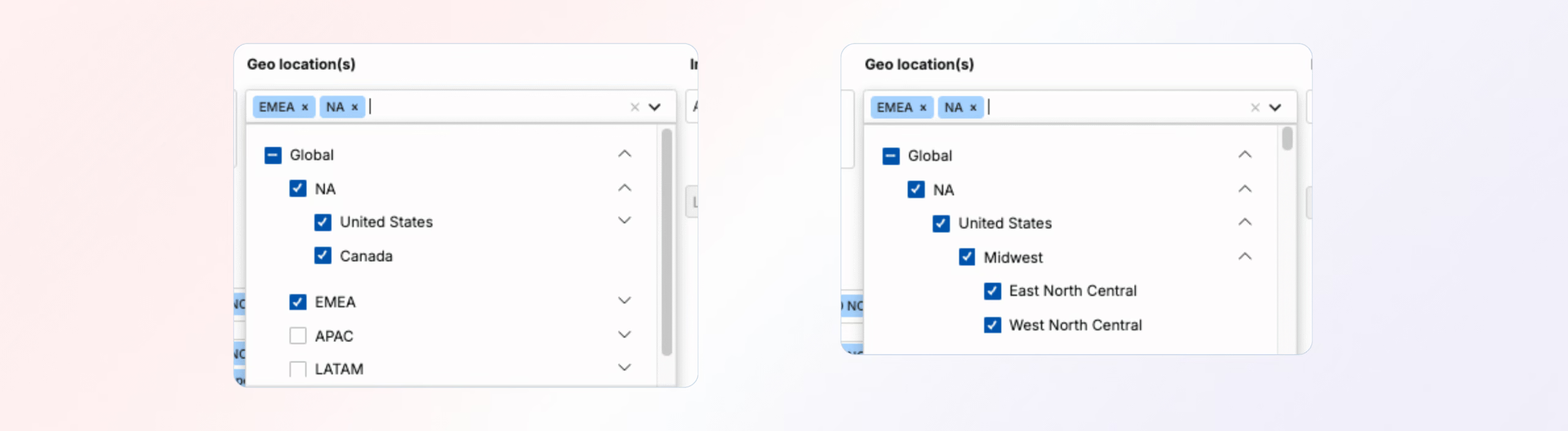
Geo Intent lets you include or exclude regions (NA, EMEA, APAC, LATAM), or drill down to countries and even sub-regions within the U.S.
Part 3: Establishing scoring methodologies
Step 1: Define engagement minute baselines
Use these recommended baselines to ensure consistent, scalable scoring. There are a lot of intent signals at any given Account, the bigger the organization the more intent signals they potentially have. For this reason we want to keep most of our scoring conservative by always staying below 1 Engagement Minute to avoid overvaluing the high volume of activities.
General Demandbase Keyword Intent
- Low = 0.05
- Medium = 0.07
- High = 0.10
Competitive Keyword Intent
- Low = 0.07
- Medium = 0.10
- High = 0.20
Trending Intent
- Generalized = 0.50
- Competitive = 1.00
Step 2: Keep it simple
Score entire keyword sets, not individual terms. It’s easier to maintain, prevents double-counting, and ensures all relevant signals are captured automatically.
One big best practice is to ensure that you do not have overlapping keywords in multiple keyword sets. This would cause potential double scoring as well.
Part 4: Scoring examples and best practices
Step 1: Score Demandbase keyword intent
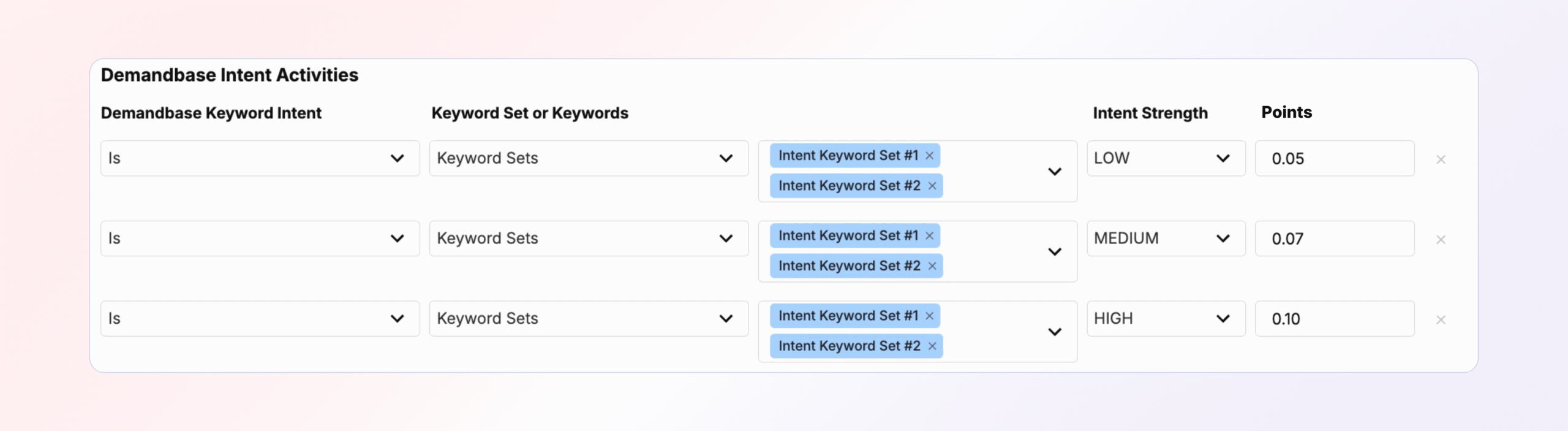
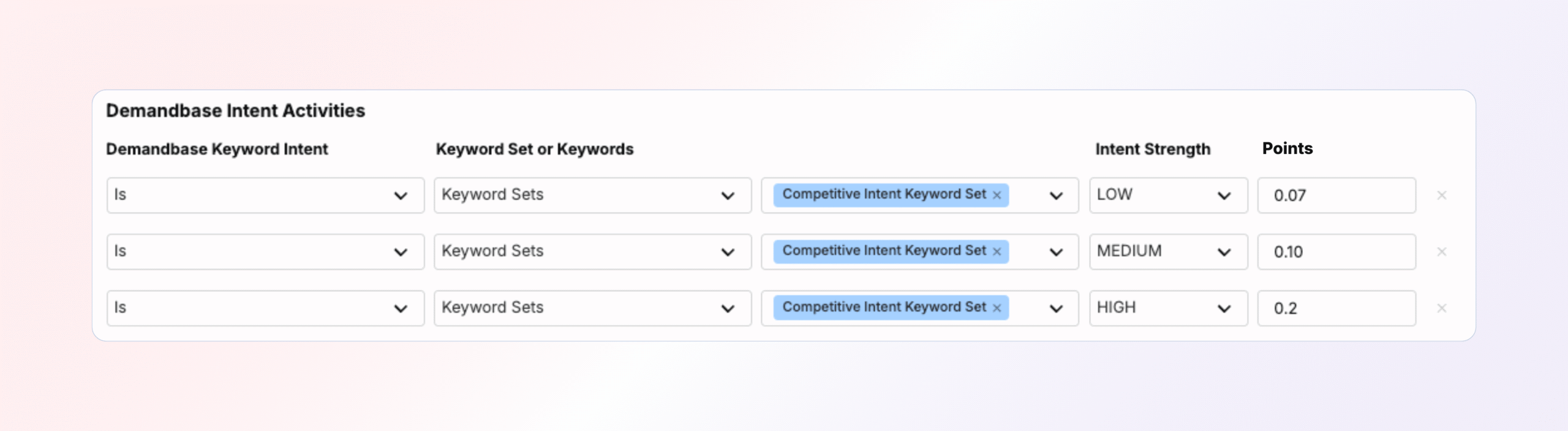
Scenario: You have two generalized keyword sets and one competitive set.
- Go to Intent Activities → Demandbase Keyword Intent.
- Use operator “Is” and select your keyword sets.
- Create three rows for Low, Medium, and High Intent Strengths.
- Assign the recommended Engagement Points and repeat for competitive keyword sets:
-
- Generalized = 0.05 / 0.07 / 0.10
-
- Competitive = 0.07 / 0.10 / 0.20
-
Tip: Populate your competitive keyword sets with specific competitor names and branded terms, not generic ones.
Step 2: Score Demandbase geo intent (geo only)
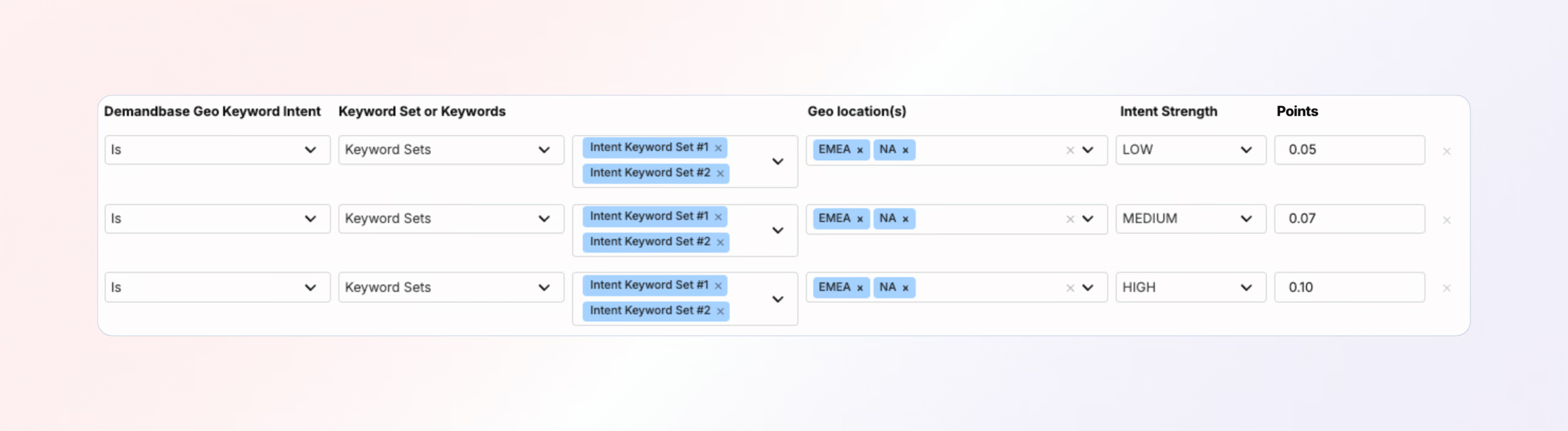
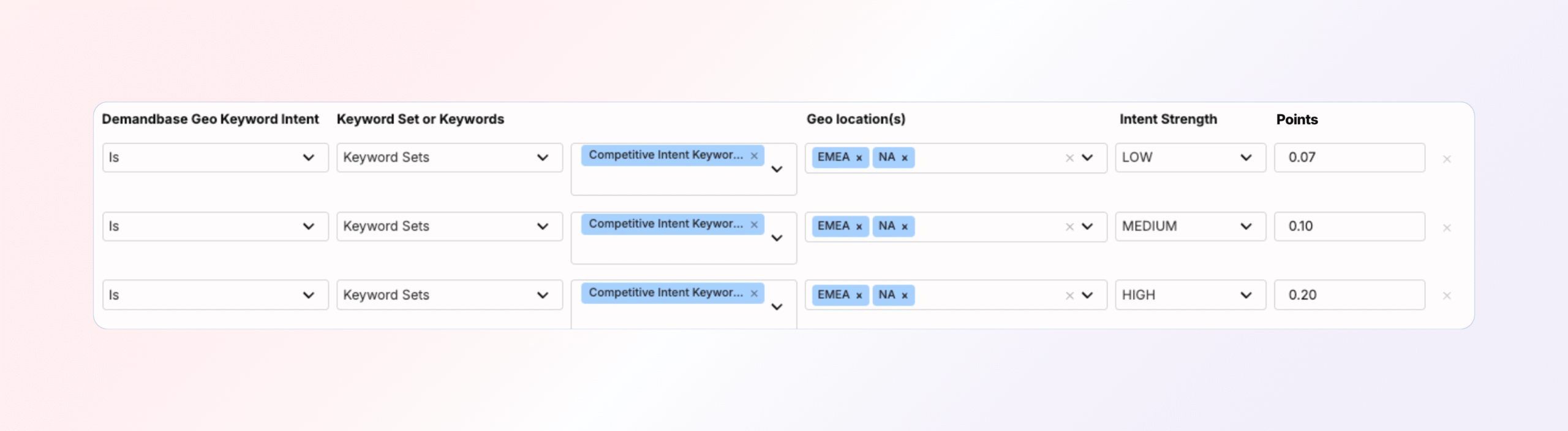
Scenario: You want to score only Geo Intent signals for the USA, Canada, and EMEA.
- In Intent Activities → Demandbase Geo Keyword Intent, choose “Is” and select your keyword sets.
- Under Geo location(s), select NA (U.S. + Canada) and EMEA.
- Create three rows for Intent Strength (Low, Medium, High).
- Assign Engagement Points:
-
- Generalized = 0.05 / 0.07 / 0.10
-
- Competitive = 0.07 / 0.10 / 0.20
-
Step 3: Score Demandbase geo intent (geo + keyword combined)
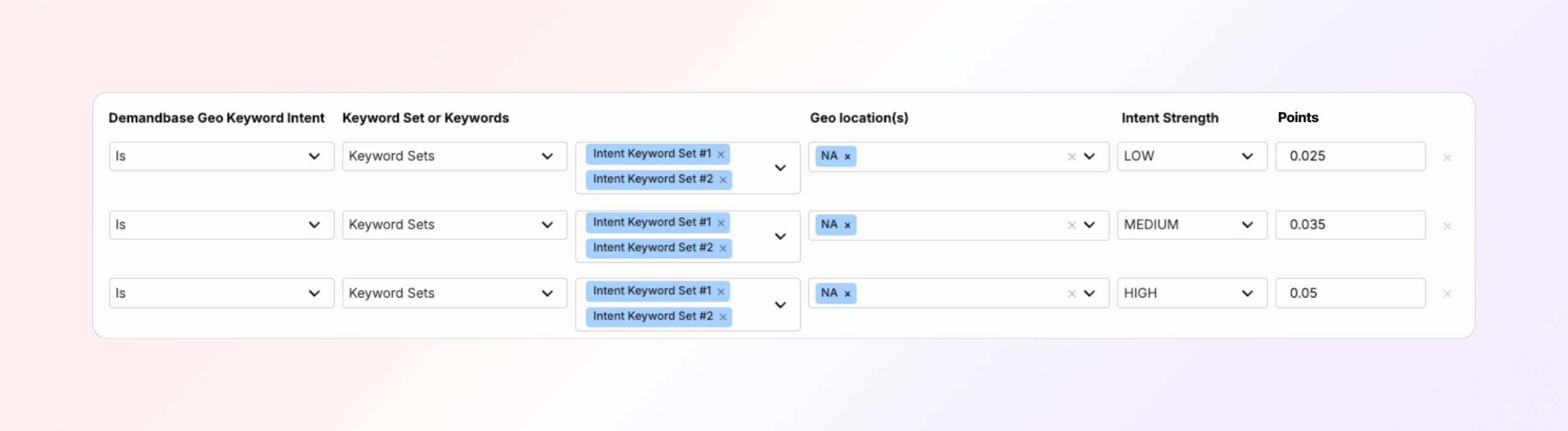
Scenario: You’re already scoring Keyword Intent and want to add Geo weighting for target regions (e.g., USA + Canada).
- Add your keyword sets under Demandbase Geo Keyword Intent.
- Choose NA as your location.
- Assign Engagement Points at 50% of the standard values:
-
- Low = 0.025
- Medium = 0.035
- High = 0.05
-
Repeat for competitive keyword sets (0.035 / 0.05 / 0.10).
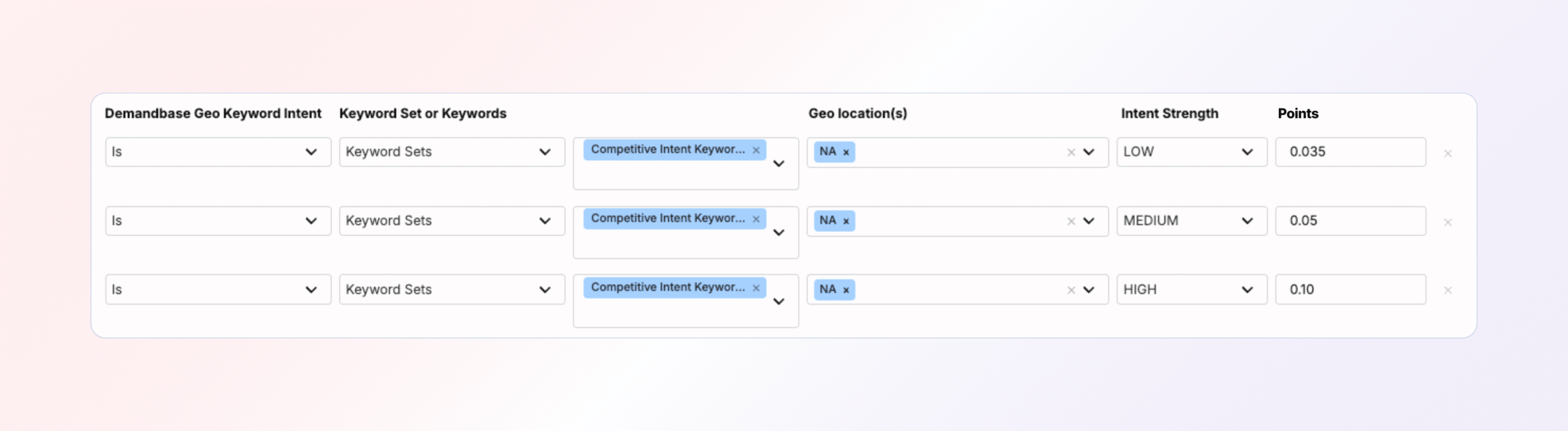
This boosts engagement for accounts in your core regions without inflating scores.
Step 4: Score trending intent
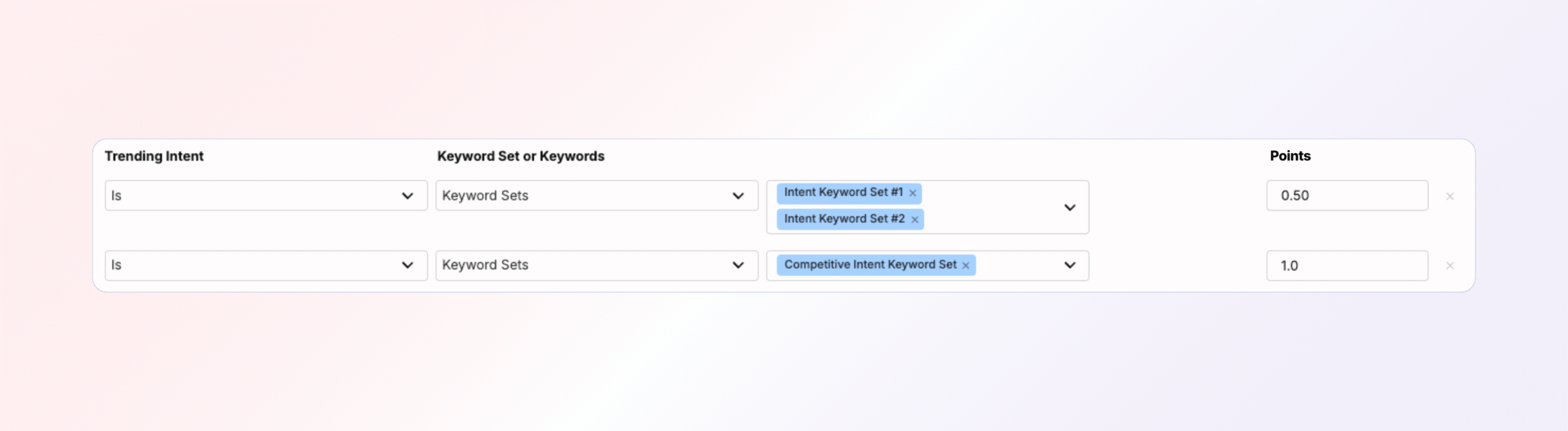
Scenario: You want to capture the surge of interest for specific keywords at specific accounts.
- Go to Intent Activities → Trending Intent.
- Use operator “Is” and select your keyword sets.
- Since there’s no Intent Strength or Location, you only need one row per set.
- Assign:
-
- Generalized = 0.50
- Competitive = 1.00
-
These are time-sensitive engagement spikes that can indicate immediate buyer readiness.
The results
Once you’ve completed this setup, you’ll have a highly accurate, intent-focused Engagement Minute model that:
- Avoids data inflation while capturing critical engagement signals.
- Scales easily across all Demandbase Intent types (Keyword, Geo, and Trending).
- Highlights which accounts are truly spiking in interest so Sales can focus where it matters most.
This framework turns raw data into a unified signal model that fuels smarter GTM decisions and accelerates pipeline impact. Once implemented, read our other playbook on “How to Find Top Competitive Intent Keywords”.
Partner with Demandbase Experts
Get tailored strategies and insights to optimize your approach, drive engagement, and unlock new opportunities.
More Playbooks
Learn how to set up and customize Demandbase's predictive models - Qualification Score and Pipeline Predict - to prioritize accounts, align with your GTM strategy, and drive higher conversion rates.
Learn how to implement account tiering in B2B marketing with our step-by-step guide. Boost ROI, align sales & marketing teams, and optimize campaign spend.
Learn multi-channel targeting, audience building, and pipeline optimization strategies using Demandbase tools.
We have updated our Privacy Notice. Please click here for details.