
The state of ABM in 2026: What 1,452 companies taught us about pipeline growth
What the data reveals about ABM maturity, buying groups, and performance


Contents
GTM teams make big calls every day. Decision about which accounts to prioritize, how many buying groups to engage, where to invest in advertising, and which systems to connect.
Those decisions shape pipeline and revenue. Yet many teams still operate without a clear benchmark for what strong performance actually looks like.
The Labs by Demandbase B2B GTM Report, brings a wider lens to the conversation. It analyzes data from 1,452 tenants (a tenant is a Demandbase instance), 429,634 ad campaigns, 38 million marketing activities, and 9.7 million sales interactions to identify the patterns that consistently drive stronger pipeline performance.
Here’s what the data reveals.
ABM maturity drives pipeline performance
ABM maturity reflects how deeply account-based strategy is embedded into execution. Early-stage programs focus on account lists and campaigns. More mature programs align sales and marketing around buying groups, integrate systems, and coordinate engagement across the full journey.
The relationship between maturity and performance is consistent. As alignment, integration, and buying group focus increase, pipeline outcomes improve.
Five findings stand out
- Buying groups outperform lead-centric models. Organizations that align marketing and sales around buying groups achieve up to 2–3× higher win rates than teams that still center execution on individual leads. A typical buying group includes 13–17 stakeholders, each with different priorities and levels of influence. Engaging a single contact rarely advances a deal. Coordinated, multi-threaded engagement across roles produces stronger progression. Buying group strategy anchors high-performing ABM programs.
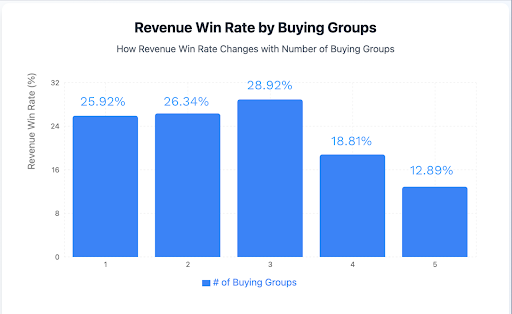
- Two to three buying groups is the sweet spot. Win rates peak when teams focus on 2-3 buying groups per product. Expanding beyond that range introduces operational complexity and diminishing returns, as shown in the chart below.
Teams that concentrate effort where engagement signals are strongest maintain tighter coordination and see more consistent results. - Engagement depth correlates with conversion. Interaction volume has a measurable impact on outcomes. As the graph below indicates, buying groups with limited touches convert at the lowest rates. As engagement increases, conversion rises sharply. Groups receiving 180–190 touches reach a 94% conversion rate.
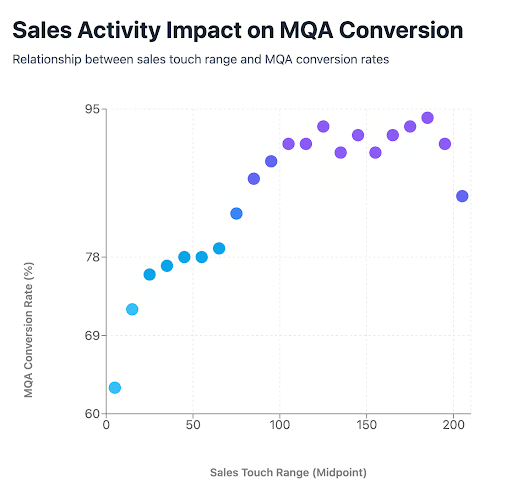 This pattern reflects sustained coordination across marketing and sales, supported by consistent messaging and follow-up.
- Integration improves MQA-to-pipeline conversion. Disconnected systems limit visibility and slow execution. Organizations connecting CRM, MAP, and predictive models achieve 22%+ MQA-to-pipeline conversion rates, compared to a 14% baseline among teams operating with limited integration. The strongest performance appears when 3 core systems are connected.
Shared data supports clearer prioritization and more aligned action.
- Advertising accelerates progression. Advertising contributes directly to account momentum when aligned with buying group engagement. Accounts supported by sustained buying group–level advertising convert to opportunities at 2–3× the rate of accounts without advertising. Companies using four advertising products report a 58.7% win rate, a 71% lift over companies running none.
Advertising performs best when it reinforces coordinated engagement rather than operating in isolation.
ABM maturity leads to better outcomes
The data draws a clear line between ABM maturity and pipeline performance.
Teams operating within more mature frameworks see a 22.33% median MQA conversion rate. Less mature programs convert at 14.19%. That difference represents a meaningful shift in opportunity creation and revenue potential.
Focus plays a central role. Companies tracking 3-4 buying groups see a 48.5% higher win rate compared to organizations taking a broader, less structured approach.
ABM maturity shows up in the infrastructure behind execution—connected systems, shared data, and a disciplined focus on buying groups actively moving through a decision process.
What ABM maturity changes for GTM teams
As ABM maturity increases, execution becomes more coordinated.
Marketing, sales, and customer success operate from shared buying group visibility. Teams see the same engagement signals and progression data, which makes prioritization clearer and follow-up more intentional. Alignment becomes part of the workflow rather than a recurring correction.
Pipeline visibility improves as teams understand how engagement patterns influence stage movement. That clarity supports better timing, sharper outreach, and more informed resource allocation.
Predictive scoring adds another layer of signal. Pipeline Predict Scores identify accounts most likely to convert in the near term and surface potential expansion opportunities within existing customers. These insights help revenue teams focus effort where momentum already exists.
Over time, this operating discipline influences results. Win rates improve. Deal values strengthen. Investment decisions rely on measurable patterns rather than instinct.
ABM maturity doesn’t reduce the complexity of B2B buying. It gives teams the structure to navigate that complexity with greater clarity and consistency.
For a deeper look at the benchmarks behind these findings, explore the full Labs by Demandbase B2B GTM Report.
More Demandbase Labs articles
Learn how engaging buying groups and increasing sales touches drives 2–3x higher win rates, larger deal sizes, and more predictable pipeline.
Research shows four ad tiers increase win rates by 71%. Learn how buying group–level advertising accelerates MQA conversion and pipeline.
Discover how combining first-party data, third-party intent, and predictive scoring drives larger deal sizes and smarter buying group engagement.
We have updated our Privacy Notice. Please click here for details.