

Great ads deserve great destinations: how to build a highly personalized digital account strategy

B2B marketers have gotten remarkably good at finding the right audience.
We can identify high-value accounts, uncover what they are researching, understand where they are in the buying journey, and deliver campaign messages tailored to their needs.
Then someone clicks the ad—and the personalization disappears.
The industry-specific message that earned the click leads to a generic product page. The ad promoting greater efficiency lands on a page that tries to communicate every possible benefit. The offer designed for an in-market buying group sends visitors to the same website experience as everyone else.
It is the digital equivalent of starting a one-to-one conversation and then responding with a mass email.
Personalization has a last-mile problem.
Serving the right ad is no longer enough. The strongest B2B programs make sure every touchpoint after the ad continues the same conversation.
Because great ads deserve great destinations.
Personalization should travel across the entire buyer journey
Account-based personalization is sometimes treated as a collection of individual tactics:
- A targeted display ad
- An industry-specific email
- A customized landing page
- A personalized sales message
Each tactic may perform well on its own. But buyers do not experience your channels independently. They experience one company, one story, and one journey.
A highly personalized digital account strategy connects:
Who the audience is → what they care about → what message they see → where they land → what they should do next
That connection matters even more in B2B, where buying decisions rarely follow a straight line.
A CMO may care about growth and differentiation. A demand generation leader may focus on campaign performance. A marketing operations practitioner may need to understand implementation and scalability. Each person needs a relevant reason to engage, but the overall narrative should still feel cohesive.
That is the difference between simply targeting an account and creating an account-based experience.
The goal is not to repeat identical copy everywhere. It is to make every interaction feel like the logical next step.
The hidden cost of inconsistent messaging
Imagine seeing an ad that speaks directly to a challenge your team is trying to solve.
You click.
The destination page does not mention that challenge. Instead, it gives you a broad overview of the company, several competing value propositions, and a generic “Learn more” button.
Now the buyer has to work to reconnect the page with the original promise.
That extra work creates friction—and friction gives buyers a reason to leave.
This disconnect appears in several common ways:
- An industry-specific ad sends visitors to a generic product page.
- A high-intent account segment receives a landing experience that does not reflect its research.
- An opportunity-stage campaign uses an early-funnel call to action.
- Advertising, web, email, and sales teams describe the same value proposition differently.
- The ad promotes one use case while the page prioritizes another.
Every inconsistency weakens the story and wastes some of the precision used to reach the right audience in the first place.
A click is not the finish line. It is a handoff.
Your ad creates an expectation. Your destination needs to meet it.
1. Start with audience segments that are specific enough to matter
Good personalization begins with a useful definition of the audience.
Broad categories such as “enterprise accounts,” “financial services companies,” or “open opportunities” may be operationally convenient, but they are not always specific enough to produce a meaningfully different experience.
Stronger segments might combine:
- Industry
- Account tier
- Buying stage
- Intent topic
- Product interest
- Customer status
- Opportunity stage
- Buying group role
- Advertising engagement
- Website activity
- Content consumption
Instead of targeting financial services accounts, for example, a team might focus on:
Tier 1 financial services accounts showing intent for account-based advertising and engaging with current display campaigns.
That audience gives marketers much more to work with. The campaign can speak to the regulatory, efficiency, or growth challenges relevant to the industry, acknowledge interest in advertising, and guide the account toward a logical next step.
The goal is not personalization for personalization’s sake.
The goal is to make each audience feel like the next step was built for them.
That does not require hundreds of microsegments. In fact, trying to personalize for too many audiences at once can make a program difficult to operate. Demandbase has previously recommended starting with a limited number of clearly differentiated segments and expanding as teams learn what works.
A smaller number of meaningful experiences will usually outperform a large number of superficial ones.
2. Build the message architecture before you build the assets
Many personalization problems begin before the first ad is designed or the first landing page is built.
They begin when different teams work from different briefs.
Advertising writes the campaign promise. Web develops the page headline. Content chooses the supporting asset. Sales creates its own outreach language. Each team may be doing good work, but the pieces do not necessarily form one story.
A simple message architecture can prevent that.
Before producing campaign assets, document:
| Element | Question to answer |
| Audience | Exactly who are we trying to engage? |
| Pain point | What problem matters most to this segment? |
| Core promise | What outcome are we offering? |
| Proof | What evidence makes the promise credible? |
| Ad message | What should earn the audience’s attention? |
| Destination | What experience should continue the message? |
| CTA | What is the right next action for this stage? |
| Follow-up | How should email and sales advance the story? |
| Measurement | What account-level behavior should improve? |
This does not need to become a complicated planning exercise. A one-page message map is often enough.
Its value comes from giving every channel a shared strategic idea.
The most effective personalized campaigns are not merely targeted. They are orchestrated.
3. Match the destination to the promise
This is the most important part of the strategy.
A relevant ad creates momentum. A generic destination slows it down.
If the ad focuses on efficiency, the page should reinforce efficiency.
If the ad is designed for healthcare accounts, the destination should reflect healthcare priorities, language, and proof.
If the campaign targets accounts showing interest in a particular product, the page should help them explore that product rather than making them navigate from a general homepage.
The destination is not an afterthought. It is the second half of the campaign.
Depending on the audience and objective, a personalized destination might include:
- An industry-specific headline
- A role-based value proposition
- A use-case-specific CTA
- Customer proof from similar organizations
- Segment-specific hero copy
- Personalized content modules
- Recommendations based on intent
- Offers aligned with the account’s buying stage
- A direct path to the relevant product or solution
- A customized chat or sales experience
Consider a campaign aimed at demand generation leaders researching ways to improve advertising efficiency.
The ad might promise:
Reach the accounts most likely to buy—without wasting media on everyone else.
A matching destination could then:
- Lead with advertising efficiency
- Explain how account and intent signals improve targeting
- Feature a relevant advertising success story
- Recommend content about media optimization
- Use a CTA such as “See how account-based advertising works”
A poor destination would lead with a generic platform overview and ask the visitor to “Explore solutions.”
Both pages may be technically accurate. Only one keeps the campaign promise.
4. Keep the narrative consistent across channels
Consistency does not mean copying and pasting the same headline into every channel.
It means each channel plays a clear role in advancing the same idea.
| Channel | What should stay consistent |
| Advertising | The segment-specific pain point and promise |
| Website | The matching headline, CTA, proof, and content |
| The reinforced value proposition and next step | |
| Sales | The same account context and message angle |
| Reporting | A shared view of engagement and progression |
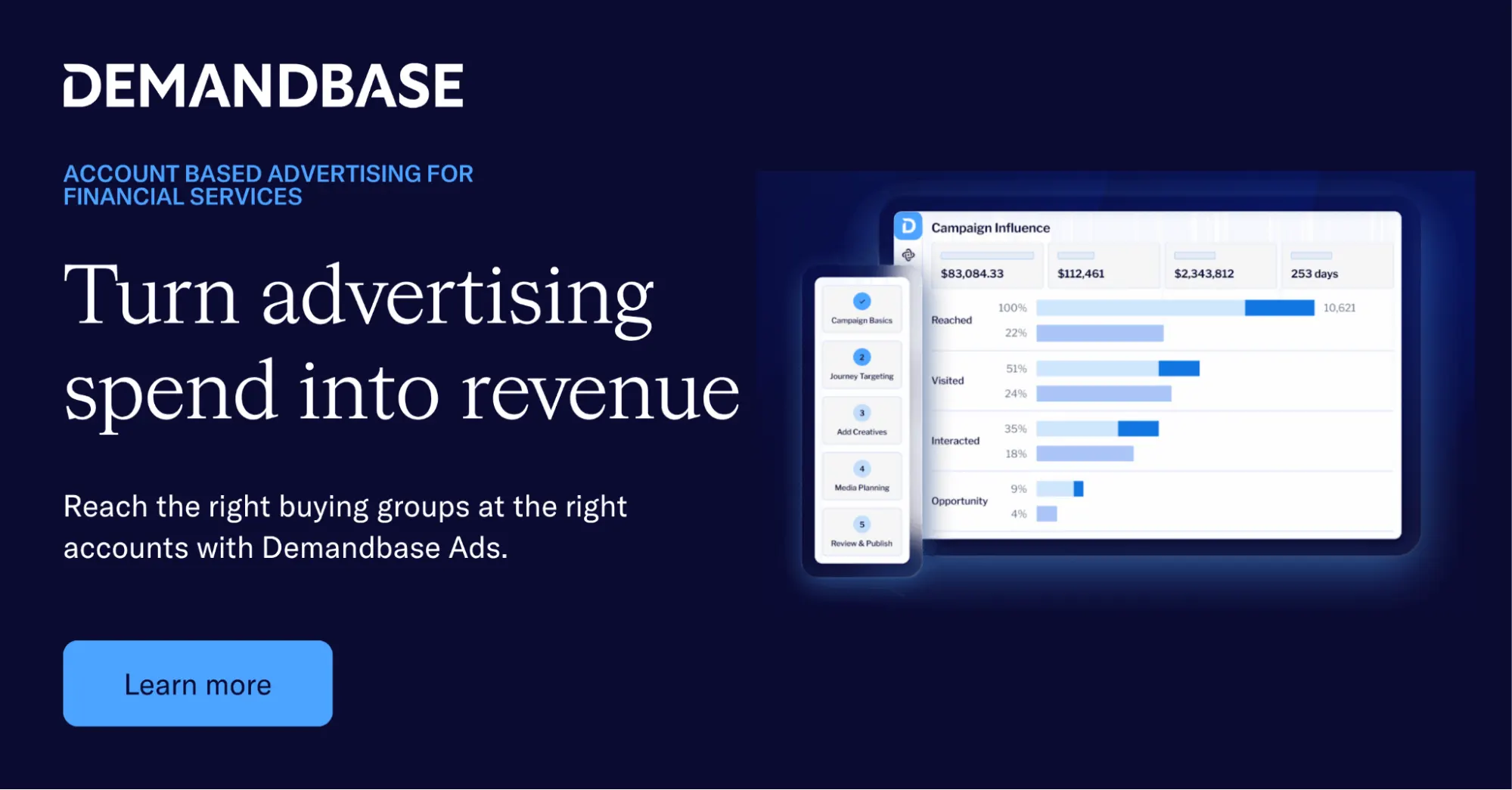
In our display Ads
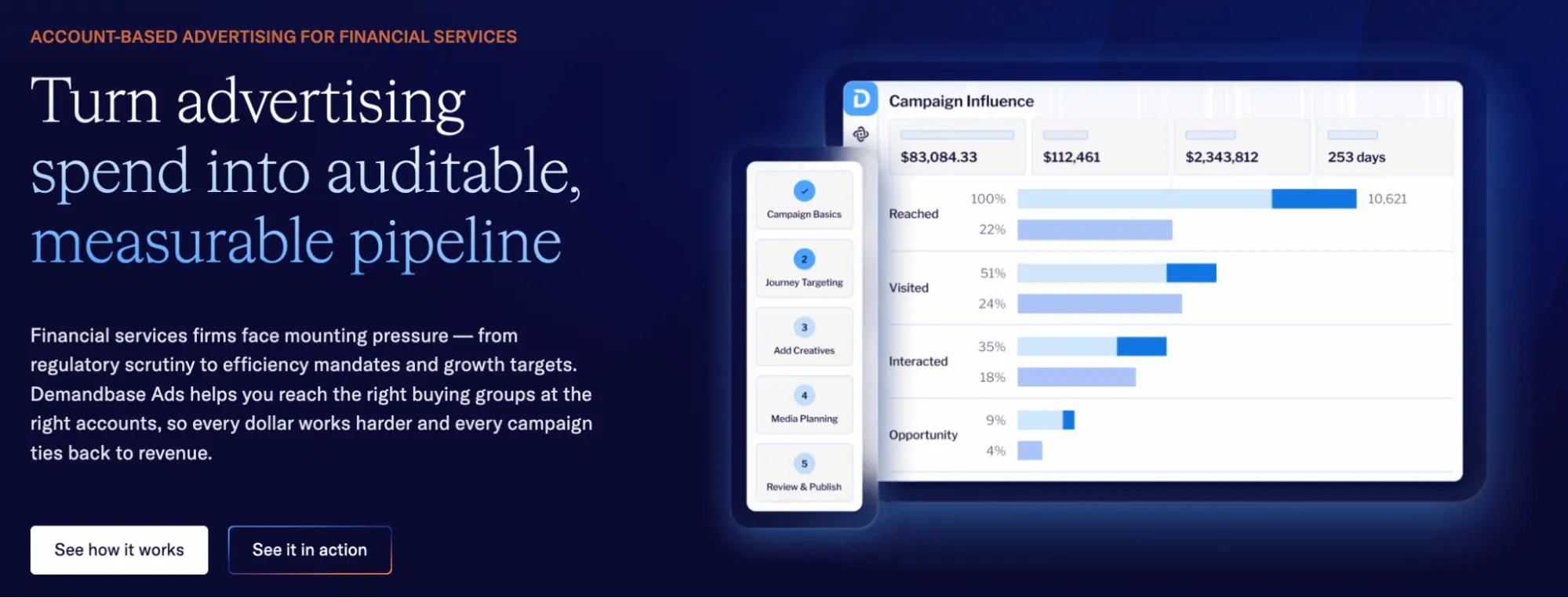
On Demandbase.com
An ad might introduce the problem. The landing page can explain the solution. An email might add proof. Sales can connect the solution to the account’s current priorities.
The words change, but the strategic thread remains intact.
That cohesion is particularly important when different members of a buying group engage through different channels. The economic buyer may see an executive-level ad while a practitioner reads technical content and another stakeholder speaks to sales.
Those interactions should not feel identical, but they should feel like they came from the same company with the same understanding of the account.
AI can help teams create and adapt content more quickly. But speed alone is not the end goal.
The bigger opportunity is using AI to coordinate experiences across channels, reduce manual work, and help every team execute against a common account strategy.
5. Measure the journey, not just the individual campaign
Marketing teams have traditionally measured channels separately:
- Advertising tracks impressions, clicks, and click-through rate.
- Web teams track visits, time on page, and conversions.
- Email teams track opens and clicks.
- Sales tracks meetings and opportunities.
- Revenue teams track pipeline.
Those metrics are useful, but they do not reveal whether the full account journey is working.
A personalized digital account strategy should ask broader questions:
- Are the right accounts clicking?
- Are they arriving at the intended destination?
- Are they engaging with the personalized content?
- Are more accounts showing increased engagement?
- Are additional members of the buying group becoming active?
- Are high-value accounts moving to the next stage?
- Are personalized accounts progressing differently from non-personalized accounts?
- Is sales acting on the engagement signals generated by the campaign?
The difference is subtle but important.
Instead of asking, “Did the ad perform?”, ask:
“Did this connected experience move the account forward?”
That shift changes optimization, too.
A campaign with a strong click-through rate may still underperform if visitors encounter an irrelevant destination. A landing page with high engagement may generate little value if it attracts the wrong accounts. A sales follow-up may fail because it does not reflect the message the account engaged with.
Looking across the journey helps teams find the actual point of friction.
It also provides a more complete picture of personalization’s impact. In Demandbase customer analysis referenced in the outline for this article, customers using personalization in advertising saw improvement across several indicators, including click-through rate, lifted accounts, site visits, and interacted accounts. Those figures should be validated against the latest approved source language before publication.
The broader signal is what matters: when relevance carries from advertising into the broader digital experience, improvement can appear across multiple stages of engagement—not just in the click.
6. Design personalization for operational scale
Most marketers understand why personalization matters.
The harder question is how to execute it consistently.
A campaign team needs a new landing experience. Web needs a brief. Creative needs copy and design. Demand generation needs the campaign live quickly. Brand, legal, or product teams may need to approve the changes.
By the time everything is ready, the campaign window may have moved on.
Personalization often fails not because the strategy is wrong, but because the operating model cannot support it.
Scalable execution requires four things.
Reusable frameworks
Teams should not have to rebuild their process for every campaign.
Create standard message maps, page templates, audience definitions, CTA libraries, proof-point modules, and measurement plans that can be adapted quickly.
Shared governance
Establish who owns the audience, message, destination, approval process, and optimization decisions.
Clear ownership prevents personalization from becoming a sequence of open-ended handoffs.
Modular content
Develop content and page components that can be recombined for different industries, roles, use cases, and stages.
Modular personalization is faster and more sustainable than creating every experience from scratch.
AI-assisted execution
AI can help marketers move from strategy to execution with fewer manual steps, particularly when it understands the audience, existing page, campaign objective, and approved messaging.
The purpose is not to remove marketers from the process. It is to give them a faster way to translate account insight into a relevant experience.
7. Treat personalization as an ongoing system
A personalized campaign should not be launched and forgotten.
Audience behavior changes. Intent shifts. New people enter the buying group. Accounts move between stages. Messages that work for one segment may underperform for another.
Personalization should therefore operate as a learning system:
- Define a meaningful segment.
- Align the message across channels.
- Create a destination that keeps the promise.
- Measure account-level response.
- Identify where the journey loses momentum.
- Refine the audience, message, experience, or next action.
- Scale what works.
Start with a clear hypothesis.
For example:
We believe in-market financial services accounts will engage more deeply when an advertising campaign about media efficiency leads to an industry-specific page featuring relevant proof and a late-stage CTA.
That hypothesis gives the team something specific to test.
The result may show that the industry headline matters, the customer story drives the most engagement, or the CTA is too aggressive for the account stage.
Each insight improves the next experience.
From targeted advertising to connected account journeys
Demandbase helps marketers put this strategy into practice by connecting account-based advertising with personalized web experiences.
With Demandbase Advertising, teams can use account intelligence to identify and reach relevant accounts with messages aligned to their needs. Demandbase Site Customization can extend that relevance to the website by tailoring copy, imagery, calls to action, links, and other page elements for selected audiences.
Site Customization Agent is designed to make that execution easier. Using a conversational, AI-assisted workflow, marketers can translate the context of a campaign, audience, and webpage into recommended site changes—helping them build campaign-matched digital experiences without relying on a long chain of manual handoffs.
Together, advertising and web personalization can support a more connected journey:
Target the right accounts. Deliver a relevant campaign message. Send buyers to an experience that continues the story. Guide them toward the right next action.
That is the opportunity in front of modern B2B teams.
Personalization is no longer about inserting a company name into an ad or creating a handful of audience-specific landing pages. It is about using account insight to coordinate the entire experience.
The marketers who win will be the ones who connect the right audience, message, channel, destination, and action—so buyers never have to connect the dots themselves.
Because great ads deserve great destinations, and great buyer journeys depend on both.
Book a meeting to see how Demandbase Advertising and Site Customization can help you connect the right accounts, messages, and web experiences to create more relevant buyer journeys from first click to conversion.
Related content


We have updated our Privacy Notice. Please click here for details.