

What B2B leaders are really saying about AI in GTM
6 takeaways from Demandbase’s latest Customer Advisory Board
AI is everywhere in B2B right now.
Every vendor is shipping new AI features. Every executive team is being asked what their AI strategy looks like. And every go-to-market leader is under pressure to do more with fewer resources.
For many GTM teams, the challenge isn’t access to AI tools. It’s figuring out where AI actually changes how revenue teams operate.
When we recently convened Demandbase’s Customer Advisory Board (CAB), the conversation cut through the hype.
Our CAB brings together senior marketing, sales, and RevOps leaders from some of the most sophisticated enterprise GTM organizations — companies running complex account-based programs at scale and managing large revenue engines. These leaders are navigating the same questions many B2B teams are facing right now: where AI actually creates value, how to operationalize it responsibly, and how to tie it directly to pipeline performance.
Instead of debating whether AI matters, the discussion focused on a more important question:
How does AI actually improve go-to-market outcomes?
Those conversations directly inform how we’re innovating at Demandbase. Our approach is simple: listen closely to the market, collaborate with our most advanced customers, and incorporate that feedback into the platform.
Here are six of the biggest insights from that conversation.
1. AI must drive pipeline — not just productivity
Most teams have already experimented with AI tools. Early AI use cases in GTM focused heavily on productivity — writing content, summarizing calls, or automating tasks. But CAB members made it clear the real opportunity is different: using AI to influence pipeline outcomes.
As one CAB member put it:
“If Demandbase could tell me what’s actually driving pipeline… yes, absolutely. That’s the whole point of it.”
For many organizations, the biggest challenge isn’t generating insights — it’s knowing which GTM activities actually influence pipeline and conversion.
That insight reinforces a core principle behind Demandbase: AI should connect goals directly to execution.
Instead of simply surfacing data, AI should help answer questions like:
- Which accounts should we prioritize?
- Which campaigns influence pipeline the most?
- Where should we invest next?
This shift from productivity to pipeline impact is the real evolution of AI in GTM.
2. The biggest opportunity is prescriptive orchestration
Modern GTM execution is incredibly complex. Teams operate across multiple channels, personas, products, and buying stages — often simultaneously.
That complexity leads to one of the most common frustrations in B2B marketing.
As one CAB member said:
“Can somebody please help me figure out the right mix of channels and in what order?”
This is where AI has the potential to make the biggest difference.
Rather than generating more dashboards, leaders want AI that can:
- Recommend the best channel mix
- Suggest next-best actions
- Identify which journeys are working
This insight is shaping how Demandbase is being built — and why we’re investing in upgraded capabilities like orchestration, which connects signals, insights, and execution across the entire GTM motion.
Our goal is not just to provide insights, but to help orchestrate coordinated GTM execution across sales and marketing teams.
3. Data trust is the gatekeeper for AI
Of course, none of this works without reliable data. Data quality surfaced repeatedly throughout the CAB discussion.
One participant summarized the tension clearly:
“This is all great… assuming the data is great.”
Another added:
“I’ve never met a marketer who said their CRM data is perfect.”
Many AI initiatives stall at this stage — not because teams don’t see the value of AI, but because they hesitate to trust the recommendations if the underlying data is inconsistent.
That’s why Demandbase continues to invest heavily in data quality, identity resolution, and account intelligence. AI models are only as strong as the signals they’re built on.
For AI to truly impact GTM strategy, organizations need a trusted foundation of account, intent, and engagement data.
4. AI adoption is uneven — and follows a clear maturity curve
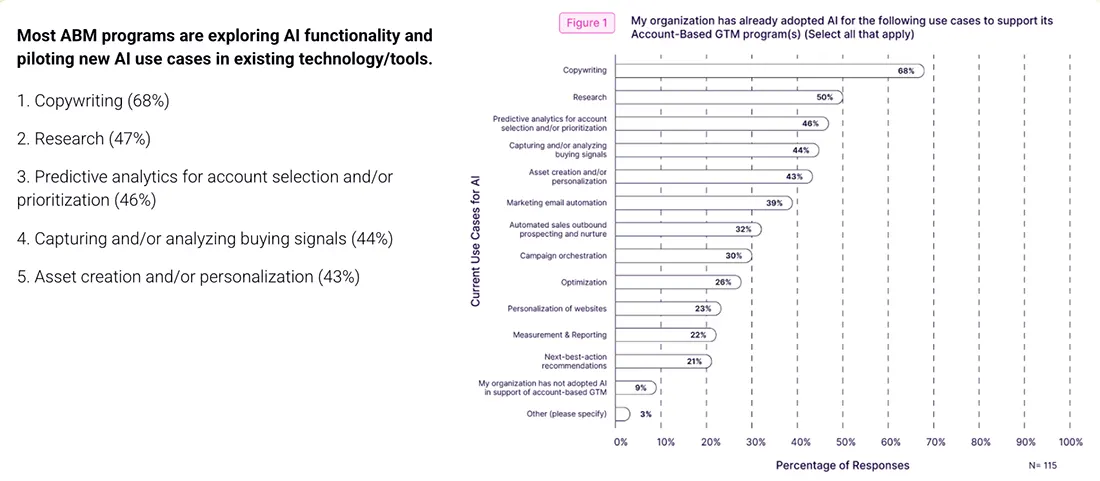
To ground the discussion, we looked at industry data from ForgeX on how AI is being adopted across ABM programs.
While adoption is widespread, most teams are still early in translating AI into measurable outcomes. AI is most commonly used today for copywriting, research, and signal analysis, while high-performing teams are more likely to see impact in pipeline and conversion. Organizations with a clear AI roadmap are also significantly more likely to outperform their peers.
This suggests that AI maturity isn’t about access to tools — it’s about how effectively teams apply them to revenue.
What we heard from CAB members
We saw a similar pattern in our CAB breakout exercise, where members mapped AI usage across GTM workflows.
- Audience & account intelligence shows the highest AI adoption, especially for segmentation, intent, and prioritization
- Content and campaign execution are primarily human + AI, with AI accelerating workflows
- Strategic decisions — like budget allocation — remain human-led
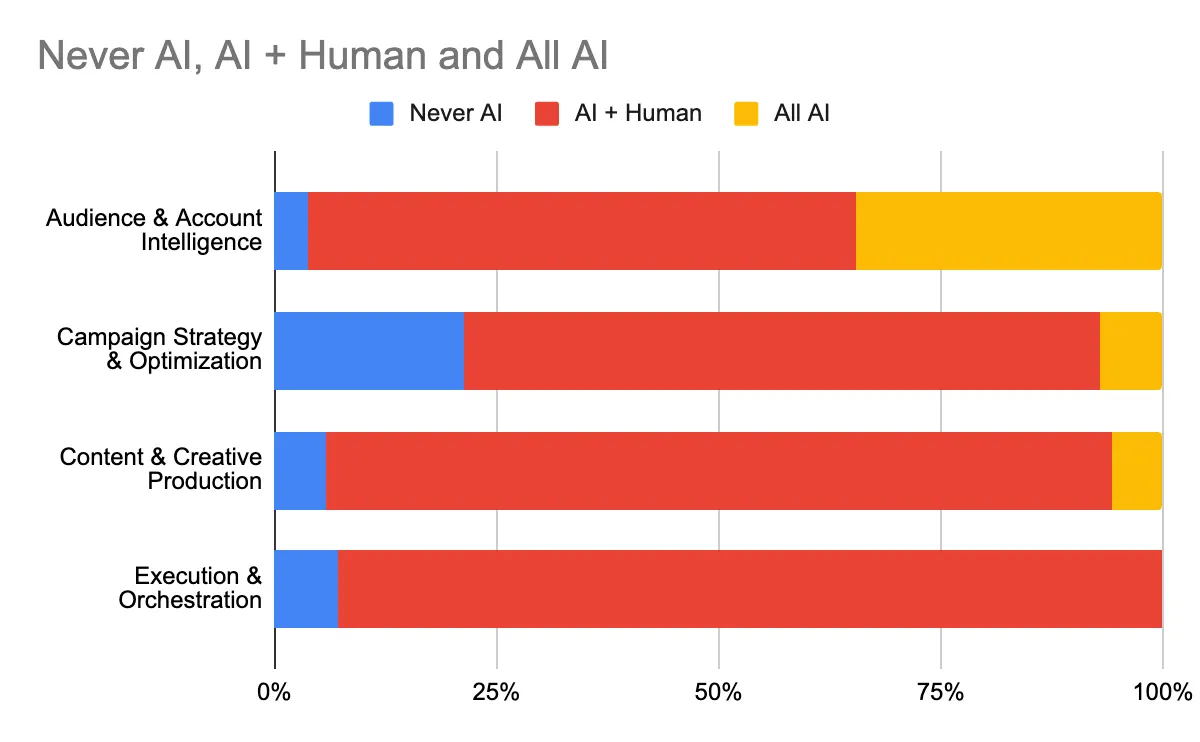
AI adoption follows a clear progression: teams start with intelligence, expand into execution, and gradually build trust in decision-making.
This is exactly how we’re approaching AI — starting with account intelligence and signal-driven insights, and expanding toward orchestrated execution and outcome-based recommendations.
5. AI is only as good as its integrations
Another theme that emerged quickly: AI can’t operate in isolation.
The most valuable insights often live across multiple systems — CRM platforms, call transcripts, webinar platforms, and engagement tools.
As one CAB member noted:
“It’s meeting transcripts, data, and notes… that unlocks a ton of opportunity.”
For AI to deliver meaningful recommendations, it must be able to connect signals across the entire revenue ecosystem.
That’s why integrations remain a core area of investment for Demandbase. Our platform continues to expand connections across the GTM tech stack so that AI can operate with a complete view of account activity.
Because the real value of AI isn’t just intelligence — it’s intelligence in context.
6. Enterprise AI requires governance and guardrails
Finally, CAB members highlighted an operational reality that many AI conversations overlook: governance.
As AI becomes embedded across sales and marketing workflows, organizations need clear guardrails to ensure consistent execution.
One participant raised a concern many enterprise leaders share:
“How do we make sure that if we turn 50 marketers loose in this thing, that we don’t get chaos?”
For AI to scale in enterprise environments, platforms must support:
- role-based permissions
- governance frameworks
- controlled execution across teams
These controls are essential to ensure AI accelerates strategy — without creating operational risk.
Shaped by the leaders running modern GTM
The insights in this post come directly from discussions with members of the Demandbase Customer Advisory Board — a group of senior leaders responsible for some of the most advanced account-based go-to-market programs in the industry.
CAB members represent organizations across technology, financial services, consulting, and SaaS, including companies such as:
Workday | TransUnion | Broadcom | Guidewire Software | VISA | CBIZ | Cloudflare | INTELEX | Actian I Palo Alto Networks I NTT Data Americas
These leaders are operating at the forefront of modern B2B GTM, managing complex buying groups, large account portfolios, and multi-channel orchestration across sales and marketing teams.
Their feedback plays a critical role in shaping how we build and prioritize innovation across the Demandbase platform.
For current Demandbase customers, you can explore and sign up for upcoming beta opportunities through Innovation Lab, where we’re continuing to bring these capabilities to market in close partnership with our customers.
Because the best GTM technology isn’t built in isolation. It’s built alongside the teams pushing the boundaries of what modern revenue organizations can do.




We have updated our Privacy Notice. Please click here for details.