

Turning GTM signals into personalized outreach with an email intelligence platform

Key takeaways
- Demandbase built an Email Intelligence Platform that transforms account, contact, engagement, financial, news, and technographic signals into structured context for AI-assisted email generation.
- A reusable Topic Intelligence Layer prioritizes and summarizes raw signals before they reach the language model, improving relevance and consistency.
- MailMate powers both Email Agent and conversational experiences through the same orchestration pipeline and business logic.
- Sellers remain in control by choosing the signals, tone, products, messaging guidance, and call to action used in each draft.
- Separating business context from language generation creates a foundation that can support future AI-assisted selling experiences beyond email.
The challenge: Personalized outreach requires more than data
Modern B2B sales teams have access to extensive information about their prospects. They can review campaign engagement, account activity, buying personas, company news, financial disclosures, and the technologies used by target accounts.
Yet creating a strong outbound email often remains a manual process. Before writing, a seller must determine who the recipient is, what interests they have shown, what is happening across the account, why this is the right time to reach out, and which products or solutions are relevant. The information may already exist, but it is spread across multiple systems and rarely presented as one coherent story.
AI cannot solve this problem on its own; models can produce natural language, but the quality of their output depends on the quality and organization of the input. Sending raw CRM fields, engagement events, and news articles directly to a model can create noisy context, inconsistent prioritization, and generic emails. Separate product experiences may also interpret the same customer information differently.
Thus, the core challenge was creating a consistent understanding of seller and customer context Demandbase needed a shared intelligence layer that could transform fragmented go-to-market signals into structured, reusable business context for every AI-assisted outreach workflow.
What we built
Demandbase built an Email Intelligence Platform between its GTM data and its AI-powered outreach experiences. Instead of treating email generation as a single prompt, the platform gathers relevant signals, organizes them into business topics, combines them with seller intent and preferences, and then generates personalized outreach.
This design separates business understanding from language generation. The platform determines which signals matter, how activity should be summarized, which company events create a compelling “why now,” and which products align with the customer’s interests. The language model receives that structured context and focuses on communicating it naturally.
MailMate is the first end-user application built on this platform. It powers personalized drafting within Email Agent and also exposes the same capabilities through Model Context Protocol (MCP), enabling conversational AI experiences without creating a separate implementation.
The platform provides several reusable capabilities:
- Signal Collection: Gathers account, contact, engagement, technographic, financial, news, and offering context.
- Topic Intelligence: Prioritizes raw data and turns it into concise, seller-readable insights.
- Context Assembly: Combines customer intelligence with seller preferences, product context, and messaging guidance.
- Prompt Orchestration: Creates consistent, model-ready inputs.
- Draft Generation: Produces relevant subject lines and email bodies.
- Preference Management: Optionally remembers seller instructions and communication style.
- Governance: Applies privacy safeguards, AI usage controls, and messaging standards.
- Multi-channel access: Makes the same capabilities available through Email Agent and conversational AI.
Why we needed a Topic Intelligence Layer
Every account can contain dozens or hundreds of potential signals. Some reflect immediate buying interest; others describe long-term company priorities. Their relevance also changes depending on the recipient, product, and purpose of the outreach.
Exposing all of this information directly to a language model results in context bloat without necessarily improving the result. It can cause the model to emphasize a minor activity, overlook a stronger signal, or produce a message that lists facts without connecting them to customer value.The Topic Intelligence Layer standardizes how these signals are interpreted, summarized, and prioritized.
Instead of sending hundreds of individual activities downstream, the layer produces focused summaries containing the information most likely to improve the outreach. Every application consumes these shared summaries rather than creating its own interpretation of the underlying data.
This reduces prompt complexity, creates consistent customer narratives, and gives new AI experiences access to the same business understanding without requiring each team to rebuild signal-selection and summarization logic.
The customer experience
Although the underlying orchestration is sophisticated, the seller experience is intentionally simple.
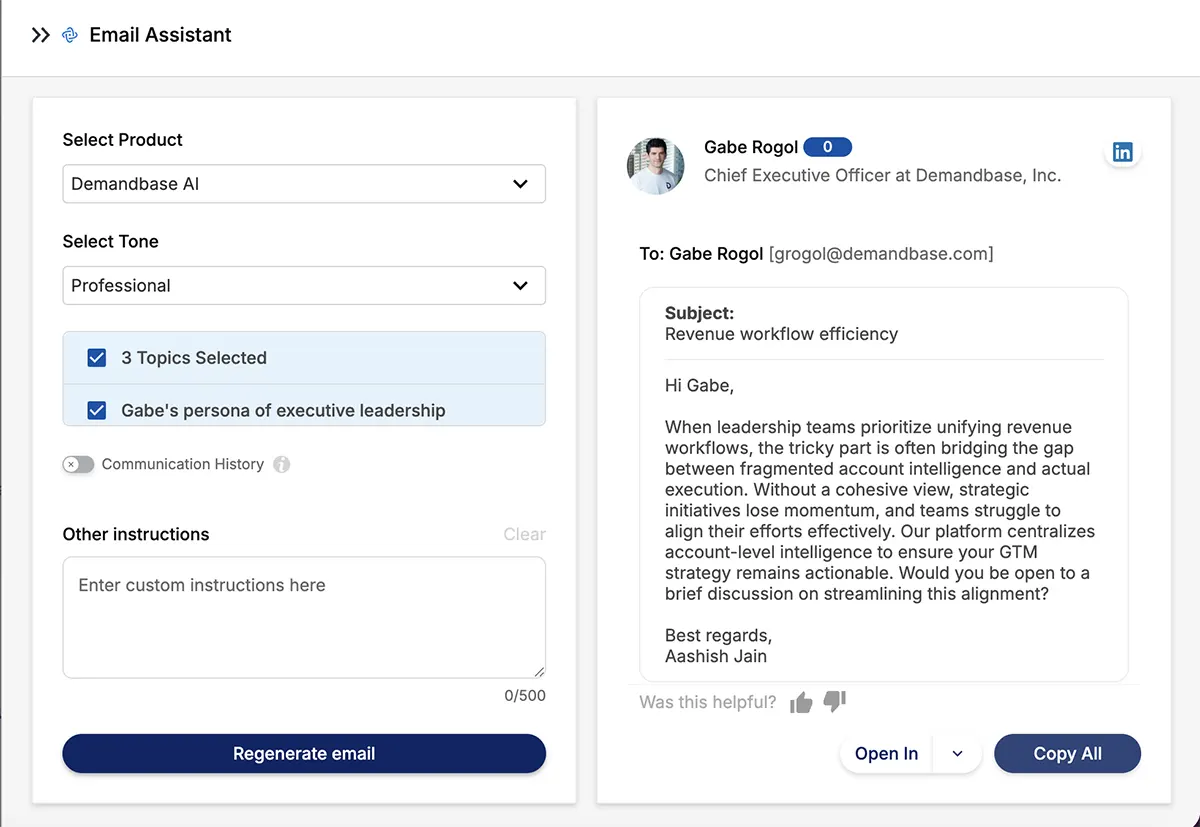
The seller begins by identifying the contact and, when needed, the relevant account. They then choose the signals that should influence the message, They can further guide the draft by selecting:
- Communication tone
- Products or solutions to discuss
- Campaign or messaging guidance
- Custom instructions
- A preferred call to action
- Whether these preferences should be remembered
Behind the scenes, the platform gathers the selected signals from Demandbase intelligence services. Topic Intelligence converts those signals into concise business insights. Context Assembly combines them with the seller’s instructions and product information, while Prompt Orchestration creates a consistent request for the language model.
The seller receives a personalized subject line and email draft grounded in the selected context. They can also review the summarized business topics that influenced the output, providing transparency into why the message was generated. This results in outreach that connects verified customer context with relevant seller value while keeping the seller in control of the final communication.
The architecture: Separating business context from language generation
One of the primary design goals was to make language models responsible for writing not for independently interpreting business data.
At the foundation is the Demandbase GTM Data Platform, which provides information about accounts, contacts, engagement, technographics, company news, financial disclosures, and seller offerings.
The Email Intelligence Platform processes that information through a layered workflow:
- Signal Collection retrieves the relevant account, contact, and seller data.
- Topic Intelligence prioritizes and summarizes the raw signals.
- Context Assembly combines those topics with seller preferences and product information.
- Prompt Orchestration creates a consistent model request.
- Draft Generation produces the customer-facing subject line and message.
Email Agent and MCP both use this same pipeline. Business services determine what information matters, while the language model determines how to communicate it. This separation reduces duplicated logic and allows signal processing, prioritization, or language models to evolve centrally without requiring every product experience to change.
How MCP fits into the platform
Email Agent provides a structured product workflow, but sellers may also want to request outreach conversationally. A seller might say, “Help me write an email to my champion at Acme about their recent engagement,” without supplying exact identifiers or navigating multiple screens.
Demandbase supports this through MCP, which acts as another interface to the Email Intelligence Platform rather than as a separate drafting engine.
The conversational workflow has three stages:
- Context resolution: The assistant identifies the correct account, contact, and available selling context. When a request is ambiguous, it asks a follow-up question instead of making an unsupported assumption.
- Topic intelligence: The assistant retrieves the same standardized summaries used by Email Agent, ensuring consistent interpretation of engagement, financial priorities, company news, and persona information.
- Draft generation: The shared Context Assembly, Prompt Orchestration, and Draft Generation services produce the message.
Whether a seller starts in Email Agent or through natural language, the same data, business rules, and orchestration determine the result. New conversational interfaces can therefore reuse the platform without creating conflicting prompt logic or customer narratives. All of that to say that the Email Agent natively supports headless functionality. A user can expect the same behaviour and output independent of how they access the capability.
Benefits of the platform approach
The platform architecture provides benefits beyond a single email feature:
- Consistent interpretation: Every experience uses the same definitions and prioritization rules for engagement, personas, technographics, financial priorities, news, and account activity.
- Stronger personalization: Organized, relevant summaries help the model connect customer priorities with seller value instead of listing disconnected facts.
- Seller control: Users choose the signals, products, communication style, instructions, and calls to action that shape the message.
- Reusable capabilities: Signal Collection, Topic Intelligence, Context Assembly, Prompt Orchestration, and Draft Generation can support other AI-assisted workflows.
- Simpler product development: New applications consume existing platform services rather than rebuilding prompt engineering and signal-processing logic.
- Consistent interaction models: Structured product experiences and conversational assistants produce aligned results because they share the same intelligence pipeline.
Governance and seller trust
AI-generated customer communication must respect organizational policies, customer expectations, and responsible AI practices. Governance is therefore part of the platform rather than an application-specific addition.
Before generating outreach, the platform checks whether AI capabilities are enabled for the requesting organization and user. Shared guardrails apply privacy-aware messaging, tone guidance, prompt validation, output standards, and reusable business policies across every drafting experience.
The platform also supports optional seller preferences. Users can save recurring guidance such as concise executive messaging, product emphasis, or call-to-action style so it becomes part of future context assembly without removing their ability to adjust each draft.
Responsible personalization is equally important. Generated emails focus on appropriate business context, such as public company information, engagement trends, buying roles, and product relevance. The goal is to create communication that feels informed and useful, not intrusive.
Building for future AI-assisted selling experiences
MailMate began with email, but the underlying services are not tied to a single communication channel. The same structured context can support meeting preparation, executive account summaries, opportunity research, follow-up messages, multi-touch sequences, renewal and expansion outreach, buying committee recommendations, and opportunity risk summaries.
Product teams can focus on the experience unique to each application while inheriting a consistent understanding of the customer from the platform. New signal types, improved ranking strategies, richer summarization, and future language models can also be introduced centrally.
This creates a foundation that can scale with both product innovation and advances in AI technology.
Lessons learned
Building MailMate reinforced several principles for AI-assisted selling:
- Structure business context before sending it to the model. Organized, relevant insights produce more reliable personalization than large collections of raw records.
- Centralize shared intelligence. Common Topic Intelligence prevents each application from developing a different interpretation of the same customer.
- Invest in orchestration, not only prompt wording. Selecting, prioritizing, summarizing, and assembling the right information has more impact than repeatedly adjusting prompts around weak context.
- Reuse business logic across interfaces. Conversational AI should consume established platform capabilities rather than create another implementation.
- Keep sellers in control. AI can automate research and drafting, but sellers should decide which signals matter and what message is ultimately sent.
The quality of AI-generated outreach depends less on the language model alone and more on the business context provided to it.
Demandbase’s Email Intelligence Platform transforms fragmented GTM signals into structured, reusable context before generation begins. MailMate uses that foundation to power personalized drafting in Email Agent, while MCP makes the same intelligence available through conversational experiences.
By separating signal interpretation from language generation, Demandbase can deliver more consistent personalization today and reuse the same platform across future AI-assisted selling experiences.
Related content



We have updated our Privacy Notice. Please click here for details.