

-
Journey Stage
Acquisition
-
Team
Sales
-
Expertise Level
Beginner
Contents
Partner with Demandbase Experts
Get tailored strategies and insights to optimize your approach, drive engagement, and unlock new opportunities.
What you’ll learn
This playbook is your step-by-step guide to mastering account-based selling through Demandbase. It covers tailored strategies for 1:1, 1:Few, and 1:Many approaches to ensure targeted outreach and maximize success. You’ll learn:
- How to design and execute strategies based on account engagement levels and buyer intent signals.
- The importance of aligning personalization with account tiers to foster deeper connections.
- Effective ways to use Demandbase Journey Stages to guide outreach strategies.
- Practical approaches for conducting thorough account research and creating personalized messaging.
By the end of this playbook, you will have a repeatable framework to drive engagement, focus your resources wisely, and create impactful results with your top accounts.
Why is this important?
Effective account-based selling is not a one-size-fits-all process. With today’s competitive environment and the overwhelming noise in prospect communication, personalized, insights-driven outreach is essential. This playbook ensures that you engage accounts with the right message, at the right time, and in the right way to secure meetings, strengthen relationships, and ultimately win deals.
Account tiers have different needs, and without a targeted approach, outreach becomes inefficient. This playbook helps you prioritize and tailor your efforts, ensuring critical accounts receive the attention they deserve, while nurturing others until they’re ready to move forward.
What you need to get started
To implement this playbook, ensure you have the following in place:
- Access to Demandbase, including Journey Stages and engagement insights.
- A defined target account list categorized into Tier 1, Tier 2, and Tier 3 accounts.
- Accurate CRM data, including account histories, engagement points, and contact details.
- Research tools like LinkedIn to gather individual-level insights.
- Internal tools for outreach (e.g., email templates, video messaging platforms like Vidyard).
- Commitment to personalization at every step of the process.
Step-by-step playbook
Part 1. Establishing a strategy framework
Step 1. Understand tier-based strategies
Different account tiers require different outreach approaches. Here’s how to categorize your outreach methods:
- Tier 1:
- Focus on High-Value Accounts, referred to as “Highly Engaged & Marketing Qualified Accounts (MQA).” These may generate 3–5 large opportunities per month.
- Engage 10+ individuals within the account, tailoring unique messages to different personas.
- Leveraging 1:1 outreach is crucial here—customization and hyper-personalization will drive results.
- Tier 2:
- Engage with medium-sized account lists (50–200 accounts) aimed at mid-market to enterprise opportunities.
- Generate 5–8 opportunities per month.
- Execute 1:Few strategies, contacting multiple buying groups within each account.
- Tier 3:
- Prioritize large lists (200+ accounts) and focus on nurturing or creating brand awareness.
- Generate 8+ opportunities by leveraging broad outreach tactics.
- Use 1:Many strategies, which scale outreach with less personalization.
Step 2. Leverage Demandbase Journey Stages
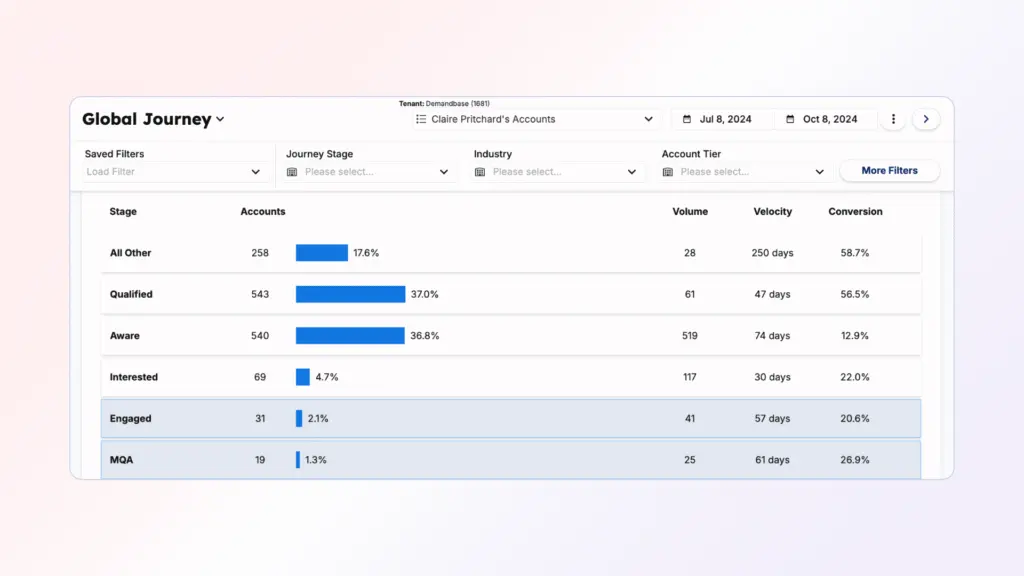
Demandbase Journey Stages provide critical insights into account engagement, helping you align the right outreach model with the account’s behavior. Use the following decision framework:
- Tier 1 accounts showing high engagement belong in MQA Journeys and qualify for 1:1 outreach.
- Tier 2 accounts in the “Aware” or “Interested” stages are ideal candidates for 1:Few approaches.
- Tier 3 accounts with little or no engagement are suited for 1:Many campaigns.
Part 2. Executing 1:1 outreach
Step 1. Research the account
Comprehensive research forms the backbone of 1:1 outreach. Here’s what you need to investigate for maximum impact:
- Account-level insights
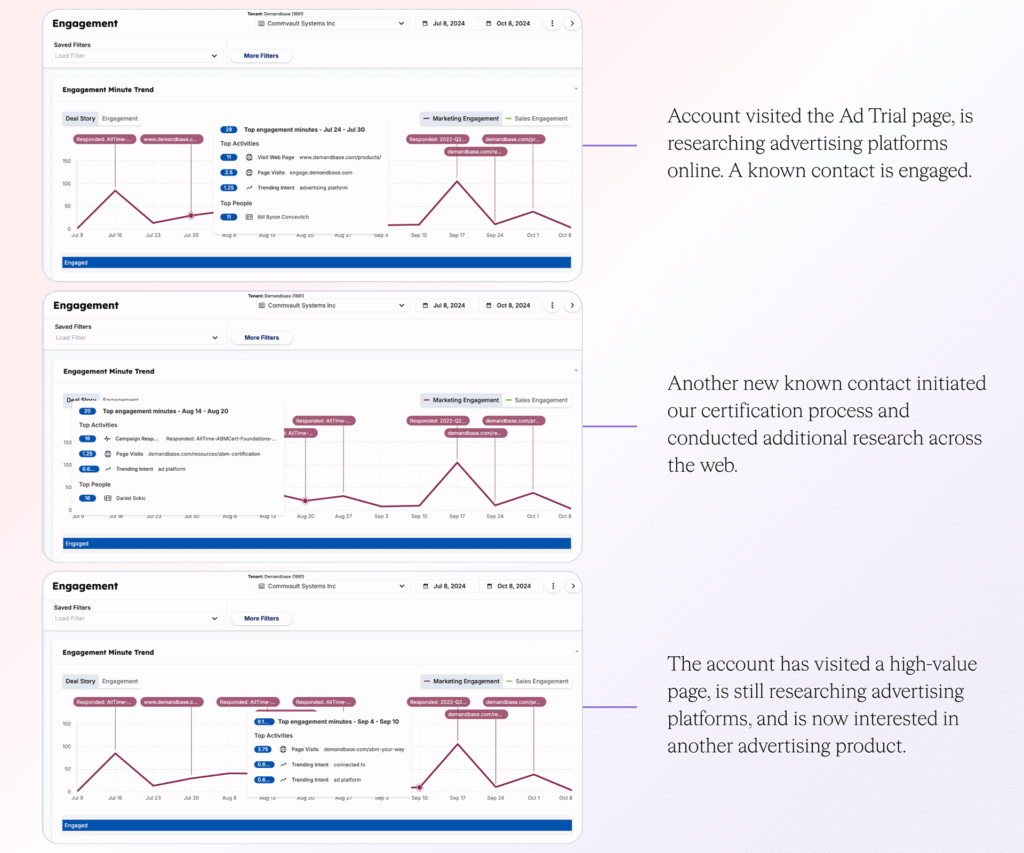
- Use Demandbase signals to identify high-value pages visited, trending intent, and offsite interest.
- Check the company’s recent initiatives and goals through 10K reports (if public), press releases, website news, and financial presentations.
- Contact-level insights
- Leverage LinkedIn to uncover key decision-makers and understand their roles.
- Research recent milestones for targeted individuals, such as promotions, thought-leadership contributions, or award recognitions.
- Avoid generic “flattery” — tie the insight you gather to a clear pain point you aim to address.
- Competitive context
- Identify whether the account has engaged with competitors and pinpoint where your solution can provide a better alternative.
- Identify whether the account has engaged with competitors and pinpoint where your solution can provide a better alternative.
Step 2. Personalize with precision
Combine account and contact insights to craft personalized messages. Follow this structure when reaching out:
- Observation: Highlight specific behavior or pain points observed during research.
- Problem: Identify how that challenge currently impacts their business.
- Solution: Clearly connect how your offering uniquely addresses their pain.
- CTA: Propose an interest-driven action with clear next steps. For example, “Would reviewing X help you with the outcome you’re driving?”
Example: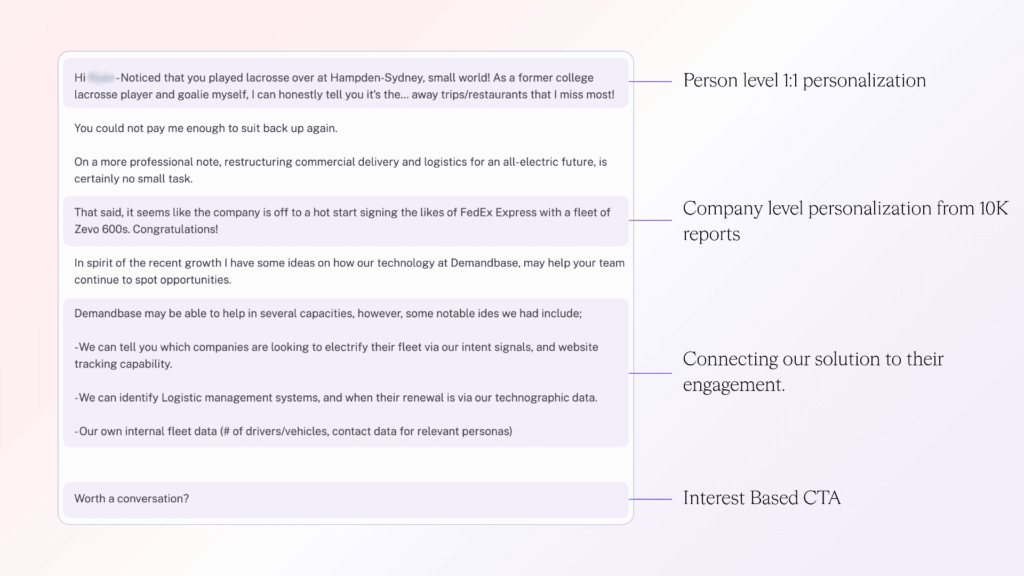
Step 3. Leverage multi-threading
Engage multiple personas within the account buying team. For example:
- C-suite for strategic initiatives.
- Operations for execution-level advantages.
- Budget owners for ROI/financial messaging.
Part 3. Scaling with 1:Few outreach
Step 1. Identify and segment account groups
Begin by grouping accounts into mid-sized lists, segmented by:
- Industry or vertical alignment.
- Similar Journey Stages (“Aware” & “Interested” accounts).
- Shared challenges or company size profiles.
Step 2. Personalize at the company level
While not as detailed as 1:1 outreach, find patterns or shared contexts that resonate broadly within the group. Tailor messaging themes to:
- Industry trends impacting all accounts.
- Regulatory or market shifts their business must adapt to.
- Products or use cases popular among similar businesses.
Step 3. Deliver consistency across personas
Craft value propositions that appeal to varied roles but support shared outcomes. For example:
- Marketing teams focusing on prospect engagement.
- Finance valuing return on spend or increased efficiency.
Example: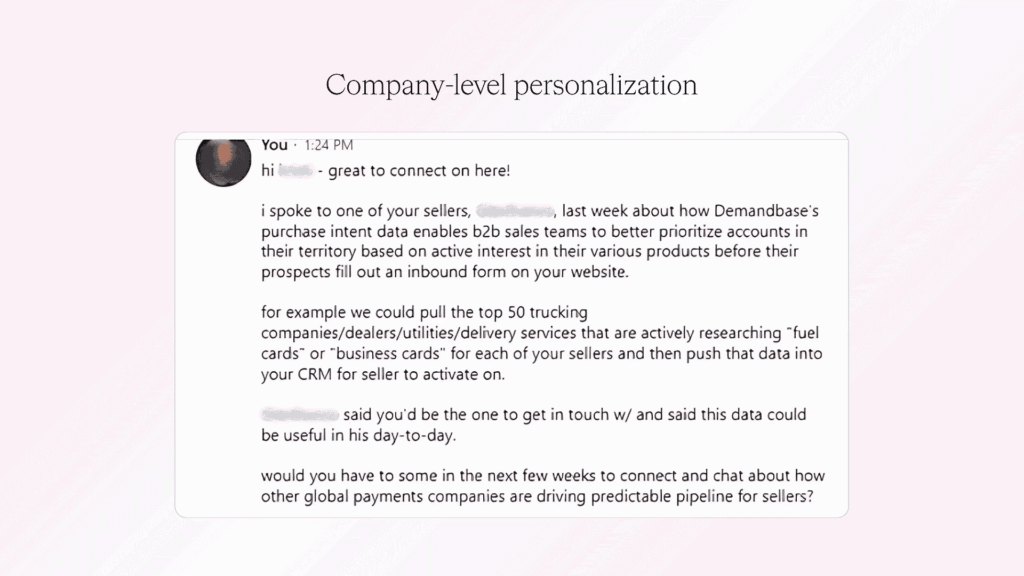
Part 4. Building awareness with 1:Many outreach
Step 1. Target large audiences effectively
Use Demandbase tools to dynamically build lists based on broad behaviors such as:
- Minimal website engagement.
- Early research activity (e.g., views on whitepapers).
- Relevant competitive or intent signals.
Step 2. Utilize scalable messaging
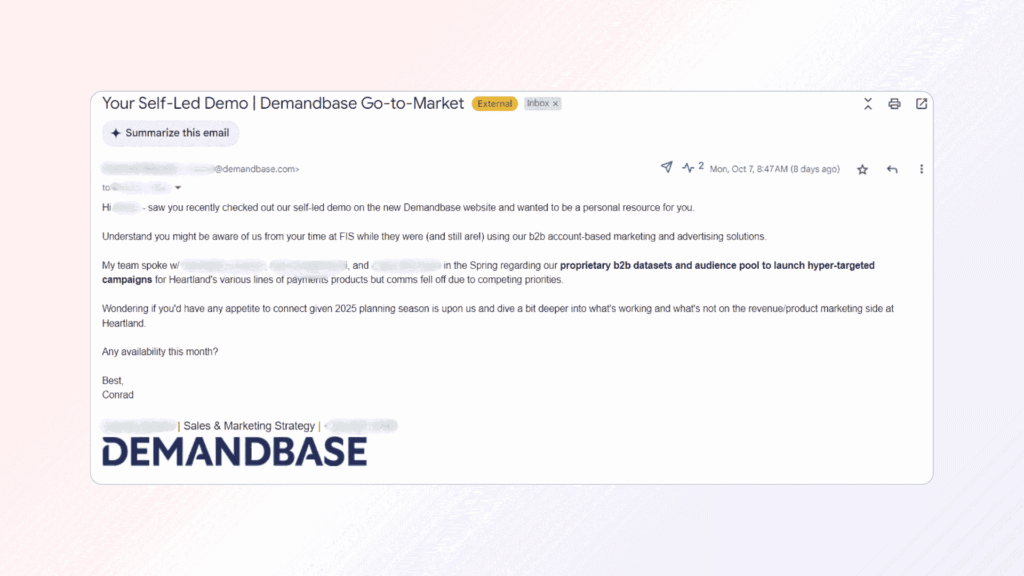
Leverage templates for Different Personas to balance efficiency with personalization:
- Include one personalized sentence tied to company-level insights to stand out.
- Focus on educational content (e.g., infographics, guides) over direct asks.
Example 1: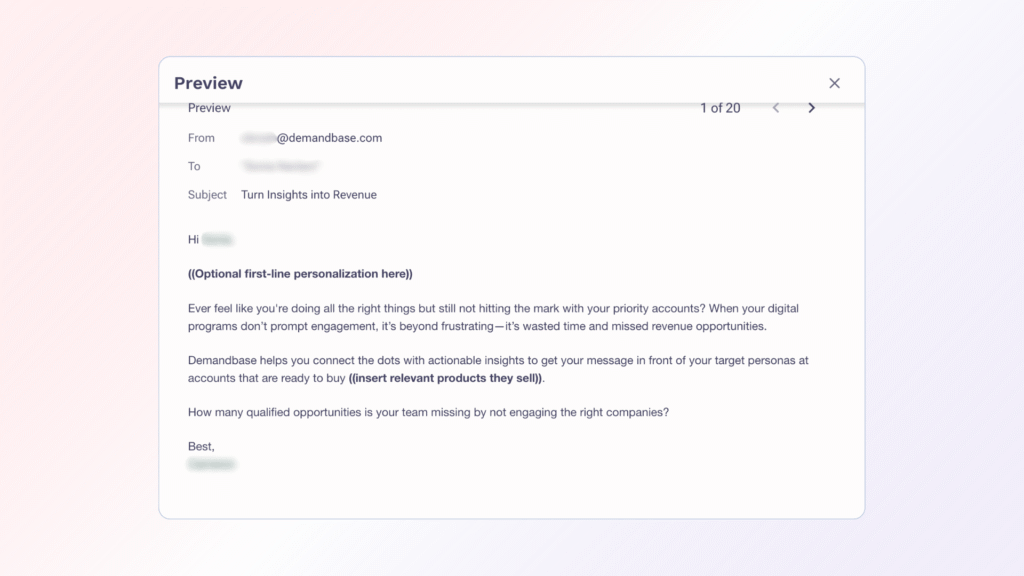
Example 2: 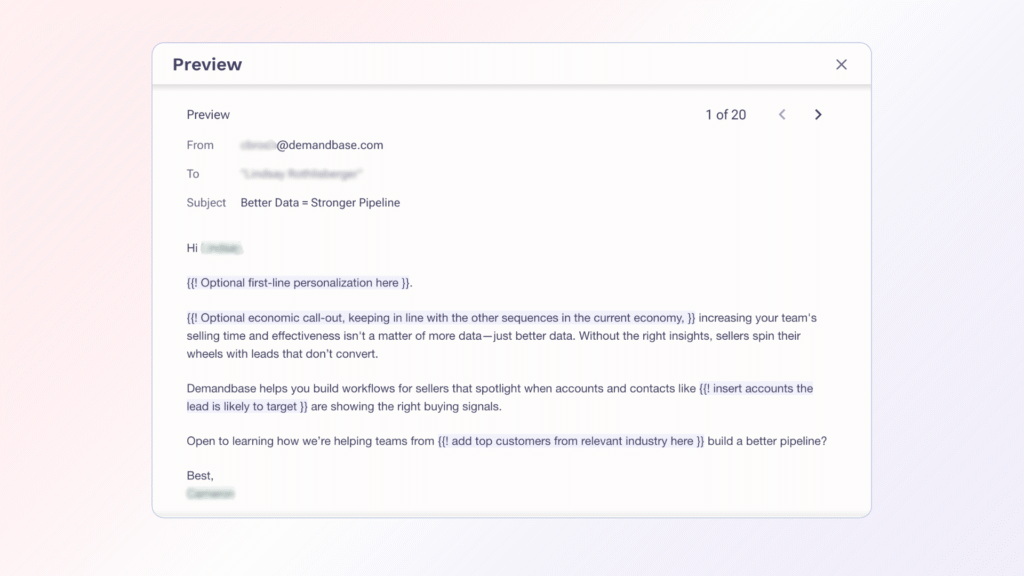
Step 3. Automate and iterate
Use automation to rotate prospects into nurturing sequences. Monitor engagement regularly to pause outreach that progresses accounts down the funnel or redirect uninterested leads.
Part 5. Building a framework around expectations for working accounts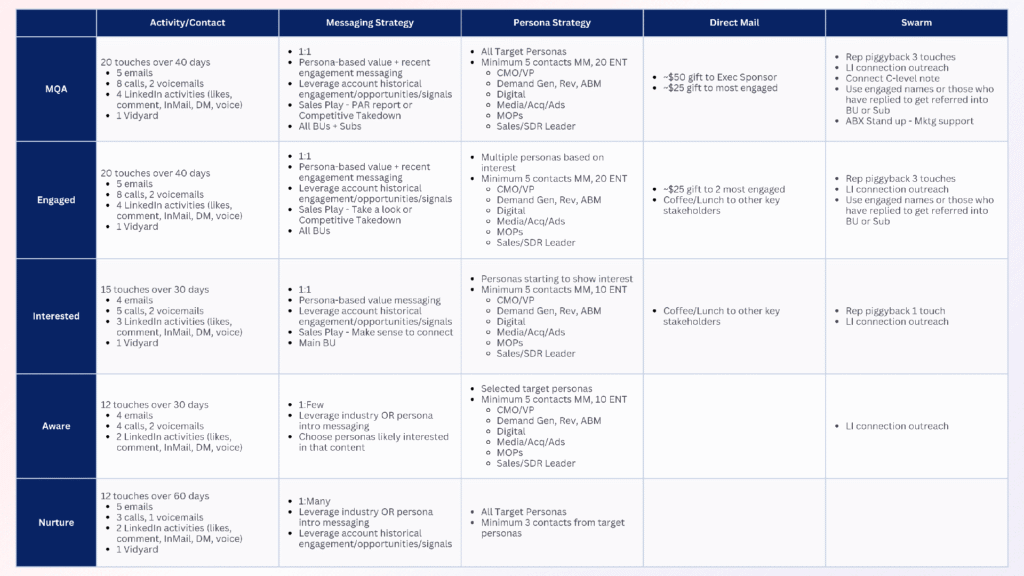
Step 1. Create a messaging strategy process
Building a structured messaging strategy is critical to ensure your team understands the level of activity and type of outreach expected for each account. Follow these guidelines to create your process:
- Define Entitlements by Journey Stage and Account Tier
- Use Demandbase Journey Stages to assign outreach expectations. For example:
- MQA Accounts: 20 touches over 40 days, including emails, calls, LinkedIn activities, and personalized video messages.
- Engaged Accounts: Similar 20-touch approach but with specific engagement-based adjustments.
- Interested or Aware Accounts: 12–15 touches, combining broader messaging tactics with lighter personalization.
- Adjust touch counts and cadence based on account tiers (e.g., enterprise versus mid-market).
- Use Demandbase Journey Stages to assign outreach expectations. For example:
- Sequence Structure
- Build sequences tailored to both the account stage and role-specific personas.
- Examples:
- Decision-makers (e.g., CMO, VP): Strategically include direct mail, executive outreach, and high-level value messaging.
- Influencers (e.g., Managers): Focus on operational value and technical strengths of your offering.
- Leverage Direct Mail and Executive Outreach
- Identify key accounts where personalized direct mail (e.g., physical gifts or handwritten notes) can differentiate your outreach.
- Use executive alignment (e.g., C-suite outreach) to open doors at the highest levels within Tier 1 accounts.
- Create Persona-Specific Content
- Customize messaging for each persona, addressing unique pain points and motivations.
- Example Persona Messaging:
- Marketing Ops Leader: Highlight tools that improve campaign measurement.
- Sales VP: Stress ROI and pipeline acceleration features.
- Use Visual Frameworks for Communication
- Design a visual representation (based on slide 35) that maps entitlements, expected touches, and outreach strategies for easy team reference. Include:
- Activity levels by account stage.
- Persona targeting expectations.
- Guidelines for aligning SDR and sales outreach.
- Design a visual representation (based on slide 35) that maps entitlements, expected touches, and outreach strategies for easy team reference. Include:
Step 2. Build accountability metrics around Engaged and MQA accounts
Accountability ensures your team remains focused on the most strategic accounts. Develop clear metrics tied to Engaged and MQA accounts:
- Set Activity Benchmarks
- Agree upon the minimum number and type of activities required per account. Examples include:
- Email Engagement: % of personalized emails sent and responded to within 30 days.
- LinkedIn Actions: Likes, comments, or direct messages to account contacts.
- Call Connections: Call success rates (e.g., live connections or meaningful voicemail follow-ups).
- Agree upon the minimum number and type of activities required per account. Examples include:
- Track Progress with Reporting
- Use dashboards in Demandbase or CRM tools to provide visibility into each rep’s progress against metrics.
- Key reports to monitor:
- Accounts touched versus untouched.
- Journey Stage progression by account.
- Effectiveness of multi-threading (number of personas engaged within an account).
- Align Sales and SDR Expectations
- Create SLA-style agreements for how frequently and thoroughly Sales and SDR teams must work Engaged and MQA accounts. For example:
- SDRs must deliver a minimum of 5 personalized outreach attempts before handing off.
- AEs must maintain regular engagement (e.g., bi-weekly check-ins) with active accounts showing buyer behavior.
- Create SLA-style agreements for how frequently and thoroughly Sales and SDR teams must work Engaged and MQA accounts. For example:
- Review and Adjust Metrics Quarterly
- Host quarterly reviews with stakeholders to refine metrics based on engagement outcomes and account performance. Use data to optimize focus on high-value tactics.
Step 3. Build account status and nurturing into your process
Just as reps manage leads through clear statuses, accounts should also follow a structured status system tied to specific nurturing steps. Here’s how to build this into your process:
- Define Account Statuses
- Create clear account status categories to guide action plans:
- Engaged: Active pipeline progression with multiple touchpoints.
- Nurturing: Accounts with past interest but no current engagement.
- Dormant: Accounts requiring reactivation after prolonged inactivity.
- Create clear account status categories to guide action plans:
- Assign Actionable Next Steps for Each Status
- Engaged Accounts:
- SDRs and AEs jointly execute advanced outreach, focusing on moving accounts to the decision-making phase.
- Incorporate deeper personalization in every interaction.
- Nurturing Accounts:
- Deliver quarterly educational content customized to industry, role, and challenges. Example formats include whitepapers, webinars, or success stories.
- Add accounts to low-frequency nurturing email sequences designed to maintain visibility without overwhelming them.
- Dormant Accounts:
- Tag accounts in CRM for “revisit opportunity” campaigns during major trigger events (e.g., budget cycles, executive changes).
- Engaged Accounts:
- Capture and Update Account History
- Use CRM tools to maintain detailed records of account progression, including:
- Past and current Journey Stages.
- Notes on successes, challenges, and primary contacts.
- Recent touchpoint outcomes (e.g., open email rates, LinkedIn activity).
- Use CRM tools to maintain detailed records of account progression, including:
- Establish Re-Engagement Triggers
- Define criteria to identify high-potential accounts ready to move from dormant or nurture status back into active engagement. Examples:
- Significant increases in website visits or intent data.
- Engagement signals showing renewed content interest.
- Define criteria to identify high-potential accounts ready to move from dormant or nurture status back into active engagement. Examples:
- Pipeline Integration
- Align statuses with pipeline stages to ensure seamless handoffs between marketing, SDRs, and sales. For instance:
- Move “Nurturing” accounts back into “Engaged” status when Journey Stage signals shift.
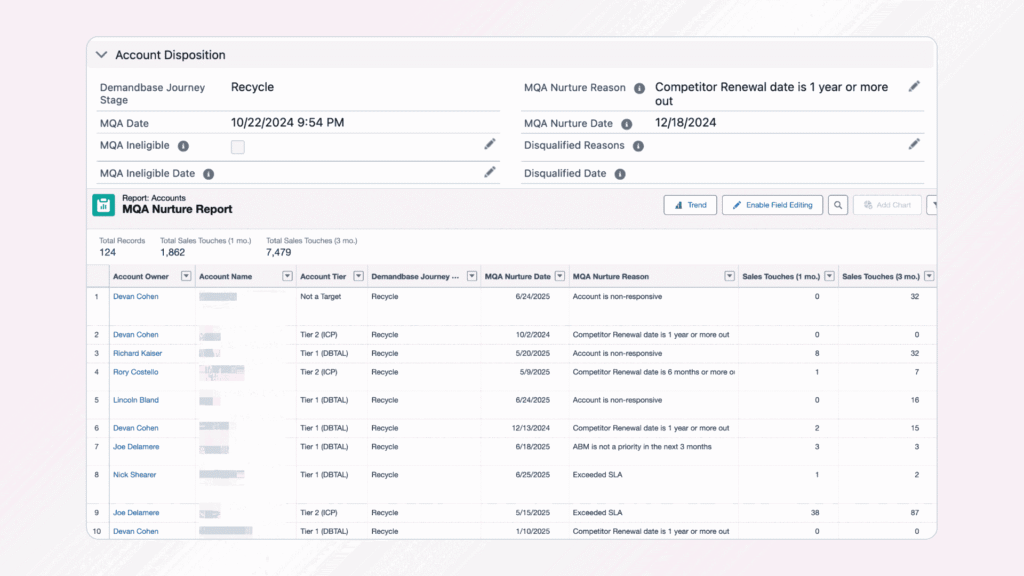
- Move “Nurturing” accounts back into “Engaged” status when Journey Stage signals shift.
- Align statuses with pipeline stages to ensure seamless handoffs between marketing, SDRs, and sales. For instance:
Part 6. Using AI to take insights to action
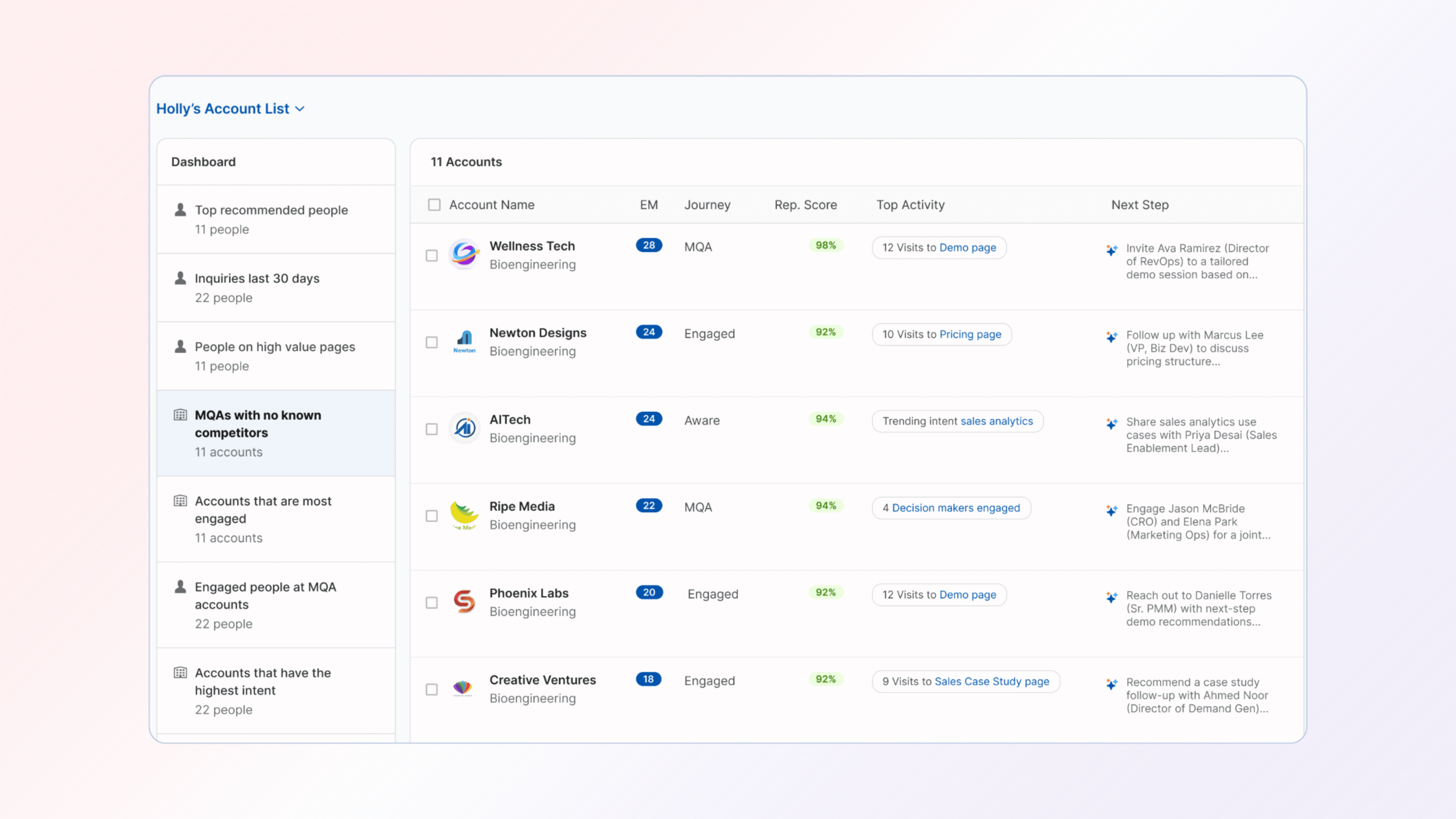
Step 1. Use AI account recommendations to guide prospecting
Your team can work smarter by leveraging AI-powered recommendations directly within Demandbase. The Prospecting Playbook delivers customized people and account suggestions based on the order of operations you’ve already established, ensuring reps focus on the accounts most likely to convert.
This tool surfaces the exact activities a prospect took, provides a transparent view of their journey, and recommends the best next actions—eliminating guesswork and empowering sellers to focus on what they do best: selling.
Step 2. Analyze the AI account summary to find top keywords
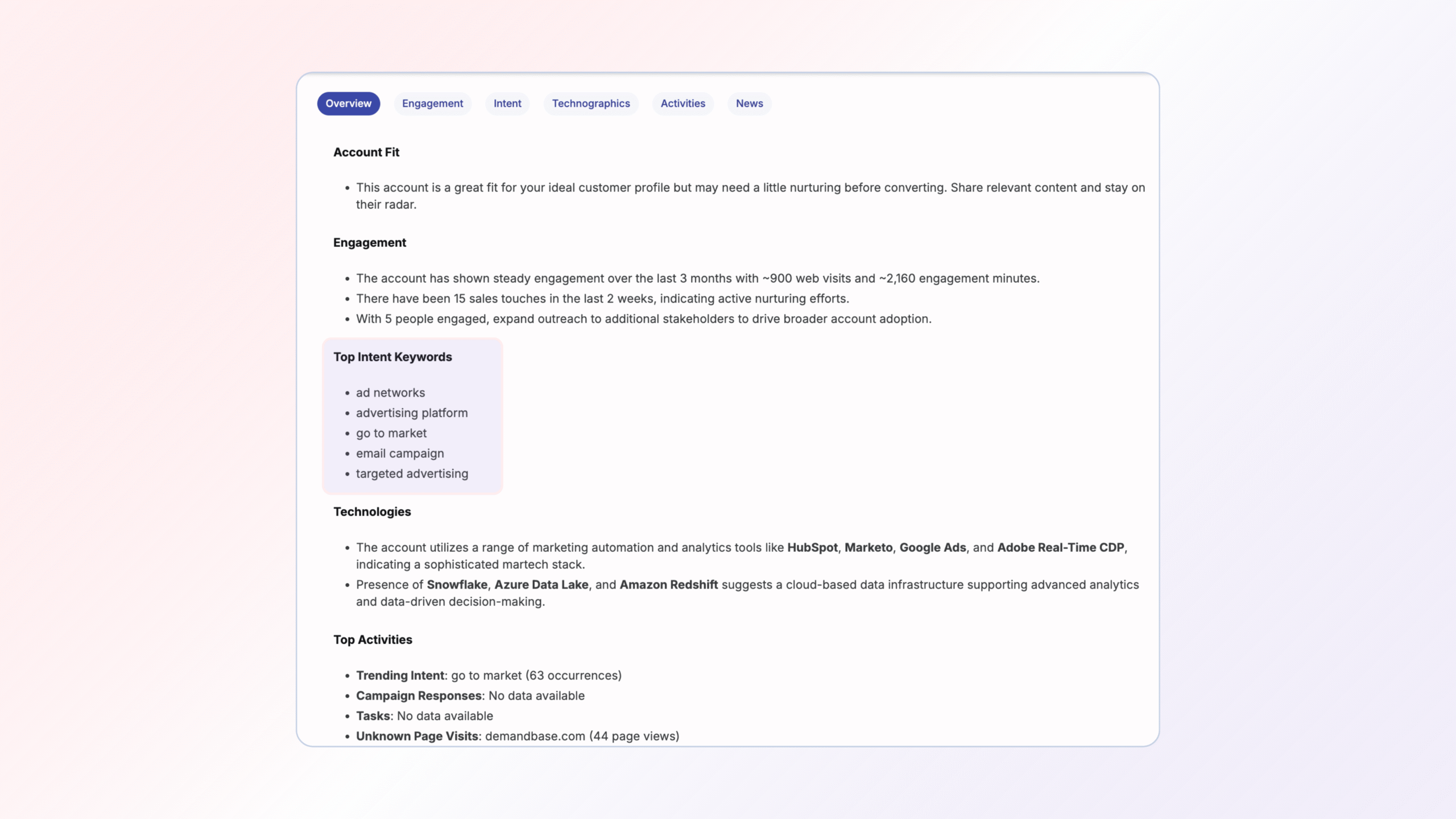
Before outreach, start with the AI Account Summary to understand an account’s core interests. It distills complex engagement data into clear, actionable bullet points:
- Identify Primary Intent
- Scan for top intent topics (e.g., “advertising,” “ABM,” or specific competitor names).
- Review Other Key Signals
- Assess account fit, complementary/competitive technographics, and top activities driving engagement.
- Copy Key Insights
- Use these bullets as the foundation of your outreach and messaging.
Step 3. View recommended actions for targeted outreach
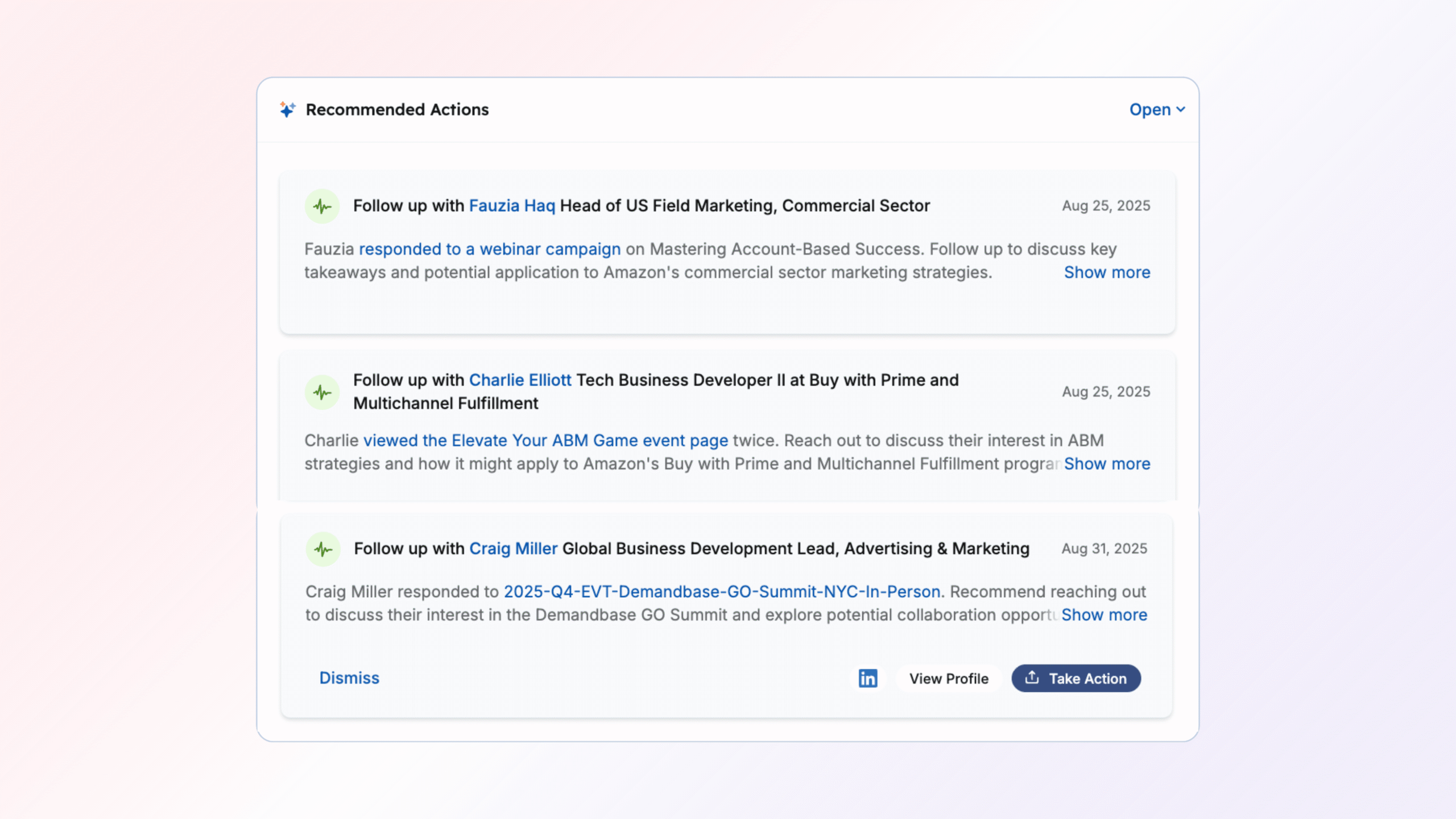
Demandbase AI recommends specific actions at the account level, helping you identify engaged buying group members who are ideal for initial outreach. It details each person’s interests and suggests how to tailor your message for maximum impact—removing the guesswork from personalization.
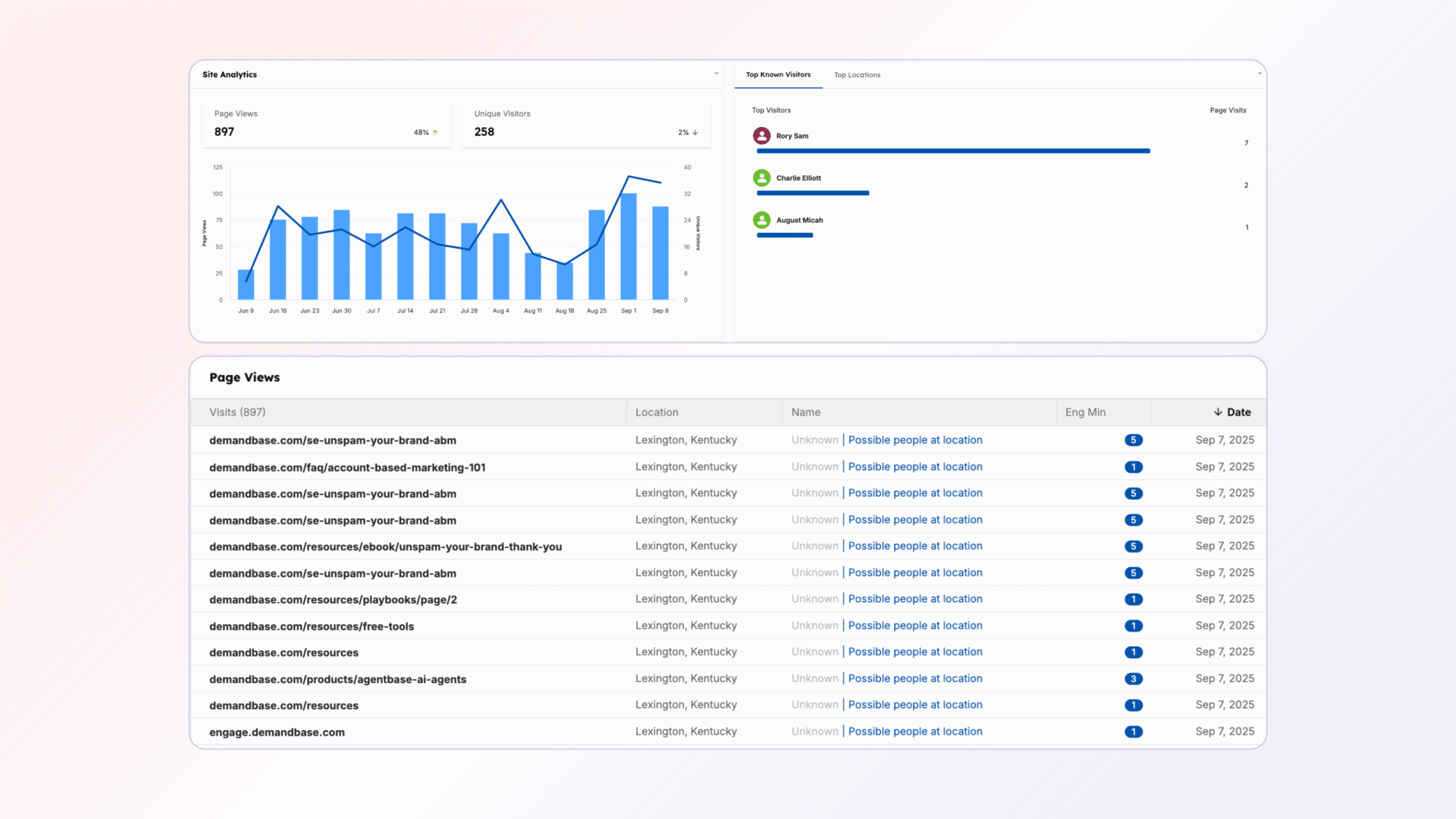
Step 4. Understand account interest through website traffic
Deepen your understanding by analyzing recent website traffic (known and anonymous). Demandbase pinpoints anonymous activity by location and buying group for a more complete picture:
- Identify Engagement Patterns
- Note trends in content consumption (e.g., ABM content, advertising playbooks, demo pages, AI solutions).
- Copy Engagement Topics
- Capture these topics to craft highly relevant outreach aligned to what the account is actively researching.
Step 5. Find and engage people in the buying group
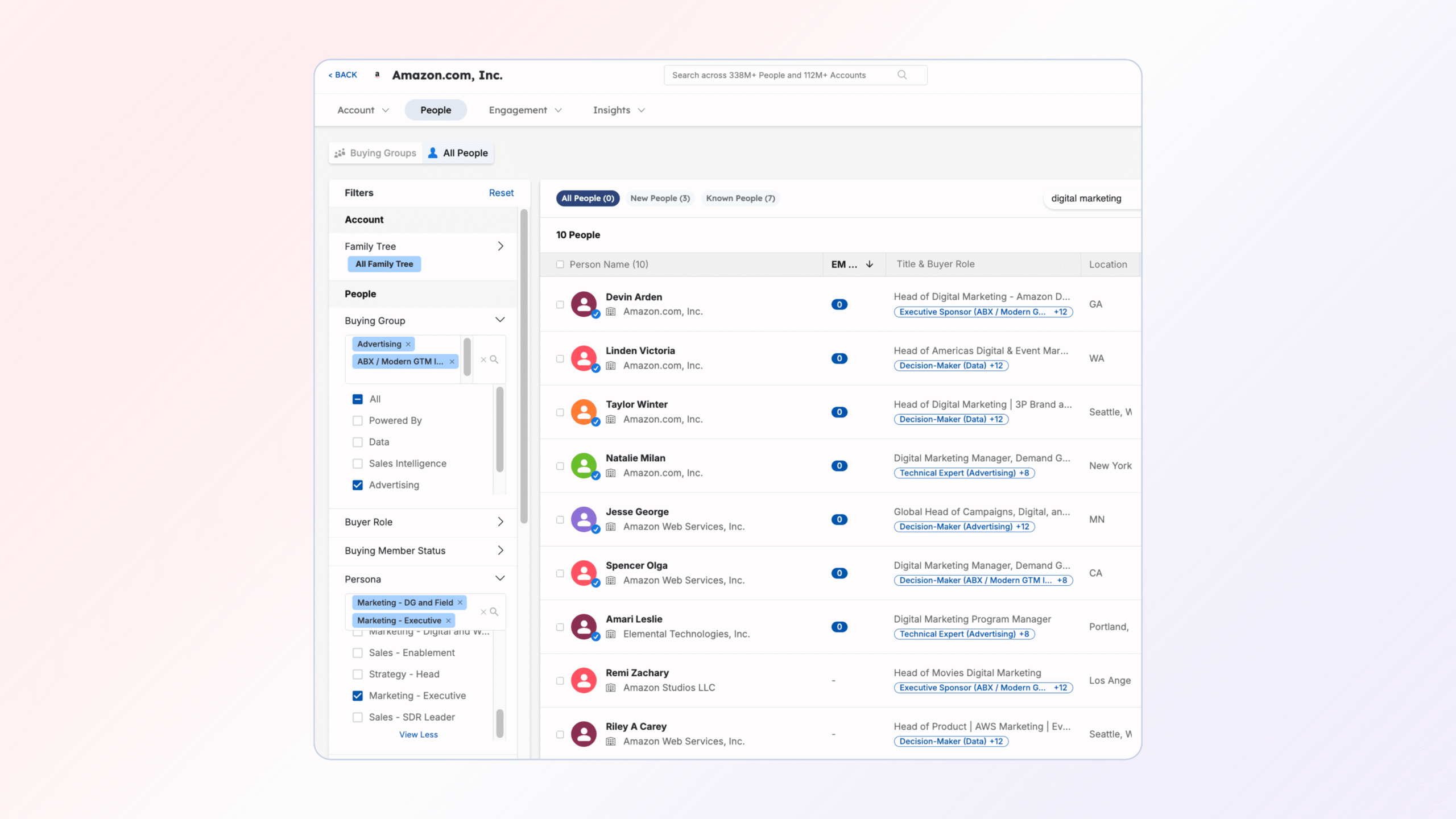
Use the People tab in Demandbase One for Sales to pinpoint key contacts, then apply filters to prioritize the right individuals:
- Filter by Buying Group
- If interest appears in ABX and Advertising, filter your list by those groups.
- Filter by Persona
- Narrow by persona or search for specific titles.
- Identify Known vs. Unknown Contacts
- Known contacts (blue checkmark) are in your CRM; unknown contacts come from the Demandbase database.
- Sort by Engagement
- Use Engagement Score to prioritize the most active individuals.
Step 6. Take action on your contact lists
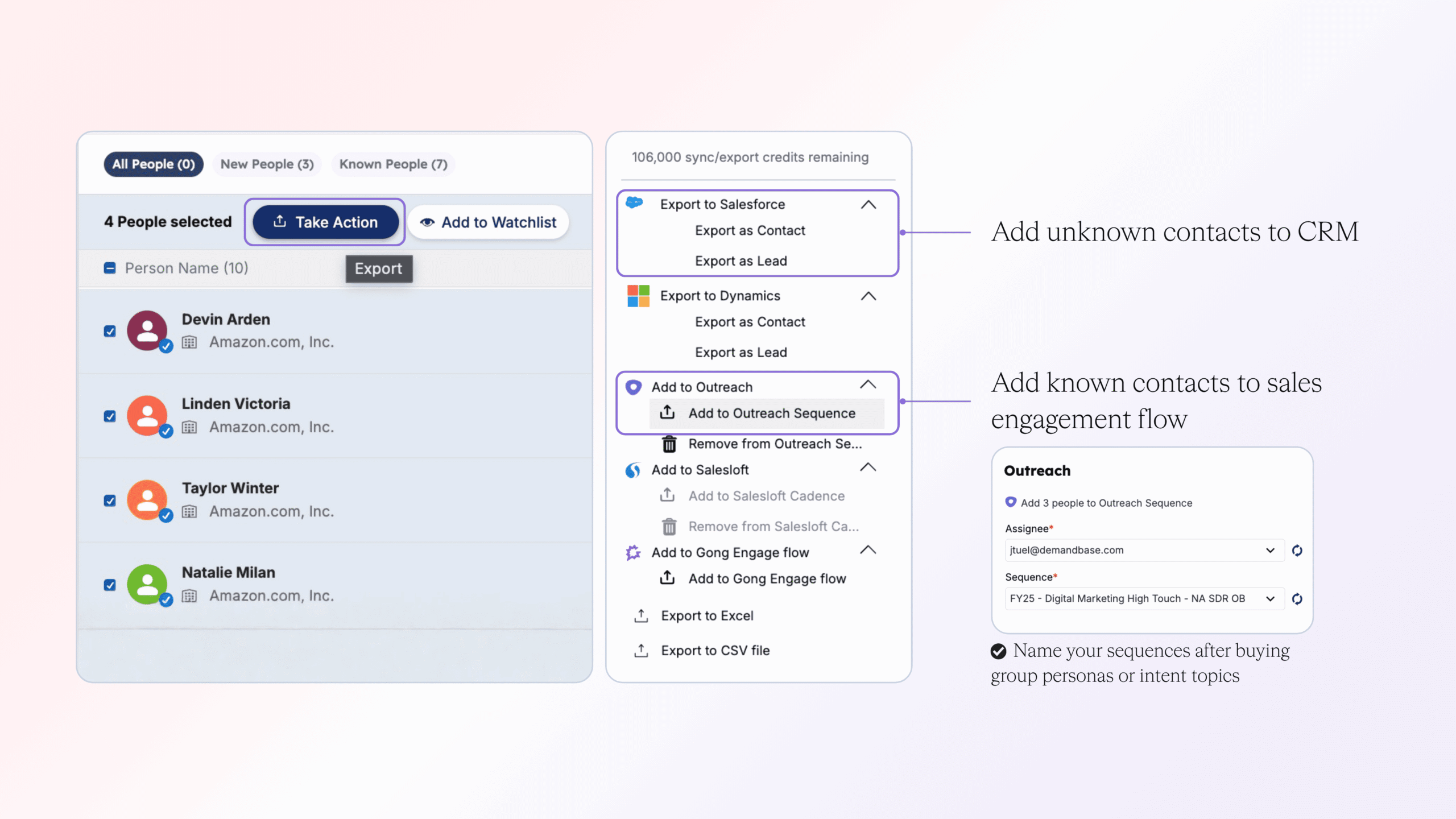
Once you’ve identified target contacts, operationalize your outreach:
- Add Unknown Contacts to CRM
- Create records for high-potential contacts not yet in your system.
- Add Known Contacts to a Sales Engagement Flow
- Enroll them in relevant sequences. Name sequences by buying group persona or intent topic for clarity and targeting.
Step 7. Leverage LLMs to help craft your email
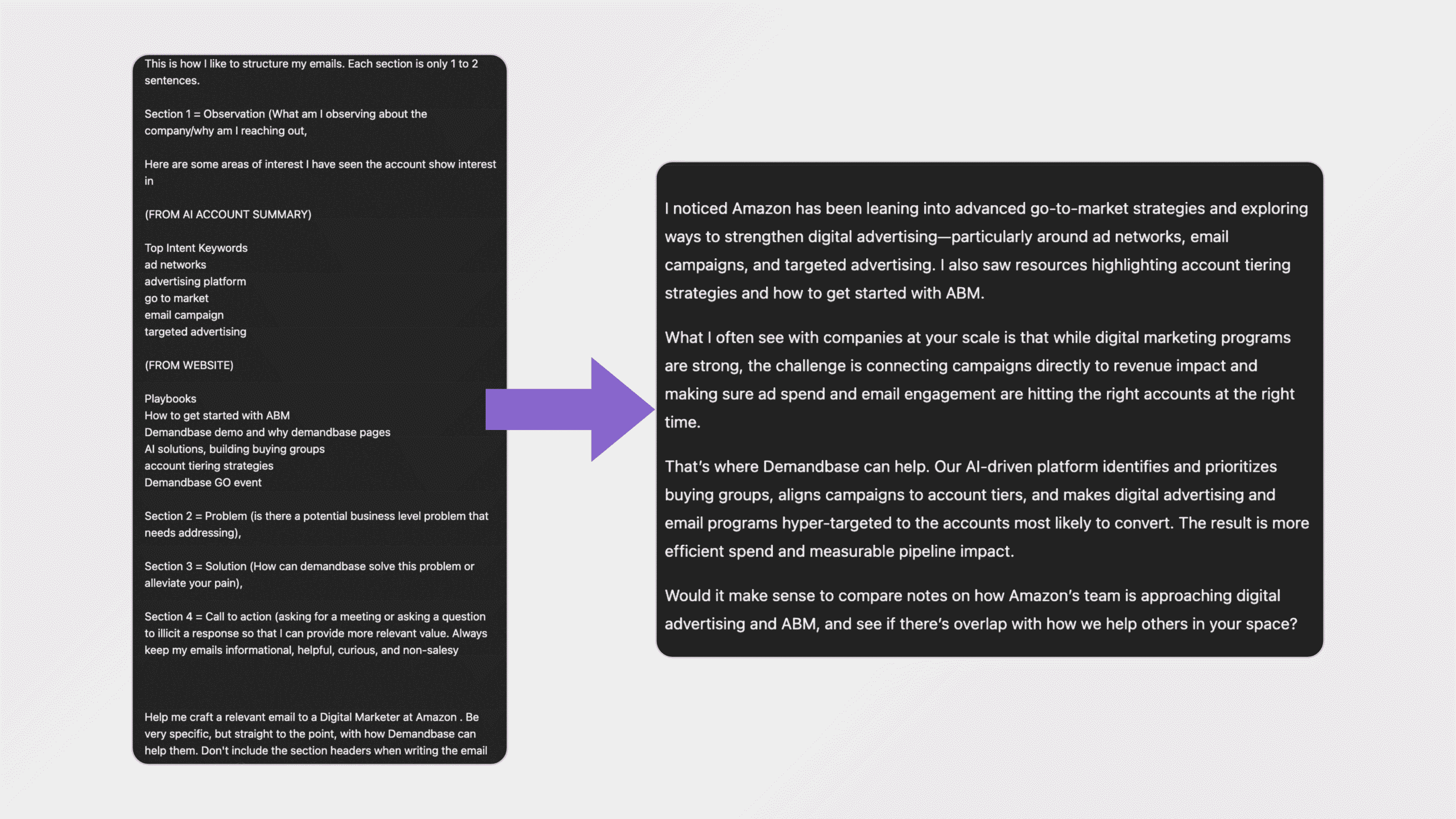
Combine your research with an LLM to produce a compelling, personalized email. Provide a clear prompt structure to guide the output.
Steal this prompt:
You are a B2B sales representative writing to a [Persona Title]. Write an email with a [Your Writing Style — e.g., confident, supportive, direct] tone.
Observation: Start by mentioning their account’s recent activity. Include the AI Account Summary intent keywords and website engagement topics you copied earlier.
Problem: Connect their activity to a business problem you can help them solve.
Solution: Explain how your solution addresses that problem, tying it directly to their observed interests.
Call to Action: End with a clear, low-friction next step. Specify how you want them to respond.
The results
Implementing this playbook empowers your team to consistently:
- Deliver highly personalized outreach for Tier 1 accounts, leading to stronger relationships and higher conversion rates.
- Engage mid-sized groups through finely tuned messaging, ensuring efficiency without losing relevance.
- Build broad awareness across large account bases to fill your funnel with early-stage opportunities.
- Save time on prospecting by leveraging Demandbase’s insights and Journey Stages.
When adopted systematically, this playbook provides the structure to confidently pursue high-value engagements and stand out by delivering value at every stage in your customer’s buying process.
Partner with Demandbase Experts
Get tailored strategies and insights to optimize your approach, drive engagement, and unlock new opportunities.
More Playbooks
Build an order of operations
Optimize your sales efficiency with the 'Build an Order of Operations' playbook. Learn to create Salesforce workflows, align priorities, and drive impactful sales strategies today.
Navigating prescriptive sales dashboards
Boost your sales strategies with our 'Navigating Prescriptive Sales Dashboards' playbook. Learn to prioritize accounts, track engagement trends, and tailor outreach for better results.
Understanding your Buying Groups
Discover key account insights with the 'Understanding Your Buying Group' sales playbook. Learn to identify decision-makers, analyze engagement trends, and tailor messaging to accelerate sales.
We have updated our Privacy Notice. Please click here for details.