

The best programmatic advertising platforms in 2026

When you compare programmatic advertising platforms today, the differences are smaller than you would expect. Channel coverage is broadly the same across the market, since display, video, and CTV are standard, and access to premium inventory is too.
The difference is in the audience each platform was built to find.
- If that audience is a person, the platform tracks cookies, devices, and behavior.
- If it’s a company, the platform resolves firmographics and works out who inside is involved in the purchase.
B2B buying rarely fits the first definition. Labs by Demandbase research puts a typical buying group at 13 to 17 stakeholders, so a platform that can only see individuals is working with only a partial view of the purchase.
This guide sorts the leading programmatic advertising platforms into those two families and gives you the criteria to work out which one you belong in.
Key takeaways →
- Channel coverage no longer separates the major platforms. What separates them is whether they target a person or a company.
- Person-level platforms (The Trade Desk, DV360, Amazon, StackAdapt, Basis, Viant, Adobe) reach individuals through cookies, device IDs, and behavioral segments.
- Account-level platforms (Demandbase, 6sense, LinkedIn) reach companies and the buying groups inside them, with frequency and reporting managed per account.
- If you sell to committees at named companies, start with the account-level family. If you sell to individuals at volume, start with the person-level family.
What are programmatic advertising platforms?
Programmatic advertising platforms are software that automates the buying and selling of digital ad inventory through real-time auctions. Advertisers set budgets, targeting rules, and creative, then the platform bids on individual impressions on their behalf.
The word “platform” gets used loosely here, and it covers both sides of the market.
- Publishers use one to make their inventory available for sale.
- Advertisers use one to bid on that inventory and place ads against it.
If you are shopping for a programmatic advertising platform, you almost certainly want the buy side, which is a demand-side platform, or DSP.
A DSP holds your budget, your targeting rules, and your creative, and then bids on individual impressions for you.
We use platform and DSP interchangeably from here, and what is a demand-side platform walks through how the bidding works if you want that detail first.
How the programmatic supply chain fits together
Programmatic runs on a chain of systems, and each one handles a different part of the transaction. Knowing which is which saves you from comparing two products that were never meant to compete.
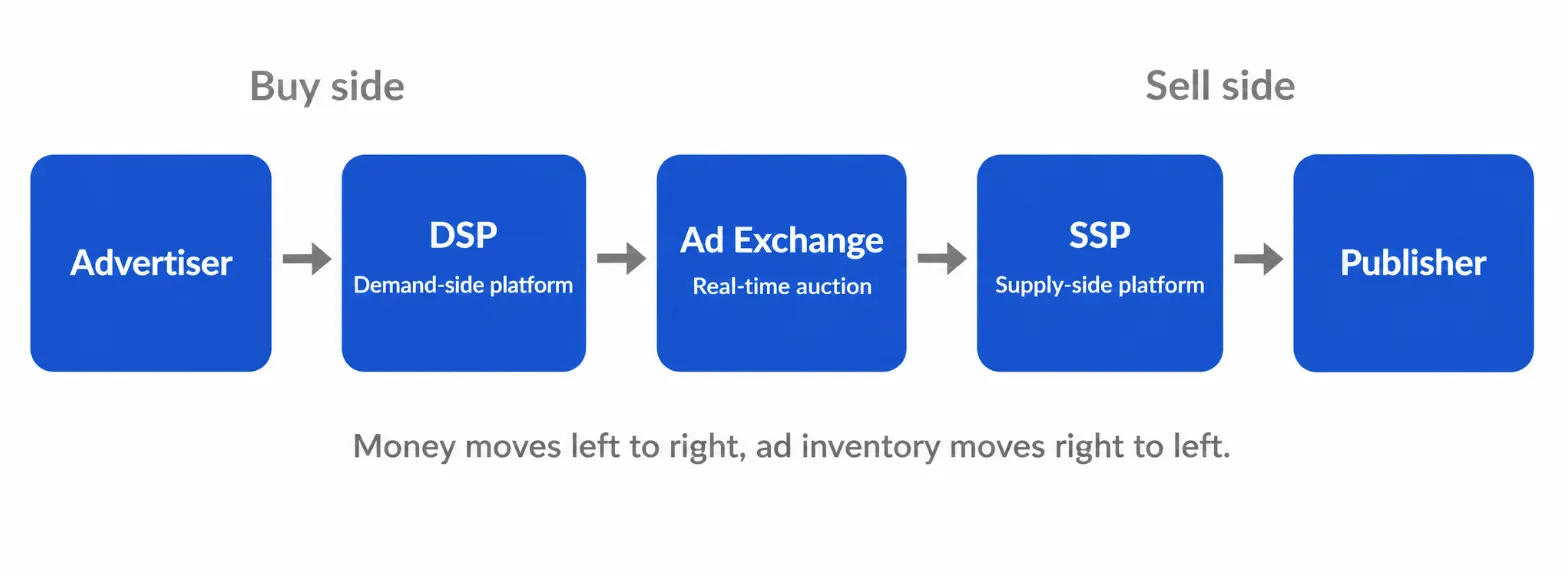
Advertisers buy through a DSP and publishers sell through an SSP. The exchange in between manages the auction and matches bids to impressions as they become available.
It starts when someone opens a page. The publisher offers the empty ad slot through its SSP, the exchange puts it up for auction, and DSPs bid on behalf of the advertisers they represent. The winner’s ad appears before the page has finished rendering.
The table below breaks down each component and where it belongs:
| Component | Side of the market | What it does | Who uses it | What it means for you as a buyer |
|---|---|---|---|---|
| DSP (demand-side platform) | Buy side | Bids on impressions on behalf of advertisers | Advertisers and agencies | This is the product you are shortlisting |
| Ad exchange | Neutral | Runs the real-time auction that matches bids to inventory | Both sides | You reach exchanges through your DSP, so ask which ones it connects to |
| SSP (supply-side platform) | Sell side | Offers publisher inventory into auctions at the best price | Publishers | Nothing to buy here, though SSP relationships shape what inventory your DSP can see |
| DMP or CDP | Attaches to buy side | Stores and segments audience data used for targeting | Advertisers | Some DSPs include this, others expect you to bring your own |
| Ad server | Attaches to both | Delivers the creative and records the impression | Both sides | Determines whose numbers you trust when platform reporting disagrees |
Notice that the last two rows do a different kind of work → The first three are stages, and every bid request travels through all of them in order. A DMP or CDP feeds audience data to the DSP, and an ad server handles delivery after a bid wins. Both attach to the chain at a single point, which is why neither appears as a stage in the flow above.
The four ways to buy programmatically
There are four ways to buy programmatically, and the open auction is only the most familiar. The others trade some of that reach for better inventory, fixed pricing, or guaranteed delivery.
Here’s how the four compare:
| Buying type | Inventory access | How price is set | Volume commitment | Typical CPM | Best for |
|---|---|---|---|---|---|
| Open real-time bidding (RTB) | Anything on the open exchange | Live auction, highest bid wins | None | Lowest | Reach and scale at low cost |
| Private marketplace (PMP) | Invite-only publisher inventory | Auction within a closed set | None | Higher than open RTB | Brand safety and premium placements |
| Preferred deal | Reserved inventory, no commitment | Fixed price, first look | None | Negotiated | Specific publishers at a known rate |
| Programmatic guaranteed | Reserved and committed inventory | Fixed price, fixed volume | Fixed impressions | Highest | Guaranteed placements and sponsorships |
Useful to know → Most B2B programs use a mix. Open RTB carries the volume, private marketplaces cover the publications where brand safety matters, and programmatic guaranteed handles sponsorships negotiated with a specific publisher.
The one question that sorts the whole market: who are you actually targeting?
Programmatic grew up in consumer advertising, where the person who sees the ad is the person who buys. Everything follows from there. Platforms target individuals, cap frequency per user, and count a click or a purchase as the result. A company that sells running shoes, for example, needs exactly that.
B2B breaks the assumption in three places →
- The buyer is a company, so the entity you are selling to has no cookie, no device, and no browsing history.
- A budget pays for the purchase, which puts approval in different hands from the person who wants it.
- The decision gets made by a group whose members have competing priorities and rarely visit your site in the same week.
A platform built around individuals reaches parts of that group by chance. Nothing in its data connects one member to the next.
You will see this in your frequency reports. Twelve impressions against a target account might mean one person saw the ad twelve times or twelve people saw it once, and the platform reports the same number either way. Consumer advertising can live with that. B2B cannot, because only one of those outcomes moves a deal.
Nick Webb, Senior Leader at CloudPay, described what that looks like from the inside. CloudPay provides global payroll across more than 140 countries, and their targeting had focused on the obvious buyer:
“We had only really been targeting, albeit inaccurately, global heads of payroll people. When we looked into the data and actually went into the system and had a look around, we found that there were 17 different job titles involved, either in the preamble when we were marketing or during the buying process. And that really opened our eyes to the fact that we needed to be mindful of the buying groups.”
Seventeen people took part in one payroll purchase, and CloudPay had been marketing to one of them. A campaign built around the head of payroll reaches that person and misses the other sixteen, any one of whom can hold up the deal. Labs by Demandbase research puts win rates 2 to 3 times higher for teams that engage the whole buying group and increase sales touches against it.
Keep in mind → Nothing here counts against person-level platforms. They solve a problem that most advertisers have, and some B2B teams do not, which gives the market two families to choose between. How your company sells decides which family fits.
Each family makes a different set of choices downstream:
| Dimension | Person-level platforms | Account-level platforms |
|---|---|---|
| Unit of targeting | Individual user or device | Company, plus the buying group inside it |
| Identity basis | Cookies, device IDs, hashed emails | Firmographic and company resolution |
| Audience built from | Behavioral and demographic segments | Target account lists, firmographics, intent |
| Frequency controlled at | User level | Account level |
| Campaign measured against | Clicks, conversions, ROAS | Pipeline, opportunities, revenue |
| Fits | High volume, short cycle, individual purchase | Considered purchase, committee decision, long cycle |
| Breaks down when | The buyer and the decision-maker are different people | Volume matters more than precision |
The right column describes ordinary enterprise B2B. Long cycles, committee decisions, and named target accounts are the normal conditions, and the platforms in that family are built around them.
Learn more → Top Reasons Why a B2B DSP is Better than a B2C DSP
How to evaluate a programmatic advertising platform
Once you know which family fits, the comparison narrows to the platforms inside it. These six criteria are what separates them, and each one comes with a question you can put to a vendor directly.
- Targeting capability: Granular means different things to different vendors. One platform’s version is a behavioral segment built from third-party data, another’s is a named account list narrowed by job function, seniority, and buying group role. Ask what the smallest unit you can target is, and whether you can upload your own account list.
- Data and integrations: Your CRM holds a record of which accounts closed and who was involved in each deal. A platform that can read that data builds better audiences than one working from purchased segments, and a platform that writes data back lets you connect campaign exposure to pipeline. Also check where the platform’s own data comes from, since coverage and accuracy vary widely between B2B data vendors. Ask whether the integration writes back, and where the platform’s own data comes from.
- Attribution and analytics: Click-through rates on display advertising are low across the board, and B2B purchases involve too many people for a click to represent much. Ask whether the platform reports at the account level and whether opportunity data appears alongside campaign data. Ask how the platform links an impression to an opportunity, and how long it can track that connection.
- Inventory access and quality: Reach numbers look impressive and say little about where your ads will appear, since made-for-advertising sites and cheap long-tail inventory absorb budget while producing nothing. What separates platforms is the strength of their exclusion controls and whether premium and private marketplace inventory is available when you need it. Ask which exchanges it connects to and what it blocks by default.
- Pricing transparency: Programmatic spend covers three or four separate things, including media, the platform fee, data and audience fees, and service fees on managed accounts. Vendors who quote one blended CPM make it impossible to see how much of your budget reached publishers. Ask to see platform fee, media cost, and data fees as separate lines.
- Cross-channel orchestration: Display, video, CTV, and social come standard now, so the question is how well they work together. Channels that cap frequency independently waste budget on people who have already seen your ad, and they make total reach impossible to measure. Ask whether frequency is managed across all channels, and at what level it caps.
Worth knowing → Two or three criteria usually carry the decision. For account-based programs, data integration and attribution depth are the ones worth pushing on, since targeting and inventory even out quickly across the market.
The best programmatic advertising platforms in 2026
The list below covers ten platforms, grouped by the split from earlier. Account-level platforms come first, since that family is smaller and easier to define. Person-level platforms follow, and they account for most of the market by spend.
Every platform gets the same treatment, which is what it is, who it fits, its channels, how it targets, and one honest limitation. Most of these limitations come from a design decision rather than a flaw, since a platform built for one kind of buyer works less well for another.
| Platform | Family | Strongest for | Channels | Service model |
|---|---|---|---|---|
| Demandbase | Account-level | The only DSP built for B2B from the ground up, with account and buying group targeting tied directly to pipeline | Display, video, CTV, social, web | Self-serve and managed |
| 6sense | Account-level | Predictive account scoring with advertising attached | Display, video, CTV | Self-serve and managed |
| LinkedIn Campaign Manager | Account-level | Verified job title and company targeting | LinkedIn feed, plus the LinkedIn Audience Network | Self-serve |
| The Trade Desk | Person-level | Independent reach and scale across the open web and CTV | Display, video, native, audio, CTV, DOOH | Self-serve and managed |
| Google Display and Video 360 | Person-level | YouTube inventory and the rest of the Google stack | Display, video, CTV, audio, DOOH, native, YouTube | Self-serve |
| Amazon DSP | Person-level | Retail purchase signals and Amazon-owned inventory | Display, video, CTV, audio | Self-serve and managed |
| StackAdapt | Person-level | Mid-market teams that need multichannel coverage without heavy ad ops | Display, native, video, CTV, audio, DOOH, in-game, email | Self-serve and managed |
| Basis Technologies | Person-level | Agencies that consolidate programmatic, direct, search, and social in one system | Display, video, CTV, audio, native, DOOH, search, social, site-direct | Self-serve and managed |
| Viant | Person-level | Household-level CTV targeting and measurement | CTV, linear TV, display, video, audio, in-game, DOOH | Self-serve and managed |
| Adobe Advertising | Person-level | Teams already standardized on Adobe Experience Cloud | Display, video, CTV, audio, native, paid search | Self-serve and managed |
Account-level platforms
Account-level platforms treat the company as the unit of targeting. They work out which organization is behind an ad request, reach the people inside it, and manage frequency and reporting at the account level.
Demandbase, 6sense, and LinkedIn are the three worth comparing. The first two run their own B2B DSPs built on account identification, while LinkedIn works from employment data its members maintain themselves.
Demandbase
Demandbase is the only DSP built specifically for B2B buying, where the target is an account, and the purchase involves a group. It fits teams with defined target accounts, long sales cycles, and a need to know whether advertising influenced pipeline.
Account intelligence, intent data, and media buying share one system, so the target list behind your ABM program also powers your ad targeting.
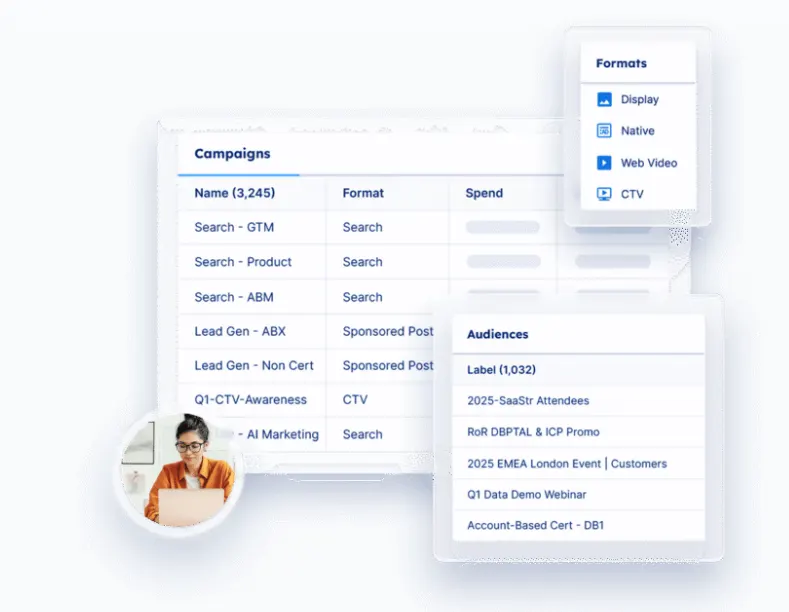
Targeting combines account identity, firmographics, intent, and buying group activity across display, video, CTV, web, LinkedIn, Meta, and Google. Frequency caps at the account level, and reporting connects ad performance to account engagement, pipeline, and revenue in your CRM.
The trade-off → That B2B specialization also narrows the use case. Demandbase makes the most sense for companies selling considered products into named accounts, not advertisers primarily focused on high-volume consumer acquisition.
6sense
6sense is a revenue intelligence platform with a B2B DSP built into it. Predictive scoring is the core of the product, since the platform models which accounts are in-market before they identify themselves, then activates advertising against them.
It’s suitable for enterprise teams who want account prioritization driving the whole go-to-market motion, with advertising as one output.
Targeting works from account segments scored on fit and intent, with persona targeting that reaches only the likely buying team members inside those accounts. Company identification comes from 6signal, which resolves accounts without cookies. The native DSP covers display, video, and CTV, and audiences sync to LinkedIn, Meta, and Google Ads.
Trade-off → Advertising comes attached to the full Revenue AI platform, so the commitment is larger than a standalone DSP. Channel coverage is narrower too, with no audio or DOOH.
Learn more → 6Sense reviews: Is 6Sense really worth it? (based on 100+ user reviews)
LinkedIn Campaign Manager
LinkedIn is the only platform here where members maintain their own targeting data. Job titles, companies, seniority, and skills come from the audience itself, which makes it the most accurate source for reaching specific roles. It fits teams that need precise job function targeting, and teams starting account-based advertising without the budget for a full DSP.
Targeting covers job title, function, seniority, industry, company size, and skills. Matched Audiences adds company lists that reach all employees at your named accounts, contact uploads, and website retargeting through the Insight Tag. Inventory covers the LinkedIn feed plus the LinkedIn Audience Network, which extends reach to third-party apps and sites.
Trade-off → LinkedIn’s audience data stays inside LinkedIn, so you cannot activate it elsewhere or extend a campaign to open web and CTV inventory. Campaign Manager also has no manual frequency settings.
Person-level platforms
Person-level platforms build audiences one individual at a time. They identify users through cookies, device IDs, or hashed emails, group them into behavioral and demographic segments, and cap frequency per person.
The seven below are strong products, and their shared limitation in B2B is structural, since each was built for a market where one person sees the ad and that same person buys.
The Trade Desk
The Trade Desk is the largest independent DSP and the main counterweight to the walled gardens. It owns no media of its own, which removes the conflict of interest built into platforms that sell their own inventory, and advertisers get full visibility into bidding and costs.
Teams that want open web scale and transparent buying without dependence on a single ecosystem get the most value.
Channels cover display, video, CTV, audio, native, and DOOH, reaching across more than 80 exchanges. Targeting is based on first-party data, a large third-party data marketplace, and contextual signals, with Unified ID 2.0 providing a cookieless, consent-based identifier.
Trade-off → The platform has no native concept of a company. B2B account targeting depends on third-party firmographic segments you bring in yourself, and frequency caps per user, so exposure across a buying group stays outside what the platform manages.
Google Display and Video 360
DV360 is Google’s enterprise DSP, part of the Google Marketing Platform. Its advantage is YouTube, which no independent DSP can sell directly, plus connections to more than 80 ad exchanges.
The natural buyer is a team already working in GA4, Campaign Manager 360, and Search Ads 360, where DV360 completes the stack.
Just like the rest of the category, channels include display, video, CTV, audio, DOOH, and native. Targeting is based on Google’s audience data, including in-market segments, affinity audiences, custom intent, and demographics, with first-party activation through Customer Match.
The trade-off → DV360 is built around user- and audience-level media buying rather than B2B account resolution. B2B teams can activate CRM and first-party audiences, but account coverage, buying-group reach, and pipeline attribution are not the platform’s native organizing model.
Amazon DSP
Amazon DSP is built on data no other platform has, which is what people search, add to cart, and buy. Those retail signals combine with streaming behavior on Prime Video and Fire TV to produce audiences grounded in observed purchases.
Brands selling physical products are the obvious buyers, though you do not need to sell on Amazon to use it.
There’s display, video, audio, and streaming TV, with inventory across Prime Video, Fire TV, Twitch, IMDb, and thousands of third-party publishers. Self-service works at any budget, and managed service typically requires a $50,000 minimum.
Trade-off → The data advantage is consumer purchase behavior, and Amazon knows nothing about what someone buys for their employer. One partial route opened in May 2026, when LinkedIn Connected TV Ads became available through Amazon DSP for US advertisers, letting job title, industry, company size, and seniority support B2B streaming campaigns bought through deals in the platform.
StackAdapt
StackAdapt is a multi-channel DSP that brings a wide range of programmatic formats into one platform without demanding the same level of operational complexity as some enterprise-focused alternatives.
It works especially well for agencies and mid-market teams that want broad channel coverage while retaining the choice between self-serve, managed, and hybrid support.
The platform maintains native, display, video, CTV, audio, in-game, and digital out-of-home advertising. Audience building can pull from first-party data, third-party segments, behavioral and contextual signals, retargeting, and lookalike modeling, with machine learning used to optimize delivery across campaigns.
The trade-off → StackAdapt can run B2B campaigns and activate first-party account data, but account resolution and buying-group intelligence are not native to the platform. Teams that need account-level frequency management or pipeline-based measurement will usually need those capabilities elsewhere in their stack.
Basis Technologies
Basis Technologies combines programmatic buying with tools for planning, direct media, search, social, reporting, and workflow management. That breadth makes it particularly useful for agencies and media teams trying to reduce the number of systems involved in running and managing campaigns.
The proprietary DSP covers display, video, CTV, audio, native, and DOOH, with search, social, and site-direct handled through API integrations with the walled gardens. Compass, launched in April 2026, converts a campaign brief into a ready-to-activate omnichannel media plan, and billing data pushes straight into ERP systems.
Trade-off → Most of what makes Basis valuable is workflow and financial operations, which matters to an agency reconciling dozens of client budgets and matters far less to an in-house team buying media for one company. Account targeting depends on third-party B2B data.
Viant
Viant is a CTV-first DSP built on household identity. Its Household ID links the people in one residence across their devices, so a campaign reaches that household consistently and caps frequency across every screen. More than half the spend on the platform now goes to CTV.
Channels are CTV, linear TV, display, video, audio, in-game, and DOOH, with an identity graph covering 115 million US households.
Trade-off → Households and companies are different units. Viant’s identity graph maps who shares an address, which gives B2B teams no way to reach the people who share an employer.
Adobe Advertising
Adobe Advertising combines programmatic media buying with Adobe’s broader customer data, analytics, and experience stack. Its strongest use case is among enterprises already using products such as Adobe Analytics or Real-Time CDP, where first-party audiences and downstream customer activity can feed directly into advertising strategy and measurement.
The DSP covers display, video, CTV, audio, and native inventory, while Adobe Advertising also extends into paid search and other channels through its wider platform.
Audience activation can use authenticated and unauthenticated first-party data, including hashed email, Unified ID 2.0, RampID, and Adobe Experience Cloud IDs. This gives existing Adobe customers several ways to carry their own audience data into paid media.
The trade-off → Much of Adobe Advertising’s advantage comes from how closely it connects with the rest of the Adobe stack. Teams that are not already invested in that ecosystem may get less value from those integrations and may prefer a DSP with a more standalone media-buying proposition.
Related read → How Demandbase & Adobe Are Transforming B2B Marketing
Where AI is moving in programmatic
DSPs have used machine learning for bid optimization for years, and that work happens after the audience is set. The model decides what to pay for an impression against a segment someone already built.
What has changed is AI moving earlier in the process, into deciding who belongs in the audience at all. For B2B, that means predicting which accounts are approaching a purchase, working out who inside them belongs to the buying group, and updating both as signals change through the quarter.
Demandbase AI handles account scoring, buying group identification, and journey stage together, so the audience keeps updating after launch.
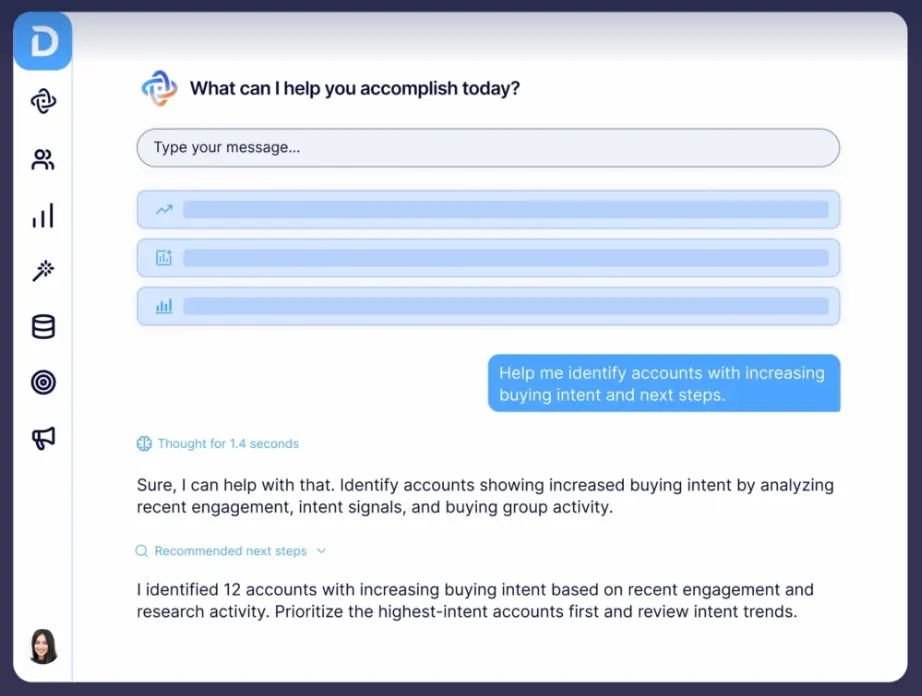
Quick advice → When a vendor says AI-powered, ask which part. Bidding automation and audience construction are very different capabilities.
Targeting without third-party cookies
Google spent five years promising to remove third-party cookies from Chrome. In April 2025, the company confirmed it would keep them and drop the planned user choice prompt, and in October it retired a large set of Privacy Sandbox technologies, including Topics, Protected Audience, and Attribution Reporting, citing low adoption. The replacement the industry spent six years preparing for arrived in a much smaller form than anyone planned for.
Chrome was never the whole story, though. Safari has blocked third-party cookies by default since 2020, Firefox partitions them to the site that set them, and StatCounter puts Safari at 29% of North American browsing.
Cross-site targeting is already impaired for close to a third of your audience. Chrome cookies degrade too, through privacy settings, ad blockers, and browser updates, which turns a hard deadline into a slow erosion nobody announces. The problem is present tense.
Five approaches work now, whatever Chrome decides next.
- First-party data activation: Your CRM records, closed-won accounts, and site visitors carry no cookie dependency. Most platforms convert hashed emails into universal IDs that work across the bidstream.
- Company and IP-based resolution: Identifying which organization an ad request came from uses firmographic and network data, which browser cookie policy does not govern.
- Contextual targeting: Ads match the content of the page and the environment around it, with no user identity involved.
- Publisher-provided identifiers: Publishers pass their own logged-in user IDs into the bidstream, built on a direct relationship with the reader.
- Clean rooms: Two parties compare data in a neutral environment and receive aggregate results back, with neither exposing individual records.
The two families face this differently, and the difference is structural. Person-level targeting depends on following an individual from site to site, which is the exact behavior browsers restrict. Account-level targeting identifies the company, which needs firmographic and network data outside the scope of browser cookie policy. Account-level platforms carry less exposure to cookie loss for that reason.
That is an advantage and not immunity. Reaching specific people inside an account still depends on identity signals under the same pressure, and every platform here relies partly on data it does not own. The difference is one of degree, and degree matters when a third of your audience already blocks cookies.
Keep in mind → No platform is fully insulated from cookie loss. What separates them is how much of their targeting depends on data they own against data they license, and that ratio is worth asking about directly.
Measuring programmatic performance
Programmatic reports impressions and clicks because those are the events the ad server records. Both describe delivery, and delivery is a long way from revenue.
Display click-through rates run a fraction of a percent across the industry, and nobody clicks a banner and then signs a six-figure contract.
B2B measurement works in three levels:
- Delivery metrics: Impressions, reach, and frequency confirm the campaign ran as planned.
- Engagement metrics: Site visits, page depth, and content consumption from target accounts show which companies responded.
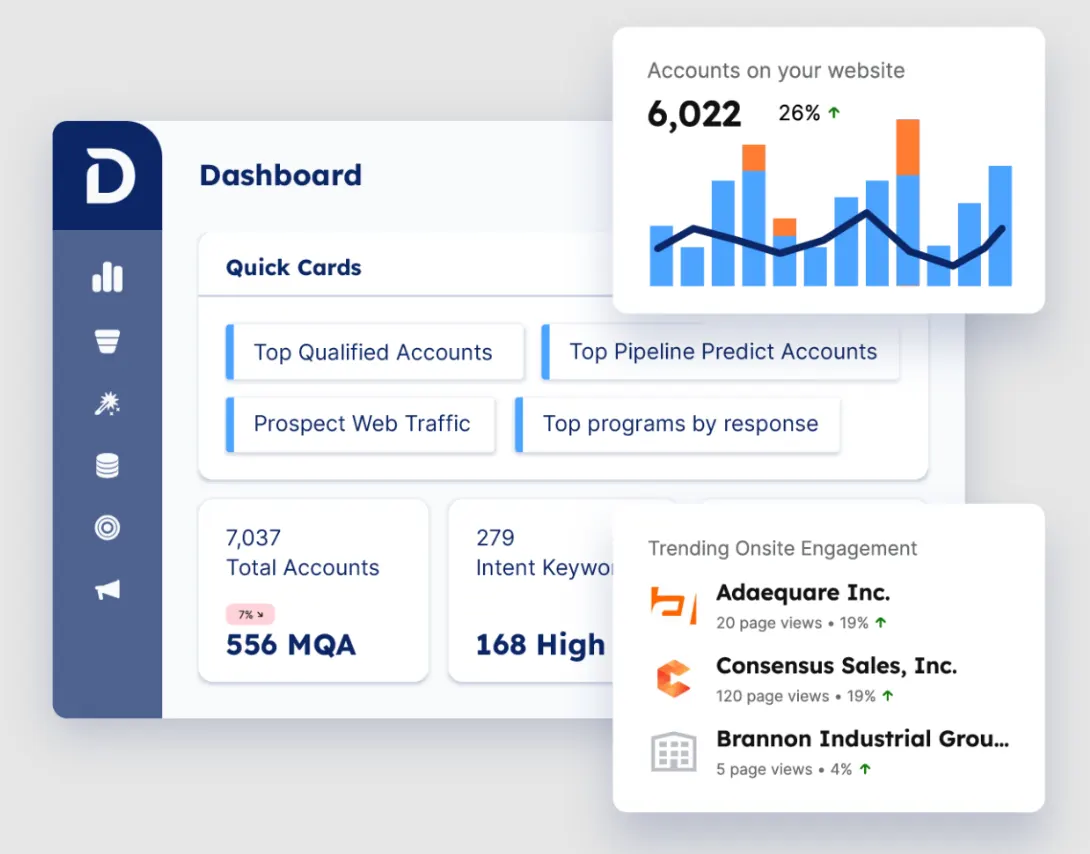
- Account metrics: Qualified accounts, opportunities created, pipeline influenced, and closed revenue connect the campaign to revenue.
All three levels share one problem. An account that engaged and then bought might have bought anyway. Incrementality testing settles it by comparing exposed accounts against a matched holdout group, where advertising is the only difference between them.
Zoom ran exactly that test, and Whitney Magnusson, their Head of Brand and Media, described the results.
“We ran a control group analysis that looked at exposed accounts versus unexposed accounts, seeing the same content, the same treatments, the same target profiles, and the exposed group performed far better.
Our Zoom Phone page visits, exposed accounts saw over eight times more visits than control. That’s over 700% lift. Our marketing qualified leads at 4X more than control, 300 plus percent lift.”
The method is what makes that number trustworthy. Both groups matched on target profile, both received the same content and treatments, and advertising exposure was the only variable that differed. An eight times lift with no control group would mean nothing.
Aggregate data points the same way. Labs by Demandbase analyzed 1,452 companies and 429,634 ad campaigns and found MQA conversion climbing from 1.78% for accounts with no advertising to 7.55% at the highest advertising volume.
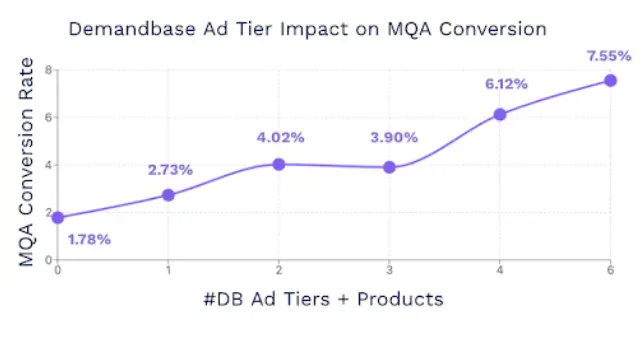
Accounts with sustained buying group advertising convert to opportunities at two to three times the rate of accounts with no advertising against them. Companies running four advertising products report a 58.7% win rate against 34.3% for those running none, a 71% relative lift.
See the full benchmarks in the B2B advertising and pipeline research.
How to budget for programmatic advertising
Programmatic pricing depends on volume, commitment, and negotiation, so published rates would be out of date quickly. The main things to understand are what makes up the cost and how to size your budget.
A programmatic bill has four components:
- Media cost: What you pay publishers for the inventory.
- Platform or seat fee: What the DSP charges to operate, either a flat fee or a percentage of spend.
- Data and audience fees: What third-party segments and identity resolution cost, usually charged per thousand impressions.
- Service fees: What managed service adds when the platform runs campaigns for you.
Request an itemized breakdown from each vendor you are considering. A single combined rate makes it difficult to compare proposals or to know which part of the cost you could reduce.
Once you know what makes up the cost, the next question is how much you need. That number comes from your account list. Mary Beth Ditterline, Campaign Strategist Lead at Demandbase, explains the method.
“The main thing you want to plan for is that you have enough budget for the entire account list so that you are usually averaging around 2,500 to 3,000 impressions per account per month, but for the entire account list. You don’t have to worry about each of those funnel stages.”
The calculation is account count multiplied by 2,500 to 3,000 impressions, then multiplied by your CPM. A list of 500 accounts needs roughly 1.5 million impressions a month. Working out your account tiering first tells you how many accounts belong on that list.
This calculation assumes impressions spread evenly across your accounts, and account-level frequency management is what delivers that. With per-user caps, a small number of heavy browsers absorb a disproportionate share while other accounts see almost nothing.
One thing to expect → B2B CPMs come in higher because you are paying to reach a much narrower audience. That makes CPM a poor basis for comparing a B2B platform against a general-purpose one, since the cheaper CPM often buys impressions against people who will never buy from you.
What about CTV for B2B?
Most platforms on this list sell CTV programmatically, and B2B teams use it to reach target accounts on streaming services.
Targeting works at the household and company level, which suits account-based programs, and a full-screen video with no skip option holds attention better than a display banner. CTV has become a standard line in B2B media plans over the past two years.
Choosing a CTV platform involves inventory and measurement questions that a general DSP comparison skips, so we covered the best CTV advertising platforms for B2B separately.
Campaign structure and measurement are a different problem again, which the CTV in B2B advertising playbook works through in detail.
How to choose the right platform for your team
Start with your own buyer before you look at platforms. That single fact narrows the list considerably, since the two families solve different problems.
| If your buyer is | Start with | Choose on |
|---|---|---|
| An individual buying at volume | Person-level platforms | Inventory quality and cost |
| A committee at a named company | Account-level platforms | Data quality and attribution depth |
Teams running both motions end up buying two platforms, since one platform stretched across both models does neither well. Companies with a self-serve product and an enterprise version are the common case here, and the two motions rarely share a budget anyway.
Four questions will separate the platforms that remain:
- What is the targeting unit? A person, a device, a household, or a company. Everything else follows from that answer.
- What happens to targeting without third-party cookies? A good answer explains which data the vendor owns and which they buy.
- What does the platform fee cover? You want media, platform, data, and service costs shown as separate lines.
- What can the reporting show past a click? Account engagement, opportunities, and pipeline, or impressions and clicks alone.
Every capability this guide told you to look for is already in Demandbase Ads. Targeting works from a target account list you control, buying group data reaches the whole committee, and frequency spreads budget across your list so no account goes dark.
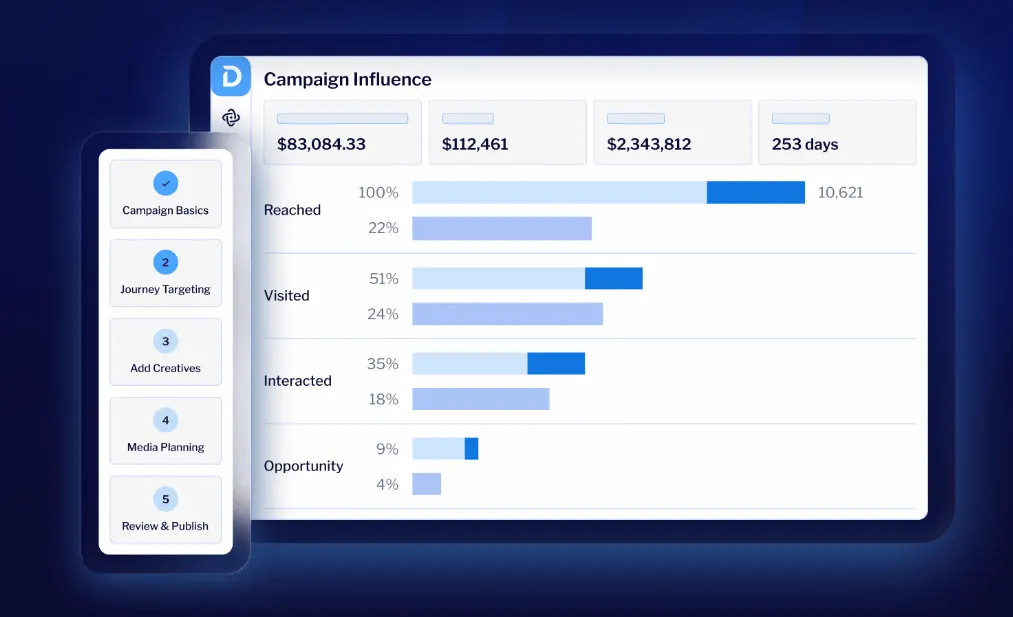
Reporting carries through to opportunities, pipeline, and closed revenue, and account resolution holds up without third-party cookies. It is the only DSP built for B2B from the start, and it shows in all of it.
Take a look at your own accounts. Request a demo of Demandbase Ads to see which of them are in market, who the buying group is, and what advertising would reach them.
When you compare programmatic advertising platforms today, the differences are smaller than you would expect. Channel coverage is broadly the same across the market, since display, video, and CTV are standard, and access to premium inventory is too.
The difference is in the audience each platform was built to find.
- If that audience is a person, the platform tracks cookies, devices, and behavior.
- If it’s a company, the platform resolves firmographics and works out who inside is involved in the purchase.
B2B buying rarely fits the first definition. Labs by Demandbase research puts a typical buying group at 13 to 17 stakeholders, so a platform that can only see individuals is working with only a partial view of the purchase.
This guide sorts the leading programmatic advertising platforms into those two families and gives you the criteria to work out which one you belong in.
Key takeaways →
- Channel coverage no longer separates the major platforms. What separates them is whether they target a person or a company.
- Person-level platforms (The Trade Desk, DV360, Amazon, StackAdapt, Basis, Viant, Adobe) reach individuals through cookies, device IDs, and behavioral segments.
- Account-level platforms (Demandbase, 6sense, LinkedIn) reach companies and the buying groups inside them, with frequency and reporting managed per account.
- If you sell to committees at named companies, start with the account-level family. If you sell to individuals at volume, start with the person-level family.
What are programmatic advertising platforms?
Programmatic advertising platforms are software that automates the buying and selling of digital ad inventory through real-time auctions. Advertisers set budgets, targeting rules, and creative, then the platform bids on individual impressions on their behalf.
The word “platform” gets used loosely here, and it covers both sides of the market.
- Publishers use one to make their inventory available for sale.
- Advertisers use one to bid on that inventory and place ads against it.
If you are shopping for a programmatic advertising platform, you almost certainly want the buy side, which is a demand-side platform, or DSP.
A DSP holds your budget, your targeting rules, and your creative, and then bids on individual impressions for you.
We use platform and DSP interchangeably from here, and what is a demand-side platform walks through how the bidding works if you want that detail first.
How the programmatic supply chain fits together
Programmatic runs on a chain of systems, and each one handles a different part of the transaction. Knowing which is which saves you from comparing two products that were never meant to compete.
Advertisers buy through a DSP and publishers sell through an SSP. The exchange in between manages the auction and matches bids to impressions as they become available.
It starts when someone opens a page. The publisher offers the empty ad slot through its SSP, the exchange puts it up for auction, and DSPs bid on behalf of the advertisers they represent. The winner’s ad appears before the page has finished rendering.
The table below breaks down each component and where it belongs:
| Component | Side of the market | What it does | Who uses it | What it means for you as a buyer |
|---|---|---|---|---|
| DSP (demand-side platform) | Buy side | Bids on impressions on behalf of advertisers | Advertisers and agencies | This is the product you are shortlisting |
| Ad exchange | Neutral | Runs the real-time auction that matches bids to inventory | Both sides | You reach exchanges through your DSP, so ask which ones it connects to |
| SSP (supply-side platform) | Sell side | Offers publisher inventory into auctions at the best price | Publishers | Nothing to buy here, though SSP relationships shape what inventory your DSP can see |
| DMP or CDP | Attaches to buy side | Stores and segments audience data used for targeting | Advertisers | Some DSPs include this, others expect you to bring your own |
| Ad server | Attaches to both | Delivers the creative and records the impression | Both sides | Determines whose numbers you trust when platform reporting disagrees |
Notice that the last two rows do a different kind of work → The first three are stages, and every bid request travels through all of them in order. A DMP or CDP feeds audience data to the DSP, and an ad server handles delivery after a bid wins. Both attach to the chain at a single point, which is why neither appears as a stage in the flow above.
The four ways to buy programmatically
There are four ways to buy programmatically, and the open auction is only the most familiar. The others trade some of that reach for better inventory, fixed pricing, or guaranteed delivery.
Here’s how the four compare:
| Buying type | Inventory access | How price is set | Volume commitment | Typical CPM | Best for |
|---|---|---|---|---|---|
| Open real-time bidding (RTB) | Anything on the open exchange | Live auction, highest bid wins | None | Lowest | Reach and scale at low cost |
| Private marketplace (PMP) | Invite-only publisher inventory | Auction within a closed set | None | Higher than open RTB | Brand safety and premium placements |
| Preferred deal | Reserved inventory, no commitment | Fixed price, first look | None | Negotiated | Specific publishers at a known rate |
| Programmatic guaranteed | Reserved and committed inventory | Fixed price, fixed volume | Fixed impressions | Highest | Guaranteed placements and sponsorships |
Useful to know → Most B2B programs use a mix. Open RTB carries the volume, private marketplaces cover the publications where brand safety matters, and programmatic guaranteed handles sponsorships negotiated with a specific publisher.
The one question that sorts the whole market: who are you actually targeting?
Programmatic grew up in consumer advertising, where the person who sees the ad is the person who buys. Everything follows from there. Platforms target individuals, cap frequency per user, and count a click or a purchase as the result. A company that sells running shoes, for example, needs exactly that.
B2B breaks the assumption in three places →
- The buyer is a company, so the entity you are selling to has no cookie, no device, and no browsing history.
- A budget pays for the purchase, which puts approval in different hands from the person who wants it.
- The decision gets made by a group whose members have competing priorities and rarely visit your site in the same week.
A platform built around individuals reaches parts of that group by chance. Nothing in its data connects one member to the next.
You will see this in your frequency reports. Twelve impressions against a target account might mean one person saw the ad twelve times or twelve people saw it once, and the platform reports the same number either way. Consumer advertising can live with that. B2B cannot, because only one of those outcomes moves a deal.
Nick Webb, Senior Leader at CloudPay, described what that looks like from the inside. CloudPay provides global payroll across more than 140 countries, and their targeting had focused on the obvious buyer:
“We had only really been targeting, albeit inaccurately, global heads of payroll people. When we looked into the data and actually went into the system and had a look around, we found that there were 17 different job titles involved, either in the preamble when we were marketing or during the buying process. And that really opened our eyes to the fact that we needed to be mindful of the buying groups.”
Seventeen people took part in one payroll purchase, and CloudPay had been marketing to one of them. A campaign built around the head of payroll reaches that person and misses the other sixteen, any one of whom can hold up the deal. Labs by Demandbase research puts win rates 2 to 3 times higher for teams that engage the whole buying group and increase sales touches against it.
Keep in mind → Nothing here counts against person-level platforms. They solve a problem that most advertisers have, and some B2B teams do not, which gives the market two families to choose between. How your company sells decides which family fits.
Each family makes a different set of choices downstream:
| Dimension | Person-level platforms | Account-level platforms |
|---|---|---|
| Unit of targeting | Individual user or device | Company, plus the buying group inside it |
| Identity basis | Cookies, device IDs, hashed emails | Firmographic and company resolution |
| Audience built from | Behavioral and demographic segments | Target account lists, firmographics, intent |
| Frequency controlled at | User level | Account level |
| Campaign measured against | Clicks, conversions, ROAS | Pipeline, opportunities, revenue |
| Fits | High volume, short cycle, individual purchase | Considered purchase, committee decision, long cycle |
| Breaks down when | The buyer and the decision-maker are different people | Volume matters more than precision |
The right column describes ordinary enterprise B2B. Long cycles, committee decisions, and named target accounts are the normal conditions, and the platforms in that family are built around them.
Learn more → Top Reasons Why a B2B DSP is Better than a B2C DSP
How to evaluate a programmatic advertising platform
Once you know which family fits, the comparison narrows to the platforms inside it. These six criteria are what separates them, and each one comes with a question you can put to a vendor directly.
- Targeting capability: Granular means different things to different vendors. One platform’s version is a behavioral segment built from third-party data, another’s is a named account list narrowed by job function, seniority, and buying group role. Ask what the smallest unit you can target is, and whether you can upload your own account list.
- Data and integrations: Your CRM holds a record of which accounts closed and who was involved in each deal. A platform that can read that data builds better audiences than one working from purchased segments, and a platform that writes data back lets you connect campaign exposure to pipeline. Also check where the platform’s own data comes from, since coverage and accuracy vary widely between B2B data vendors. Ask whether the integration writes back, and where the platform’s own data comes from.
- Attribution and analytics: Click-through rates on display advertising are low across the board, and B2B purchases involve too many people for a click to represent much. Ask whether the platform reports at the account level and whether opportunity data appears alongside campaign data. Ask how the platform links an impression to an opportunity, and how long it can track that connection.
- Inventory access and quality: Reach numbers look impressive and say little about where your ads will appear, since made-for-advertising sites and cheap long-tail inventory absorb budget while producing nothing. What separates platforms is the strength of their exclusion controls and whether premium and private marketplace inventory is available when you need it. Ask which exchanges it connects to and what it blocks by default.
- Pricing transparency: Programmatic spend covers three or four separate things, including media, the platform fee, data and audience fees, and service fees on managed accounts. Vendors who quote one blended CPM make it impossible to see how much of your budget reached publishers. Ask to see platform fee, media cost, and data fees as separate lines.
- Cross-channel orchestration: Display, video, CTV, and social come standard now, so the question is how well they work together. Channels that cap frequency independently waste budget on people who have already seen your ad, and they make total reach impossible to measure. Ask whether frequency is managed across all channels, and at what level it caps.
Worth knowing → Two or three criteria usually carry the decision. For account-based programs, data integration and attribution depth are the ones worth pushing on, since targeting and inventory even out quickly across the market.
The best programmatic advertising platforms in 2026
The list below covers ten platforms, grouped by the split from earlier. Account-level platforms come first, since that family is smaller and easier to define. Person-level platforms follow, and they account for most of the market by spend.
Every platform gets the same treatment, which is what it is, who it fits, its channels, how it targets, and one honest limitation. Most of these limitations come from a design decision rather than a flaw, since a platform built for one kind of buyer works less well for another.
| Platform | Family | Strongest for | Channels | Service model |
|---|---|---|---|---|
| Demandbase | Account-level | The only DSP built for B2B from the ground up, with account and buying group targeting tied directly to pipeline | Display, video, CTV, social, web | Self-serve and managed |
| 6sense | Account-level | Predictive account scoring with advertising attached | Display, video, CTV | Self-serve and managed |
| LinkedIn Campaign Manager | Account-level | Verified job title and company targeting | LinkedIn feed, plus the LinkedIn Audience Network | Self-serve |
| The Trade Desk | Person-level | Independent reach and scale across the open web and CTV | Display, video, native, audio, CTV, DOOH | Self-serve and managed |
| Google Display and Video 360 | Person-level | YouTube inventory and the rest of the Google stack | Display, video, CTV, audio, DOOH, native, YouTube | Self-serve |
| Amazon DSP | Person-level | Retail purchase signals and Amazon-owned inventory | Display, video, CTV, audio | Self-serve and managed |
| StackAdapt | Person-level | Mid-market teams that need multichannel coverage without heavy ad ops | Display, native, video, CTV, audio, DOOH, in-game, email | Self-serve and managed |
| Basis Technologies | Person-level | Agencies that consolidate programmatic, direct, search, and social in one system | Display, video, CTV, audio, native, DOOH, search, social, site-direct | Self-serve and managed |
| Viant | Person-level | Household-level CTV targeting and measurement | CTV, linear TV, display, video, audio, in-game, DOOH | Self-serve and managed |
| Adobe Advertising | Person-level | Teams already standardized on Adobe Experience Cloud | Display, video, CTV, audio, native, paid search | Self-serve and managed |
Account-level platforms
Account-level platforms treat the company as the unit of targeting. They work out which organization is behind an ad request, reach the people inside it, and manage frequency and reporting at the account level.
Demandbase, 6sense, and LinkedIn are the three worth comparing. The first two run their own B2B DSPs built on account identification, while LinkedIn works from employment data its members maintain themselves.
Demandbase
Demandbase is the only DSP built specifically for B2B buying, where the target is an account, and the purchase involves a group. It fits teams with defined target accounts, long sales cycles, and a need to know whether advertising influenced pipeline.
Account intelligence, intent data, and media buying share one system, so the target list behind your ABM program also powers your ad targeting.
Targeting combines account identity, firmographics, intent, and buying group activity across display, video, CTV, web, LinkedIn, Meta, and Google. Frequency caps at the account level, and reporting connects ad performance to account engagement, pipeline, and revenue in your CRM.
The trade-off → That B2B specialization also narrows the use case. Demandbase makes the most sense for companies selling considered products into named accounts, not advertisers primarily focused on high-volume consumer acquisition.
6sense
6sense is a revenue intelligence platform with a B2B DSP built into it. Predictive scoring is the core of the product, since the platform models which accounts are in-market before they identify themselves, then activates advertising against them.
It’s suitable for enterprise teams who want account prioritization driving the whole go-to-market motion, with advertising as one output.
Targeting works from account segments scored on fit and intent, with persona targeting that reaches only the likely buying team members inside those accounts. Company identification comes from 6signal, which resolves accounts without cookies. The native DSP covers display, video, and CTV, and audiences sync to LinkedIn, Meta, and Google Ads.
Trade-off → Advertising comes attached to the full Revenue AI platform, so the commitment is larger than a standalone DSP. Channel coverage is narrower too, with no audio or DOOH.
Learn more → 6Sense reviews: Is 6Sense really worth it? (based on 100+ user reviews)
LinkedIn Campaign Manager
LinkedIn is the only platform here where members maintain their own targeting data. Job titles, companies, seniority, and skills come from the audience itself, which makes it the most accurate source for reaching specific roles. It fits teams that need precise job function targeting, and teams starting account-based advertising without the budget for a full DSP.
Targeting covers job title, function, seniority, industry, company size, and skills. Matched Audiences adds company lists that reach all employees at your named accounts, contact uploads, and website retargeting through the Insight Tag. Inventory covers the LinkedIn feed plus the LinkedIn Audience Network, which extends reach to third-party apps and sites.
Trade-off → LinkedIn’s audience data stays inside LinkedIn, so you cannot activate it elsewhere or extend a campaign to open web and CTV inventory. Campaign Manager also has no manual frequency settings.
Person-level platforms
Person-level platforms build audiences one individual at a time. They identify users through cookies, device IDs, or hashed emails, group them into behavioral and demographic segments, and cap frequency per person.
The seven below are strong products, and their shared limitation in B2B is structural, since each was built for a market where one person sees the ad and that same person buys.
The Trade Desk
The Trade Desk is the largest independent DSP and the main counterweight to the walled gardens. It owns no media of its own, which removes the conflict of interest built into platforms that sell their own inventory, and advertisers get full visibility into bidding and costs.
Teams that want open web scale and transparent buying without dependence on a single ecosystem get the most value.
Channels cover display, video, CTV, audio, native, and DOOH, reaching across more than 80 exchanges. Targeting is based on first-party data, a large third-party data marketplace, and contextual signals, with Unified ID 2.0 providing a cookieless, consent-based identifier.
Trade-off → The platform has no native concept of a company. B2B account targeting depends on third-party firmographic segments you bring in yourself, and frequency caps per user, so exposure across a buying group stays outside what the platform manages.
Google Display and Video 360
DV360 is Google’s enterprise DSP, part of the Google Marketing Platform. Its advantage is YouTube, which no independent DSP can sell directly, plus connections to more than 80 ad exchanges.
The natural buyer is a team already working in GA4, Campaign Manager 360, and Search Ads 360, where DV360 completes the stack.
Just like the rest of the category, channels include display, video, CTV, audio, DOOH, and native. Targeting is based on Google’s audience data, including in-market segments, affinity audiences, custom intent, and demographics, with first-party activation through Customer Match.
The trade-off → DV360 is built around user- and audience-level media buying rather than B2B account resolution. B2B teams can activate CRM and first-party audiences, but account coverage, buying-group reach, and pipeline attribution are not the platform’s native organizing model.
Amazon DSP
Amazon DSP is built on data no other platform has, which is what people search, add to cart, and buy. Those retail signals combine with streaming behavior on Prime Video and Fire TV to produce audiences grounded in observed purchases.
Brands selling physical products are the obvious buyers, though you do not need to sell on Amazon to use it.
There’s display, video, audio, and streaming TV, with inventory across Prime Video, Fire TV, Twitch, IMDb, and thousands of third-party publishers. Self-service works at any budget, and managed service typically requires a $50,000 minimum.
Trade-off → The data advantage is consumer purchase behavior, and Amazon knows nothing about what someone buys for their employer. One partial route opened in May 2026, when LinkedIn Connected TV Ads became available through Amazon DSP for US advertisers, letting job title, industry, company size, and seniority support B2B streaming campaigns bought through deals in the platform.
StackAdapt
StackAdapt is a multi-channel DSP that brings a wide range of programmatic formats into one platform without demanding the same level of operational complexity as some enterprise-focused alternatives.
It works especially well for agencies and mid-market teams that want broad channel coverage while retaining the choice between self-serve, managed, and hybrid support.
The platform maintains native, display, video, CTV, audio, in-game, and digital out-of-home advertising. Audience building can pull from first-party data, third-party segments, behavioral and contextual signals, retargeting, and lookalike modeling, with machine learning used to optimize delivery across campaigns.
The trade-off → StackAdapt can run B2B campaigns and activate first-party account data, but account resolution and buying-group intelligence are not native to the platform. Teams that need account-level frequency management or pipeline-based measurement will usually need those capabilities elsewhere in their stack.
Basis Technologies
Basis Technologies combines programmatic buying with tools for planning, direct media, search, social, reporting, and workflow management. That breadth makes it particularly useful for agencies and media teams trying to reduce the number of systems involved in running and managing campaigns.
The proprietary DSP covers display, video, CTV, audio, native, and DOOH, with search, social, and site-direct handled through API integrations with the walled gardens. Compass, launched in April 2026, converts a campaign brief into a ready-to-activate omnichannel media plan, and billing data pushes straight into ERP systems.
Trade-off → Most of what makes Basis valuable is workflow and financial operations, which matters to an agency reconciling dozens of client budgets and matters far less to an in-house team buying media for one company. Account targeting depends on third-party B2B data.
Viant
Viant is a CTV-first DSP built on household identity. Its Household ID links the people in one residence across their devices, so a campaign reaches that household consistently and caps frequency across every screen. More than half the spend on the platform now goes to CTV.
Channels are CTV, linear TV, display, video, audio, in-game, and DOOH, with an identity graph covering 115 million US households.
Trade-off → Households and companies are different units. Viant’s identity graph maps who shares an address, which gives B2B teams no way to reach the people who share an employer.
Adobe Advertising
Adobe Advertising combines programmatic media buying with Adobe’s broader customer data, analytics, and experience stack. Its strongest use case is among enterprises already using products such as Adobe Analytics or Real-Time CDP, where first-party audiences and downstream customer activity can feed directly into advertising strategy and measurement.
The DSP covers display, video, CTV, audio, and native inventory, while Adobe Advertising also extends into paid search and other channels through its wider platform.
Audience activation can use authenticated and unauthenticated first-party data, including hashed email, Unified ID 2.0, RampID, and Adobe Experience Cloud IDs. This gives existing Adobe customers several ways to carry their own audience data into paid media.
The trade-off → Much of Adobe Advertising’s advantage comes from how closely it connects with the rest of the Adobe stack. Teams that are not already invested in that ecosystem may get less value from those integrations and may prefer a DSP with a more standalone media-buying proposition.
Related read → How Demandbase & Adobe Are Transforming B2B Marketing
Where AI is moving in programmatic
DSPs have used machine learning for bid optimization for years, and that work happens after the audience is set. The model decides what to pay for an impression against a segment someone already built.
What has changed is AI moving earlier in the process, into deciding who belongs in the audience at all. For B2B, that means predicting which accounts are approaching a purchase, working out who inside them belongs to the buying group, and updating both as signals change through the quarter.
Demandbase AI handles account scoring, buying group identification, and journey stage together, so the audience keeps updating after launch.
Quick advice → When a vendor says AI-powered, ask which part. Bidding automation and audience construction are very different capabilities.
Targeting without third-party cookies
Google spent five years promising to remove third-party cookies from Chrome. In April 2025, the company confirmed it would keep them and drop the planned user choice prompt, and in October it retired a large set of Privacy Sandbox technologies, including Topics, Protected Audience, and Attribution Reporting, citing low adoption. The replacement the industry spent six years preparing for arrived in a much smaller form than anyone planned for.
Chrome was never the whole story, though. Safari has blocked third-party cookies by default since 2020, Firefox partitions them to the site that set them, and StatCounter puts Safari at 29% of North American browsing.
Cross-site targeting is already impaired for close to a third of your audience. Chrome cookies degrade too, through privacy settings, ad blockers, and browser updates, which turns a hard deadline into a slow erosion nobody announces. The problem is present tense.
Five approaches work now, whatever Chrome decides next.
- First-party data activation: Your CRM records, closed-won accounts, and site visitors carry no cookie dependency. Most platforms convert hashed emails into universal IDs that work across the bidstream.
- Company and IP-based resolution: Identifying which organization an ad request came from uses firmographic and network data, which browser cookie policy does not govern.
- Contextual targeting: Ads match the content of the page and the environment around it, with no user identity involved.
- Publisher-provided identifiers: Publishers pass their own logged-in user IDs into the bidstream, built on a direct relationship with the reader.
- Clean rooms: Two parties compare data in a neutral environment and receive aggregate results back, with neither exposing individual records.
The two families face this differently, and the difference is structural. Person-level targeting depends on following an individual from site to site, which is the exact behavior browsers restrict. Account-level targeting identifies the company, which needs firmographic and network data outside the scope of browser cookie policy. Account-level platforms carry less exposure to cookie loss for that reason.
That is an advantage and not immunity. Reaching specific people inside an account still depends on identity signals under the same pressure, and every platform here relies partly on data it does not own. The difference is one of degree, and degree matters when a third of your audience already blocks cookies.
Keep in mind → No platform is fully insulated from cookie loss. What separates them is how much of their targeting depends on data they own against data they license, and that ratio is worth asking about directly.
Measuring programmatic performance
Programmatic reports impressions and clicks because those are the events the ad server records. Both describe delivery, and delivery is a long way from revenue.
Display click-through rates run a fraction of a percent across the industry, and nobody clicks a banner and then signs a six-figure contract.
B2B measurement works in three levels:
- Delivery metrics: Impressions, reach, and frequency confirm the campaign ran as planned.
- Engagement metrics: Site visits, page depth, and content consumption from target accounts show which companies responded.
- Account metrics: Qualified accounts, opportunities created, pipeline influenced, and closed revenue connect the campaign to revenue.
All three levels share one problem. An account that engaged and then bought might have bought anyway. Incrementality testing settles it by comparing exposed accounts against a matched holdout group, where advertising is the only difference between them.
Zoom ran exactly that test, and Whitney Magnusson, their Head of Brand and Media, described the results.
“We ran a control group analysis that looked at exposed accounts versus unexposed accounts, seeing the same content, the same treatments, the same target profiles, and the exposed group performed far better.
Our Zoom Phone page visits, exposed accounts saw over eight times more visits than control. That’s over 700% lift. Our marketing qualified leads at 4X more than control, 300 plus percent lift.”
The method is what makes that number trustworthy. Both groups matched on target profile, both received the same content and treatments, and advertising exposure was the only variable that differed. An eight times lift with no control group would mean nothing.
Aggregate data points the same way. Labs by Demandbase analyzed 1,452 companies and 429,634 ad campaigns and found MQA conversion climbing from 1.78% for accounts with no advertising to 7.55% at the highest advertising volume.
Accounts with sustained buying group advertising convert to opportunities at two to three times the rate of accounts with no advertising against them. Companies running four advertising products report a 58.7% win rate against 34.3% for those running none, a 71% relative lift.
See the full benchmarks in the B2B advertising and pipeline research.
How to budget for programmatic advertising
Programmatic pricing depends on volume, commitment, and negotiation, so published rates would be out of date quickly. The main things to understand are what makes up the cost and how to size your budget.
A programmatic bill has four components:
- Media cost: What you pay publishers for the inventory.
- Platform or seat fee: What the DSP charges to operate, either a flat fee or a percentage of spend.
- Data and audience fees: What third-party segments and identity resolution cost, usually charged per thousand impressions.
- Service fees: What managed service adds when the platform runs campaigns for you.
Request an itemized breakdown from each vendor you are considering. A single combined rate makes it difficult to compare proposals or to know which part of the cost you could reduce.
Once you know what makes up the cost, the next question is how much you need. That number comes from your account list. Mary Beth Ditterline, Campaign Strategist Lead at Demandbase, explains the method.
“The main thing you want to plan for is that you have enough budget for the entire account list so that you are usually averaging around 2,500 to 3,000 impressions per account per month, but for the entire account list. You don’t have to worry about each of those funnel stages.”
The calculation is account count multiplied by 2,500 to 3,000 impressions, then multiplied by your CPM. A list of 500 accounts needs roughly 1.5 million impressions a month. Working out your account tiering first tells you how many accounts belong on that list.
This calculation assumes impressions spread evenly across your accounts, and account-level frequency management is what delivers that. With per-user caps, a small number of heavy browsers absorb a disproportionate share while other accounts see almost nothing.
One thing to expect → B2B CPMs come in higher because you are paying to reach a much narrower audience. That makes CPM a poor basis for comparing a B2B platform against a general-purpose one, since the cheaper CPM often buys impressions against people who will never buy from you.
What about CTV for B2B?
Most platforms on this list sell CTV programmatically, and B2B teams use it to reach target accounts on streaming services.
Targeting works at the household and company level, which suits account-based programs, and a full-screen video with no skip option holds attention better than a display banner. CTV has become a standard line in B2B media plans over the past two years.
Choosing a CTV platform involves inventory and measurement questions that a general DSP comparison skips, so we covered the best CTV advertising platforms for B2B separately.
Campaign structure and measurement are a different problem again, which the CTV in B2B advertising playbook works through in detail.
How to choose the right platform for your team
Start with your own buyer before you look at platforms. That single fact narrows the list considerably, since the two families solve different problems.
| If your buyer is | Start with | Choose on |
|---|---|---|
| An individual buying at volume | Person-level platforms | Inventory quality and cost |
| A committee at a named company | Account-level platforms | Data quality and attribution depth |
Teams running both motions end up buying two platforms, since one platform stretched across both models does neither well. Companies with a self-serve product and an enterprise version are the common case here, and the two motions rarely share a budget anyway.
Four questions will separate the platforms that remain:
- What is the targeting unit? A person, a device, a household, or a company. Everything else follows from that answer.
- What happens to targeting without third-party cookies? A good answer explains which data the vendor owns and which they buy.
- What does the platform fee cover? You want media, platform, data, and service costs shown as separate lines.
- What can the reporting show past a click? Account engagement, opportunities, and pipeline, or impressions and clicks alone.
Every capability this guide told you to look for is already in Demandbase Ads. Targeting works from a target account list you control, buying group data reaches the whole committee, and frequency spreads budget across your list so no account goes dark.
Reporting carries through to opportunities, pipeline, and closed revenue, and account resolution holds up without third-party cookies. It is the only DSP built for B2B from the start, and it shows in all of it.
Take a look at your own accounts. Request a demo of Demandbase Ads to see which of them are in market, who the buying group is, and what advertising would reach them.
Related content

![16 worthy Apollo alternatives for 2026 [according to users]](https://www.demandbase.com/wp-content/uploads/2026/08/demandbase-apollo-alternatives-featured.webp)


We have updated our Privacy Notice. Please click here for details.