
Advertising as a revenue engine: How 4 ad products drive a 71% win-rate lift
A data-backed look at how coordinated ad tiers accelerate buying group engagement and pipeline conversion


Contents
ABM advertising has often been underestimated.
Research from Demandbase Labs, our applied research arm, shows that advertising isn’t simply a top-of-funnel awareness tactic, nor a disconnected channel operating outside the sales motion. It plays a measurable role in accelerating buying group progression and influencing pipeline movement.
Our analysis reveals a strong positive correlation between programmatic advertising to buying group members and MQA-to-Opportunity conversion rates.
The performance lift is material:
- Companies using four ad tiers see win rates increase from 34.3% to 58.7%, a 71% relative lift.
- From TOFU to MOFU, conversion rises from 1.78% to 7.55% as advertising engagement increases
As advertising exposure increases, accounts return to owned properties more frequently and generate clearer engagement signals. Sales gains stronger visibility into readiness and topical interest.
When integrated into a broader ABM infrastructure—connected data, buying group focus, and coordinated engagement—advertising functions as an activation layer that drives measurable pipeline acceleration.
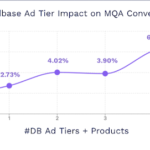
Accounts with no digital advertising demonstrate the lowest conversion rates. Performance improves progressively as advertising tier and exposure increase.
Within the highest programmatic tiers—where intent keyword optimization and buying group targeting are applied—MQA conversion rates more than double and in some cases approach triple those of lower tiers.
Advertising strengthens performance in several ways:
- Bringing stakeholders back to owned digital experiences
- Reinforcing brand presence throughout extended research cycles
- Creating observable engagement signals at the account level
When creative aligns to buying stage and persona context, advertising helps convert third-party interest into first-party engagement. That shift improves sales visibility and supports more informed outreach.
Increased traffic and engagement activity provide clearer insight into account progression and content resonance. Greater touch density across stakeholders correlates with stronger conversion outcomes.
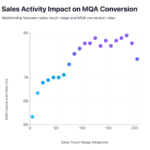
When advertising reflects the buying stage and persona context, it becomes a structural driver of mid-funnel acceleration rather than a standalone awareness tactic.
The optimal advertising mix
An effective advertising strategy begins with intent and behavioral data. Understanding where stakeholders sit in their journey informs sequencing, channel mix, and message precision.
Different personas respond to different channels, and precision increases as signal depth grows. A foundational mix often includes:
- Display advertising: Maintains visibility across target buying groups while reinforcing value propositions. Most effective for TOFU and early MOFU engagement when paired with intent prioritization.
- LinkedIn: Enables precise targeting by role, seniority, and company attributes. Particularly effective in B2B environments for aligning persona-specific messaging to known buying group members.
- Programmatic video: Supports narrative and solution education at scale. Valuable when intent signals indicate early research or complex evaluation activity.
- Retargeting: Reinforces messaging to stakeholders who have already engaged. Most effective in mid- to late-stage influence, aligning marketing exposure with active sales motion.
High-performing teams coordinate these channels as part of a unified strategy rather than operating them independently.
Ad activation model for GTM success
The research points to four structural actions:
- Tie ads to buying groups: Expanded exposure increases stakeholder engagement within target accounts and strengthens overall account readiness, even when individual leads aren’t immediately sales-qualified.
- Scale spend with intent surges: Advertising-driven engagement signals improve prioritization and clarify which MQAs are most likely to convert.
- Align ad journeys with ABM stage progression: Coordination between marketing and sales across the buying cycle compounds impact. Advertising should reflect the journey stage and active sales motion.
- Advertising should be aligned to revenue metrics: MQA-to-Opportunity conversion is a more meaningful indicator of effectiveness than clicks or impressions. Evaluation should focus on pipeline influence and revenue outcomes.
Advertising performance improves when directly tied to buying group progression and measurable revenue impact.
To explore the full benchmarks and performance data, download the Labs by Demandbase B2B GTM Report.
More Demandbase Labs articles
See how the right mix of sales touches, marketing activity, and buying group focus increases MQA conversion and improves revenue outcomes.
Discover how combining first-party data, third-party intent, and predictive scoring drives larger deal sizes and smarter buying group engagement.
Insights from 1,452 companies reveal how ABM maturity, buying groups, integrations, and ads drive higher pipeline and win rates.
We have updated our Privacy Notice. Please click here for details.