

6 B2B advertising platforms worth considering for 2026

US B2B digital ad spend is on track to reach $23 billion in 2026, and every dollar now carries more scrutiny than it did two years ago. Buying committees have grown, cycles run longer, and finance wants proof that each channel pulls its weight.
That scrutiny changes how you weigh your options. A tool you picked for its targeting can lose its fit as your market and its buying habits move. Ad tech moves fast enough that last year’s shortlist is worth a fresh read before you renew anything.
This guide gives you that read. It covers six B2B advertising platforms worth a close look in 2026, and breaks down what each does well, where it comes up short, and the type of team it fits.
What is a B2B advertising platform?
A B2B advertising platform puts paid ads in front of business buyers. It finds buyers by company, role, and the research they do, then serves ads to them across display, social, video, and connected TV.
The difference from a consumer platform comes down to who you buy:
- In B2C, one person sees the ad and one person clicks buy.
- In B2B, a purchase involves a committee of roughly a dozen people across departments, each with a different concern and a different reason to say no.
A B2B platform reaches the whole account and holds those touches together, so you can trace a closed deal back to the campaigns behind it.
Example → A consumer platform sells you an audience of people interested in cybersecurity. That group includes students, hobbyists, and analysts at companies you will never sell to. A B2B platform sells you an audience of fintechs with 200 to 1,000 employees and puts your ads in front of the three or four people inside each one who will decide whether to buy.
How does a modern B2B advertising platform work
Modern platforms orchestrate the whole cycle for you. They gather the data, judge where each account stands, adjust the audience, run the media, and hand the results to your sales team while the interest still holds.
Here’s how that works:
- The platform starts by absorbing everything it can about your market. It pulls your CRM records, matches anonymous website traffic back to known companies, and brings in third-party intent signals from across the web.
- AI then scores each account on how close it stands to a decision. Those scores range from unaware to active evaluation, and your budget follows the ones closest to the top.
- Audiences update themselves as scores change. The platform moves accounts in and out of campaigns based on real-time behavior, so your spend tracks the market as it moves.
- A native demand-side platform handles the media buy. It bids on and serves personalized ads across the open web, connected TV, and audio, using IP resolution and cookieless targeting to reach the right company’s devices.
- The loop closes in your CRM. The platform tracks ad engagement at the account level, and when an account crosses a threshold, the assigned rep gets an alert in time to act on it.
Each step leans on the one before it. Weak firmographic data pollutes your intent signals, and weak identity resolution breaks your reporting. So when you weigh the six platforms below, look hard at the data underneath them.
The benefits of using a B2B advertising platform
Here is what a B2B advertising platform gives you that a general-purpose ad tool cannot:
- Coverage across the full buying committee: Forrester’s Buyers’ Journey Survey found that the average B2B purchase now involves 13 internal stakeholders and 9 external participants. Miss half of them and your champion walks into a room full of people who have never heard of you. The platform reaches each one with a message that answers their concern.
- Advertising moves accounts through the funnel: Demandbase research across 1,452 companies and more than 429,000 ad campaigns found that accounts backed by sustained buying group advertising convert to opportunities at two to three times the rate of accounts with no advertising behind them. Ads warm the committee before sales makes contact, so the first conversation starts from recognition.
- Reach where your buyers pay attention: EMARKETER puts US connected TV ad spend at roughly $37.95 billion in 2026, and CTV CPMs have held steady while costs climb on Google and Meta. CTV never depended on third-party cookies, so account-level IP targeting works there natively. A B2B platform buys that inventory through a native DSP and delivers your ads to devices on the target company’s network.
- Win rates rise with channel coverage: Demandbase found that companies running four advertising products report a 58.7% win rate, a 71% lift over companies running none. Each channel you add reaches another member of the committee where they already spend time. The effect compounds, which is why a coordinated media plan outperforms a single-channel buy.
- Timing beats volume: Gartner found that B2B buyers spend only 17% of their total buying time in direct contact with vendors, and when several vendors compete for that time, any one of them gets 5% or 6% of it. Intent data covers the other 83%. It tells you which accounts research your category this quarter, so your ads reach them while the shortlist stays open.
6 top-rated B2B advertising platforms to consider right now
These six cover the range of what B2B advertising means in 2026, from a managed lead program you approve to a self-serve DSP you operate yourself.
Scan the table for the shape of each one, then read the section that matches how your team works:
| Platform | Best for | Key differentiator | Pricing |
|---|---|---|---|
| Demandbase | Enterprise teams that want account data to drive every bid | Piper, a DSP engineered for B2B auctions from the first line of code | Custom |
| 6sense | Revenue teams that want AI to rank accounts before media runs | Predictive stage scores feed one audience to its DSP, LinkedIn, Google, and Meta | Custom |
| DemandScience | Demand gen programs anchored in content syndication | Managed programs that pair guaranteed leads with account-targeted display | Custom, priced per lead |
| AdRoll ABM | Lean mid-market teams with no RevOps owner | Days to launch, with a retargeting tier that charges nothing apart from media | Free retargeting tier, custom above it |
| StackAdapt | Agencies and media buyers who bring their own account list | Seven channels through one console, including audio, in-game, and DOOH | Custom |
| ZoomInfo GTM Workspace | ZoomInfo customers who want ads aimed at the records their reps already call | Ad audiences pull straight from its contact and intent database | Custom |
1. Demandbase
Best for: B2B companies that want ad tech designed for long cycles and multi-person decisions.
Demandbase is an AI GTM platform with the only demand-side platform built for B2B at its core. Account intelligence, orchestrated advertising, funnel-aware activation, and pipeline reporting all work in one system, so a single account list travels from intent signal to closed-won revenue.
The DSP is the main difference here. Because Demandbase owns the bidding infrastructure, account data informs the auction directly. Campaign performance then connects to opportunity records with no integration standing between them.
Key features
- The Piper B2B DSP: Demandbase built Piper from the ground up for business audiences, so account identification informs bidding logic from the first auction. Every other platform in this list either licenses a general-purpose DSP or attaches account data to one after the fact.
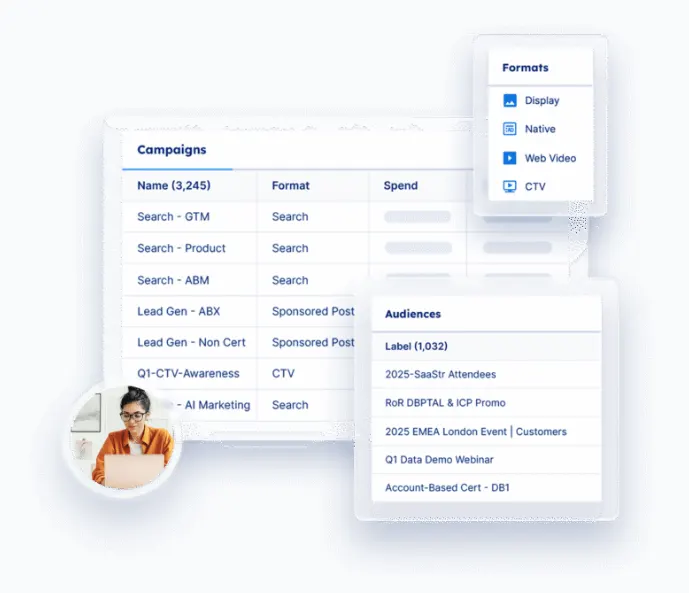
- Account-level frequency capping and SmartBid: SmartBid reads account signals before each auction and bids accordingly, so more budget reaches accounts in active evaluation. Account-level caps keep impressions distributed across the buying group and prevent concentration on whoever browses most.
- Account-based and people-based targeting together: Demandbase combines account-based strategy with people-based targeting, so ads reach the specific people who influence the purchase inside your ICP accounts. Each member of the buying group receives messaging matched to what they care about.
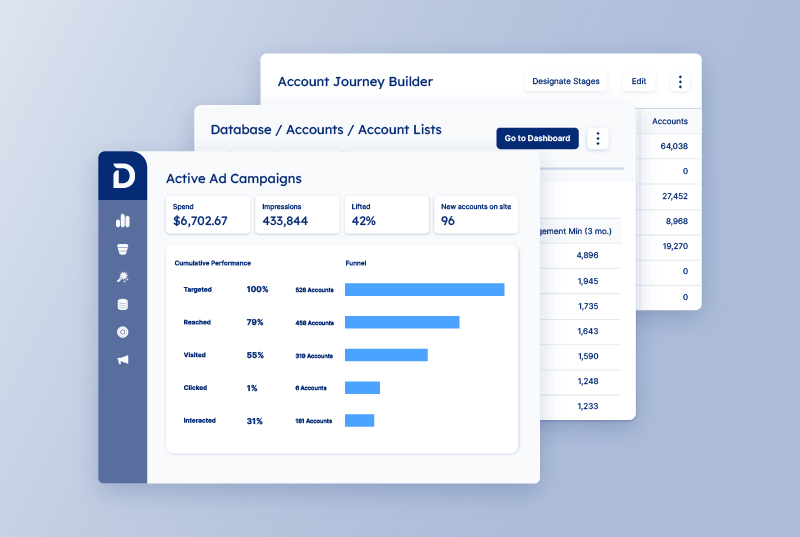
- The first CTV solution built for B2B: Demandbase CTV reaches verified decision makers across premium streaming inventory including Hulu, Pluto, Tubi, Sling, and Roku. Account-level analytics tie each impression to a company, so you can see which accounts watched, which visited your site afterward, and which entered an opportunity stage.
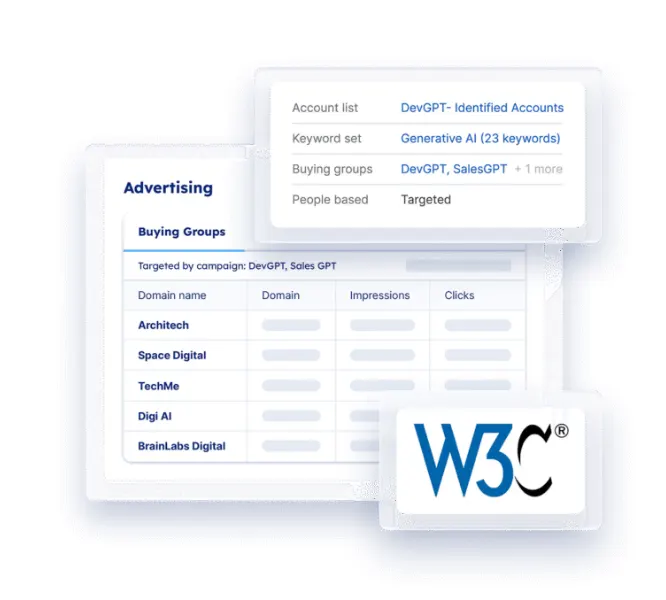
- Funnel-aware activation: Journey intelligence tracks where each account stands and adjusts creative and budget to match. Awareness messaging gives way to evaluation messaging on its own, with no manual campaign rebuild along the way.
- Demandbase AI agents: In 2025 Demandbase launched three agents that all work from the same account data. They optimize campaign performance, monitor account engagement, and interpret intent signals, so the platform acts on what it observes.
Advantages of using Demandbase
Demandbase brings intent, media buying, personalization, and pipeline reporting onto one account graph, with a B2B-native DSP underneath. Most platforms split that work across four or five tools. One G2 user credits the DSP’s direct link to self-updating account lists, so display spend reaches the accounts that matter without a separate targeting step. [ Read Full G2 Review]
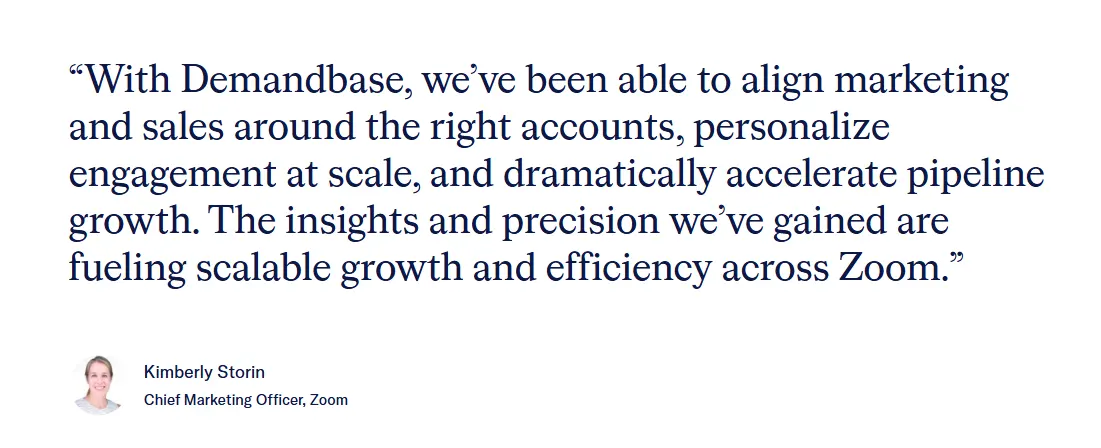
Zoom put the approach to a controlled test. The company warmed high-intent accounts through display and paid social, guided by intent data both marketing and sales could see. Accounts exposed to the campaigns produced more than 300% higher monthly recurring revenue than a control group, engagement reached 90% among Tier 1 accounts, and targeted accounts delivered a 6.25x uplift in opportunities. [ Read Case Study]
Another G2 user credits the speed. Intent signals reach the bid inside five minutes, with target accounts added to a Google Ads or Demandbase DSP audience and their bid raised automatically. They call that latency better than anything else they have used. [ Read Full G2 Review]
Pricing
Pricing works on a clear platform fee plus a flat fee per user, quoted to fit your target account volume and module mix.
Advertising is available on its own, which means you can start with the B2B DSP and add the rest of the platform when you need it.
2. 6sense
Best for: Enterprise B2B teams that run display, CTV, LinkedIn, and Google campaigns from a single audience definition.
6sense is a revenue AI platform with advertising built in. It scores accounts on fit and buying stage, then serves ads to the ones its models flag as in-market, across its own DSP and the major paid social channels.
The audience definition follows the buying group outward. 6sense pulls known contacts from your CRM and MAP who match likely committee roles, reaches unknown buyers at the same accounts through persona inference, and syncs that same audience to LinkedIn, Google, and Meta without a rebuild per channel.
Key features
- Native demand-side platform: 6sense manages campaigns through its own DSP, which bids programmatically across SSPs including OpenX, PubMatic, and Magnite.
- Audience Builder with 80+ filters: Segments draw on intent signals, buying stage, firmographic and technographic data, keyword research, web activity, and records from your CRM and marketing automation.
- Connected TV with account targeting: 6sense runs CTV campaigns across more than 20 premium streaming services, among them Fox, Roku, ESPN, NBC, Samsung, and LG.
Pros
- Shared signals hold the ABM motion together: The depth of intent data is what users point to first, and the fact that it reaches marketing and sales at the same time. Both teams work from one view of which accounts research the category and how far along they are. [ Read Full G2 Review]
- Segments sync to CRM, MAP, outreach, and ad channels: Segments built in 6sense sync out to your CRM, marketing automation platform, outreach tools, and ad channels. Teams report that they define an audience once and activate it everywhere, so a rep’s sequence targets the same accounts the display campaign covers. [ Read Full G2 Review]
- Audience orchestration takes minutes: Marketers who spend their days in the platform call the advertising module agile and easy to navigate. Audience creation flows directly into campaign creation. That saves the awkward handoff between a targeting tool and an ad tool that other stacks force on you. [ Read Full G2 Review]
Cons
- Sales Intelligence and ABM feel like two products: Teams that run both products describe a gap between them. Ad engagement shows up in the ABM view and nowhere in Sales Intelligence, which undercuts the shared-visibility promise the platform is sold on. Filter construction is clumsier in Sales Intelligence too, particularly when you need layered OR conditions. [ Read Full G2 Review]
- Export limits push work into spreadsheets: Reports look complete on screen and thin once you download them. Users want more fields in the export, since the current set forces manual reassembly whenever a report has to leave the platform for a board deck or a finance review. [ Read Full G2 Review]
- The learning curve delays your first result: Depth cuts both ways here. The same filter library and configurability that power the platform make it hard to learn, and teams describe slow adoption and delayed returns as a result. [ Read Full G2 Review]
Pricing
No paid tier carries a public price at 6sense, and advertising is licensed separately from the core platform, with rates tiered by how much you plan to spend on media.
Vendr data places the median annual contract around $55,000, though reported deals stretch from roughly $35,000 to well past $300,000.
Related reading → 15 Best 6sense Competitors & Alternatives Right Now
3. DemandScience
Best for: Demand gen teams who treat content syndication as a primary pipeline source and want ads to keep their brand present between touches.
DemandScience is a B2B demand generation vendor that acquired advertising capability through its 2024 Terminus merger. The combined product manages display and streaming campaigns at target accounts alongside content syndication, email, and web personalization.
Advertising here supports a content engine and does not stand on its own. Ads keep your brand present between syndication touches, and the program is priced on guaranteed cost per lead with replacement for any lead that misses your criteria.
Key features
- Account-targeted display across programmatic, streaming, and social: The advertising product came from Terminus and reaches named accounts on open-web display, connected TV, and social inventory.
- Ads that reinforce content syndication: Display works as the awareness module beneath a syndication program, so accounts that download your whitepaper keep seeing your brand for weeks afterward.
- Propensity and in-market activation through HG Insights: Two audience products score accounts on technographic fit, IT spend, and competitive propensity, and find active vendor comparison behavior using TrustRadius signals. Both feed straight into ad targeting.
Pros
- MQL volume holds up across channels: The lead generation works. Users describe DemandScience as central to their broader demand gen results, with qualified leads coming through consistently enough that the programs justify their place in the budget. [ Read Full G2 Review]
- The team absorbs the operational work: Working with DemandScience takes little from your team. Users call the process organized and efficient, with implementation and integration handled cleanly enough that campaigns start on schedule. [ Read Full G2 Review]
- Targeting splits by country, account, and job function: Audience construction goes deeper than most platforms allow. Users can split targeting by country, by named account, and by job function at once, and several describe that control as better than what they got from comparable vendors. [ Read Full G2 Review]
Cons
- Report labeling breaks down at scale: The reports arrive without clear labels tying them to a specific project. When multiple campaigns run concurrently, the work of sorting them from one another falls to you. [ Read Full G2 Review]
- Everything routes through your account manager: There is no console you can open to check on a campaign. Every question about performance goes through your account manager or customer experience manager, which slows down anyone who wants a quick answer at 9pm before a board meeting. Users describe the arrangement as inflexible and want more room to configure programs themselves. [ Read Full G2 Review]
- What exists of the UI feels dated: Users want simpler navigation and faster data. As things stand, updates lag and the interface offers little that a stakeholder could read unaided, which means someone on your team rebuilds the numbers before every review. [ Read Full G2 Review]
Note → In November 2024, security researchers confirmed that a leaked dataset of 122 million corporate contact records originated from DemandScience. The company attributes it to a system decommissioned two years earlier and says no current system was compromised. Worth raising in procurement if your team scrutinizes vendor data governance.
Pricing
Pricing runs on cost per lead with no platform fee attached.
Expect $55 to $200 per lead, higher with BANT qualification or European and Asian targeting, and plan for program minimums near $5,000 and a floor of roughly 150 leads per order.
4. AdRoll ABM
Best for: Mid-market B2B teams that want account-based advertising running within weeks and without a dedicated RevOps hire.
AdRoll ABM (known as RollWorks until the 2025 rebrand) connects B2B audience segmentation with a cross-channel demand-side platform in one application. Its InIQ engine reads buyer signals while BidIQ handles bid optimization across programmatic inventory.
Speed is the main pitch here. AdRoll ABM deploys in days, asks far less of your operations team than the enterprise platforms do, and its retargeting package carries no platform fee at all, so you pay only for media.
Key features
- Cross-channel DSP with account-level targeting: One console covers programmatic display, social, and native inventory, and BidIQ decides the bid on every impression.
- A proprietary B2B company database: The platform holds 18 million vetted companies, 2.6 billion digital identities, and 92 million contacts. You can assemble a target account list in minutes, then score every account on how closely it resembles your existing customers.
- Journey Stages: The platform captures behavioral signals and assigns each account a stage in its buying journey, from early awareness to active evaluation. Ad audiences follow those stages, which means your creative and your spend change as accounts progress.
Pros
- The Media Center saves an hour per launch: Ad operations take less time here than the workflow usually demands. Bulk upload handles a full creative set at once, one button attaches the same destination URL across every size, and labels make the assets easy to find later. [ Read Full G2 Review]
- Small teams operate the platform without extra headcount: Teams without an ad operations function report that they still get dynamic display campaigns out the door across multiple audiences and account lists. That matters most in niche verticals, where a bandwidth-limited marketing team carries the entire program. [ Read Full G2 Review]
- Targeting takes little ongoing maintenance: The visibility is the reason people stay. Account engagement, site activity, and campaign performance all appear in one place, so teams identify high-intent accounts and skip the broad campaigns they would otherwise default to. [ Read Full G2 Review]
Cons
- Reporting struggles to answer the executive question: The hardest part of using AdRoll ABM happens after the campaign. Users describe difficulty in showing leadership that account-based marketing ads work, because the metrics that appear most prominently describe awareness and not pipeline. [ Read Full G2 Review]
- Contact-level targeting comes up short: The campaign taxonomy causes friction. You cannot pair an ad playbook with a contact list, and the campaign type named website ads does not require a site visit, which makes the name actively misleading. Contact title and job function selections are thin, and users end up with wider audiences than they intended. [ Read Full G2 Review]
- Frequent rebrands frustrate long-term users: The product has changed names more than once, most recently from RollWorks to AdRoll ABM in 2025. Long-term users find the churn tiresome, and it complicates internal documentation, vendor records, and any search for support content written under an older name. [ Read Full G2 Review]
Pricing
AdRoll ABM offers four packages, from retargeting alone up to full ABM with advertising.
Only the retargeting tier carries a public price, and that price is zero, since you pay for media and nothing else. The rest require a sales conversation.
5. StackAdapt
Best for: Media teams and agencies that want the widest channel mix, including CTV, audio, in-game, and digital out-of-home, from one DSP.
StackAdapt is a self-serve demand-side platform that buys programmatic inventory across native, display, video, CTV, audio, in-game, and digital out-of-home. Its B2B module brings account-based targeting, where your own account lists combine with firmographic, technographic, and persona filters.
That trade gives you far more inventory and far less account intelligence, which suits teams who already know exactly who they want to reach.
Key features
- Seven channels from one interface: Native, display, video, CTV, audio, in-game, and digital out-of-home all operate through the same console, with roughly 150 ad exchanges connected.
- StackAdapt ABM targeting: You can upload a company list from HubSpot, LiveRamp, or Snowflake, and then combine it with firmographic and persona-level filters to shape the audience.
- Patented contextual targeting: A keyword and phrase engine places your ads beside relevant editorial content, covered by US patent 11,748,776. Contextual placement operates without cookies, so it even holds up in environments where identity signals fall short.
Pros
- Depth and usability arrive together: The segmentation goes further than most DSPs allow, and the interface keeps up with it. Users describe clear audience controls with a wide range of choices, and they contrast that against platforms where depth means confusion. [ Read Full G2 Review]
- Analytics and verification tools connect cleanly: Navigation takes little training, and the platform connects cleanly to Google Analytics, DoubleVerify, and the rest of a standard measurement stack. Campaign data flows out to wherever your team reports, which spares agencies the manual export step that other DSPs impose. [ Read Full G2 Review]
- Better inventory than the search platforms deliver: Niche B2B sectors are the hard case for any ad platform, and users report that StackAdapt handles them. Firmographic filters, ABM lists, and advanced behavioral and contextual triggers combine to reach audiences that broader platforms cannot find. [ Read Full G2 Review]
Cons
- No volume negotiation: Larger commitments do not translate into better rates. Users ask for the ability to negotiate on longer campaigns and find no mechanism for it, which means an agency committing to a year of spend pays the same as one testing for a month. [ Read Full G2 Review]
- Migration from another DSP takes time: Prior DSP experience does not carry over cleanly. Users coming from other platforms report a genuine adjustment period before they work at speed, which matters if you plan to migrate active campaigns on a deadline. [ Read Full G2 Review]
- Unused features crowd the interface: The left-hand navigation lists every category the platform offers, whether or not you use them. Users who build campaigns with a handful of tools describe the sidebar as cluttered and want the option to hide what they never touch. The platform provides no way to customize it. [ Read Full G2 Review]
Pricing
Pricing stays private across all five StackAdapt plans, though the commercial terms are unusually open for a DSP. There is no minimum spend, no contract lock-in, and no percentage-of-spend platform fee.
Only the entry-level Basic plan allows you to sign up directly. Everything from Grow upward takes a conversation with sales.
6. ZoomInfo GTM Workspace
Best for: Teams already paying for ZoomInfo data who want to activate it as ad audiences without exporting lists.
ZoomInfo Marketing is the advertising arm of ZoomInfo’s go-to-market platform, with a native demand-side platform built for B2B.
Targeting is based on ZoomInfo’s own database of more than 100 million company profiles and 500 million professional contacts, filtered by intent, firmographic, and technographic signals.
Key features
- Native DSP for display and social: ZoomInfo Marketing buys programmatic advertising display and social inventory through its own demand-side platform, targeted with proprietary intent signals, technographics, and real-time account insights.
- Ad audiences built from CRM data: Segments assemble from CRM records, account lists, website visitors, and intent activity, then activate on LinkedIn and Meta through GTM Studio Ads.
- Buying committee identification: The platform names the multiple stakeholders inside a target account and reaches each of them, so a campaign covers the finance lead and the technical evaluator together.
Pros
- Audience lists come together in minutes: Filters for revenue, location, industry, and job title combine quickly, and users describe pulling 500 qualified contacts in minutes. For advertising teams, that speed matters most when a campaign needs a fresh audience mid-quarter and the alternative is a manual list build. [ Read Full G2 Review]
- The platform fills gaps other databases leave: Records with missing fields still produce usable intelligence. Users describe the platform as dynamic enough to find decision-maker context even when a contact profile has holes in it, which keeps audiences intact when the data does not cooperate. [ Read Full G2 Review]
- Heavy daily use follows a light setup: Users describe integration as straightforward and support as responsive, and several report opening the platform 50 to 100 times a day once it is in place. [ Read Full G2 Review]
Cons
- Data quality varies by company size: Contact accuracy holds at the enterprise level and slips below it. Users report that mid-market and SMB records decay faster, and several cross-check before outreach. For advertising, stale contacts translate directly into impressions served to people who left the company. [ Read Full G2 Review]
- The topic taxonomy needs manual filtering: The intent taxonomy casts a wide net. Users find account-level signals useful and the topic categories imprecise, with adjacent subject matter appearing under the topic they selected. Anyone allocating ad spend against those signals should expect to filter first. [ Read Full G2 Review]
- The platform gives you more than you asked for: Scope is the problem here. Between prospecting, enrichment, intent, workspace views, and advertising, the feature surface takes time to work through, and users report a genuine ramp before the platform pays back. Teams without a RevOps owner feel it longest. [ Read Full G2 Review]
Pricing
No public price list exists. Vendr’s transaction data places the median ZoomInfo contract at $31,875 a year, though the figure covers the whole platform and not advertising alone.
Marketing packages carry their own pricing, reported to begin around $20,000 annually, and most teams buy them alongside a sales license.
Related reading → 16 Best ZoomInfo Alternatives & Competitors in 2026
How to choose the right B2B advertising platform for your organization
Choosing well depends on your marketing team’s maturity, your primary go-to-market motion, and your available ad budget. Each platform below fits a different combination of those three. Find the profile that matches yours.
By team maturity and budget →
- If you have an enterprise budget and a RevOps team to match, Demandbase gives you the highest ceiling of anything here. Account intelligence, the DSP, and pipeline reporting share one system, so the orchestration depth is there when your people can use it.
- If your team wants the platform to prioritize accounts before anyone opens a spreadsheet, 6sense predicts where each account stands in its buying cycle. That prediction then drives targeting, bidding, and budget on its own.
- If nobody on your team owns ad operations, AdRoll ABM keeps the barrier low and the setup short. You pay only for media on the retargeting tier, which makes a first program easy to justify.
By primary go-to-market motion →
- If advertising carries your pipeline, Demandbase owns the only DSP built for B2B, so account data informs bidding from the first auction. You can buy the Advertising solution on its own, which means the DSP never requires a full platform commitment.
- If you would rather approve campaigns than build them, DemandScience assigns a team to plan and execute the whole program. Display supports the syndication engine, so accounts that download your whitepaper keep seeing your brand for weeks.
- If you want maximum channel reach and control, StackAdapt covers native, display, video, CTV, audio, in-game, and digital out-of-home from one console. You bring your own account data, and no ABM subscription stands between you and the inventory.
- If your sales team already works out of ZoomInfo, ZoomInfo Marketing turns that same contact and intent database into ad audiences on LinkedIn, Meta, and its native DSP. Marketing advertises to the accounts your reps call, and ad engagement appears in the CRM beside every other account activity.
By tech stack and CRM integration →
- If your reps work in Salesforce all day, Demandbase puts ad performance in front of them there. Account engagement, intent scores, and campaign influence all write back into the records they already open.
- If you work primarily in HubSpot, AdRoll ABM connects out of the box and builds ad audiences from your active HubSpot lists with little technical setup. StackAdapt publishes a HubSpot ABM app too, so weigh channel breadth against ease of configuration.
Why Demandbase remains the top B2B advertising platform in 2026
Most B2B teams pay for advertising four times. Intent data from one vendor, media buying from another, personalization from a third, and attribution stitched together by whoever owns the CRM.
Demandbase brings all of it onto one account graph, with a DSP built for B2B underneath. Nothing gets handed between vendors, and nothing gets lost in the handoff.
Everything below is downstream of that decision:
- Demandbase owns the bidding infrastructure, so nothing has to translate your account data before the auction sees it.
- More than a trillion buying signals reach the platform each month, every one resolved back to a named company.
- Ads find each person with a vote inside your target accounts, and each of them gets a message built for their concern.
- B2B connected TV puts your brand on premium inventory and tells you which accounts watched.
- Build the audience once and it works across display, search, social, and CTV with no rebuild between them.
- Creative and budget follow accounts as they progress, so nobody maintains a separate campaign per funnel stage.
- Ad influence writes into opportunity records, which means pipeline and revenue answer for the spend.
Your buyers are researching right now, on a committee you have not met, through channels you cannot see. The platform you choose decides whether they find you during that window or after a competitor has already shaped the shortlist.
Get an advertising pilot and see what Demandbase puts in front of them during that window.
FAQs
Should we choose a platform with a native DSP or one that just orchestrates our existing ad accounts?
It depends on how much of your budget goes to programmatic display.
Orchestration tools push audiences into LinkedIn, Google, and Meta, then get out of the way. That works if those channels carry your program and you already know your target accounts. You keep the ad accounts you have and skip a media contract.
A native DSP buys the open web, connected TV, and audio on your behalf, and it can bid on account signals directly rather than waiting for a synced list. The trade is a bigger commitment and less control over where each impression lands.
Most teams need both. If you run more than a third of your spend outside the walled gardens, a native DSP earns its place.
How do LinkedIn Ads, Meta Ads, and paid search fit alongside a native DSP?
Each one reaches a different part of the committee. LinkedIn ads deliver the tightest job-title targeting available, and most B2B teams anchor their sponsored content budget there.
Meta ads and TikTok cost less per impression and reach the same people off the clock, which serves brand awareness and little else. Paid search runs on a pay-per-click model, so your PPC budget captures the committee members who have already written a shortlist and misses the ones still forming one.
A native DSP buys what those platforms cannot reach. Display ads and native advertising on the open web, plus connected TV and audio, account for most of a buyer’s screen time. Run the walled gardens for precision and the DSP for coverage, then keep both audiences in one platform so conversion tracking credits the whole sequence instead of the last click.
How should paid advertising work with our SEO and content program?
Advertising buys attention on a schedule, while SEO earns it over quarters. A B2B marketing strategy that funds one and starves the other pays twice for the same buyer.
Your content marketing program produces the assets that make an ad worth clicking. Thought leadership gives the economic buyer a reason to trust you, and product content gives the technical evaluator a reason to shortlist you. Advertising puts each one in front of the person who needs it while the research window stays open.
B2B lead generation through organic search fills your funnel with people who already know what they want. Advertising reaches the accounts that do not know you exist yet. Run both against the same account list, and let the platform report which combination closed the deal.
Which metrics prove that B2B advertising works?
Three metrics answer three different questions.
- CTR tells you whether the creative earned attention. Treat it as a diagnostic, since a high CTR on the wrong accounts wastes budget faster than a low one on the right accounts.
- CPL tells you what a name costs. It travels well in a board deck and it hides what matters, because a lead is one person on a committee of thirteen.
- ROAS tells you what the program returned. Account-level conversion tracking ties every impression, click, and visit back to a company, then to an opportunity record. Return on ad spend calculated that way answers to finance.
Watch account conversion rates by journey stage as well. Predictive analytics score each account on how close it stands to a decision, and the accounts your retargeting campaigns move from awareness into evaluation tell you the program works before any revenue lands.
Which of these platforms is best if our goal is still traditional lead generation?
DemandScience. It prices on guaranteed cost per lead and replaces any lead that fails your criteria, which no other platform here offers.
Just know what you are buying. A lead is one person, and most B2B purchases clear a committee of a dozen. Syndication fills the top of your funnel. It does little for the eleven other people who have to say yes.
If your board counts leads, start there. If it counts pipeline, Demandbase reaches the whole account and ties every impression back to the deal.
Related content



We have updated our Privacy Notice. Please click here for details.