
How to identify buying groups and activate the right revenue signals

Sr. Principle GTM Expert
-
Journey Stage
All Stages
-
Team
Marketing, RevOps
-
Expertise Level
Intermediate
Contents
Partner with Demandbase Experts
Get tailored strategies and insights to optimize your approach, drive engagement, and unlock new opportunities.
What you’ll learn
By the end of this playbook, you will know how to:
- Shift from optimizing individual leads to understanding account-level buying behavior.
- Identify the personas and buying group roles involved in a purchase.
- Interpret fit, intent, engagement, and CRM signals in context.
- Turn buying group insights into Journey Stages and coordinated campaigns.
- Align the revenue team and measure account progression, pipeline impact, and revenue outcomes.
Why is this important?
For years, B2B marketing teams have optimized around individual leads: form fills, MQLs, hand raises, and nurture paths built for one person at a time.
But complex B2B purchases are not made by one person. They are shaped by buying groups: the decision makers, champions, influencers, technical evaluators, users, procurement stakeholders, and blockers who collectively determine whether a deal moves forward.
That reality is not new. B2B teams have always known that complex deals are won through groups of people, not individual leads. What has changed is the ability to act on that knowledge.
Technology has made it possible to identify buying group signals, understand stakeholder roles, coordinate Marketing and Sales action, and measure progress in ways revenue teams can operationalize.
The challenge is no longer collecting data. It is knowing how to turn that insight into coordinated action across Marketing and Sales.
This playbook explains how to bring buying group understanding into modern Account-Based GTM: why the shift matters, how to identify meaningful signals, how to activate campaigns across the buying journey, and how to measure success as one revenue team.
What you need to get started
Before putting this playbook into action, assemble:
- One priority ICP segment, account tier, product line, or use case.
- A selection of recent won, lost, and stalled opportunities.
- Access to fit, intent, engagement, sales activity, opportunity, and customer data.
- An initial view of the personas and roles involved in the buying process.
- Representatives from Marketing, Sales, SDR/BDR, Customer Success, RevOps, Digital, and Field or Events.
- Baseline account engagement, MQA conversion, opportunity, pipeline, and revenue metrics.
Start with one meaningful segment and buying motion rather than attempting to redesign your entire GTM strategy at once.
Part 1: Why the shift is happening
Lead-centric GTM was built for a simpler buying strategy
Lead-based GTM is familiar because it is easy to count.
One person fills out a form. One person receives a score. One person becomes an MQL. One person gets routed to Sales.
But that model breaks down when buying decisions involve an entire committee.
A single lead might be interested but not influential. A highly engaged account might have no clear hand raiser. A deal might stall because a technical evaluator, economic buyer, or procurement stakeholder was never engaged.
In those moments, more leads do not solve the problem. Better buying group insight does.
The shift is not from Marketing to Sales, or from demand generation to ABM. It is a shift from optimizing individual activity to orchestrating revenue motion around account-level buying behavior.
Leads give you a name. Accounts give you a company. Buying groups show you who moves a deal.
Step 1. Recognize where the lead-centric model falls short
Review recent marketing and sales activity for signs that individual lead behavior does not reflect the full account opportunity:
- High-fit accounts showing meaningful activity without a traditional hand raiser.
- Multiple people from the same account being treated as unrelated leads.
- Highly engaged individuals with little influence over the purchase.
- Opportunities that depend too heavily on one contact.
- Deals that stall because an important stakeholder was not engaged.
The objective is not to eliminate lead data. It is to stop treating one person’s activity as a complete representation of the buying decision.
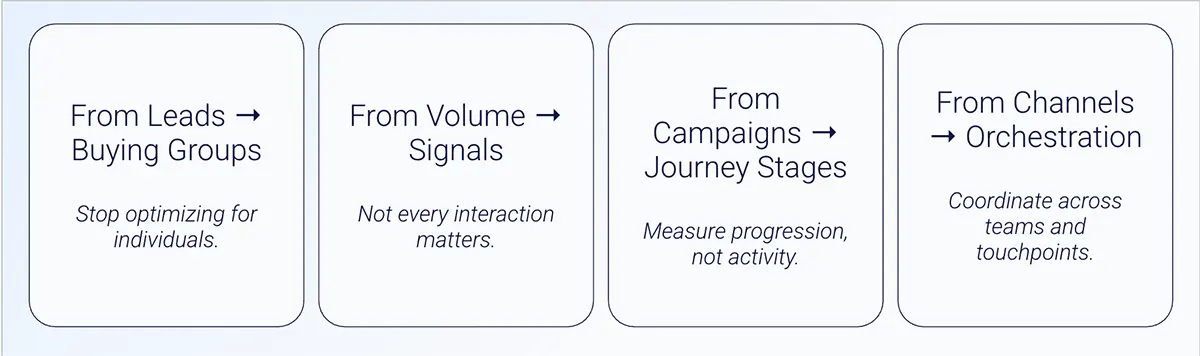
Step 2. Adopt the four operating shifts
| Shift | What it means |
| From Leads to Buying Groups | Stop optimizing for individuals. |
| From Volume to Signals | Not every interaction matters. |
| From Campaigns to Journey Stages | Measure progression, not activity. |
| From Channels to Orchestration | Coordinate across teams and touchpoints. |
These shifts change the questions revenue teams ask.
Instead of asking only how many leads a campaign generated, ask:
- Which target accounts became more active?
- Which stakeholders were involved?
- Did engagement expand across the buying group?
- Did the account progress?
- What should Marketing or Sales do next?
Part 2: What a buying group is
A buying group is a map of influence, not a longer contact list
Start by identifying the buying group: the people who influence, evaluate, recommend, approve, champion, use, or block a purchasing decision.
It includes the stakeholders your team already knows, as well as less visible influencers who may shape the outcome behind the scenes.
A buying group is not simply every contact at an account. It is the right people, playing the right roles in a specific buying decision, showing the right signals at the right time.
Step 1. Distinguish personas from buying group roles
One of the biggest misconceptions about buying groups is that personas and buying group roles are interchangeable. They are not.
A persona describes who someone is within the organization: their job function, responsibilities, or area of expertise. Examples include IT Director, Marketing Operations Manager, CFO, Procurement Manager, or Sales VP.
A buying group role describes the part that person plays in a specific purchase. The same persona may play different buying group roles depending on what is being evaluated.
| Persona | Buying Group Role (Example) |
| CIO | Decision Maker or Economic Buyer |
| IT Director | Technical Evaluator or Decision Maker |
| Marketing Operations Manager | Champion or End User |
| Procurement Manager | Procurement/Legal |
| Sales VP | Influencer or Executive Sponsor |
Understanding both dimensions gives revenue teams a more complete picture.
Personas help determine what messages and content someone is likely to care about. buying group roles help determine when to engage them, what part they play in the decision, and where gaps exist in the buying process.
Step 2. Define the roles that matter
Framework: Personas and Buying Group Roles
| Buying Group Role | Primary Focus | Common Personas |
| Decision MakerEconomic Buyer | Business outcomes, ROI, investment decisions | CIO, CMO, VP, Business Unit Leader |
| Champion | Drives the initiative internally and builds consensus | Director, Manager, Power User |
| Influencer | Recommends solutions and shapes opinions | Department Lead, Architect, Subject Matter Expert |
| Technical Evaluator | Validates technical fit, integrations, security, implementation | IT Director, Solutions Architect, Security Lead |
| End User | Evaluates day-to-day usability and adoption | Individual Contributor, Manager |
| Procurement/Legal | Manages commercial terms, compliance, and contracting | Procurement Manager, Legal Counsel |
Step 3. Map the buying group
- Start with your best recent deals and map the roles involved.
- Identify which people appeared early, which appeared late, and which were missing when deals stalled.
- Create a simple buying group role model for your top segment or use case.
- Align Marketing, Sales, SDRs, Customer Success, and RevOps on the role definitions.
- Avoid overcomplicating the model. Start with three to five roles that influence deal progression.
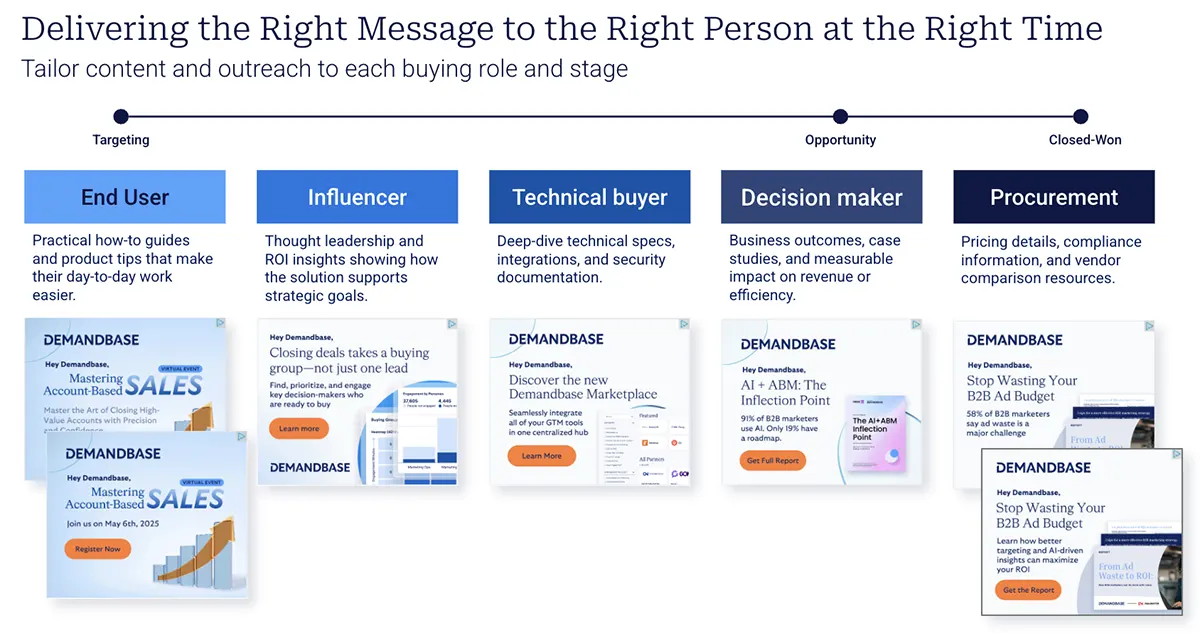
Step 4. Match content to the persona and role
| Audience | Content focus |
| End User | Practical how-to guides and product tips that make day-to-day work easier |
| Influencer | Thought leadership and ROI insights showing how the solution supports strategic goals |
| Technical Buyer | Technical specifications, integrations, security, and implementation documentation |
| Decision Maker | Business outcomes, case studies, and measurable impact on revenue or efficiency |
| Procurement | Pricing details, compliance information, and vendor-comparison resources |
Personalize by Persona. Prioritize by Buying Group Role.
Personas tell you what message someone needs to hear. Buying group roles tell you when they should be engaged, how they influence the decision, and where they fit in the buying process. Modern Account-Based GTM requires both.
Where Demandbase Buying Groups helps
Demandbase Buying Groups helps teams identify relevant personas, map known contacts to buying roles, and fill gaps with relevant contacts.
It also gives teams a clearer view of missing roles, active engagement, and silent influencers so they can understand who is involved, who is engaged, and where action is needed.
Part 3: Move from signal volume to signal quality
Not every signal matters. The right signals show buying group momentum.
The lead-centric model often treats every action as a scoreable event.
A page visit adds points. A form fill adds points. An email click adds points. Eventually, an individual crosses a threshold.
When teams bring buying group understanding into their Account-Based GTM strategy, they start asking better questions:
- Who is engaging?
- What role do they play?
- Is engagement increasing across the account?
- Are multiple members of the buying group active?
- Are the right roles present, or are critical stakeholders missing?
- Does the activity look like research, evaluation, consensus building, or deal acceleration?
The goal is not to collect more signals. The goal is to interpret signals in context.
Step 1. Organize the signals that matter
Framework: The four signal categories for identifying your Ideal Customer Profile
| Signal category | Question it answers | Examples |
| Ideal Customer Profile (ICP) Fit | Is this account worth prioritizing? | Firmographics, technographics, account tier, segment, custom criteria |
| Intent | Is this account researching a relevant problem? | Topic surges, category research, competitor research |
| Engagement | Who is interacting with us? | Website visits, content views, event attendance, email engagement, ad engagement—direct brand interactions |
| Relationship/CRM | Is there an active revenue strategy? | Meetings, opportunity stage, sales activity, customer status, renewal/expansion context |
No single signal category provides the complete picture.
Fit indicates whether the account deserves investment. Intent indicates whether the account is researching a relevant problem. Engagement shows direct interaction with your brand. Relationship and CRM data reveal whether an active sales or customer strategy already exists.
Step 2. Layer in buying group context
Once those signals are available, evaluate them through a buying group lens.
| Buying group question | Why it matters |
| Are multiple people active in the account? | Indicates broader account interest, not isolated curiosity. |
| Are the right roles active? | Helps determine whether the opportunity has stakeholder coverage. |
| Is a key role missing? | Reveals where Marketing or Sales should focus next. |
| Are silent influencers present? | Helps teams avoid single-threaded outreach. |
| Are signals increasing over time? | Shows buying group momentum. |
| Are signals aligned to a known opportunity? | Helps prioritize Sales follow-up and campaign investment. |
| Are the right roles active for this stage of the buying journey? | Buying groups change as opportunities progress. New stakeholders may join while others become less active, creating new engagement opportunities and potential gaps. |
Step 3. Determine who should be engaged next
Buying groups are dynamic. Not every buying group member will engage at the same time or at the same stage of the buying journey.
As buying decisions evolve, new stakeholders often enter the process while others become less active.
The goal is not to engage everyone immediately. It is to understand:
- Who is involved today.
- Which roles are active.
- Who is missing.
- Who should be engaged next.
Where Demandbase Buying Groups helps
Demandbase provides a centralized view of buying group insights, helping teams identify missing roles, actively engaged contacts, and silent influencers.
AI-powered recommendations can help surface relevant contacts by buying group roles, while Sales views help teams prioritize accounts that may require action. Those insights can then support campaigns, CRM workflows, reporting, and the broader revenue technology stack.
Part 4: Turn insights into Journey Stages
Buying group understanding is most valuable when it tells you what to do next
Signals by themselves do not create revenue impact.
Revenue impact happens when teams use those signals to understand where an account is in its journey and what action should happen next.
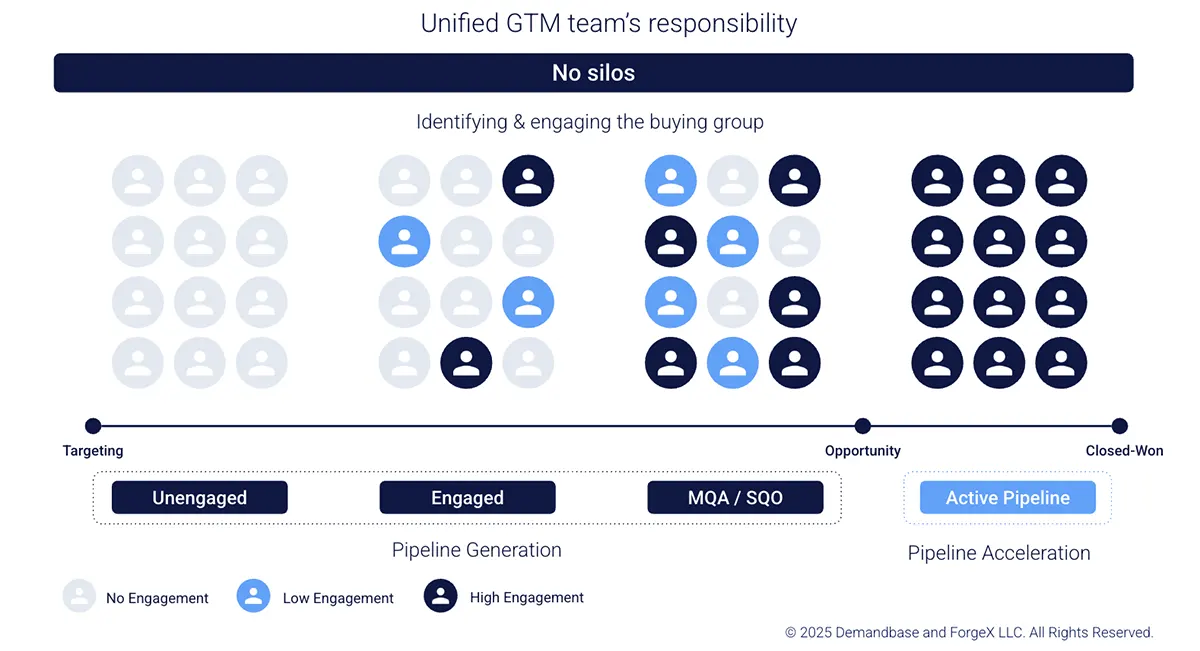
A simple Journey Stage model helps teams turn buying group signals into action without overcomplicating the process. Instead of building dozens of micro-stages, start with a practical model that tells Marketing and Sales how to respond.
The operating model should move accounts from Unengaged to Engaged, MQA/SQO, Active Pipeline, and Closed-Won, with unified GTM responsibility rather than functional silos.
Recommended Journey Stage model
| Journey stage | What it means | Signals to watch | Primary action |
| Qualified | Account fits ICP but has limited or no engagement | Fit, segment, target account tier | Build awareness |
| Aware | Account shows research or intent | Intent topics, category research, anonymous activity | Educate and introduce relevant problems |
| Engaged | Known or anonymous account activity increases | Website visits, content engagement, webinar attendance | Personalize content and retarget by interest |
| MQA | Multiple high-value signals suggest sales readiness | Multi-person engagement, key-role activity, strong intent | Coordinate Marketing and Sales follow-up |
| Opportunity | Sales conversation or active opportunity exists | Stakeholder coverage, role gaps, deal-stage content engagement | Accelerate consensus and deal progression |
| Customer/Expansion | Existing customer shows adoption, renewal, or expansion signals | Product interest, customer engagement, new buying-center activity | Support retention, cross-sell, and expansion |
How to put the model into practice
- Define the Journey Stages your team will actually use.
- Decide which signals move an account from one stage to the next.
- Align each stage to a primary team owner and supporting teams.
- Map the next-best Marketing and Sales action for each stage.
- Review stage movement weekly with Sales and SDR teams.
Part 5: Execute buying group campaigns
Build campaigns around role, stage, and signal strength
Traditional campaigns often start with a list and a message.
buying group campaigns start with a revenue question:
- Which accounts are showing meaningful buying activity?
- Which people are involved?
- Which roles are missing?
- Where are they in their journey?
- What action should Marketing, Sales, or Customer Success take next?
That context determines the audience, message, channel, and handoff.
This is where personas and buying group roles come together.
Use personas to tailor messaging, content, and creative. Use buying group roles to determine who to engage, when to engage them, and what action should happen next within the account.
Step 1. Define the campaign strategy
Campaign planning framework
| Planning element | What to define |
| Account segment | Which accounts are included? |
| Journey stage | Qualified, Aware, Engaged, MQA, Opportunity, Customer/Expansion |
| Personas | Which personas are you trying to reach and what messages resonate with each? |
| Buying group roles | Which roles are present, active, missing, or high priority? |
| Signal trigger | What activity or threshold qualifies the account for this play? |
| Message angle | What message will resonate with each persona? |
| Channel mix | Ads, email, web, Sales outreach, events, direct mail, Field, executive touch |
| Sales action | What should Sales do, with whom, and why now? |
| Success metric | What movement should this play create? |
Step 2. Select the appropriate campaign play
Choose the play that matches the account’s Journey Stage, buying group activity, and desired outcome.
Campaign Example 1: Awareness Play
Use when: Target accounts fit your ICP but show limited engagement.
| Element | Example |
| Audience | High-fit target accounts with low engagement |
| Goal | Create awareness and problem recognition |
| Signals | ICP fit, target account tier, limited direct engagement |
| Buying group roles | Decision Maker, Influencer, Champion |
| Example Personas | VP Marketing, CMO, Marketing Director, IT Director |
| Channels | Display, paid social, thought leadership, ungated content |
| Sales role | Light monitoring; no aggressive follow-up yet |
| Success metric | Account engagement, new known contacts, movement to Engaged stage |
Campaign Example 2: MQA Activation Play
Use when: An account shows strong engagement across multiple people or roles.
| Element | Example |
| Audience | Accounts with multi-person engagement and relevant intent |
| Goal | Convert buying group activity into Sales conversation |
| Signals | Intent surge, repeat site visits, webinar attendance, multiple engaged contacts |
| Buying group roles | Champion, Decision Maker, Technical Evaluator |
| Example Personas | Marketing Operations Manager, VP Marketing, IT Director, Solutions Architect |
| Channels | Role-specific nurture, retargeting, SDR outreach, Sales alerts |
| Sales role | Use buying group insight to prioritize outreach and personalize by role |
| Success metric | Meetings booked, opportunity creation, MQA-to-opportunity conversion |
Campaign Example 3: Opportunity Acceleration Play
Use when: There is an active opportunity, but stakeholder coverage or momentum is incomplete.
| Element | Example |
| Audience | Open opportunities with missing or under-engaged roles |
| Goal | Build consensus and reduce deal friction |
| Signals | Opportunity stage, role gaps, low executive engagement, technical content views |
| Buying group roles | Economic Buyer, Technical Evaluator, Champion, Procurement |
| Example Personas | CIO, CFO, VP Marketing, Enterprise Architect, Procurement Manager |
| Channels | Personalized content hub, case studies, analyst proof, executive outreach, Field events |
| Sales role | Multi-thread the account and engage missing stakeholders |
| Success metric | Stage progression, stakeholder engagement, shorter sales cycle, win rate |
Campaign Example 4: Expansion Play
Use when: Existing customers show new interest, adoption signals, or expansion potential.
| Element | Example |
| Audience | Customer accounts with new product interest or new buying-center activity |
| Goal | Support retention, cross-sell, or expansion |
| Signals | Product page visits, customer engagement, event attendance, new contacts in account |
| Buying group roles | Champion, Decision Maker, End User |
| Example Personas | Customer Success Manager, Marketing Operations Manager, Director of Digital Marketing, VP Marketing |
| Channels | Customer marketing, executive business review, Field event, targeted education |
| Sales/CS role | Coordinate account expansion plan |
| Success metric | Expansion pipeline, renewal health, product adoption, NRR influence |
Step 3. Coordinate the campaign across teams and channels
Campaign orchestration should connect:
Meaningful signal trigger → account and buying group context → role-specific message → coordinated channels → Sales or Customer Success action → measurable progression
Avoid running separate channel programs against the same account without shared context.
Where Demandbase Buying Groups helps
Demandbase Buying Groups connects insight to action by helping teams see buying group activity, identify role gaps, prioritize active accounts, and recommend relevant contacts.
Teams can then use those insights across campaigns, CRM workflows, reporting, CDPs, BI platforms, and advertising programs such as Demandbase JourneyIQ.
Part 6: Work as one revenue team
Account-Based GTM only works when Marketing and Sales share the same view
Account-Based GTM is not a Marketing-only strategy.
It requires Marketing, Sales, SDRs, RevOps, Customer Success, Digital, Field, and leadership to work from the same account and buying group context.
Marketing should not simply generate engagement and throw it over the wall. Sales should not treat every account alert the same. RevOps should not measure success only through legacy lead stages.
The team needs a shared operating model: shared definitions, shared signals, shared plays, and shared accountability.
Step 1. Define each team’s role
Revenue team operating model
| Team | Role in the buying group strategy |
| Marketing | Defines segments, role-based messaging, campaign plays, and content journeys |
| Demand Gen/Digital | Activates paid, web, email, nurture, and retargeting based on signals and stage |
| SDR/BDR | Prioritizes high-signal accounts and engages the right people with context |
| Sales | Uses buying group insight to multi-thread, personalize outreach, and progress opportunities |
| Field/Events | Creates high-value moments for active accounts and priority stakeholders |
| Customer Success | Extends the model into adoption, retention, renewal, and expansion |
| RevOps | Defines stages, data rules, routing, reporting, and governance |
Step 2. Run a weekly revenue-team review
Use a consistent agenda:
- Which accounts moved stages this week?
- Which accounts show the strongest buying group activity?
- Which roles are active?
- Which important roles are missing?
- Which accounts need Marketing air cover?
- Which accounts need Sales outreach?
- Which opportunities need stakeholder expansion?
- What did we learn from last week’s plays?
End each account discussion with a clear next action and owner.
Part 7: Start with a 90-day activation plan
You do not need to rebuild your entire GTM strategy at once
The fastest path to Account-Based GTM is not a massive transformation project.
Start with one segment, one use case, one set of roles, and one shared view of what meaningful buying activity looks like.
The goal of the first 90 days is to prove that buying group insight helps the revenue team focus, personalize, and progress accounts more effectively than lead volume alone.
Part 7A: Days 1–30 — Define the strategy
| Deliverable | Description |
| Priority segment and deployment model | Choose one ICP segment, account tier, product line, or use case, then select the deployment model—1:1, 1:Few, or 1:Many—that aligns with its strategic value. |
| Buying group roles | Define 3–5 roles that matter most |
| Signal model | Select the signals that indicate awareness, engagement, readiness, or acceleration |
| Sales alignment | Agree on what makes an account worth follow-up |
| Baseline metrics | Capture current account engagement, MQA conversion, opportunity creation, and pipeline metrics |
Start with a segment your executive team already cares about, then connect every insight, campaign, and result back to those priorities.
Choose the right deployment model
Not every account deserves the same level of investment.
Once you have selected your priority segment, determine the appropriate deployment model based on account value, buying complexity, and available resources.
| Deployment Model | Best For | Typical Strategy |
| 1:1 | Strategic, high-value accounts | Highly personalized campaigns coordinated with Sales |
| 1:Few | Similar accounts with shared needs | Personalized messaging and plays for small account clusters |
| 1:Many | Larger target segments | Scalable digital programs with personalization based on account signals and buying group insights |
The right deployment model determines how much personalization, orchestration, and Sales engagement each account should receive, ensuring resources are aligned with the accounts that matter most.
Continue learning: For a deeper look at deployment models, account prioritization, and resource allocation, explore the Account-Based GTM Certification on Demandbase Academy.
Part 7B: Days 31–60 — Build and launch the play
| Deliverable | Description |
| Audience | Build account and buying group lists by fit, stage, and signal strength |
| Content map | Match messages and assets to roles and Journey Stages |
| Channel plan | Define ads, email, web, Sales, Field, and event motions |
| Handoff rules | Decide when Marketing alerts Sales and what Sales should do next |
| Reporting view | Create shared reporting for account progression and buying group engagement |
Continue your Account-Based GTM journey: Explore the Account-Centric Growth Metrics Strategy Playbook to learn how to build executive-ready dashboards, align Marketing and Sales around shared KPIs, and measure the business impact of Account-Based GTM.
Part 7C: Days 61–90 — Optimize and scale
| Deliverable | Description |
| Weekly review | Review active accounts, missing roles, and next actions with Sales |
| Campaign optimization | Adjust messages, channels, and thresholds based on response |
| Sales feedback | Capture whether insights improved prioritization or outreach quality |
| Outcome review | Measure account progression, MQA conversion, opportunity creation, and pipeline influence |
| Scale plan | Decide whether to expand to another segment, Journey Stage, or campaign type |
Low-lift starting point
Pick your top in-flight opportunities and map the buying group.
Identify who is active, who is missing, and what each role needs to move forward. Then align Marketing and Sales on the next action for each opportunity.
Buying groups are dynamic. As priorities shift and new stakeholders join the buying process, revisit your definitions, signals, and plays to keep the strategy aligned with how customers actually buy.
Part 8: Measure progress and success
Measure revenue progress through buying group engagement
Measuring the success of a buying group strategy requires a different approach than measuring lead-centric marketing.
Traditional activity metrics still matter because they help diagnose engagement, but they should not be the headline.
Clicks, opens, form fills, and impressions provide useful context, but they do not measure revenue progress on their own.
Instead, measure whether:
- Target accounts are progressing through the buying journey.
- The right buying group members are engaged.
- Marketing and Sales are acting on shared insights.
- Those efforts improve pipeline creation, deal progression, and revenue outcomes.
As the strategy matures, evaluate performance across two complementary dimensions:
- Which personas are engaging with your content? This shows whether the messaging is resonating with the right audiences.
- Which buying group roles are participating in the buying decision? This shows whether the opportunity has the stakeholder coverage needed to move forward.
Strong buying group engagement requires both the right personas and the right buying group roles.
Step 1. Use the measurement framework
| Measurement category | Example metrics |
| Account engagement | Target account engagement rate, account activation, account journey progression |
| Buying group quality | Number of engaged buying group members, key-role coverage, missing roles, decision-maker engagement |
| Sales readiness | MQA volume, MQA quality, MQA-to-opportunity conversion, Sales acceptance |
| Pipeline impact | Opportunities created, pipeline sourced, pipeline influenced, opportunity progression |
| Revenue efficiency | Win rate, sales cycle length, average deal size, customer acquisition cost (CAC), pipeline velocity |
| Customer growth | Expansion pipeline, renewal health, product adoption, retention, NRR influence |
| Revenue team alignment | Sales response time to MQAs, buying group coverage before opportunity creation, Sales adoption of buying group insights, Marketing and Sales touch coordination |
Step 2. Change the reporting questions
| Old question | Better buying group question |
| How many leads did we generate? | Which target accounts are progressing? |
| How many MQLs did we create? | Which buying groups show meaningful readiness? |
| Which channel drove the most clicks? | Which channels helped activate the right roles? |
| Did one person fill out a form? | Are multiple stakeholders engaging around the same problem? |
| Which persona downloaded our ebook? | Which buying group roles are engaged, and who is still missing? |
| Did Sales receive a lead? | Did Sales receive useful context for the right account and people? |
| Did Marketing influence pipeline? | Did buying group engagement improve conversion, velocity, or deal quality? |
Step 3. Set the reporting cadence
| Cadence | Audience | Focus |
| Weekly | Marketing, SDR, Sales | Active accounts, missing roles, next-best actions |
| Biweekly | Campaign team | Channel performance, role engagement, content performance |
| Monthly | Revenue leadership | MQA quality, opportunity creation, pipeline influence |
| Quarterly | Executive team | Win rate, deal size, cycle length, CAC, expansion, retention |
Where Demandbase Buying Groups helps
Demandbase Buying Groups supports this measurement shift by helping teams centralize buying group insights, identify engaged and missing roles, prioritize accounts, and make buying group data available to downstream tools such as CDPs, BI platforms, and advertising systems.
Part 9: The practical checklist
Account-Based GTM readiness checklist
Use this checklist before launching your first buying group campaign.
| Area | Checklist item |
| Strategy | We have selected one priority segment, account tier, or use case |
| Buying group roles | We have defined 3–5 buying group roles |
| Signals | We know which fit, intent, engagement, and CRM signals matter |
| Journey stages | We have mapped signals to stage movement |
| Campaigns | We have role-based messages and content for each stage |
| Sales alignment | Sales knows when to act, who to contact, and why |
| Data | buying group insights are visible to Marketing and Sales |
| Measurement | We report on account progression and buying group engagement |
| Optimization | We have a weekly review process to learn and improve |
The results
Modern Account-Based GTM starts with buying group understanding
The move from leads to buying groups is more than a measurement shift. It is a more complete way to understand how buying decisions happen and how Marketing and Sales can work together to influence them.
When teams understand who is involved in the buying decision, what role each person plays, which signals matter, and how the group is progressing, they can stop reacting to isolated lead activity and start coordinating engagement across the people who influence the decision.
Modern Account-Based GTM is not about replacing persona-based marketing with buying groups. It is about bringing the two together.
Personalize by Persona. Prioritize by Buying Group Role.
Personas determine what message someone needs to hear.
Buying group roles determine when to engage them, how they influence the decision, and where they fit in the buying process.
When revenue teams personalize by persona and prioritize by buying group roles, they engage the right people with the right message at the right time—creating more opportunities to move deals forward.
That is the promise of bringing buying group understanding into modern Account-Based GTM:
- Better focus for Marketing.
- Better context for Sales.
- More relevant buyer experiences.
- Greater visibility into what drives revenue.
Every step should lead to a specific outcome that supports revenue impact.
| Step | Outcome |
| 1. Choose your segment | Focus your investment |
| 2. Identify buying groups | Understand your stakeholders |
| 3. Interpret signals | Prioritize the right accounts |
| 4. Map Journey Stages | Determine the next-best action |
| 5. Execute campaigns | Engage the right people |
| 6. Measure progress | Optimize revenue impact |
Partner with Demandbase Experts
Get tailored strategies and insights to optimize your approach, drive engagement, and unlock new opportunities.
More Playbooks
How to create custom engagement point counts
Learn step-by-step how to create custom engagement point counts using DemandbaseOne Marketing. Discover how to track product interest, streamline sales efforts, and enhance GTM strategies with actionable insights.
How to identify the most visited web pages
Learn how to track and analyze your prospects' most visited web pages with Demandbase. This step-by-step guide helps GTM teams leverage website behavior data for personalized engagement.
Learn how to map the right content and allocate optimal budget across different buyer journey stages with this comprehensive Demandbase playbook for B2B marketers.
We have updated our Privacy Notice. Please click here for details.