
Buying Groups are the new conversion engine
A data-backed look at how buying groups actually drive revenue decisions

Contents
B2B go-to-market teams have long operated on a familiar set of assumptions: more leads drive more revenue, one persona drives the deal, sales engages when accounts are ready, and marketing engagement signals buying intent.
Those ideas shaped strategy for years. The structure of buying has changed.
Sales cycles are longer. Stakeholders are more distributed. Engagement spans more channels and more roles. Revenue growth now depends on coordinated interaction across buying groups rather than isolated contacts.
The Labs by Demandbase research reflects that shift.
What the data shows
- Buying groups typically include 13–17 stakeholders
- Revenue teams that align Sales and Marketing around engaging the right members see 2–3× higher win rates.
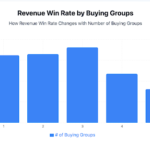
- Execution matters: win rates peak at ~29% when teams focus on 3 buying groups, then fall to ~12% at 6 as coordination complexity rises.
As former Demandbase CMO and Marketo Co-founder Jon Miller wrote, “buying groups provide a more nuanced view of the buying process, focusing on the collective decision-making units within organizations rather than narrow leads or broad accounts. This approach aligns with the reality of B2B buying.”
Note: Buying group benchmarks are based on roughly one year of buying group data in this study. As operating models mature, performance benchmarks may evolve.
Engaging buying groups with focus
Buying groups represent the operational center of effective ABM. They provide the right level of precision between individual leads and broad account-level engagement.
High-performing teams tailor outreach to stakeholder roles and priorities within each group. Marketing and sales coordinate sequencing, messaging, and follow-up around shared visibility into buying group activity.
That coordination consistently correlates with stronger win rates and higher-quality pipeline.
How many buying groups should you engage?
Labs research shows a clear pattern.
Win rates increase as teams focus on up to three buying groups. Beyond that point, performance declines as complexity rises.
When teams concentrate on three buying groups, win rates average around 29%. Expanding to six buying groups reduces win rates to roughly 12%.
Focused execution produces stronger results than distributed engagement across too many groups.
Optimizing buying group touches
After defining how many buying groups to prioritize, depth of engagement becomes the next lever.
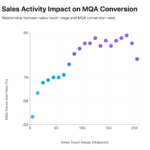
Data shows a strong relationship between touch volume and opportunity progression:
Average touches to progress from MQA → Opportunity:
| Conversion Percentile | Avg Sales Touches |
| 25% | 2 |
| 50% | 5 |
| 75% | 14 |
Conversion continues to climb as touches increase. Buying groups receiving 180–190 coordinated touches approach 94% conversion.
Progressing a buying group typically requires sustained interaction over time. Achieving that level of engagement depends on structured coordination across marketing and sales rather than isolated outreach.
When teams focus on fewer buying groups and deepen engagement within each, workflows become clearer and engagement more intentional. That depth correlates with higher ASP, improved win rates, faster cycle times, and a more predictable pipeline.
Multi-threading drives conversion
Multi-threading means engaging multiple stakeholders within a buying group instead of relying on a single contact.
Teams that engage two to three buying groups and consistently multi-thread across stakeholders report stronger performance across win rates, deal size, and expansion potential.
Top-performing SDRs often reach ten or more buying group members through coordinated sequences that span phone, email, social, meetings, and events. Sustained engagement across roles reduces risk and builds broader consensus within the buying organization.
Buying group intelligence fuels engagement
Effective buying group execution depends on visibility into who is involved and how engagement evolves.
Buying group intelligence helps GTM teams:
- Identify and map out BG stakeholders (WHO to engage),
- Understand their behavior (HOW to engage), and
- Align messaging to role and buying stage (WHEN to engage, with WHAT messaging).
This intelligence combines multiple data sources, including:
- First-party engagement data (information a company collects directly from its own customers/audiences via owned channels like websites, apps, campaigns, events, other sales and marketing activities, etc.)
- Third-party intent and technographics (information collected from external entities about customers/audiences that can be used by GTM teams to expand reach, enhance customer profiles, and inform marketing strategies)
- Predictive models (typically AI-driven machine learning models that identify which accounts are most likely to buy, and when, based on historical patterns)
- Journey progression analytics (insights gained from the tracking, measuring, and analysis of customer interactions across all touchpoints, from initial awareness to revenue generation)
- Buying group behaviors (the collective actions of buying group stakeholders as they interact with you via various channels throughout the buying journey)
- Multi-touch sales activity (records that track every interaction a prospect has with you throughout their buying journey)
When these signals are connected, teams gain a clearer view of where momentum is building and which stakeholders are influencing progression. That visibility supports smarter resource allocation, stronger alignment, and more consistent pipeline growth.
Buying group intelligence reshapes how GTM teams operate. Engagement becomes coordinated progression across stakeholders rather than reactive outreach to individual contacts.
To explore the full benchmarks and engagement patterns behind these findings, download the full Labs by Demandbase B2B GTM Report.
More Demandbase Labs articles
See how the right mix of sales touches, marketing activity, and buying group focus increases MQA conversion and improves revenue outcomes.
Research shows four ad tiers increase win rates by 71%. Learn how buying group–level advertising accelerates MQA conversion and pipeline.
See how integrating CRM, MAP, predictive scoring, and ads increases MQA conversion rates, accelerates pipeline, and improves win rates.


We have updated our Privacy Notice. Please click here for details.