
From chaos to momentum: Why B2B needs Agentic Marketing


Marketers from career starters to CMO are the purveyors of perception, drivers of demand, masters of brand, and influencers of the influential. When you see your marketing friends and colleagues rebranding themselves as “GTM engineer” it becomes readily apparent that disruption in the era of AI isn’t a bug, it’s a feature.
As companies and entire industries relentlessly march towards optimal efficiency through AI, marketers are under more pressure than ever to deliver results faster, with fewer resources and by using disconnected tools that slow them down.
Enter, Agentic Marketing.
Agentic Marketing is the use of autonomous, context-aware AI systems that orchestrate and execute end-to-end campaigns across marketing platforms from strategic briefs, shifting AI from isolated prompt generation to multi-system coordination.
This shift changes how work gets done, with intelligent agents marketers can trust to take on the operational heavy lifting, while enabling brands to reach a new generation of AI agents shaping buying decisions.
By bringing these capabilities into the tools and environments marketers already use, Agentic Marketing gives teams the capacity to focus on strategy and creativity while moving at the speed of a constantly changing – and often relentless – market.
Escape the B2B bottleneck created by operating within the confines of traditional playbooks and a world of genuine possibilities open up.
The AI era banished the traditional marketing playbook
Since the launch of ChatGPT on November 30, 2022 nothing has been the same. This is old news and marketers have been living through the new reality ever since.
It hasn’t been a smooth transition.
With any major technological shift, much less one of this magnitude, workers, leaders, companies, and entire industries are forced to adapt or end up severely falling behind. In the AI Era, some sectors and departments are moving faster to break through the ongoing disruption than others. 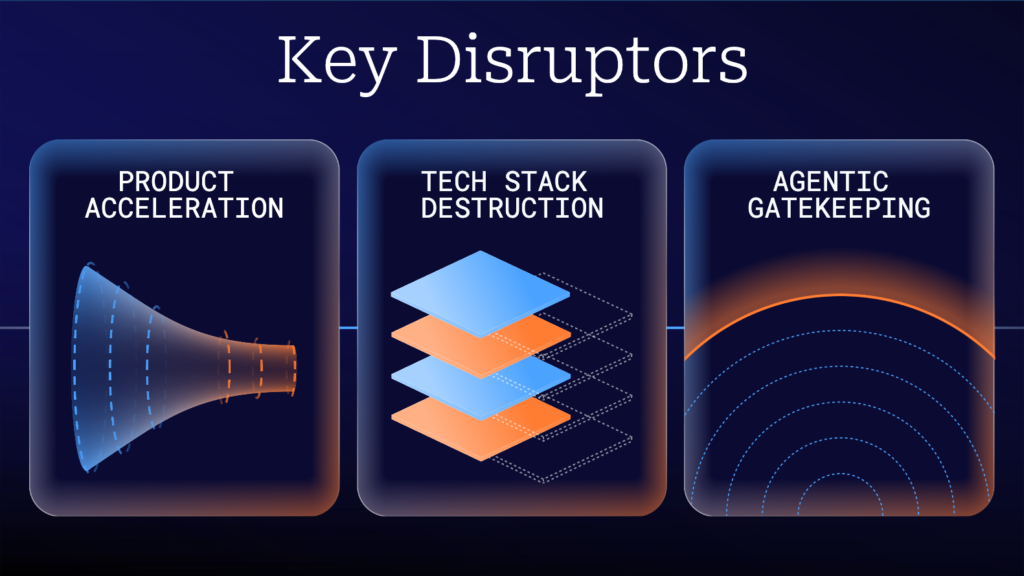
Engineering has perhaps been one of the biggest beneficiaries of the move into AI and a key reason why Product is severely outpacing GTM. Have marketers benefitted from similar AI gains? No, and you can see why when viewing it through a historical lens.
In 2011 there were 150 marketing tools. In 2026 there are 15,505 on the market and growing. This underlines just how much tools are changing, succeeding and failing, and has left marketers continually chasing the next best thing only to find out that it’s not and a new “better” tool has replaced what they started using yesterday.
Add in IT and Finance teams severely consolidating what martech tools marketers might have found useful out of the vast multitudes, and the result is a loop of tech stack destruction that might benefit the bottom line organizationally, but not operationally for marketing teams.
When marketers are working with hollowed out tech stacks and from their backfoot because product has raced ahead, having the time and brainspace to build campaigns and strategies to reach AI search engines and the AI discovery or “AI Gatekeeper” agents that are evaluating vendors in place of humans it prevents momentum, causes burnout, churn, and marketers beating their heads against misaligned expectations. This is the new reality of B2A (Business-to-Agent) marketing, where Gartner predicts 90% of B2B buying will be intermediated by AI agents by 2028, representing over $15 trillion in enterprise spend.
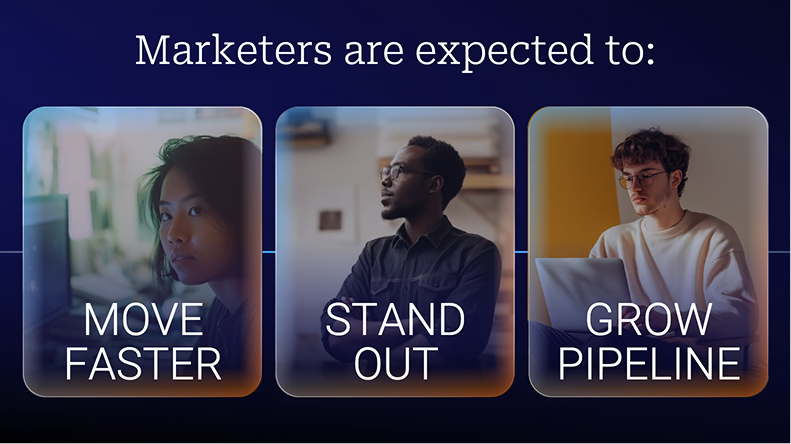
According to our new G2 report Navigating Marketing’s new pace, which interviewed 124 frontline B2B marketers, 70% of them responded they face accelerated turnaround expectations, while 79% spend hours manually verifying AI outputs and fixing data errors.
Marketers rebranding themselves doesn’t change the underlying issues and the answer is not succumbing to chaos and scrambling to keep their heads above an ocean of shifting AI tools while manually hunting for mistakes in AI. All while living up to expectations.
In order to build actual, sustainable momentum in the AI Era, marketers still need to embrace new ways of working and innovating, but they have to have the right tools and technology to reach the right audiences with the appropriate messaging.
Demandbase CEO Gabe Rogol understands that AI can speed up individual tasks without speeding up the end-to-end campaign process. He states that, “The challenge isn’t finding another standalone point tool to automate a single task; it’s coordinating execution across the entire workflow so marketers can focus on high-judgment decisions.”
Why B2B needs Agentic Marketing
To break out of manual review loops and fragmented handoffs, B2B teams need a fundamental shift in execution. As Gabe Rogol highlights, the core question for revenue leaders has changed:
“The question for leaders has changed from ‘Where can we automate this task?’ to ‘Which decisions need judgment and where can software coordinate execution?’ People still need to decide which markets to target, define the product’s differentiated position, interpret customers’ needs and set the creative. But AI can take on more of the coordination needed to turn those strategic decisions into action.” – Gabe Rogol, Demandbase CEO
This is where Agentic Marketing transforms the day-to-day workflow. Unlike single-purpose AI generators performing isolated tasks only when prompted, agentic systems work directly from a strategic brief. They determine the required sequence of actions across systems, execute campaigns across channels, and continuously adapt based on real-time market results.
Our G2 report verifies that the problem isn’t a lack of software; it’s the friction required to pass content between sales, marketing, and product systems as 56% of marketers identified process handoffs between teams as their leading operational constraint as compared to only 21% who blame their actual software tools.
Agentic Marketing solves this friction through The Marketing Brain, a cognitive foundation built on decades of B2B intelligence, long-term memory, custom models, and account context. It gives autonomous agents the baseline knowledge required to execute accurately, sharing a central memory layer so human marketers remain in strategic control without constantly copying data between apps. This same foundation powers Demandbase’s B2B marketing agent Mojo, which turns briefs into campaign execution alongside a suite of specialized agents working in tandem.
This isn’t just reclaiming efficiency in the day-to-day grind. It allows marketers to re-discover the joy in what they do by bringing back the stimulating work that motivates them to wake up every morning excited about the work ahead.
Agentic Marketing by Demandbase is uniquely positioned to help marketers get back to doing what they do best.
Specialized agents, native workflows
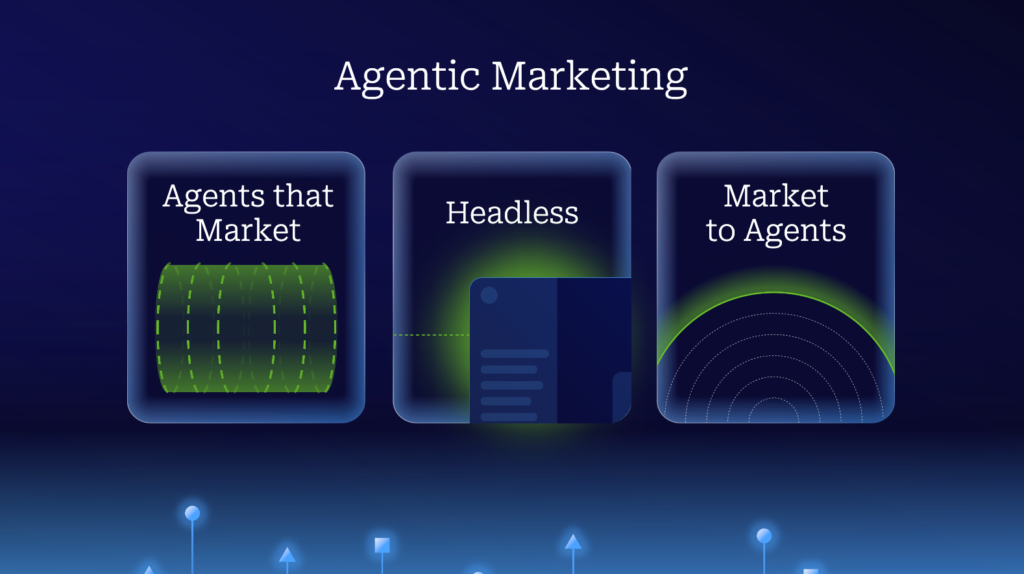
On their own, AI agents can be incredibly useful partners to a marketer. The idea of using agents that market on their own is not a new concept. But pairing agents that market with the foundational depth and intelligent context supplied by the marketing brain, is.
By leveraging managed, coordinated agents that market within such a strategic foundation it turns into real, tangible momentum for the teams deploying them.
Campaign and audience agents that continuously work together relieve the burden of spending literal days jumping between legacy tools, exporting CSVs, and manually refreshing audience lists. These agents can research high-intent target accounts, launch tailored touchpoints, build precise segments, and adjust campaign parameters on the fly as market signals change.
Operational drag that took weeks is ditched for instant, realtime execution without the manual pain.
Even those buyer audiences the campaign and audience agents are used to help reach have changed. Some of those top-of-funnel buyers are no longer even human. Human buyers are delegating discovery and vendor evaluation to AI answer engines and research bots.
As AI continues to evolve and advance, agents that market to only humans face a degrading rate of return. Where as AEO Agents that help B2B brands shape how buyer AI agents see, interpret, and recommend their solutions during early-stage research allow to keep pace with the changing landscape.
Once able to keep pace there’s a need to measure if campaign strategy is working.
The G2 report recognizes that while 62% of marketers have already changed their search strategies for AI answer engines, 65% still lack systematic tracking to measure if it’s working.
The AEO Agent gives teams the dedicated mechanism to optimize their brand presence for AI discovery engines (AEO/GEO), ensuring breakthrough of the agentic gatekeeping layer before a human buyer ever fills out a form.
Even the most capable AI agents lose value if they require learning another complex platform interface. Whether a marketer does their best work in Claude or lives inside Slack, the technology needs to meet them in their existing daily workflow.
Agentic Marketing with Demandbase is headless, delivering intelligence directly where teams already operate, enabling marketers and sellers to prompt agents, pull account research, and receive proactive performance alerts directly inside tools like Slack.
The future of marketing is human
When software engineering embraced developer tools powered by deep context, productivity skyrocketed. B2B marketing deserves that exact same unlock without the title re-brand.
Agentic Marketing enables marketers to inspire customers and dive deep into their creative potential. It doesn’t turn creative leaders into prompt mechanics or replace them. It elevates them. By delegating manual coordination and operational heavy lifting to intelligent agents, marketing teams regain the time and clarity needed to focus on what software can’t replicate: brand narrative, creative vision, customer connection, and strategic growth.
The market data backs this up. The G2 research found that 56% of marketers view strategy, creativity, judgment, and leadership as the most critical skills in their job today, far outranking AI tool fluency.
“We want to empower B2B marketers in this shift to business-to-agent (B2A) marketing without adding more clutter to their workday. Passing off operational heavy lifting to purpose-built agents lets human teams refocus on the work that led them to marketing in the first place: strategy & creativity.” — Rachel Truair, Chief Marketing Officer, Demandbase
When specialized agents handle execution under human direction, marketing stops being a reactive bottleneck and becomes the primary engine for business growth. That is how B2B teams escape the chaos, regain their creative edge, and build lasting momentum.
Get the full G2 report: Navigating Marketing’s new pace, read our Agentic Marketing announcement, and see what’s happening at our industry-leading NYC GO event.



We have updated our Privacy Notice. Please click here for details.